Thursday, December 5, 2024

The Words Of The Prophets

This year of travel has been strange. And by that, I mean really, really strange. I spent more nights in hotels in 2024 than I have ever spent in any single prior year I've been alive. I took the longest single trip (to Singapore, Cambodia and Malaysia) of my life. And I feel more weary from packing and getting on trains or in cars or in planes and then unpacking at the other end than I have ever felt. That all should make me super, super happy. But somehow, I ended up writing fewer blog posts about travel than I have written since I started this blog 11-1/2 years ago. Go figure.

I blame that whole situation on one thing: business travel. It's changed a normal travel year into a very, very non-traditional travel year. And not for the better. I've been on the road a whole lot but a whole lot of that whole lot hasn't been all for me. Or us. Two one week plus vacations is not enough for an entire year. It's honestly been a bit of a drag. But it's also driven me to change how I gather value from travel. This year, I've taken to squeezing in little experiences that make me feel like I've been traveling in between all the work assignments. It's a way different way of exploring than I ever would have thought of five or ten or even two years ago. And I don't want to do this as a substitute for real travel again.

But it has been a huge part of my 2024 travel narrative. So to close 2024, I'm going to write two posts about how this year has featured a lot of trips that are discontinuous but have reinforced a common theme and which ultimately, have built into something cohesive and coherent, even if these experiences were assembled in a way that I don't want to do again.  But both are part of my travel narrative this year. 

But before I get to all that, a little rant about business travel.

Mary Miss' "Framing Union Square". Union Square (L / N / Q / R / W / 4 / 5 / 6).

I dislike traveling for work. It sounds great (I mean it's free travel, right?) but it's never as fun as it seems like it should be (probably the work thing...). At its worst it can involve early morning breakfasts followed by a full work day with working lunches concluded with dinners with coworkers that last for hours until late into the night. It can be really pretty draining. Way more work than travel. You can probably tell by all the "work"s in this paragraph.

I guess I've been fortunate to travel some, but not a ton, for work over my career. I don't really think I've spent a lot of time on the road for my employers but for sure I've traveled a bit. Over my 30 plus years working I've ended up in hotels in Boston, San Francisco, Dallas, Chicago, Los Angeles, Orlando, Houston, Austin, Jersey, upstate New York, Charlotte, Roanoke (yes...Roanoke), Miami, suburban / rural Maryland (twice), Denver and maybe one or two other spots.

But over the last 15 months or so, I've had a regular travel-for-work gig and it's been to one of my favorite places of all: New York City. When I first took on this assignment, I spent my time in the City doing something resembling what I described two paragraphs ago: going to the office; going back to my hotel (which was really very close to the office); eating dinner (also very close to the office and the hotel); and then repeating until it was time to go home. After a couple of months of doing that I decided I had to do more. I had to accept that I was there for work but I also wanted to maximize the opportunity that I had to be living rent-free in New York two or three days at a time. I had to make my nights something more.

William Wegman's "Stationary Figures". 23 St (F / M) station.

So in January of this year (four months or so into my NYC assignment), I decided to do start exploring. I found izakayas and ramen places. I went to the 9/11 Memorial. I tried out different hotels. I went to a jazz club. I met up with old friends. I went to the opera. I explored Grand Central Terminal. I went to a play. I found different ways to see the city. It's definitely been rewarding for me. I feel like I've got something out of this in addition to my employer getting something out of me. 

I knew my time where I'd be making regular trips to New York was going to end at some point and in about the middle of this year I decided the appropriate time to cut this off would be at the end of 2024. I have to admit that deciding to terminate this assignment was sad. No more free meals at world class restaurants. No more hotel points or Amtrak points. No more opportunities to explore my favorite city for (almost) free. But it had to be done. 

I decided a needed a personal send-off. And I decided that send-off should be art focused. Do you know how many art museums there are in New York City? Me either. And it really didn't matter that much because my plan wasn't to explore art at the MoMA or the Met or the Guggenheim or the Frick or the Whitney or anywhere else that had the word museum in it. My plan was to go see some art for free. Or maybe an admission fee of $2.90 at a time. To do that, I headed underground. 

Leo Villareal's "Hive". Bleecker Street (6) and Broadway-Lafayette St (B / D/ F / M) Station.

Did you know that one of the best collections of art in New York City is in the Subway? Yes, the thing that has trains that take New Yorkers all over the City. The Metropolitan Transit Authority (MTA) has been purchasing and commissioning permanent and temporary works of art by emerging, famous and non-famous artists for decades. They have amassed quite a collection. Some of their art sponsorships are ephemeral (for posters that fill unused advertising space on Subway cars) but there is a lot that is not. And a lot of their collection is pretty world-class.

Now for sure, viewing art in the Subway is way different than doing it in an art museum. You can decide to roam around the Subway system randomly and just look at what you like I sometimes do in new museums that I visit, but the collection is pretty de-centralized and, in most cases, you'll have to get on a train to go find the next piece. And it might not be something you appreciate. 

Their collection also sometimes takes some finding. They are not all like William Wegman's "Stationary Figures" ("Station"ary...get it?), which I found myself staring at when my F train stopped at 23rd Street station one night on the way back from dinner in the first half of this year.

Fortunately for the wannabe Subway art appreciator, there's a guide to art on the MTA's website and it's organized by borough. So for this last not-a-resident-but-so-in-love-with-New-York work/tourist quest, I decided to organize at least one night per trip starting in August around going to see some art, even if it was just one piece. If I could do it as part of a trip to dinner or some other spot in the City I wanted to see, then I'd do that. If not, maybe I'd just have to make a special trip. If it had to be a special trip, theoretically it's a $2.90 admission fee (the price of a ride on the Subway), assuming I can go see the piece I wanted to see and come back without exiting the system. Do you know how much it costs to get into the MoMA or the Met? $30. $2.90 is a bargain.

Ann Schaumberger's "Urban Oasis". 5 Av / 59 St (N / R / W) Station.

My intentional visits to the MTA's fantastic art collection started on a Tuesday night in August with a trip on the Q Train to legendary hot dog stand Papaya King on the Upper East Side (or UES to New Yorkers). Two hot dogs with mustard and 'kraut and a papaya drink if you must know.

The 86 Street Q-Train-only station less than two blocks from Papaya King houses Chuck Close's 2017 installation "Subway Portraits". That was my first quest. To see that piece. It's a series of large scale portraits intending to depict regular New Yorkers you might encounter on the Subway. That is if you consider Philip Glass, Lou Reed and Close himself to be regular New Yorkers. The works are huge, spanning from almost the floor of the station to almost the ceiling. And they are incredibly impressive. If these things were on display at the MoMA or somewhere else, people would be standing and gazing at these things in wonder rather than just hurrying past when I stopped for a while before heading to Papaya King. 

Like many works of art within the MTA system, "Subway Portraits" are executed in super durable materials. Mosaics of glass and ceramic or just straight up ceramic tile. This has to be one of the most hostile environments that someone can intentionally decide to place art and so it makes sense that the choice of medium be something that can withstand a lot of abuse. And I don't mean intentional. There's just a lot of stuff that happens in the Subway that is pretty down and dirty. Beautiful things need to be able to protect themselves. 

Close up of three "Subway Portraits". Eye. Eye. Nose/moustache.

On my way back from 86th Street, I stopped by the 5th Avenue/59th Street Station on the east edge of Central Park to see Ann Schaumberger's "Urban Oasis", her de-centralized tribute to the animals at the Central Park Zoo. I love animals (just not zoos) and some of those in "Urban Oasis" hit a chord big time, including the monkeys (I was born in the Year of the Monkey), the penguins and the macaws. 

I feel the representation within Schaumberger's work is definitely different from "Subway Portraits". And by that I mean less high art (if that's even a term and if it is, I know I'm being a snob). I can't see the monkeys and the penguins and the macaws on the edge of Central Park being on display in some museum in the City. And that's totally OK. On some level, these works are supposed to enliven commutes and provide relief from what is potentially a stressful rat race in America's largest city. They don't all need to be worthy of hanging in the MoMA or the Met.

I headed back to my hotel with some satisfaction that I had started something travel related that could be pretty special and I was doing it for almost free.

Over September and October and November, I continued to explore. Wegman's Wiemaraners on the way to dinner when I was staying at the Hyatt House on 28th Street. Stumbling across Tom Otterness' little figures who seemed to be everywhere in the "Life Underground" installation at the 14 St Station. A special trip to Ann Hamilton's transcription of the United States Declaration of Independence and the United Nations Universal Declaration of Human Rights in her "CHORUS" work at the newly constructed WTC / Cortlandt Station. Hamilton's work is inspiring and uplifting, as flawed as the Declaration of Independence might be in its attitude towards the "all men" who are "created equal". It was calming and reassuring on an early November night.

Otterness' whimsical little men and women and rats and crocodiles and other sorts of bronze figures are an amusing distraction when you are not in a hurry to catch your Subway train on the way home or to work or wherever else you are headed. I love the image of these little mini-men taking care of business (including toting around giant Subway tokens) while us full size humans are passing them almost without a thought and largely unaware.


Tom Otterness' "Life Underground".  14 St (A / C / E / L) Station.

As I explored, I started to notice something as I was going from one of these installations to another, roaming around stations (some of these things are huge!!!) trying to find the latest work on my list. And that is that these things are EVERYWHERE. I started to notice more art installations that I wasn't looking for than I was looking for. In some stations (yes, Union Square and Times Square-42 St, I'm looking at you), there is more to see around every corner. Not just one piece of artwork, but multiple works in a single station. Everywhere. I'm telling you.

I visited stations all over Midtown on my way to work or dinner or somewhere else and bumped into works of art when I got to platforms or when I entered stations or when I got where I was going. Roots and plants and pipes with words of wisdom written on them near Bryant Park. Art Deco-like women performing theater and dance on the way to Lincoln Center. Recessed little square boxes in the underground walls at Times Square. And of course, I saw them while I was riding the Subway itself, fleeting glimpses of mosaics or glass seen through the open train doors during a brief stop at a station or even briefer looks when viewed from an express train that has no intent of stopping at some stations.

Some provided unexpected surprises and got a smile or two. During a stop at 23 St on the R or W (can't remember which), I looked up from my phone or whatever else I was paying attention to and saw a series of hats of all types rendered in tiles on the walls. And yes, when someone waiting for the train was standing in front of one at just the right height, it looked like they were wearing the hat behind them. I get it. Funny. Who wears a top hat any more?

Here's the other thing I noticed: there were other people noticing too. I was not the only one stopping and looking and studying and taking pictures. These things work. They ARE appreciated by people moving through this system, even if it looks like most are just hustling by because that's exactly what they are doing.  

Had to stop and look on my way to the 42nd Street Shuttle. 
It's now December 2024 and I just finished my last three nights in New York for this year. That brings me to a total of 44 nights in the City in the past 12 months. What a ride! Or more accurately a stay, I guess. That's probably not going to happen again but who knows. 

I didn't deliberately visit any Subway art on this last trip despite having a couple of spots left on my list. My off hours in December were spent with friends who had made the trip up to NYC with me to go explore the City in all its pre-Christmas glory while I slaved at work. And because I knew that's what December held, I knew when I visited in November that would likely be my last underground art time in 2024.  

So I had to do something special.

Roy Lichtenstein's "Times Square Mural". Times Sq-42 St (1 / 2 / 3 / 7 / N / Q / R / W / S) Station.
One of my favorite artists of all time is Roy Lichtenstein. Put him up there for me with Warhol, Jasper Johns, Gerhard Richter, J. M. W. Turner, Van Gogh, Mondrian, Magritte and likely too many others that I can't think of right now. I am always drawn to Lichtenstein's renditions of ordinary objects, famous works of art and works that look like they are torn from a comic strip in the style of those same American comic strips. It seems like most of the times when I see Lichtenstein's works in museums, they are among my favorites and I usually end up with a few pics of something by Roy on my phone.

And yes, there's a Lichtenstein in the Subway. Like an original work commissioned especially for the New York City underground train system. It's called "Times Square Mural" and it's at the Times Sq-42 St station (which is admittedly enormous) in the middle of a transit area that seems to be constantly flowing with commuters and tourists and art aficionados passing from the street to the Subway or one line to another or the Subway to the street. It's a futuristic Lichtenstein-yellow Subway car pulling up to the platform at 42nd Street and it's just glorious. And it's all yours to see for the low, low price of $2.90. What a bargain.

I found this work on my last underground art pilgrimage. I went there deliberately and specially to see it. I wasn't passing to or from Times Square or anywhere else. I rode the Subway specifically to see this piece and lay eyes on it for myself. It was well worth the price of admission.

If you decide to ever go seek out some of the works in the MTA's permanent collection, I am sure you will find something that resonates with you. I am also sure that you will find some other kinds of art down in the Subway while you go looking. And I don't mean more stuff hanging on the walls or little bronze men. By that I mean you'll likely find someone, somewhere performing some music. Rock, folk, classical, rap, whatever. I did when I went to see the "Times Square Mural" and it elevated that experience to something greater than I could have possibly imagined.

It was opera. 

Yes, standing in front of Roy's glorious mural when I visited on a Wednesday night, there was a young tenor (he's on the left in the pic below) standing in front of an "Opera Collective" sign with a collection bucket nearby singing the most gorgeous vocal parts to some sort of classical music coming out of the boombox next to him. It was inspiring and uplifting and impressive and spectacular. And it made my night as the perfect accompaniment to that magnificent yellow train pulling into some imagined 42nd Street station.

This aria emphasized to me the point of getting out there. Go. Explore. Find. Be curious. Adventure. Seek out something that you love or may love or will love. And every so often, you'll find it. And sometimes, it will be amazing and incredible and even better than you ever thought it (whatever it is) could be. Travel...I'm telling you...

Wednesday, November 13, 2024

Cornish Pasties

OK, so to start with here (and yes, I'm addressing some of the Americans...), it's pronounced past-y not paste-y. The second one is something different. Got it? Good!

Strap in for this post. We'll end up covering more than just pasties but just wanted to get the whole pasty pronunciation thing out of the way first. Now that's done, let's move on, shall we?

In late August, we made our way to Great Britain for the fifth time in the last ten years. It would have been six but COVID-19 had other ideas for our travel plans in 2020. Suffice it to say that we've spent a good amount of time over in England and Scotland since I started writing this blog so I can remember what I've done and seen and felt (and smelled and tasted I guess) while I've been trotting all over this globe of ours. Our travels in England have been focused in two spots: Yorkshire (where family lives) and London. We figured this time, we'd explore somewhere else. Somewhere else I'd never been, even though I was born in England. That somewhere else turned out to be Cornwall. Time to head south and west about as far as we could without falling into the sea.

The first thought I had when we decided to spend some time in Cornwall was Cornish pasties. Not Land's End or cute seaside harbors or winding country roads or art galleries or cream tea. Cornwall = Cornish pasties. That was mission one in Cornwall. We'd figure out the rest later.

So let's start with pasties and maybe we just need to start with what is a Cornish pasty. Quite simply it's a pastry crust, crimped shut by hand on one edge and filled with beef, potato, swede and onion and then baked. It's a portable dish that one can take on the road or on a picnic or just eat at home piping hot from the oven. Today, of course, it's available with all sorts of different fillings. Beef is by no means the only option whether you are making these things at home or buying one at your neighborhood pasty shop.

Cornish pasties are nothing new for me. I've been eating these things for the majority of my life, although there was admittedly a huge non-Cornish pasty period between the time I left home for college and pretty recently. Maybe not quite as recently as our few days in Cornwall but pretty close. I will admit I have not been a big consumer of Cornish pasties over the last 40 (wow, is that number right?) years or so. Despite that history, I was looking forward to seeing what we could find in Cornwall.

My mother's Cornish pasties that I ate growing up, by the way, resembled the pasties in the cover picture of this post with the crimp on top. And they were served with gravy and (I'm assuming here since my memory is not that good) a vegetable side. I'm guessing peas. I seem to remember peas.

We ended up spending four nights total in Cornwall, meaning three full days. We ate a Cornish pasty on each of those days: one at Land's End; one in St. Ives; and one at the Lost Gardens of Heligan. They were all good and (at least the ones I had) differently flavored: chicken, bacon and leek at Land's End; steak and stilton in St. Ives; and cheese and onion at Heligan. No gravy at all. Kills the portable thing, I think.

I am a strong believer in the quality of the pastry making a dish like the Cornish pasty into something exceptional. And hands down, the best pastry we ate was wrapped around the steak and stilton filling and handed to me across the counter at the St. Ives' Bakery. It's not the only thing I appreciate about this type of meal but the quality of the pastry means a lot here. The St. Ives' Bakery pastry was flaky and delicate and buttery (butter counts for a lot here).

The filling in the St. Ives' Bakery pasty also had the best potato and swede but the complete lack of stilton was a bit concerning. This last issue likely placed the filling in this pasty behind the Land's End pasty, which was to me the most flavorful. I'd eat all of these again. But I'd get something other than cheese and onion at Heligan.

Consuming a pasty on the streets of St. Ives, which really just looks like I'm eating a paper bag.

So that's it, right? End of blog post? Nothing more to see here. Hello, Cornwall...thanks for the pasties...see you later?

I don't think so. I told you this post wasn't just about the pasties. We needed and wanted more out of England's most southwestern county. Yes, we wanted to connect with Cornwall's historic, iconic food but we also wanted to explore something else about Cornwall's soul. Hey, we weren't just there for the food. But as it turned out, the Cornish pasty was actually the connection between the food and the history.

So let's do a little history. Starting with the history of the Cornish pasty itself.

Nobody today knows when these things were invented but there seems to be some degree of consensus that wherever they started out being baked, it was pretty likely for sure NOT in Cornwall (they were likely a French import). But at some point in the history of food in England, the concept of the pasty took off some how, some way down in Cornwall. There are references to Cornish pasties in print going back to the 1840s. These things have been in vogue for a couple of centuries. 

At some point, some (likely) Cornish woman put two and two together and started packing pasties as a lunch for the men (or at least her man) working in the fields all day doing whatever kind of farming was going on in the season when this idea first took root. This concept took off; soon pasties for lunch were a thing. They were easy to carry; filling; provided energy; and I guess stayed warm through lunchtime. Although (and I'm assuming here...) no gravy.

This whole local-dish-turned-portable-while-working thing is not unique to Cornwall and the Cornish pasty. We've heard stories like this in Naples (pizza) and Key West (key lime pie). I'm sure there are many, many more.  

When Cornish men started taking their pasties to work for their midday meal, they didn't all take them to the farm. That's not because some of them left their pasties at home; it's because not every Cornish man was a farmer. Cornwall has the longest coast of any county in England so certainly fishing was every bit as important to staying employed and staying alive as was working in the fields. I feel pretty confident that many a Cornish fisherman throughout the years has taken a pasty on board whatever size fishing vessel they were using to haul in a load of fish on any given day.

There's one other place that Cornish men took their pasties: underground. That's because Cornwall has a history of mining that is about as long as the Cornish have been farming and fishing. That industry is intimately entwined with the Cornish character and the history of the area. So when we made our final Cornwall itinerary we had two must-sees on the list: eating some Cornish pasties and visiting a Cornish mine. 

And there is a connection between the two, although the connection may be at best a myth. We'll get to that. 

Mining in Cornwall has been going on for centuries. Seriously. The history of extracting metal from that part of England goes back all the way to the Bronze Age. That's like 4,000 years ago in case you don't have your stop and start dates on all the Ages memorized. 

Bronze is an alloy made up of two metals: copper and tin. And Cornwall had and has plenty of both close to the surface of the Earth so it could be pretty easily extracted without a lot of effort. As easily as hard rock mining could get before the deposits got too deep in the ground and out of reach, that is. Mining minerals like copper and tin is not like mining for softer stuff like coal. I'm sure mining of any kind is not easy in any way, but I'm sure it's a lot more difficult if the stuff you are trying to get at is harder than the rock it is sitting between.

But men kept at it over the centuries, pulling that metal out bit by bit, until someone invented ways to get at the valuable stuff easier, which eventually (of course) they did. The Industrial Revolution provided men with new ways of separating the lode from the rock (some involved explosives); getting men in and out of very deep holes (not always super safely); moving ore up to the surface for processing; and keeping water out of the mine.

Once someone figured out how to do all those things, mining in Cornwall really took off. When it becomes easy to extract valuable things from the Earth with a ready supply of willing and cheaply paid labor with few regulations in place, these things tend to happen. By the turn of the 19th century, Cornwall was the largest supplier of copper in the world.

So...pasties and mine. The first one was really pretty easy. The second would require a little more effort. But there are some mines that you can visit in Cornwall. We picked a tin mine called Geevor.

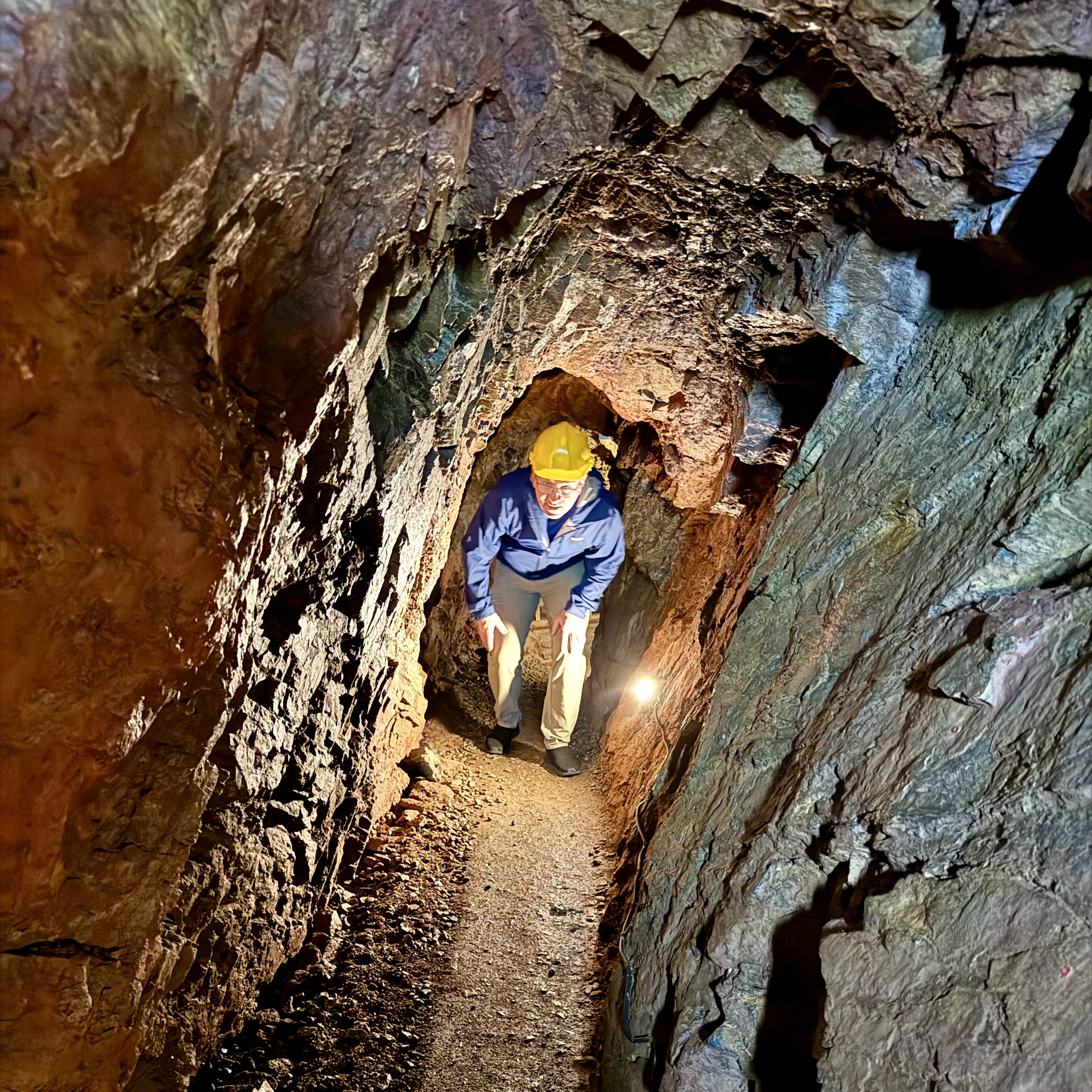
In the Wheal Mexico mine.

The Geevor Tin Mine is all the way on the west coast of Cornwall close to the Atlantic Ocean. And by close, I mean really, really close. Like ON the Ocean (check out the second to last picture on this post). If tin were discovered in that location today, I have to believe the property would be more valuable as unspoiled oceanfront land than as a mine. But when mining started in earnest in that area in the late 1700s, tin was more valuable than an ocean view and it likely stayed that way through the mine's heyday in the early and mid-1900s. Ot at least I'm supposing.

I am by no means any sort of authority on mining means and methods or the history or the extraction or rock and minerals from the planet but I am pretty sure there must have been, over man's history, many, many different ways of removing valuable stuff from below the surface of the Earth. At Geevor, they used a method called stoping.

Pulling tin from below ground at Geevor first involved drilling a vertical shaft near a seam of the precious metal, and then digging six foot wide by seven foot high tunnels (called development drives) stacked on top of one another but spaced every 100 feet vertically. From there, teams of two men (called stopers, and hence the name of the mining method) would drill vertically upwards from a lower development drive to the one immediately above, allowing the broken ore-containing rock to fall below them which they then would use as their drilling platform. 

Does this sound safe in any way? Drilling up and allowing rock to fall past you and then using that potentially unstable deposit as a place to stand while doing the same thing again? Clearly, this kind of thing could only be used in places where removing rock below wouldn't cause the whole thing to collapse but still...I guess if you have no control over your economic situation and it's either drill into rock above you while that same rock falls past you and then serves as a not-so-firm footing for doing that same thing over and over, I guess you do what you have to do.

Geevor Tin Mine is no longer operational. And no, it's not because the whole operation for the miners was universally unsafe. It closed in 1986 after the price of tin crashed worldwide a few years earlier and made mining in a place like Cornwall a non-profitable business. Today it's a museum to preserve the history of this important Cornish industry, which of course is how we ended up being able to visit.

Model of the shafts and development drives that made up Geevor and two nearby mines.

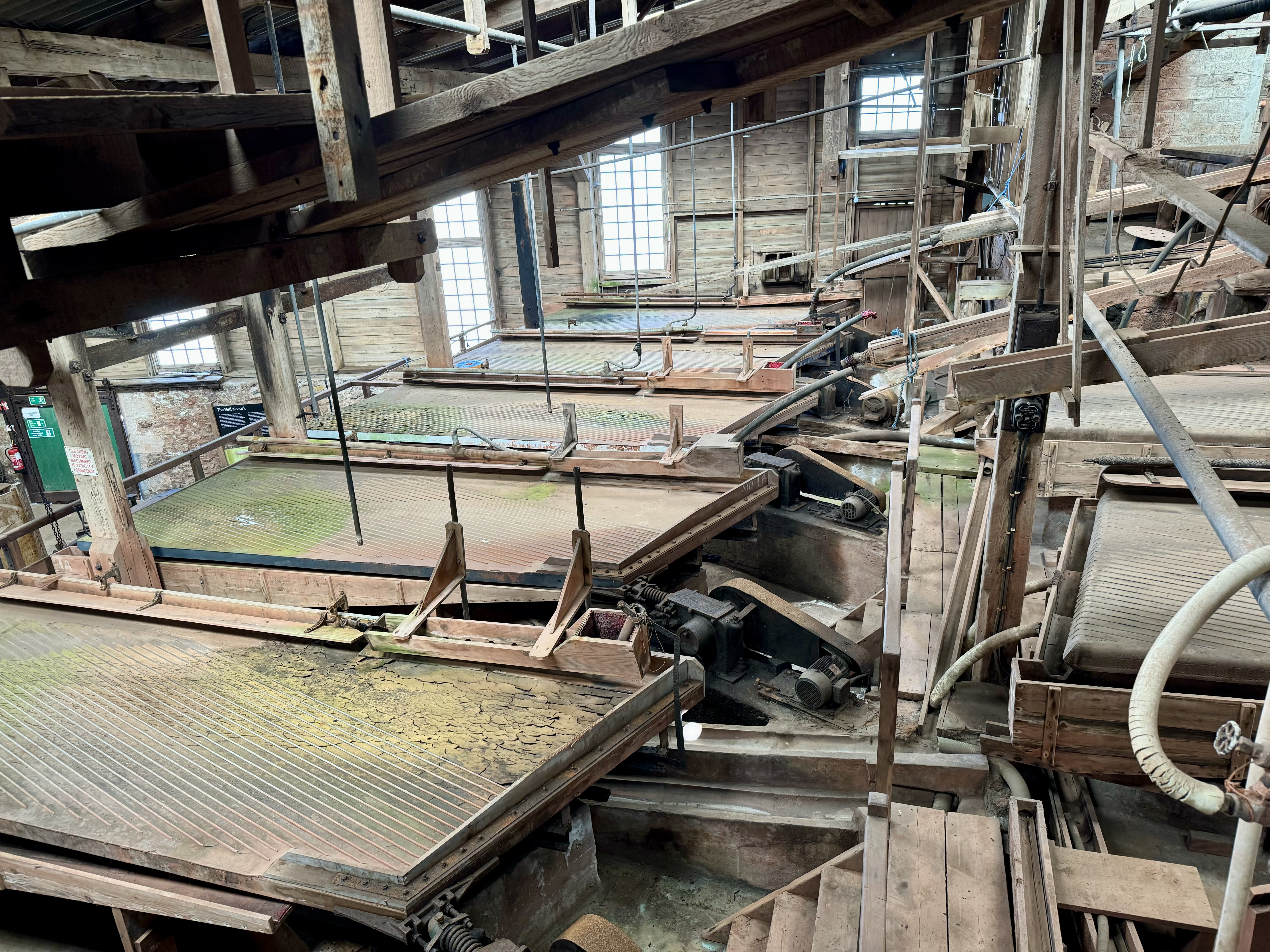
Geevor today from the ground up looks (I would imagine) just like it did when it was operational, although I guess with a lot fewer employees. All the buildings necessary to operate and sustain a viable mining enterprise are still there, but they have all just been turned into museum spaces. The Winder House. The Compressor House. The Mill which housed all the machinery that used to separate the ore from the rock. The Dry where the miners changed before and after their shifts underground. All still in place and completely inoperable. Or maybe not completely, but certainly inoperable right now. 

This was not our first visit to a former mine. We did something similar in a former coal mine back in 2014 in Yorkshire near where my parents grew up and met. The stories that stuck with me on that visit were not the tales of the technology that pulled the coal from the ground, but the human stories. The stories of what men and women and children had to risk and endure to go down into some very scary and confined and sometimes completely unsafe situations because, ultimately, they had a choice between doing that and starving to death.

Those same sorts of thoughts came back to me at Geevor. I was completely uninterested in the equipment that supplied compressed air to all the tools used by the miners in their everyday work or the diameter of the steel ropes that lowered the cages holding the men down the shaft and into the mine. I was more concerned about thinking about the people going through the process of mining than I was about the technology. And those thoughts started in the Winder House with the cages that the miners used to stand in to be lowered into (and pulled out of, I suppose) the mine. 

Do you know how tight these things are? Being packed into these metal mesh cages with enough other large men to fill the entire enclosure and then being suspended down into some dark, wet, dangerous place every day must have been incredibly demoralizing. And being hauled out was likely just as bad. Sure there was the fact that you were returning to the surface of the Earth and fresh air and all that but the smell of those other miners (there were no bathrooms in the mine) at the end of the day must have been horrendous. You can read all about this sort of stuff in books I guess but there's nothing like standing next to the actual old cages to hammer the point home.

All that lowering and hoisting is assuming everything worked just fine, by the way. I'm sure towards the end of the life of the Geevor Tin Mine that the operation was pretty safe but there are for sure stories of mine collapses that killed men and orphaned children in significant numbers in a single event.

The cages. Imagine having to jump up and down in these things.

The history of Geevor is told from the first building you walk into (which houses the main museum) all the way through every building on the site. It is told by walking around the property and visiting the places where men risked their lives and their health every day in the mine, in the mill or operating any variety of equipment to pull that tin out of the ground. 

And at the end of the whole thing, you get to go underground. Not into the deep parts of the mine where the stopers worked (we did that sort of depth in Yorkshire 10 years ago and it was truly chilling), but into an older, shallow mine called Wheal Mexico. And no, nobody knows why it's called Wheal Mexico. At least nobody we talked to and asked that question.

The Wheal Mexico mine dates from the late 1700s and it can't be located more than 30 feet (that's a total guess since the mine is tunneled into a hill) below the ground. But walking through its limited length is remarkably perspective-altering. First of all the sensation of being below a massive amount of soil that theoretically could crush you is daunting. I'm sure it's totally safe and secured now but that can't have been the case back a couple of centuries ago. 

Second, the access (or lack thereof) to light and air, particularly in a mine that was active and being worked by teams of men (rather than being completely empty) must have been extremely claustrophobic and possibly panic-inducing. The atmosphere today is fine. There's plenty of fresh air and the whole tunnel is well lit with LED lights. But when you get to the shaft that brings air into the tunnel, it becomes obvious that there haven't been near or past too many (or any of those) in the mine to that point. 

Pulling tin out of a tunnel that you can't easily and often stand up to full height in? Not for me thanks. And yes, hardhats were mandatory on this whole tour and yes, I hit my head like four of five times while underground.

The machines that sorted the ore from the non-ore.

But none of that was the best part about Geevor. The best part was the talk with a miner (Eddie) who actually worked the place. 

Sometimes when you travel, you get lucky. We've been plenty of places that haven't worked out the way we planned over the last 11 or so years. We've also visited countries and cities and towns and the middle of nowhere where things have worked out spectacularly. Geevor was one of those in the spectacular category. 

I don't mean to sound melodramatic here but there are only so many men walking the face of this planet that used to work down in mines like Geevor and you don't get to talk to those sorts of people every day to hear tales of what they have lived through.  I know, there are men and women who go down into the pit every day in the United States and all sorts of other places in the world today and I'm not wondering around places like West Virginia or somewhere like that to hear mining stories. But if what was written in the museum or on cards or displays in the museums taught me a thing or two, it was nothing compared to what I was told by someone who had really been there.

I'm not transcripting it. But here's what I heard from Eddie and remembered. 

Hernias. Cancer. Heart surgery. Multiple hip replacements. May as well start with what mining can do to a man. This is not a healthy occupation.

The cages used to stick on the way down and when they did, the miners used to jump up and down to un-stick them. Yes, those same cages that I couldn't imagine being crammed into sometimes stuck. I don't know if it is worse to be stuck in a cage or down in the mine, but stopers were paid on a production basis, not an hourly basis. Being stuck in the lift didn't pay. You jumped.

You could be working over holes 1,000 feet deep below you and could not even know they were there. Water was dangerous. Safety equipment could save your life but sometimes it got in the way of your work and you needed to take it off. Eddie did once and fell and remarkably didn't get seriously hurt. That accident apparently was not one of the hip replacements or hernias.


Pictures from The Dry: lockers and clothes drying on hot steam pipes.

The talk took place in The Dry, where the men changed into their mining clothes at the beginning of their shift and changed back at the end of the workday. Sometimes Eddie was so dirty at the end of a shift that he showered fully clothed and then just threw his soaked gear over one of the hot steam pipes in the changing room. If he was lucky, it would be dry in the morning. If not, he'd be wearing wet clothes in a cold and wet mine.

The men weren't the only things alive in changing room. The mice used to eat the men's soap. Worse than the mice were the ticks. The ticks used to eat the men.

Speaking of food (were we?), eventually Eddie stopped taking food down into the mine. He used to eat a big breakfast and then just take liquids on his shift. Food caused cramps. And besides, there were no bathrooms down in the mine anyway.

I can't imagine doing what these men did down in the dark every day of their lives for money that probably wasn't really worth it. But then again, what choice did they have. 

The Cornwall coast. Chimneys against the Atlantic Ocean view.

So...pasties and a trip down a mine. That's not all we did in Cornwall. There were, after all, gardens and multiple cream teas and art galleries and museums and a huge domed botanical garden. But those two things are definitely part of our core Cornwall experience.

Before we ate our first (real, genuine) Cornish pasty and before we arrived at Geevor, we heard a Cornish tale about pasties and mining that may or may not be true. And it's all about the crimp really.

It is a well-established historical fact that pasties have been feeding working men at their jobs in Cornwall for decades, if not centuries, including in mines. Well maybe a century or a century and a half anyway. Tin mining is a hazardous occupation. And I'm not talking about the hernias or the falling or the mice or the ticks or the getting stuck in the cages. A byproduct of the tin mining process is the production of arsenic. And arsenic is, of course, poisonous. 

So eating in a mine where arsenic is in the air isn't exactly a great idea. I mean you don't want to accidentally ingest a bunch of toxic dust while you are taking a break from work (assuming you decide, unlike Eddie, that you still eat lunch down in the mine), right? 

Here's where the crimp comes in. Those grubby, arsenic-laden fingers can hang on to the crust on the edge of the pasty while you eat the pastry around the meat and veg and then you can just toss the crimp when you are done with lunch. Other than being totally scary that men are potentially ingesting arsenic (which I am sure went on anyway), it's a cool story right? Food evolving to meet the needs of society or something like that?

It's apparently a myth. Or a legend. Or maybe it's totally true and someone has artificially debunked it. That's all I got on this one.

Last bite of the chicken, bacon and leek pasty.

Sunday, October 20, 2024

Time In A Bottle


Imagine that you are lost. Can you imagine that? Probably not, right? Not any more. Pull out the iPhone and you know exactly where you are, presuming Google Maps or your app of choice isn't confusing your location with somewhere else or someone else and there's enough signal. Like that last part is much of an issue any more. 

But it wasn't always that way, right? We do remember those days, don't we? Some of us? Maybe? Not before reliable signal. I mean before phones with us everywhere we go.

So it used to be different. What's the big deal about being lost anyway? I mean so you go down the wrong street and have to turn around and walk or drive back again. What's the problem? Who really needs a nav app? And people used to get around fine with paper maps. I can't quite believe it but I used to drive all over the United States with no cellphone and a road atlas or a series of printed or written directions or both. Hey...it worked. I got everywhere I needed to get and I was rarely, if ever, late. No. Big. Deal.

Now imagine it's the early 1700s and you are on a boat. I don't mean like a rowboat within sight of shore somewhere. I mean like a ship on the open ocean. Do you have any idea where you are on the face of the planet? There's no GPS back then and there's nothing to see but just water, water, everywhere. How the heck do you know where on the ocean you are?

There is insufficient time (and personal understanding of the subject) for me to go into exhaustive detail on this blog about the history of mankind's ability to navigate on open water. But suffice it to say that various methods of moving on and over our planet's large expanses of water have been used over time. Star charts. Ocean charts. The compass (after like the 11th or 12th century). Bird movements (not kidding). And the sun. But the sun and the stars had some limitations. The stars could only help at night (and a cloudless night at that) and the sun could really only help with a latitude determination (meaning where you are up or down the planet) based on the known date. True position determination needs more than just latitude.

You need both latitude and longitude.

Standing either side of the Prime Meridian (0 degrees longitude), Greenwich.

Longitude (meaning where you are relative to the prime meridian or right to left on the planet) was way tougher to determine. And honestly, if you know where you are up-down but not right-left, it's not really that useful in determining exactly where on the open ocean you are. So sure, I'd rather have some clue where I am north-south on the globe but disaster can strike if you don't know where you are in the other direction. And it did. Frequently. Wrecking ships and killing sailors. 

So why is figuring out longitude tougher? Well...it's not. It really is pretty easy and can be done if you know what time it is. We have that on our phones, right? Oh wait a second...

Let's go back to that early 1700s on a boat scenario shall we? At that time in history there were two options for timepieces: clock or pocket watch. Clocks at that time in our history had pendulums and didn't work so well when on the ocean. The waves kind of messed up the pendulum's action. Not an option. And pocket watches? Terribly inaccurate. There's an unverified comment on the pocket watch Wikipedia page (always a dangerous source of information, I know...) that states that pocket watches in the 1700s were fast to the tune of an hour a day. Know how long an ocean trip took back then? More than a few days. And if your watch is an hour fast and you try to plot your position, you could be a time zone off. That's pretty big.

The Octagon Room inside the Flamsteed House, Greenwich.

So, around the turn of the 18th century, some countries decided to try to do something about the issue of figuring out longitude while ocean-bound. In 1714, Britain issued a challenge for anyone to take up: find a way to solve the issue of determining longitude while at sea and there's a reward. It was called the Longitude Act. And some people took that challenge pretty seriously. Hey...there was government cash involved. Like £20,000. That's like about £4 million in today's money.

One of those people was a carpenter and clockmaker from the West Riding of Yorkshire named John Harrison. In 1714, he was 19 years old. And he thought if he could make a clock that worked on a ship, that prize might just be his.

To be clear, here, there were potentially other solutions to the longitude problem, but not necessarily to a clockmaker.

14 years later, John Harrison was hard at work designing and manufacturing a marine clock using two interconnected balances joined by a spring that would substitute for the traditional pendulum on most clocks of the day. It was based on a design that he had used in building incredibly accurate wooden clocks in the past, although wood clearly wouldn't work on board a ship due to expansion concerns. To me, this clock looks like it has two pendulums with large balls on the top which oscillate towards and away from each other (there's a picture below). 

Harrison's first marine clock (now called H1) was the first device or idea of any sort tested to see if it might meet the requirements of the Longitude Act. It was taken for a test drive on a journey to Portugal in 1736, about eight years after Harrison had started working on it but just five years after he actually started building it. Eight years. Designing and building a clock. I assume he had other work to do during this period but you know...

Harrison's clock worked and it didn't work on the voyage there and back to Lisbon. It lost time on the way there but was used to correctly pinpoint the longitude of the ship on the return trip when the ship's Master's opinion was that the ship was in a different location. Pretty good, right? But not good enough for either Harrison or the Board of Longitude. Another clock would be required. Although it was promising enough that Harrison was paid £500 by the Board to start work on H2.

Nice try. Thanks for the last eight years. Keep going but start over.

H1. Completed 1735. Tested 1736.

If you want to see the H1 clock today that Harrison built 190 years ago or so, you can. It's in the Flamsteed house, the Christoper Wren-designed part of the Royal Observatory that's at the top of the hill in Greenwich, England, just a bit down the Thames to the east of London. H1 sits smack in the middle of an entire exhibit devoted to the Longitude Act. The stories of the ships that were wrecked on hidden reefs or rocks all because they didn't know or couldn't tell exactly where in the ocean or sea or channel or whatever they were floating on are astonishing. It's no wonder that this was such a high priority for more than one European nation to issue a call for solutions.

There is also a really pretty informative interactive display showing why a pendulum clock won't work on a boat that is listing to one side. When the boat is tilted in the exhibit, the clock's pendulum keeps swinging, but the center of the clock where the action of the pendulum advances the time doesn't ever get passed by the pendulum, so it doesn't keep time. 

Harrison's second effort (H2) is in the Royal Observatory as well. And spoiler alert: so is every other clock that Harrison submitted in consideration of the Longitude Act prize. H2 took Harrison just three years to build and it actually seemed like it would work well enough to claim victory over the whole longitude issue. It was tested by Harrison on land enough that he felt pretty confident about this device having a shot at winning the cash money. But he eventually figured out that the device might not survive the tilt of a boat tacking and he couldn't very well tell captains of ships not to tack. I guess he knew what he had done wrong because he suddenly ceased work on the H2 clock version and started on the third iteration of his ideas (H3) in the year 1740. Another three years gone. So we are up to now what...11 years? All in pursuit of a clock that works on a ship?

To me, H2 looks less like a traditional clock than H1. Not a whole lot, but it's definitely less timepiece-like. Maybe that's part of the point of what was going on in Harrison's head. Maybe the answer here would be something that didn't look like a traditional clock. I am pretty confident here that I will never, ever be able to understand how these or any other clocks work, so I'm sure I'm stabbing in the dark here and making the leap that less clock-like means closer to the solution. Maybe it's the architect in me that's speaking here. 

All of these clocks in the Royal Observatory by the way: spectacular condition. I mean these things look better than any object I own in my entire house. And they are almost 200 years old. I realize there are probably people out there paid a lot of money to maintain these things but still...spectacular!!!

H2. Completed 1740. Never tested at sea.

If H1 and H2 represented a pretty good effort at the Longitude Act prize, H3 was, simply put, an incredible science project for sure. Eight years on H1 and three on H2? Child's play. H3? 19 years. 1740 to 1759. 19 years on one clock. Apparently, it was a masterpiece. It moved clock technology forward through the introduction of a bimetal strip for temperature compensation and a special roller bearing that would reduce friction. The design of the clock got Harrison the Copley Medal, the highest award conferred by the Royal Society. By all accounts, it was an act of supreme clock-making genius and craftsmanship, well worth the 19 years that Harrison labored over the thing. 

But it didn't win him the Longitude Act money. It wasn't accurate enough. He knew it as soon as it was done. They didn't even test it on a ship. Skipped the whole thing.

Can you imagine working on something for almost two decades to get to a specific goal only to abandon it because what you had invented and built wasn't good enough? Harrison turned 66 in 1759. He'd been working on this problem for over 30 years and he still hadn't solved it, including after spending 19 whole years on his third try.

H3 sits in the same room in the Flamsteed House as H1 and H2. Like both of its predecessors, it is in immaculate condition. It's just gorgeous. But it does not look like a clock. Not really. Not the way I think of a clock with a 1-12 dial with an hour, minute and maybe a second hand on it. I realize that H1, H2 and H3 all look primarily like really well put together bronze boxes but with each iteration, I feel they are getting further and further away from being clock-like. It's pretty obvious (with the benefit of 200 plus years of history) that something interesting is going on here.

So...30 plus years in working on a problem and he still doesn't have it licked. Thinking about quitting? Not our guy John Harrison. He kept going.

If you are feeling bad for Harrison at this point, by the way, I guess that's understandable. But he was receiving some payment from the Longitude Board for his efforts. Thought the completion of H3, Harrison had taken home £3,000 in payment for his efforts. I know it's not 30 years worth of effort but it's not nothing. Still...three clocks and only one sea test? That is kind of brutal.

H3. Completed 1759. Never tested at sea.
So what happens after you work for 30 years on a single problem without solving the issue? Well, in John Harrison's case, he just went ahead and solved it. He did it with H4. And H4 looks nothing like H1 through H3. Nothing. 

While he'd been working away on his sea clocks, John Harrison had continued to make clocks un-related to the Longitude Act. In the early 1750s, he had commissioned a watch maker to assemble a pocket watch for him that would continue to run while being wound but also would work consistently under different temperature conditions. And apparently, these innovations for this watch inspired Harrison to make something completely unlike his previous sea clocks and decidedly more pocket-watch-y. Although it's a pretty darned large pocket watch and is really nothing like a pocket watch at all.

I've claimed extreme ignorance of the inner workings of timepieces once in this post and here I'm going to do it again. I have no ability to explain how H4 works other than reading what's on the Royal Observatory's website and writing that H4 in pretty much all ways resembled a full size clock more than a something you would carry in your waistcoat pocket and the fact that it ticked five times a second allowed it to be more accurate and more resilient than any other portable watch created to date in human history.

The enclosed mechanism of H4 (minus the outer case that made it watch-like) is on display in the Royal Observatory. It looks like something out a science fiction movie. It is simultaneously space-ace and absolutely beautifully crafted as if worked on by an Arts and Crafts movement master (note the capital A and capital C there; not an accident). If this thing had popped in in one of the Dune movies (the 21st century ones, not the Dino De Laurentiis one), it would not have looked in the least bit out of place. It's stunningly gorgeous. 

H4. The winner.

H4 was ready for a sea test in 1761, just two years after Harrison stopped working on his 19-year long H3 project. It passed that sea test to Jamaica and it passed a second sea test (this time under competition with other Longitude Act competitors that had gone the non-sea clock route to win the prize) to Barbados in 1764 where it was declared accurate within the constraints of the Longitude Act. Harrison had won.

The end of this story isn't as tidy as that. There were disputes as to payment or whether full payment should be conferred. The Royal Astronomer (Nevil Maskelyne, if you must know) was especially determined to not let Harrison win the prize and kept debating and refuting the effectiveness of H4 for at least two years after the Barbados test. According to the Royal Observatory, Harrison was eventually paid everything that was owed to him but it may have been by Parliament and not the Longitude Board. The description next to H4 says that H4 is "arguably the most important timepiece ever made." Not too shabby for 32 or 33 or years of work, right?

H4 was not the last clock Harrison produced in his life. He apparently was still tinkering with his last clock design when he died in 1776. That's some serious dedication.

John Harrison. Front and center.

There is a lot to see at the Royal Observatory that is not related to John Harrison or the Longitude Act. I'm not sure I can adequately describe everything that they have on display up there at the top of the hill in Greenwich but Wren's building, telescopes and planetary observation history might top my list if pressed. We didn't go to see any of that stuff. We were strictly focused on Harrison's clocks, which (full disclosure) I had already seen in person but which will endlessly fascinate me. It's as much the story as the history.

If you want to go do the same thing (and only the same thing) as we did on this trip, I'd suggest you not ask any of the museum staff "where are the clocks?" We did and our question was answered with a question: "which clocks?"

Yes, there are many, many clocks at the Royal Observatory and fewer than ten of them were designed and built by John Harrison (there are more than four Harrison clocks at the Observatory although I don't know how many; I'm guessing not more than ten). Asking where are the clocks ain't going to cut it at this cultural attraction.

There are some other things to see that are at least partially relevant to longitude and the accuracy of timekeeping. First (and I realize it's a huge tourist trap type thing), the Prime Meridian (or zero degrees longitude) passes through Greenwich in recognition of the Royal Observatory's role in defining longitude. There's a literal line you can straddle with one foot in each of the eastern and western hemispheres. Of course we did this. How could we not? I stood in two hemispheres in Ecuador; I had to do it here in Greenwich.

Second, there is a big red ball on the top of Flamsteed House. It was installed there in 1833 and was dropped at 1 pm each day so that ships on the river in sight of the Observatory could re-set their watches each day. I know I already wrote about the inaccuracy of personal timekeeping devices but it is still astonishing to me that there would be a bunch of ships' captains on the river side of Greenwich watching a red ball drop to re-set their chronometers but I guess it happened. Like every day. The Observatory still observes this tradition today and we happened to be exiting the building at about 1 so we stuck around and watched. I fell like I'm closer to history for doing this.

Saturday, October 12, 2024

The Acropolis Marbles


This post is about one room in a museum. I promise it's not that simplistic. Let's get right to it...

Actually...let me say one more thing first. 

I debated using an apostrophe after the word "Acropolis" in the title of this post. I think it's correct but ultimately, I think it looks better without. I do, however, think that there should be an apostrophe. Sometimes you can't have it all. It's not the first time I've bent the rules of grammar or punctuation based on how I think things should look. Oxford comma. That's all I really need to say on that subject. NOW, let's get right to it...

Last fall we visited Greece. Or maybe more accurately, last fall we visited Athens. As an architect, a trip to Athens was a long time coming for one reason and one reason alone: the Acropolis, the hilltop site in the center of the city which includes the most perfect Greek Doric temple of all time, the Parthenon. Look, the Greeks pretty much invented architecture. Finally laying eyes on one of their masterpieces (if not THE masterpiece) was super exciting.

Our whole experience at the Acropolis was incredible. I mean it really was as impressive as I'd been promised for decades. Our understanding and appreciation of the 2,500 or so year old temples on top of the hill was only enhanced by our visit to the Acropolis Museum right after we descended back down to Athens proper. But our visit to this site wasn't really complete, and that's because a good portion of the sculpture and carvings that used to be on the Parthenon are neither on the building itself nor are they in the Acropolis Museum. 

Now, this is not some huge mystery regarding what happened to them. It's not like they are lost or locked away somewhere. Everyone knows where they are. They are in the British Museum in the middle of London. So after visiting Greece and not seeing them there where they started out, and this year finding ourselves in England and more specifically London, we couldn't not go see these things and make last fall's trip to Greece more complete. 

Make sense? It made perfect sense to us.


Let's address the most obvious question about what I've written so far, shall I? Why is a part of the Parthenon in London and not in Athens where the rest of the mostly intact ancient temple is? It's a simple question, right? Maybe there's a simple answer. And I think there is. The simple answer is that they were removed from their original location by Thomas Bruce, the 7th Earl of Elgin, in the early 1800s. The truth, from at least one side of the table, would be argued as more nuanced than I've just described. So, not being one to mince words (or facts, in this case) let's just dig into that whole history for a minute.

Greece has not existed continuously as a country (or even as a collection of truly independent city-states) since the time of the Parthenon. It's evolved or devolved from a relatively successful series of independent cities to quite a bit less than that before pulling things together and establishing an independent nation. In between the Parthenon times and now (and like most places on this planet of ours) parts of modern day Greece at one time were under foreign control. In the early 1800s when this part of the story takes please, the city of Athens happened to be part of the Ottoman Empire. 

Now two plus centuries ago, much like today, nations appointed ambassadors to other nations to provide a personal touch in maintaining diplomatic relations. In the year 1800, the British ambassador to the Ottoman Empire was one Thomas Bruce, 7th Earl of Elgin. And I guess this appointment caused Bruce (I'm going to switch back and forth between Bruce and Elgin in this post when referring to the man) to turn his attention to the carvings that once adorned (or still did adorn in some cases) the Parthenon on the northern side of Athens' Acropolis. He decided he would use part of his time in his new post having some folks under his employment make some plaster casts and drawings of the remaining sculpture still hanging around the site. For posterity, I'd imagine.

Elgin approached the British government to see if they'd like to cover the cost of his idea and the answer was apparently a hard no. So he decided to do it himself. He hired himself a crew and they started working. To make a long story short and I'm sure I'm skipping a ton of details, at some point, this effort switched from making plaster casts and drawings to just removing the items from Athens entirely and bringing them to London where they just became the property of Lord Elgin. I know, I know, I skipped a lot of the story.

For his part, Elgin claimed to have the permission of the Ottoman Empire to abscond with some of their treasures and even produced a signed document from the Ottomans endorsing the removal. Apparently, the Ottoman Empire have never publicly confirmed the legitimacy of the document but Bruce had his story. 


The treasures of the Parthenon are not, today, in the possession of the descendants of Lord Elgin. They are (as I've already mentioned) in the British Museum. How did the British museum get them? Well...they bought them in August of 1816 for tidy sum of £35,000. 

Isn't it kind of sketchy for the British government to purchase some artwork that clearly originated at the site of another nation's national treasures and that were removed under some circumstances that appeared to be less than wholly legitimate? Apparently, the answer to that question was "yes" and to avoid the appearance of impropriety, in February 1816, the House of Commons conducted an investigation into whether the pieces of the Parthenon were removed legally or not. Today, there are questions about the document Elgin claimed was issued to him by the Turks and (assuming that document was genuine) whether removal of sculptures and carvings from the site are covered by that document. But in early 1816, apparently it was good enough for the House of Commons. Purchase approved! 

Today, all of the treasures gathered by Elgin sit in a special room on the west side of the British Museum. The room is dumbbell shaped and you enter the room at the center of the "handle" and are greeted by a carved sign that reads "These galleries designed to contain the Parthenon sculptures were given by Lord Duveen of Millbank 1939", although 1939 is written out in Roman numerals. These things are a big deal to the Museum. They are very valuable and important, even though they have absolutely nothing to do with anything to do with Great Britain or the British Empire other than some dude who was British removed them from their original location and sold them to the Museum.

Dionysus. Perhaps drinking wine at one time? Maybe?
The entire current "Elgin Marbles" collection includes three series of sculptures: (1) statuary from the east and west pediments of the Parthenon (the pediments are the triangular pieces at each end of the building); (2) 15 metopes or carved panels from the outside of the building which were located just above the perimeter columns; and (3) a good portion of the frieze that was installed on the exterior of the interior cella. The cella basically formed the two rooms of the temple, one of which housed the long lost statue of Athena. 

Of all the sculptures and carvings in the collection, the metopes (which show a battle between a group of centaurs and a peoples known as Lapiths at the wedding of Pirithous and Hippodamia) and the frieze (which shows a celebration procession for a festival honoring Athena) are clearly the best preserved of the artifacts in the room. They are actually largely intact, particularly the many panels of the frieze (there is about half of the total length of the frieze from the Parthenon in the British Museum) which are generally two-dimensional carved panels and have little to be knocked off because of the complete lack of three dimensional objects in space. If they are damaged, they are often broken at the corners.

The centaurs and Lapiths on the metopes are less intact, mostly a product of arms or legs or heads of centaurs and Lapiths being carved in the round away from the panels. In some cases, the heads are out there. Just not in London. Or Athens either. One of the description cards next to one of the metopes informed us that the missing head of the Lapith about to be hit with a pitcher by a centaur is in a museum in Copenhagen. Why? Why does some museum in Copenhagen need a part of that panel?

As a bit of an aside here, the centaurs and Lapiths are fighting because at the wedding that both groups were invited to, the centaurs tried to kidnap some of the Lapith women. Don't invite centaurs to your wedding is a lesson learned here for me.

Headless metope. Want to see the heads? Go to Copenhagen.
The most important and most visible, but also the least well preserved, sculptures in the Museum are the figures from the pediments at the ends of the Parthenon. These things are in some cases little more than fragments. Dionysus reclining among the figures that used to occupy the east pediment is probably the most intact, just missing his right arm and his left hand. I'm assuming at least one of those missing hands was holding a cup of wine. Heck, maybe even both were. 

I assume the reason that these particular sculptures are in such poor condition is that they could fall off or be knocked off the building and the result of such a fall would pretty much shatter the statues to bits upon impact. I remember seeing an animation in the Parthenon Museum last year showing Christians up on the pediments throwing the heathen god statues to the ground and smashing them. For some reason that animation stuck with me. Maybe learning in museums does work after all. 

The biggest thing that struck me about seeing the marbles from the pediments, though, was not their condition or their lack of completeness. It was the fact that they were carved on the back sides. Here are these figures that were installed way above ground level 2,500 or so years ago and the back sides will never, ever be seen. I mean, never. They have to know that, right? Yet the hems and folds of what the gods and titans and whomever else was wearing up there a long way from anyone being able to see anything really are detailed in stone by some stone carver who spent their time embellishing a piece of marble in a way nobody was ever intended to see. It's impressive. 

Or maybe they knew one day some English lord would swipe what they carved from where they were supposed to be and stick them in some museum where someone like me would marvel at the attention to detail. I guess we'll never know which of those versions of the story is true.


The back side of the east pediment statuary.
So let me just say this one small but pretty important thing about this whole setup: these things would have a whole lot more meaning back in Athens in the Acropolis Museum which sits directly at the bottom of the Acropolis and in sight of the actual, still there in place, Parthenon.

Are the statues and carvings in the special room in the British Museum impressive in their own right? Sure they are. They look incredible for being 2,500 years old. Even to me, and let's just assume I know nothing about the quality of ancient Greek sculpture, they look like pretty darned impressive specimens of sculpture from the fifth century B.C.

But can they be understood the same in London as they can be in Athens? Not to me, they can't. Maybe there are people out there a lot smarter about this stuff than me but there's no emotional connection, no sense of understanding the place from which these things were created. Our trip to the British Museum to see the Parthenon marbles was not my first viewing of these sculptures. I'd been twice before to the Museum to see these masterpieces. The meaning of these panels and figures didn't hit home until I actually set foot in Athens and went to see the place where they started out for myself. It would just be a lot more meaningful to have them back where they started. Why deny people who have made the pilgrimage to the Acropolis the opportunity to see all of it? Why make people go to London after they have been to Athens to really understand the whole picture?

And to be a completist, I guess you'd at least have to go to Copenhagen as well to see the heads of some of the Lapiths and centaurs from the metopes. And maybe some other places too. Why aren't they all in one spot??

I will say that we went through something like my past British Museum experiences a couple of years ago. Knowing that one day we'd want to visit the ancient site of Ephesus in present day Turkey, we went to see the sculpture from that site that is housed in the Ephesos Museum in Vienna since we happened to be in Vienna to visit a few Christmas markets. My reaction to what we saw in that museum was the same as my first two viewings of the Parthenon sculptures at the British Museum. Cool ancient sculptures, but lacking any emotional attachment because I haven't actually been to the site they were swiped from. I guess I'll have to likely go back to Vienna if we ever make it to Ephesus. Oh well...I suppose we might have missed a thing or two in Vienna.


Let's not kid ourselves. These things are not going back to Greece any time soon. And it's not because the Museum had a special room built to house them back about a century ago. These works are valuable. They are prestigious. They bring people to the building to spend money (although admittedly, admission is free or at least optional which most people interpret as free). The British Museum has a very long and detailed explanation about the legality of their possession of their works on their website along with a standard disclaimer about a willingness to loan items out to other institutions in accordance with their standard loan procedures. 

All of that hasn't stopped the Greeks from trying to get them returned. They have made formal requests either directly to the British government or through UNESCO all the way back to 1836 and as recently as 2013 and there have been talks between the two countries ongoing up to the year 2022 but with absolutely no change in the ownership status. It's never going to happen.

The British side of the argument seems to center on three issues. First, they were obtained legally. Second, they are in better condition now as a result of their being in the United Kingdom for the last two plus centuries than they might have been had they remained in Athens. And third, if Britain started turning over antiquities based on an "it's better to have them in the place they were made originally" doctrine, then they would have to return a lot of stuff in their museums.

Here's my take. 

For me, legal or illegal ownership means nothing. Who cares? I know I said these artifacts are super valuable but they are way more valuable to everyone visiting Athens than they ever will be in London. If you want to say something about this, go to London then go Athens and then go back to London and tell me where they are more valuable. Until you have been to both, you don't really know.

I also don't care about what might have happened if they had remained in Athens. There's no proof that they would have been lost or destroyed or stolen by someone else and there is some evidence that cleaning methods used by the British Museum might have damaged some of the metopes and panels of the frieze. Where an item is better protected from damage is not an argument for thievery. 

I get the third point. However, I don't think giving the Acropolis Marbles back would cause some landslide of return of objects from all sorts of museums to their original locations. It certainly doesn't have to. One exception does not make a rule. There would have to be a way to rationalize keeping artifacts in museums that are in a different spot than the items originated.

Surely there must be a way to reunite these sculptures and carvings with the building they were removed from. Can't the United Kingdom and Greece find a way to work out a fair and equitable form of compensation even if it's exchange or rotation of artifacts with a huge and sincere acknowledgment to Britain for keeping them safe in times of strife or war in Greece? I'm not holding my breath. All I know is that people who visit the Parthenon in Athens would be better off being able to see these works of art at the site where they were originally installed. Travel is about discovery. It would be helpful for a monument as important as the Acropolis that the discovery be able to occur there and not on the other side of the continent.

That's all I have on this one. This third viewing (for me) of these marbles was the best and most important. But only because I understood where they came from based on our visit to Athens last year.

Lapiths and centaurs: still battling it out at the wedding. Just don't invite them...