Wednesday, September 7, 2022

Gathered Together In A Cave And Grooving With A Pict

There is a town in Scotland, about two thirds of the way between Aberdeen and Dundee, named Aberlemno. In many respects to the casual passerby or passer through (that would be me, in this case), Aberlemno is no different than many other Scottish towns and villages out there. There are fields used for farming as far as the eye can see. The roads are seemingly all too narrow and are edged with earthen berms topped by low stone walls. Maybe there are some sheep here and there. And there is an astonishing lack of actual buildings around for people to live in, although there always seems to be a parish church of some type somewhere around.

We drove through Aberlemno on a Tuesday afternoon in June. Our passing through there was no accident. In fact, it was quite deliberate. Because, really, as much as Aberlemno might resemble a lot of other Scottish towns, in one respect it is actually quite remarkably different: if you drive to the right spots in Aberlemno, you will find some carved stones standing by the side of a road or in a churchyard which have been there for more than 1,200 years. That, to us, seemed like a good reason to visit on a Tuesday afternoon, especially since we happened to be traveling from Aberdeen to Edinburgh (and past Dundee) on that very same day anyway.

The four stones in Aberlemno that we made our way deliberately to visit were carved by a group of people called the Picts between (and I guess this is estimated) 500 and 800 C.E. They weren't the only stones carved by these people found there. There were at least two others, one of which was lost (I don't know how you lose a piece of stone taller than a person...) and one of which was relocated to a museum in Dundee. They are still looking for others.

Our planned stop in Aberlemno made me wonder...who were the Picts and what else is out there in Scotland that might have been left behind by these people? Turns out there's actually quite a bit of mystery surrounding the Picts. And they sure did leave a lot of stuff behind.

Detail, top back side of the Roadside Cross, Aberlemno.

If you had asked me before our trip to Scotland this year to sum up the last say couple of thousand years in that corner of the planet, I'm not really sure how good a job I could have done. I could probably have spit out something about Hadrian's Wall in the second century C.E. and probably could have thrown out names like Robert the Bruce and William Wallace before boldly claiming that Scottish resistance to English rule was brutally squashed at the Battle of Culloden. Beyond that? Railways and bridges and ships, maybe? Industrial revolution and all that stuff?

But the details and the timing of all that? Maybe not so clear. I might not even have been close to within a hundred years or so.

Now if you had really pushed me for some more details on this history stuff, I might have used words like Picts and paganism and Celts and Gaels and I might have intertwined and interrelated all these concepts. But honestly, I just wouldn't have had the faintest real clue. So faced with a town like Aberlemno where there was a real opportunity to fill in some giant gaps in my understanding of Scottish history...well, I was all in! I needed to know about these Picts. And I guess the Gaels and Celts too if they happened to be in the story.

Maclean's Cross, Iona.

So first of all, the Picts were not what they called themselves. Apparently, the name was what the Romans called the people living in the north of what is now Britain. You know, the part of the island that Rome could claim they conquered but then couldn't hold on to. The Picts (or whoever they really were) weren't much help here with their own name or names. They had a tendency to not write stuff down so whatever they were called as well as what they did or built and how they lived is all pretty much lost to history.

And there were Celts and Gaels in the mix here who may or may not have been the same people as the Picts. The Celts were a peoples who were living in the British Isles before anyone who kept any sort of history at all was around that part of the world. The Celts were just there in Britain at some point when other groups (like the Romans and the Vikings and the Normans) started showing up and trying to take over. The Gaels were from Ireland, but they definitely had a presence in Scotland, particularly on the west coast near...well...Ireland. Big surprise there. So yes...Picts, Celts and Gaels...all in Scotland at some point. But let's stick with the Picts for this post.

For some reason, and I know it's my own personal cultural bias in operation here, I assumed that the Picts north of The Wall (of Hadrian) were all pagans. Which is totally true. Long ago, before history was written down in northern Britain, the people living there worshipped nature and maybe gods long forgotten. There were certainly offerings and sacrifices (not saying human, necessarily) for things like good harvests, and they built rings of stones and other temple-like places to seemingly relate to things like the solstices.

At some point, paganism started to fade and Christianity made its way to the Picts. Not likely through written books translated into English or Olde English or any other sort of written language. Likely there were monks or missionaries or priests or saints (or whatever) that started to reach the people in the north and talk about Christ and the gospels and all that. Eventually, stuff began to stick.


Two of the stones at Aberlemno. The Serpent Stone (top) and the Roadside Cross (bottom).
In Aberlemno, you can see hints of all of this transition between religions and much more.

As you drive into town, there are a series of three large stones on the left hand side of the road, carved to various degrees of precision and detail. Two of the stones (known today as the Serpent Stone and the Crescent Stone) depict symbols from nature, one clearly marked at the top with a depiction of a snake and the other less clearly carved with some faint crescent shapes. Maybe the moon. Although the plaque next to the Crescent Stone does not make that speculation.

The third stone, and the most massive of the three, is an intricately carved cross with angels flanking either side of the shaft of the cross on the front of the stone. On the rear face of the stone, there are representations of a hunting scene along with a centaur gathering medicinal herbs and David saving his flock of sheep from a lion. At the top of the back side of the stone, there is the same crescent shape (shown above) found on the Crescent Stone and some Pictish symbols, similar to those found on the Serpent Stone.

If there's any evidence needed that the Picts were both pagan and Christian, to me it shows up clearly in these three stones. Two of the three are devoid of any reference to Christianity; the third is a clear mixture of the two. For me, though, the fact that these stones show a transition from paganism to Christianity isn't the point here. I mean it's cool as an indication of history, I guess, but that's not what I got out of our visit to Aberlemno.

The real beauty in these things for me is the fact that they have lasted more than 1,200 years and that they are carved so intricately by a peoples who must still have been using most of their waking hours just to stay alive. I can't imagine what the people who made these things would have thought if they knew someone in the 21st century from an ocean away was driving by in a rented Honda Jazz to look at what they carved. It staggers my imagination.

The Crescent Stone. The carvings are barely visible but it is like 1,500 years old or something.

If I was impressed by the three stones by the side of the road (and I was), I still had one more to see at the Aberlemno Parish Church in the middle of the graveyard. It was placed there after the church was built, rather than the church being built where the stone stood.

The churchyard stone is the most interesting of the four stones we saw in the town, not only due to the artistry and the intricacy of the carving but also for the historical document that it is. There is a large cross on one side of the stone which is carved in what I can only articulate as a Celtic design. The cross itself is filled in with patterning that looks sort of rope-like, much like the jewelry we saw in souvenir shops in Ireland almost three years ago. Animal figures fill in the space between the cross and the edge of the stone.

The other side depicts a battle scene, what historians believe might be the Battle of Dún Nechtain in the year 685, a battle waged between the Picts and the invading Northumbrians led by King Ecgfrith. The Picts, as carvers of the stone, clearly won. This scene represents not just a work of art but a story told by people who are no longer around to be able to relay their history. I know I just poo-pooed the historical nature of the other three stones but this one is way cooler. This shows an actual event, not just a change in religious representation or focus. I'm sure the battle was way more chaotic than the stone represents, by the way. And I'm sure King Ecgfrith didn't succumb to the raven attacking him in quite the way the stone shows.


The Churchyard Cross, front side and back side, Aberlemno.
Aberlemno was actually the last place on this trip that we visited to see stones that were carved by the Picts. In terms of quantity and variety, it was clearly the best. There was no other site we visited that had more than one. But we did see others that were perhaps better quality.

Aberlemno was the last Pictish stones site that we added to our itinerary. The first places I planned on this trip were the Hebridean islands of Islay, Mull and Lewis and as it turned out there are ancient Pictish stones on the Isle of Islay and on Iona just off the west coast of Mull. We actually started building our Pictish stones journey from those places and couldn't resist the quick detour off the Aberdeen to Edinburgh path once we found out about Aberlemno. Visiting a single stone doesn't tell the same sort of story as visiting four in one site, but I think there was still a lot of value in chasing these things down.

Perhaps the most famous and most important of the carvings we found was Maclean's Cross on the Island of Iona. Maclean's Cross was produced way, way later than the stones we found at Aberlemno. It was placed on Iona around the year 1500 as a marker for pilgrims on their way to Iona Abbey, one of the most important early centers of Christianity in Scotland. The cross is enormous and covered with carvings of patterns around a central picture of the crucifixion of Christ. Unlike the stones in Aberlemno, it's actually cross shaped. As a work of art, it's impressive, particularly in its size and detail. It's also probably most famous for being where it is as much as for what it is. Among its many claims to fame, Iona Abbey may have been the place where the Book of Kells, now prominently on display in Dublin's Trinity College, was written before it was moved to save it from potential raids by the Vikings.

The back side of Maclean's Cross, Iona.

I can't say if someone who knows way more about this subject has ever produced any sort of list of the best Pictish carved stones in Scotland or anything like that. If there is, I'm not sure what we saw at Aberlemno or Iona would make the list. Impressive? Sure. Even the fact that these things are still around today is impressive. But I'd have to think the first stone we looked for and found might stand a chance of making such a list. That stone would be the Kildalton Cross on the Isle of Islay.

I don't know what it is about the Kildalton Cross exactly that makes it so impressive, unless I just say it was everything about the Cross that blew me away. Of all the carvings we found on our trip, this was clearly the most complex and most well executed. Its form is a ring-headed or Celtic cross, a crucifix with a circle superimposed at the crossing of the two arms. It's massive and it's intact, which is super-impressive considering it dates from about the year 700, older by far than Maclean's Cross and perhaps even older than some of those at Aberlemno.

The decoration on the Cross is detailed with patterning and biblical scenes and the decoration is not only carved into the plane of the cross but also "attached" to the front of the cross. I guess "attached" is the right word, although maybe not if the Cross was carved from a single stone. It is a true work of art. It's also in the same spot it was originally erected in the courtyard of the former parish church of Kildalton. It's incredible that it's even in this spot still standing. The things this cross must have seen over the last 1200 or 1300 years...

Kildalton Cross, Islay.
There were two other factors working in favor of Kildalton Cross being the most impressive we saw in Scotland. First, the weather was perfect. The sun shining on the front side of the cross made every carved piece of the stone pop to life. I know it's superficial to credit sunlight as making a carving more memorable but it was absolutely true. We had great weather much of the time we were in Scotland but not at the exact times we were on Iona or in Aberlemno. The sun helped Kildalton Cross immensely.

Finally, Kildalton Cross is frustratingly challenging to get to. It's located past the three southern coast of Islay distilleries after the two lane paved road becomes a two-way, one lane road which is definitely a bit more overgrown and not-cleared than a lot of the other two-way, one lane roads we traveled down in Scotland. And there's actual traffic coming the other way and not exactly plentiful passing places. Make it all the way to the old parish church and your reward is the finest piece of Pictish carving we found in our limited search in Scotland. The journey definitely makes the payoff better.

The magnificent front of Kildalton Cross in full sunlight.
Our pilgrimage to find ancient Pictish carvings in Scotland was really a result of finding out that these sorts of works were in places where we were going anyway. We went to Islay to learn about whisky; we went to Mull to see wildlife; and we had to travel past Aberlemno on the way from one place we really wanted to go (Dunnottar Castle south of Aberdeen) to the final stop on our Scotland trip (Edinburgh). We thought taking a quick detour on Islay and Mull before hitting Aberlemno would string together some similar sights that would get us a little bit of exposure to a bit of history made by peoples whose history is mostly long forgotten. Or maybe it's preserved in what we saw and many other similar carvings that we didn't see.

In many ways, it would have been a better experience if we had made the trip in reverse and ended up on Islay last. It would, I think, have made Kildalton Cross that much more impressive. But that's not how we planned this trip and I have no regrets about doing it the way we did it. If I ever get back to Islay, I will have to go back to the old Kildalton Parish Church. Not holding my breath there. For now, I'll stick with the memory of 2022. 

How We Did It

Of all the carved stones we found in Scotland, Aberlemno is probably the easiest to get to, if for no other reason that it's on mainland Britain. We just plugged in Aberlemno into our navigation app and after taking many lefts and rights on the (barely) two lane road to the town, we drove past three stones on the left hand side of the road. There's a parking lot just beyond the stones that has some informational signage and replica stone depicting the battle scene of the Churchyard Cross. Park the car, cross the road (remember traffic is on the left) and walk down to see the Roadside Cross, Crescent Stone and Serpent Stone. If you want to see these stones, better come when it's not winter; apparently they cover them in winter to protect the stones from the elements.

The parish church can be found by traveling a bit further north up the same road and taking a left toward the church. We didn't find any sort of parking at the church but just pulled over and accessed the courtyard. I'm not sure we parked legally but there was literally nobody in sight. No harm, no foul here.

Getting to Kildalton Cross and Maclean's Cross is a bit more involved because it will involve at least one boat and a combination of two more boats or planes. To get to Kildalton Cross, drive east from Port Ellen past Laphroaig, Lagavulin and Ardbeg distilleries and follow the signs to the Cross. There's also a walking trail on the south side of the road but it's a long walk all the way to the Cross.

We found Maclean's Cross by being dropped off at the ferry landing on Iona and walking straight up the hill and hanging a right after passing the ruins of the old nunnery. It's not much of a walk to the Cross and you can't realistically walk past it without missing it.

My understanding of the history of the Picts and the Gaels and the Celts and when they worshipped nature vs. Christ wasn't helped much by any of our visits to these sites. I managed to find a book called A Pocket History of Scotland at the Battle of Bannockburn Experience near Stirling which told me pretty much all I needed to know about Scottish history in an easy to read format. It cost me all of £5.99 and it's been worth its weight in gold. I can't remember buying a book this small for this low a price that has helped me so much, although I'll dispute the "pocket" label just a bit. Not saying I don't have pockets I can fit this book into, but I certainly have a lot of pockets that it won't fit into.


Thursday, August 25, 2022

Don't Pay The Ferryman

Our trip to Scotland in late June and early July of this year lasted almost exactly two weeks. I mean that quite literally. We spent 14 days there almost to the hour from the time we crossed the Scottish border heading north to Glasgow to crossing the same line heading back south to England. That's about 336 hours of time, if you are inclined to do the math. Clearly, I was.

Of those 336 hours north of the border, we spent an awful lot of time on boats. Like an astonishing amount of time. We sailed (sailing here means a boat with a motor; there were no actual sails involved on this trip) on small boats with about 10 other people to massive boats seemingly capable of spending long hours at sea in all sorts of weather. We left the shore in search of puffins, gannets and other sorts of birds; floated past world famous whisky distilleries right on the shoreline; and roamed around the largest loch in Scotland (and largest body of water by far in Britain) in search of monsters that never bothered to have the common courtesy to surface right next to our vessel and make us internationally famous.

But of all the boats we set foot on during this trip, we spent by far the most amount of time on ferries moving us back and forth between the mainland of Scotland and the Hebrides, the string of islands on the west coast of the country. By my count, we spent about 16 hours either on these ferries or waiting to get on these ferries. And they were worth pretty much every minute of it, and not just because we needed them to take us and our trusty Honda Jazz to some amazing places. 

So I'm thinking the ferries deserve a post, right? I mean almost 5% of our total trip was spent on these things. I wrote a post about gannets and our looks at those birds lasted less than an hour. And to be completely frank, we probably spent more than 16 hours with the wait times. We are always early, after all.


Early morning sail from Islay to the mainland (top); and leaving Ullapool en route to Lewis (bottom).

So honestly, if we really wanted to go to the islands of Islay, Mull and Lewis (and we did), we pretty much had to take ferries to get around. Sure, we could have flown to each island, leaving our car at whatever airport on the mainland we flew from and picking up some sort of transport on the islands, but that seemed way more complicated. The ferries (all of which were operated by Caledonian MacBrayne, or CalMac for short) were an essential part of our trip that ultimately probably crossed that line from necessary commodity to beloved travel partner by the end of our time in the Hebrides.

Maybe "beloved" is a bit of stretch but there was for sure a special kind of kinship with the CalMac ferries that we picked up during our first week in country. Part of that love (or whatever it is) is the romance associated with certain types of travel. Most of our time getting away is probably spent in planes and cars, two decidedly non-romantic types of travel, unless we are talking about a seaplane or something like that (like the one that took us to Dry Tortugas National Park in 2014). But if we start talking about moving from place to place on a boat or a train, now we are talking about a mode of travel that definitely makes me happier and more relaxed. 

There is something about being on a boat on the open water (and to clarify, we are talking calm water here) that is relaxing and peaceful. Just the ocean or sea as far as you can see with specks of land in the distance marking your departure point and destination or just an island or shore that you are passing by. It's slow. It's serene. It's exhilarating being out on deck watching it all. It's amazing.


I know...it's not a sailboat. It's a ferry. It has a pace to it that's plodding and unexciting on the surface. And those big engines are working hard and probably using all too much energy to get us from port to port. 

But there is a throwback quality to ferries that appeals to me. They are not fancy but they are the ultimate short and mid-distance people movers on the water that have been around for a long, long time. It's even better if you get to drive your car on and off them (which we did on six of the seven CalMac ferries we rode). There's something cool about putting your entire vehicle onto a boat and just driving it off on the other side. For all the places I've ever been, I'm not sure I've ever driven a car onto a ferry. That sounds crazy but I think it's true. Although, not any more.

About that driving onto the boat, though. You definitely need to pay attention when you are doing it. Most of the ferries we took had a single level of parking for cars; getting on and off those was pretty straightforward. The ferry between Ullapool and Stornoway (on the Isle of Lewis), though, had a second level of parking in its hold on each side of the boat towards the exterior. The second deck was accessed by a ramp on each end that was raised after it was full and then lowered to allow disembarkation. 

We were unlucky enough to park on the upper deck both ways on that trip. I say unlucky here because they let the upper decks off last; it's kind of difficult to lower the ramps to the upper decks when there are cars below. But we were not as unlucky as one person next to us who managed to drive their front wheel off the side of the ramp down from the upper deck. I don't know how long that mess took to get sorted out because we got off as soon as we could. Just watch where you are driving when getting on and off ferries is the message here.


The ferry to Islay opening up their vehicle "door" (top); and driving on at Ullapool (bottom).

One of the great things about boat travel is there is generally enough room to move around some (or a lot) and there's usually some stuff to do. Exploring a boat this size can take some time and we are not talking about open ocean travel here so there's typically something to look at while you are going wherever the boat is taking you. Plus, if you need a meal, there's a full galley. None of this is like a plane or train where you are confined to a relatively small space for the duration of your journey. More room is better.

We did manage to see some pretty amazing things looking overboard, from a very fleeting look at some dolphins (or maybe they were porpoises); to lots of birdlife, like gannets plunging into the water in search of food; to seaside distilleries on Islay; to a few ruins or a lighthouse or two or maybe even a castle. There are some great views of Duart Castle on Mull from the CalMac from Oban to Craignure. Duart is not a medieval castle; it was re-built in the early 20th century. But you still get a great view from the water. People pay for tours to see these sights. You get it all on the ferry for free.

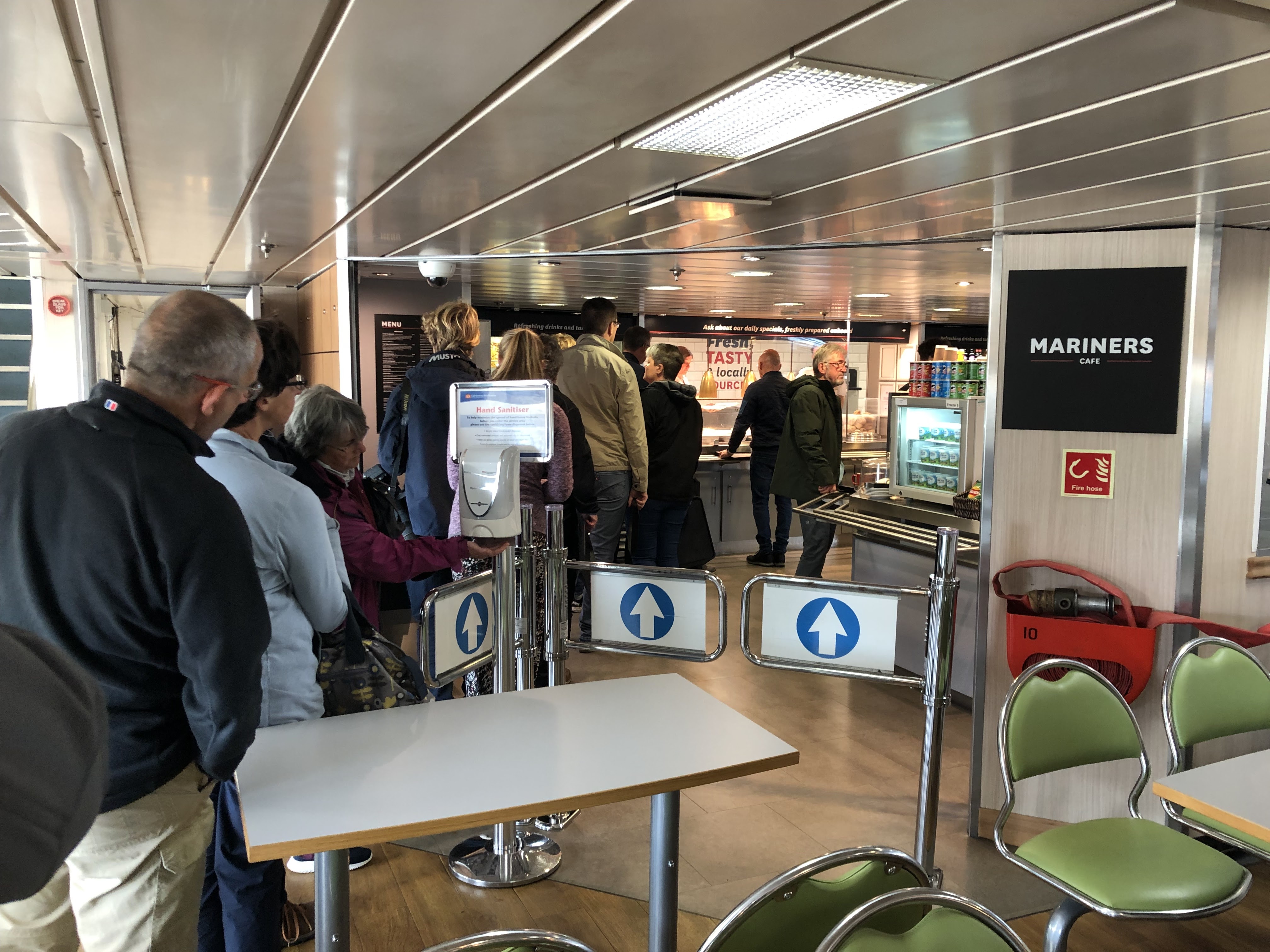
And that food? Pretty good. At least for breakfast. We actually ate breakfast twice on the ferries. I'd highly recommend the bacon and tomato breakfast sandwich. I'll also say that we got the sense that the staff working in the galley really cared. If your order wasn't ready at the counter then someone would find you in the dining room and bring it. I got the sense that the job is not viewed as a stepping stone to something else. We saw when we got back home that the BBC is making a reality series about life working on the CalMac ferries. HAVE to find a way to watch that when it gets released next year.

Oh, there's also a full bar on board in case you need a dram of whisky. Just not at breakfast time. Islay is well represented, appropriately enough.


Waiting for breakfast (top) and I'm counting six types of Islay whisky at the bar (bottom).

As I've already said, we pretty much had to take these ferries to get where we were going but there is actually a benefit to getting to some of the departure points. These places could be seen as a necessity to get where we really wanted to go on the other side of the water, but we used the opportunity to explore a bit and appreciate the drives that it took to get there, wherever there happened to be.

We left for Mull from Oban, which is a bustling ferry hub. There are boats coming in and out of there all day so it would stand to reason that there would be something going on. Our destination here was lunch, which turned out to be a bite to eat at the sketchily named Oban Seafood Hut, a green painted stall right on the water. The shrimp sandwich was great but I'd steer clear of the rubbery whelks. It's the animal, not the place of business. Who likes whelks? I can't imagine.

Our other two points of departure (Kennacraig and Ullapool) took us by some of the best scenery we drove past on this trip. The road to Kennacraig took us past the shoreline of the west coast of Scotland. The road to Ullapool took us through the highlands. Both were amazing drives and the best part was they were just a bonus. We weren't there to drive through spectacular scenery at all; they were just throw ins for free on a drive of necessity. 

Ullapool, where we departed to Lewis from, is a gorgeous little town of rowhouses lined up facing the harbor. I can't imagine what people in Ullapool do for work because it seemed to be utterly remote, but the place is really well put together. I suppose the ferry brings a lot of business to the town. We ate at the local chippy here before we boarded and found a couple of Scottish fish and chip shop delicacies that we had no concept of what they might actually be. We stuck to the fish but looked up the king rib and the red pudding later. Glad we got the fish.


Scenes from the ferries: Port Ellen, the islands on the way to Stornoway, and Duart Castle.

The longest ferry we took on this trip was between Ullapool and Stornoway which was two and half hours (or maybe just a bit longer on the way there) each way. The shortest we took was from Iona to Fionnphort on Mull which was all of 15 minutes long. The ferry from Iona was mercifully short but the ferry to Stornoway was probably the best ride we took, despite the length. The weather was perfectly sunny on that 7 p.m. trip and the islands we motored past were just so picturesque. It was almost worth the price of admission for that view alone.

Speaking of admission and despite the title of this post (I have to search for song titles, right?) we did pay the ferryman here. And before we got to the other side. These things are not cheap, particularly with a vehicle to pay for. We were whale watching (or more accurately staring at the water) in the morning on Lewis talking to a dude from Salisbury, England and complaining about the cost of the ferries. He summed it up well (and I'm paraphrasing here): the cost of taking a car on the ferries is not cheap, but if you want to get to what's on the other side, you just have to pay for it. He was right. The CalMacs got us to some incredible places. I can't imagine doing it any other way.

The menu at Deli-Ca-Sea Fish and Chip Bar, Ullapool. Red pudding anyone?


How We Did It

The Caledonian MacBrayne ferries run all throughout the islands off Scotland's west coast, from Arran in the south to Lewis in the north. There are about 30 different routes in total and they operate at different times on different days of the week. Their schedules also vary by season. We were in Scotland right near the summer solstice so I assume the ferries were running much more frequently that time of year than during the winter months. Check their website for their most current schedules.

You will likely find that most routes require passenger arrival in advance of departure time, typically 30 to 45 minutes ahead of the actual departure. We were told by the hotel owner in Stornoway that we should not be late on these arrival times or else we'd risk being left behind. We planned on being early anyway (we are always early) but there were signs at some ferry terminals listing what happened to late cars. If I'm remembering right it was that you get put to the back of the line, but I suppose risk of being left behind might be real in some situations.

I like to think that I make travel reservations far in advance but I honestly almost got caught with no ferry reservation to Lewis. I bought ferry tickets on April 4 for that trip on June 25 and two of the three ferries to Stornoway that date and one the next day back to Ullapool were sold out. Fortunately, neither of the ferries we wanted to take were booked solid. Just don't count on last minute availability.

And not kidding about the breakfast. Or the BBC series. The food is good and I can't wait for that series to be released.


Sunday, August 21, 2022

Bass Rock

Our trip to Scotland this summer took us from a starting point in Glasgow; up through the Hebrides Islands on the west coast of the country; down through Inverness and past Aberdeen; before ending up at the terminus of our trip in the capital of Edinburgh. It took us by lochs and glens; past mountains (such as they have in Britain...); over seas and straits; and through fields and fields of sheep. Sometimes literally through fields of sheep. There was actual waiting in some spots for sheep to move off the road.

By the end of all that traveling, we were ready to settle a bit. We spent more nights in Edinburgh than we did in any other city. We wanted to root ourselves a bit after bopping between five prior hotels in various other towns and cities, but we also wanted to take advantage of Edinburgh's proximity to sights around the city by day tripping out of town for a couple of days. Including our last opportunity for a truly excellent and intimate look at some of the seabirds that nest in the summer months of the coast of Scotland before they head out to sea for most of the year.

When we were on the west coast of the country, we spent a couple of hours on the Isle of Lunga getting up close and personal with a whole lot of puffins. On the Edinburgh side of Scotland, our target was Bass Rock, home to a whole lot of nesting gannets. We've seen quite a few species of seabirds on our travels over the last nine years or so but we hadn't managed to get up close and personal with some gannets until Scotland. We couldn't let this opportunity pass.

The point of departure for our trip to Bass Rock was the town of North Berwick, specifically the dock next to the Scottish Seabird Centre right on the shoreline of the town. The day we tripped to North Berwick was rainy and cold, so we figured there would be little chance of us actually going out to sea. After the 45 minute or so ride from Edinburgh, I was ready for some disappointment. But we were pleasantly surprised to find the trip still a go despite the lousy weather. In fact, the staff at the Centre seemed a bit shocked that I would even ask the question. Good thing. We didn't want to have driven all that way only to turn around, and the weather when we actually got on the water turned out to be just fine.

Bass Rock, by the way, is just that. It's a very, very large rock in the middle of the Firth of Forth (or the mouth of the Forth River). Despite being a giant rock, it has, over the years, been inhabited by a number of different types of people. The first recorded inhabitants were early Christian hermits, and there's nothing like getting away from it all to live on a rock. I mean, how did they even survive out there without a reliable source of fresh water? I guess from reading wikipedia's entry on the Rock, it wasn't always as barren as it is today. Probably the guano is making it that way these days.

Eventually, the Rock fell into the hands of the Lauder family who ended up holding the it for several hundred years before losing it to Oliver Cromwell in the 1600s. The Lauders certainly made their mark on the place by building a castle there, the ruins of which are still visible today. After the Lauders built their castle, the island was used as a couple of different kinds of prisons or jails (or gaols, if you prefer), until it made its way into the hands of the Dalrymple family in 1707 who still hold it to this day. The lighthouse on the island (visible in the picture above) was added in the early 20th century. 

Today, all of that is all abandoned and the entirety of the island is used as a nesting colony by some 150,000 northern gannets. Not a typo. One hundred and fifty thousand.


So about those gannets.

The northern gannet, much like those beloved puffins that we found earlier on in this same trip, are predominantly a seabird, which means they spend most (like 9-10 months) of the year at sea feeding and ultimately sort of homeless. But in the summer, gannets return to their traditional breeding grounds and raise a chick for a couple of months. And by a chick, I really do mean just one. One single chick per pair. And the pair is generally the same every year. 

Now, if you think you might want to see some gannets, the coast of the United Kingdom in the summer is definitely the place to do that. Fully 2/3 of the entire global population of northern gannets returns every year to the islands and cliffs of the British Isles to do their part to perpetuate the species. If you decide you only want to visit one spot in Britain, Bass Rock is a pretty darned good choice. If that 150K number seemed like a big number, it should; there are more breeding gannets there during the summer than any other spot on Earth. 

The gannet, like a lot of other seabirds, are an incredibly well put together and perfectly groomed bird. There's not a feather out of place. I feel this same way about the puffins we saw last year in Maine and on this trip on Lunga and the mollymawks we saw off the coast of Stewart Island in New Zealand. I'm guessing they have this appearance because they need to shed water efficiently on a day to day basis. 


Gannets are not the cuties that puffins are and they are not the spectacular gliders that the mollymawks (or lesser albatrosses) are but they are incredibly appealing just the same. The majorities of their bodies are almost pure white, with the exception of their yellow-tinged heads and the black tips on their wings. They really do stand out on the open water from all other species like kittywakes and various types of gulls due to their bright white color.

They are also spectacular divers. When they spot a school of fish below them in the water, they can fashion their bodies into virtual missiles, dropping from the sky at speeds up to 100 kilometers (or 60 miles) per hour. In this respect, they remind me a lot of the boobies we saw fishing down in the Galapagos a few years ago. Indeed, the long, razor-sharp gannet bill very much makes their head resemble a booby head, although the gannet body, particularly for its size (they are the largest seabird in the northern hemisphere) is far sleeker than the blue-footed booby.


Our trip from the Scottish Seabird Centre took us out of the harbor at North Berwick, past Craigleith Island and to Bass Rock. The entire duration of the tour was supposed to be one hour long and I guess that was true, but both Craigleith and Bass Rock are so close to the shore that this ride really does get you a lot of time to get close up looks at the gannets on the Rock.

Craigleith is home to about 15,000 nesting puffins in an average year. In a sign of how good our visit to Lunga earlier in the trip was, we barely paid much attention to the puffins on this part of the trip, preferring to try to spot some kittywakes while really wanting to see a ton of gannets. There are almost no puffins on Bass Rock, by the way, most notably because puffins burrow to make their nests and you can't do that in rock. There is one nesting pair of puffins on the Rock who have made their home in the crevices of the old castle wall built by the Lauders.

There are an astonishing number of nesting pairs of gannets (and their chicks) to watch on this tour. There is ample time to to watch them sit around (lots of that); take off and fly (sort of awkwardly); land after fishing (definitely awkwardly); and interact with each other. On the last point we managed to see a few couples bill fencing, a greeting ritual performed to strengthen the bond between pairs. The picture immediately below shows the end of that ritual.


Now, I am sure to the untrained eye, it appears that there are a lot of gannets in the pictures on this blog post. And no doubt, that is probably true, but maybe not the 150,000 that usually nest there in a typical summer. The islands around Britain had been hit this summer with an outbreak of avian flu, which had started to devastate some of the populations of birds nesting on the outlying islands, including at Bass Rock. 

The Seabird Centre does run trips to Bass Rock that land and allow you to walk around closer to the gannets but those were at least partially cancelled this summer due to the flu outbreak. We also heard after getting back home that landings at Lunga had been stopped due to the flu. I feel like we got really lucky with the spread of the flu. I can't imagine missing that puffin experience. We elected not to take the landing tour of Bass Rock specifically because we knew we already had the same thing scheduled at Lunga. I'm glad we didn't swap those two tours out. We definitely got lucky with the flu and our vacation plans.

The effect of the flu was devastatingly visible on our boat trip our of North Berwick, by the way. All kidding aside with the fact that we got lucky with the flu and our trip plans (because that's really way less important than dying birds), we did see a lot of dead birds around Bass Rock. Our guide told us some were likely victims of their own ability to land safely, but there's no doubt that some of the carcasses we sailed past were avian flu victims.


I don't have a list of bird species that I want to see in the wild before I leave this world. That would be a bucket list and I will never, ever make a list that once everything on it is done then I can die. But I for sure wanted to make getting close to some gannets a part of this trip to Scotland. I didn't really see when I would get this good an opportunity. 

The gannets on Bass Rock weren't the only gannets we saw on this trip. We spent time on several boats that were being followed by a couple or a few dozen of these birds. But the opportunity to see these spectacular creatures at Bass Rock was a real treat. One more species off the list (the list that doesn't exist, of course). I feel we did this one pretty comprehensively in just an afternoon that started out rainy and ended up being pretty much perfect.

As a closing note to this post, I will point out that gannets are heavily protected in Scotland, but there was a time when people used to eat these birds. The methods of cooking that our guide relayed to us were less than appetizing. Apparently, the birds were either traditionally cooked in rhubarb leaves or the young gannets used to be plucked from their nests and the flesh fermented. That second method sounds similar to what goes on in New Zealand today with the sooty shearwaters (or mutton birds) although I'm not sure they ferment the meat. The plate I had when we were there in 2019 didn't taste fermented in any way. 

I stuck to seafood or haggis in Scotland. No gannets on the menu for me.

I found it very difficult to photograph gannets in the air on this trip. I would have loved a close up shot of one in flight. Need to work on that skill. And quickly.


How We Did It

This experience was pretty short and simple. We took the Seabird Catamaran Cruise offered by the Scottish Seabird Centre and then sat back and had them do all the work. The boat was small enough to offer some really good looks at the gannets but big enough that the cost didn't set us back too much. The crew of the boat did enough turning around so that each side of the boat got some good looks. We grabbed an edge seat towards the back, which seemed to be a good decision.

I know I downplayed the quality of the puffin sightings at Craigleith Island but if you have never seen these birds in the wild, you really can get pretty close to them on the water and that's honestly pretty exciting, That part of the experience didn't match what we saw in Maine last year or the prior week on Lunga but it's a great addition to the Bass Rock experience. Don't let my jaded view of that part of the trip cause you to not pay attention.


Tuesday, August 16, 2022

Haggis Etc.

On my last trip to Scotland in 2007, I had my first ever meal of haggis, which is often described as the national dish of Scotland. I waited until the very last meal of the very last day I was in country and had a good amount of beer (or liquid courage, if you prefer) to get myself psyched up for the occasion. It was actually really good. I remember it as meaty and salty and didn't even mind the turnips (or perhaps they were swedes) that came as the traditional accompaniment to the meal.

Why did I need some beer before tucking in to haggis, you might ask? Well, let's consider what haggis actually is. Traditionally, it's sheep offal (perhaps heart, liver and lungs and stuff like that) mixed with oatmeal, salt, spices, suet, maybe some onion and stock and then boiled in a casing until cooked. The casing is traditionally the stomach of the sheep but today, most folks probably use some kind of artificial casing. Sound yummy? THAT's why I needed a couple of beers before my first haggis.

By the way, I'm not sure the haggis I had in whatever bar I found in Glasgow 15 years ago was actually as offal-y as the dish historically is or was. Maybe that's why it tasted so good. 

This year, I was determined to not make the same mistake I made in 2007. I was all in on the haggis and no liquid courage would be required, although beer is an excellent pairing with some offal and oats, if that's what you actually get on your plate when you order it in whatever establishment you happen to be in when you order.


Haggis nuggets and haggis pizza. The Mishnish, Isle of Mull.

I was not just all in on haggis this year, by the way. I was all in on all Scottish food. Fish and chips. Full Scottish breakfasts (with black pudding and tattie scones). Tablet. Fresh seafood like scallops and shrimp and whelks (like eating rubber; never again!). Smoked fish. Afternoon tea. Tunnock's teacakes and caramel logs. Anything I could get my hands on to stuff into my mouth. But none of that (with one notable exception I'll discuss later) really merited writing about. Except haggis. So here you have a post about haggis. Mostly.

We arrived in Scotland on a Saturday afternoon and by the time I laid my head to rest on my pillow for the first night in country that night in Glasgow, I'd had my first haggis. I had my second tasting the very next night also in Glasgow. In addition to two meals of haggis in Glasgow, I ate the stuff in Edinburgh, Inverness and on the Isles of Mull and Islay. I ate it in traditional (meaning likely made from offal) form, in vegetarian form, in a sandwich, in spring rolls, on pizza, in a toastie (OK, so also technically a sandwich) and in nugget form. I covered haggis pretty well on this trip, I'm telling you.

Neeps, tatties, haggis. Ardnamurchan restaurant, Glasgow.

Haggis traditionally comes served with neeps and tatties. For those of you who don't speak Scottish, that means with swede (or turnips, which I guess is shortened to neeps) and mashed potatoes (tatties). Indeed both the full on traditional (above) and the vegetarian version of the same thing (first picture) that we ate came served just that way with a boat or serving of whisky sauce on the side. We found the whisky sauce essential to full enjoyment of these meals of haggis. None of the rest of the forms of haggis we ordered were served with these three sides, although the haggis egg rolls I ate did come with both some kind of chili dipping sauce and chips and gravy.

I am suspecting most of the haggis we were served in our time in Scotland was not offal-based. Most of it had a sort of ground-meat-with-grain texture that belied what it should be and really didn't necessarily improve the flavor, although the mouthfeel of the meat was far more relatable than the really smooth pureed traditional haggis that likely had some animal parts in it that I don't really want to be informed of. I'd put the haggis we had in sandwiches and on the pizza and in nugget form into this meat/grain category, although of all these dishes, I'd put the haggis sandwich I had at the Islay Hotel on the Isle of Islay as head and shoulders above the rest of those other meals. I'd go back for that any day.

Haggis Sandwich. The Islay Hotel, Isle of Islay.

The best plate of haggis we had? Honestly, it was the traditional haggis at the Ardnamurchan restaurant in Glasgow. I'm shocked to be writing this actually because the mouthfeel was cloyingly pasty as if there was some meat I don't usually eat pureed into the mix and the aftertaste was definitely a little metallic. But the overall taste was meaty and satisfying and the mashed potatoes were perfectly fluffy and well-seasoned. When eaten with the neeps and the whisky sauce (which was honestly just fantastic - we could have eaten a lot more of that), the bites of this dish felt homey and very Scottish which was just what we were looking for. I'm not sure I could have eaten an entire portion by myself (it was rich and we split the dish) but I would definitely go back and share this plate again.

The vegetarian haggis we were served the very next day was a reasonable facsimile to the eye, but the taste was nothing similar to the real deal at Ardnamurchan. I'm not sure quite what the point is. It's not good enough to be crave-able. Maybe people eat it to say they have had haggis without eating something legit? 

If there were a close second to Arnamurchan's haggis (and it's really a distant second), it would be the haggis egg rolls I got from The Chippy by Spencer in Edinburgh. They were clearly not as smoothly pureed as the best haggis we had but the texture was different enough from the ground-meat-and-grain texture we had so much that it made this dish seem more legit. At least to my extremely uneducated haggis palate; I mean, after all, I've still only had this stuff eight times. I'd go back to The Chippy for these. They went well with the chili sauce too. 

Considering we spent just 14 nights in Scotland on this trip, I'm pretty satisfied with seven haggis dishes in that time. I definitely got way more into this stuff than I have ever in all my previous at least three trips to Scotland. I could have had more, including haggis for breakfast, but I'm satisfied with my level of exploration here. At least I won't need to get liquored up to try this stuff ever again.

Haggis egg rolls, chips, gravy. The Chippie by Spencer, Edinburgh.

The title of this post is Haggis Etc. And so of course, there's an etcetera to talk about. We really did have a lot of Scottish dishes on our wish list for this trip and really and truly, most of them weren't unique enough to spend any time really writing about. Except for the haggis and one other dish that is probably the most ordinary sounding dish of all, a mix of fruit, oats, honey and whipped cream called cranachan.

Maybe I left one or two details out of my description in the prior paragraph but honestly, there's not much to this cranachan dish. It's kind of like a parfait, with raspberry coulis layered with toasted oats, honey and whisky liqueur whipped cream and then topped with a single raspberry. And maybe it was where we had this dish (Ardnamurchan, again) but this dessert was mind-blowingly good. The sweetness of the coulis with the silky whiskey cream against the texture of the oats was just incredible. We had this dish once in our two weeks in Scotland and it was the best thing we ate. I mean, there is no competition. It's so simple that it seems like it should be easily replicated at home but I'm not convinced it's actually that simple. And we did look for it again. We struggled to find it, although an ability to eat in restaurants in Edinburgh due to contracting COVID certainly affected our options in Edinburgh.

If I ever am in Glasgow again, I'm eating every night at Ardnamurchan and I'm having cranachan for dessert every night. 

That's my Scotland food report. Haggis and cranachan. Great stuff!

Cranachan. Ardnamurchan Restaurant, Glasgow.

How We Did It

We had a lot of great food and drink in Scotland but haggis-wise (and cranachan-wise), I'd just recommend three places based on what we ate.

The best meal we had in Scotland hands down was at Arndamurchan in Glasgow. We made a reservation for our Saturday night meal and I sort of felt like it was a good thing we did. We only ate three dishes here (we split all three) but the haggis was the best haggis we ate and the cranachan was fantastic (in case that wasn't obvious from the post). Go here. Before we left home it looked like the best restaurant on paper and it certainly delivered.

I'd also recommend The Chippy by Spencer in Edinburgh. They had the second best haggis I ate but they also served up some good looking fish and chips. Unlike some other fish and chip shops we ate from, they seemed to be preparing the food to order, rather than just pulling something from under a heat lamp and handing it to you in a box.

If you are looking for a good haggis sandwich and happen to be on Islay, The Islay Hotel in Port Ellen definitely serves a good one. The bread is super soft and warm and the sandwich comes with melted cheddar and red onion marmalade. It's not just ground meat and some oats on a roll. There aren't that many restaurant choices in Port Ellen. Wandering into the Islay Hotel was a good idea on our part.