Thursday, August 11, 2022

Culloden

Scotland has a long history of conflict. Or maybe a better word here is resistance. For as long as history about people and events in what is now Scotland has been written down, it seems like outsiders have been constantly trying to conquer the land in the north of Britain and bring the people who lived there to heel. And the people there have been fighting back. Hard.

The Romans tried it a few times before just giving up and building a country-wide wall to keep the people in the north out of Roman-held territory. Then the Vikings took a turn and were largely successful. And after the Norman invasion of England, the object of conflict and resistance for the Scots (not always called this; just simplifying a bit here) became the English. And this conflict lasted for centuries. 

But all that resistance came to an end at the Battle of Culloden. And in brutal fashion. We don't spend a lot of time on vacation at battlefields, although we did visit two on this trip and we have spent time on past trips walking sites where huge battles took place. Generally, I find these places to be confusing to understand what really happened hundreds of years ago on what is now usually a field of grass and brush. But Culloden was a must-see for us on our recent tour of Scotland for one reason and one reason alone: last year, we watched the first two seasons of Outlander, the time-travel, adventure-romance series set against the historical background of the Jacobite uprising in Scotland that ends its second season at the Battle of Culloden.

Strange reason to want to visit a battlefield? Maybe. But this is essential Scottish history, even if it didn't turn out well at all for the Scots.

Monument to the Highlanders, Culloden.

The origins of the Battle of Culloden are complicated and are deeply rooted in power and politics and seemingly religion (although I believe the historical conflict that seems to revolve around religion in Britain and Ireland has really way more to do with power than religion). Let's see if I can make this explanation relatively short. Although I probably won't succeed there.

When Elizabeth I of England died in 1603, the line of succession to the English throne passed to James VI of Scotland, who was the son of the great-niece (Mary, Queen of Scots, if you must know...) of Henry VIII (Elizabeth's father). Henry VIII, of course, famously separated the church in England from the Catholic church based in Rome. When James became king of England, he became James I and effectively had joint support to rule both England and Scotland.

When James died, the crown passed to his son, Charles I, who was especially unpopular in Scotland because of his actions to promote the Church of England despite his wife (French princess Henrietta Maria) being Catholic. Charles became a victim of the English Civil War which abolished the monarchy (temporarily) and was beheaded in 1649. It would take until 1660 for his son, Charles II (who was generally endorsed by the Scots), to be restored to the throne.

When Charles II died in 1685, his son James II of England (and VII of Scotland) became king but didn't last long, being deposed in 1689 in favor of William of Orange (who was James' nephew) and his queen, Mary, with heavy assistance from English Parliament. It is here that real conflict between England and Scotland re-ignited. Most Scots supported James, and not William.

When William died childless in 1702, the throne passed to James' daughter, Anne, and when she died 12 years later (also childless), George I (Anne's second cousin) ascended to the throne. George wasn't English at all. He was German. He was also 53rd in line for the English throne. Why pick Anne (over restoring James II) and then a German to sit on the English throne? Simple...they were Protestant, and Parliament had passed an act in 1701 requiring all future English monarchs to be Protestant (this followed a similar act in 1673 banning Catholics from serving in either House of Parliament). Now we are ready to talk about Culloden. Almost.

The brush, Culloden Moor, 2022. Very difficult to really understand the conditions in 1746.

The Battle of Culloden is often thought of as a battle between the English and Scottish. That perception is wrong. Culloden pitted the Jacobites, a group of people interested in seeing James II (or his heirs) restored to the throne of England and Scotland, against the English government, whether that be the government of William and Mary or Anne or George I or George II. There were Scots fighting for the English government and there were English backing the campaign of the Jacobites, along with other nationalities in the mix, particularly French and Spanish fighters. Jacobites vs. English government; not Scottish vs. English.

The conflict that was ended with Culloden was actually the fourth Jacobite uprising. The first started way back in 1689 when William and Mary were installed on the throne. That uprising, along with the second and third versions, was defeated but not crushed. Despite the first, second and third defeats, the Jacobites kept coming back for more.

The fourth uprising was led (at least from a figurehead point of view) by Charles Edward Stuart, grandson of James II, who was better known as Bonnie Prince Charlie (we'll call him Charles or BPC from this point forward in this post). Charles arrived for the first time in his life in Scotland in July of 1745 and started raising an army, with some overseas help and financing most notably provided by France.

And raise one he did. There was a time in 1745 that things were actually going really well for the Jacobites. They recorded victory after victory after victory as they marched through Scotland, over the border to England and all the way to Derby, about 125 miles from London (and the throne). They might have kept going except for the onset of winter and a report that the King was sending an army out from the city to meet the Jacobites. Instead of continuing to London, they retreated back to Scotland, marching their army (which at this point was low on provisions and basically half-starved) fiercely all the way.

Apparently, there was no army sent out to meet the Jacobites. That information had been passed on to deceive and make them retreat. If they had kept going, they might have marched into a city utterly unprotected and taken the throne. Instead, their retreat give George II a chance to raise the army that BPC and his advisors had feared, with George's youngest son, the Duke of Cumberland, in command.


The locations of the battle lines today: blue for the Jacobites; red for the government.

We are getting close to Culloden, I promise.

Despite all of the retreating and the lack of food, the Jacobites managed to make it back to Scotland and got camped out at the perfect spot to meet the government's army. Then they got impatient. And impulsive. They found out that the army they were waiting on was having a party on April 15 to celebrate the Duke of Cumberland's birthday and figured it might be a great opportunity to sneak up on a bunch of drunk Englishmen and slaughter them in their sleep. Charlie was a go. Good plan, yes?

Yes, is the answer. But good plans require good execution. And here the Jacobites didn't quite do it right. We got two accounts of what happened. In one, the guides they hired to lead them on the 12 mile march (that's one way, by the way) didn't quite get the whole Jacobite force to the party, and faced with too many Englishmen to handle, they turned around. In the second, the march started late and the terrain was way rougher than they anticipated and they had to turn back because they just wouldn't get there in time. Either way, they marched 24 miles or so (maybe a little less) in the dark on empty stomachs on the eve of battle. Not good.

The next day, April 16, 1746, the two armies would face off in battle.

A surviving farm building on Culloden Moor, likely used as a field hospital of some sort in 1746.

So let's set the stage here a little. On one side, we have an exhausted, starving Jacobite army that has marched up and down most of the length of Britain. On the other, there is a mile long line of professional soldiers including the second best artillery unit in the world who could release a shot from a musket every 18 seconds. That musket speed is fast, but it was even faster when the 1/3 of the soldiers fired every 6 seconds. And that mile long line of men? Just the front line. There were two more behind it.

The government on paper had the advantage. Big time. The two sides had the same sort of weapons available to them but there were just far fewer Jacobites and they were nowhere near as well trained and they were exhausted. Oh, and in case you were wondering, apparently the Austrians were better trained artillerymen in the mid 1700s. Ready for battle? I guess both sides thought they were. 

According to Andy (or it might have been Andi; not sure here), our guide on Culloden Moor, the Jacobites may have fired the first shot and possibly not on purpose. But once shots had been fired, it was on and the Jacobites did what they always did in battle: run towards the enemy; fire their muskets as much to create a cloud of smoke as to try to wound those they were firing towards; toss their muskets aside; and engaged in hand-to-hand combat in what is known as the Highland Charge.

It didn't go well, primarily because it appears the right third of so of the Jacobite line engaged the government troops in combat while the other highlanders got stuck in a bog that they hadn't realized was between them and the Duke of Cumberland's army. So when a very small part of the government's soldiers were engaged in a skirmish, the rest of their fellow troops pitched in and massacred the 1/3 of the Jacobites who made it to the fight. The estimate here is 700 men killed in 2-3 minutes and a little more than twice that number in 45 minutes. The Battle of Culloden was over almost as soon as it started.

Starting point for 400 Jacobites, looking over the former bog.

I can't help thinking, after walking through the on-site museum and taking a guided tour of a portion of the Battlefield and then walking the rest by ourselves, that Culloden was an entirely stupid endeavor from the Jacobites' standpoint. Pretty much every significant decision BPC and his band of generals made was wrong. And not just slightly wrong; like way, way wrong. Turning back at Derby; marching their men to the point of exhaustion; abandoning a favorable position to go raid a birthday party; getting lost on the way to said birthday party; and then directing (or at least failing to prevent) 2/3 of their troops rushing into a bog that they couldn't get out of on battle day. I guess I can give them a pass on the turning back at Derby thing (they were deliberately misled, after all) but the rest look like bad decision after bad decision. Utter stupidity, even.

I suppose that if BPC had made better decisions, the total death count from the battle might have been greater since it would theoretically have been a fairer fight and more men might have died on both sides (the government claimed just 50 deaths but that number seems suspiciously low according to historians). But the leaders of the Jacobites basically served their men up as slaughter victims before they fled the battlefield themselves.

Charlie, by the way (and, of course, right?) made it out alive. He fled the country disguised as a woman via the Isle of Skye.

Victorian-era marker at Culloden. Likely not entirely true.

As much as the actual battle was a complete and utter disaster for the Highlanders, the aftermath may have been worse. Remember this was the fourth Jacobite uprising and after this one, the Duke of Cumberland had had enough. He was determined to stop this from ever happening again. So after he made sure no injured men escaped from the battlefield alive and maybe did a little burning and pillaging of villages in the area, he imposed some rules: no tartan, no bagpipes, no weapons, no Gaelic, no gatherings of men or boys in numbers greater than five. In all of Scotland. In short, no clans and no Highland culture ever again.

It stuck, mostly because the enforcement of the rules was left to local authorities, who tended to take a very strict approach to making sure the rules lasted. Some even classified farm implements as weapons and when they confiscated them, they took away the very livelihood of the Highlanders. Culloden's impact was instant and it extended far, far beyond the Battlefield.

We were aware of this last point (meaning the impact) before we set foot on Culloden Moor. I just didn't expect to find out that the battle lasted for so little time and feel that the effect of the aftermath through the stories we were told, both in person and by walking through the museum. This was the last battle in Britain fought hand-to-hand. It's incredible that it affected so many people living on the island so severely and so quickly. It almost completely wiped out Scottish culture. Fortunately, despite its immediate impact, it didn't eliminate everything. And that's a good thing, because I think there is a lot to be valued in Scottish culture.

The rolling mounds are mass graves from 1746; stones added later.

A couple of other things we got out of our visit to Culloden Moor are probably worth mentioning.

First, there is a section of the Battlefield where there are mass graves from the actual conflict way back in 1746. It's a bit chilling - our guide told us each grave holds an estimated one to 200 men from that day - and they are right there in front of you to walk past and around. At the foot of some of these graves are stones with the carved names of clans that fought and died in the Battle, but the clan names don't necessarily match the actual people buried there for one good reason: in 1746, clan tartan wasn't a thing so the dead couldn't be identified by the clothing they wore. Highlanders wore whatever they could get weaved for them in whatever color was available.

Now, if you've ever walked the Royal Mile at Edinburgh, I'm sure you've seen souvenir shop after souvenir shop with tartans from each Scottish clan on mugs and plaques and glasses and anything else you can put tartan on including actual tartan clothing. It's all fake. The Victorians made it all up. There never was any clan tartan (although the Royal Stuart tartan may be an exception). The markers were placed on Culloden Battlefield during Victorian times by the way.

Second and last, if you were a Scotsman who really wanted to own weapons and wear tartan after 1746, there was a way to do it: join a Highland Regiment and serve in the armed forces overseas. Sound like a bad deal? It may have been. But faced with a choice between living at home with no way to make a living under constant watch from the authorities just waiting for you to violate some minor rule, maybe it was the least of two evils. 

So a lot of Scottish men did it and when they arrived wherever they were stationed throughout the British Commonwealth, they found out things were better than they were at home and they stayed. There are a lot of Scottish people all over the world. The Highland Regiments were a big reason why. If you meet someone of Scottish ancestry not living in Scotland, there's a good chance they are where they are because their ancestors were part of this post-Culloden Scottish diaspora.

The Fraser Clan stone. With flowers, likely in appreciation of the fictional James Alexander Malcolm MacKenzie Fraser.

How We Did It

The Visitor Centre at Culloden Battlefield is open almost year round (there is a time in late December and early January when it is closed) starting at 9 a.m. or 10 a.m. until 4 p.m. For full opening times, check the Battlefield's website. The Battlefield itself is open year round even when the Visitor Centre is closed.

We spent a total of about 2-1/2 to 3 hours on site, including walking through the museum, taking a guided tour of the Battlefield and walking the rest of the site on our own. Admittedly, we didn't read every word in the museum but that amount of time feels probably about right for someone to get the feel of the place and more than scratch the surface of the history. 

If you hear someone walking through the museum attempting to round up people to lead on a Battlefield tour, I suggest you drop what you are doing and follow that person. We found that part of our experience to be especially beneficial. I find it's so difficult to really get a picture of how things played out on an open field 250+ years after two sides tried to slaughter each other without a lot of help. The narration from an actual live person helped a ton.

Culloden Moor is about a 15 minute (maximum) drive from Inverness. If you are looking to stay in a town or city with any size, Inverness is pretty much your only option.


Wednesday, August 3, 2022

Lunga

One of the things we realized pretty early about Scotland when we were researching itinerary ideas was that this country seemed to offer some amazing opportunities to go seabird spotting. And I don't mean like one or two birds at a time. I mean hundreds or thousands at a time. Our trip planning had established a rough agenda of about a week in Glasgow, Inverness and Edinburgh and the other week in the Hebrides, the islands off the west coast of Scotland. For our island time, we picked Lewis (for the Standing Stones of Callanish) and Islay (for whisky) but we needed a third. We decided we should emphasize seabirds for our final island.

Enter the Isle of Mull, an island at the bottom of the Hebrides a little bit south of the Isle of Skye. I mention Skye not because it's a marker that I expect everyone to know, but because it's likely the most popular island for tourists to visit in the Hebrides, probably because you can just drive across a bridge to get there and don't have to take a ferry. 

Skye was, in fact, our original choice for a third island in the Hebrides. But when we started looking closer at our Scotland guidebook, Mull seemed like it was too good to pass up. I have no idea whether Skye is wonderful and if we missed out on something better than Mull, but Mull was the best place we went on this trip in my opinion. It was wild. It was remote. There were sheep seemingly everywhere. The roads were maddening because most of them were two-way and one-lane at the same time. Tobermory was the perfect village to stay in with some great places to eat and drink. It was absolutely a gorgeous place to be. I can see people falling in love with a place like that.

Off the coast of Mull there's an island called Lunga. And it's about the easiest and most ideal seabirding destination you could imagine. And they have tons of nesting puffins. But only in summer. Come late August these birds will be out at sea on their own until next May or June. We were there in June. Let's go!!


I don't know quite what it is that makes me keep pursuing the same things on vacation again and again. Maybe it's a quest to get an experience just perfect. Maybe I just have a narrow range of interests (not sure that's right) or I just like what I like and lots of it (that's probably closer to the truth). Who knows? But I do tend to do it a lot. Last year we went to Maine and saw our first wild puffins. It was awesome but it was fleeting. It honestly wasn't a great opportunity to watch and take pictures at the same time. Pick one or the other. On Lunga, we'd have a chance to correct that experience and move closer to that perfect puffin encounter. And more.

I believe you can get a boat to Lunga from a number of spots on Mull. You certainly can catch one from both Tobermory (where we were staying) and Fionnphort (where we caught our boat). The trip there is about a 45 minute boat ride from either location, so not too bad a ride once you get on board. I think our decision to depart from Fionnphort was well intentioned (we wanted to spend some time on Iona after our trip to Lunga and the boat stopped there) but that drive to the boat was an adventure. It's all of 48 miles but the road requires rapt concentration every second of the ride (which is almost two hours long, by the way). The scenery was just gorgeous and I can't believe someone actually built a road (one-lane, two-way of course) in some spots on that drive but it is not for the faint of heart. Not regretting our decision, exactly, but it would have been much quicker from Tobermory.

So an almost two hour drive; 15 minutes or so to walk to the dock and climb on board; a little wait for absolutely everyone who signed up for the trip (why are people late to these things...); 45 minutes or so on the water followed by a pretty cool docking with a floating gangway (who knew these things existed?) that the boat pushed to the shore to allow us to disembark; and we were on Lunga. For two hours and 40 minutes. That sounded like a long time. 

It flew. But it was also a really good amount of time. Sort of the sweet spot, I think. Just right. On our own for almost three hours with a ton of seabirds, most of whom are puffins. Cool.


Our docked boat. And the (main) object of our search.
The quest for puffins (and other birds, I guess...) on Lunga starts with an uphill climb. I mean our landing point on the island was pretty much at sea level (where else would it be?) and puffins nest in burrows on top of cliffs. So the first task after getting onto land was to climb up to the top of the cliffs where the puffins are. What else would we do?

So of course, there's a rush, right? Everyone wants to be the first one to the top, as if all the puffins were going to fly away and never come back or as if there might not be enough puffins for all the people on the boat (and other boats, keep in mind...) to see and we'd end up stuck with a guillemot or something. There's excitement and there's a little bit of desperate near-panic. It's exhilarating. It's frenzied. It's like Christmas morning as a kid. And all of that I guess sometimes causes the first one to the top of the hill, which happened to be me, to miss the point entirely. Which I did. When I got to the top of the first cliffs, I kept going up (because I could) rather than making a beeline for the cliffs where the birds are.

It didn't matter. We had more than 2-1/2 hours, after all. There was plenty of time. And it didn't take long for me to recover. Being fifth or tenth or whatever to get to the clifftops didn't really matter in the end. 

But that first puffin you see up close is magical. The one that doesn't move when you approach. You have to capture the moment. You have to get the camera out and snap, snap, snap. This moment in time you've never had before. This was nothing like Maine. It is right there on solid land and it's like two feet away. What if there are no more on the entire island? That first one. Just wow.


Of course, people don't take a 45 minute boat ride and climb up a big hill to see a single puffin, especially if it took them about two hours to drive to the boat dock. Focus off that first puffin and there's another one right close to the one that you've taken about 15 photographs of. Then another couple a few feet away. Then five or so more beyond those. And ten or a dozen or so on the next cliff. There is no shortage of puffins on Lunga. Not at all.

They literally do not move when you approach by the way. We were told by our boat crew that the puffins actually like humans walking around them because it protects them from the gulls. Apparently gulls enjoy a little puffin for lunch sometimes. Not nice to think about that but you know...nature.

So once you realize that there is plenty to see, the whole situation calms down. Breathe...these things are everywhere. There is a sort of trail that leads from one end of the island to the other. It's muddy and it's messy and it's slippery and your pants will get dirty even if you are wearing boots (trust me!). It will lead you along the edge of the cliff past nest after nest after nest up hills and down slopes clambering over rocks both ways. It also gets you looks at all sorts of puffins and other birds flying, fishing and nesting. It's a little chaotic and it's awesome.

I suppose the trail might go around the whole island. It looked like it headed up a steep hill at the opposite end of the island and continued along the island's ridge back towards our docking point. We didn't do the whole loop; we turned around at what we saw as the "other end", content with knowing there couldn't be more puffins on the other side of Lunga than the one we had just scrambled across. After all, we didn't really see any on the way past that side on the boat.


So about those other birds. Yes, there are birds on Lunga that are not puffins. I know, I know, not as cute, but they are there. We saw a good number of black and white razorbills and guillemots, both of which resemble some sort of penguin. They are decidedly NOT penguins, mostly because both species fly, but they look remarkably similar if you are not paying attention. These birds, which are about puffin-sized, both seemed to be interspersed with the puffins on the clifftops that we first climbed to. Definitely not as numerous as the puffins on the beginning part of our hike but noticeably there.

They caught up in numbers later on. At the spot we turned around and headed back to the boat, we stopped at an enormous rock on the end of Lunga that was covered in guillemots. Not exaggerating. Like thousands and thousands packed together. They looked like insects covering the ground there were so many. We'd seen images like this on nature programs before (penguin nesting sites actually come to mind here) but never in person. It's amazing that they can even find their mate amongst all the other guillemots. I mean, they all look the same. But they probably think the same thing about us.

We also passed a few shags, which I'd sort of describe as cormorants on steroids. These birds are large, way bigger than their smaller cormorant cousins who we have seen all over the world and their plumage is absolutely gorgeous. All four species we saw on Lunga (the shags, puffins, guillemots and razorbills) are all very well put together; they barely look like they have feathers at all they are so smooth. But the shags have this patterning to their feathers that almost looks like have scales rather than feathers. It's quite impressive and not something we could see very well until we got super close to these birds. There's value in getting close.

Shags were the scariest nest defenders on the island, by the way. We didn't really get near any nests while on our walk but we also didn't get any sort of warning signs from the puffins, razorbills or guillemots. Not so with shags. They seemed to nest in, amongst and below rocks and when you pass too close they stick their necks out of the holes between the rocks and sort of hiss-squawk at you with their mouths wide open, displaying what I remember as some yellow and blue sort of striping from within their mouths. Their beaks are pretty scary too. I definitely don't want to ever tangle with a shag after seeing that.


One shag, two razorbills and a whole lot of guillemots.
Our trip on Lunga ended with about 45 minutes or so of standing on those first cliffs we found that I almost sprinted by. At this point, we were determined to watch intently, rather than filling up the camera memory stick with as many images as we could pack on there before our boat picked us up again. We knew that we'd have plenty of time to just watch and observe.

The puffins obliged by behaving like puffins, taking off towards the sea by just jumping off the cliffs and spreading their wings and then returning and landing so clumsily with a mouthful of shiny silver sand eels, either on the land and then shuffling quickly towards their burrow or just diving right into the burrow itself in a way that seemed more graceful that puffins could handle. It was a constant conveyor belt of food delivery to their chicks (or pufflings...not kidding, that's their name). We never saw the pufflings, by the way. Apparently the chicks are so vulnerable to predators that they don't come out during the day. They learn to fly at night until one day they just take off and never come back. Until they need to start raising pufflings of their own.

I spent my time on this portion of our landing trying to get pictures of puffins doing something other than just standing around. I had an informal goal for the day to get some good pictures of a puffin or two with some sand eels dangling from their mouths and I think I accomplished that goal. I also wanted to capture puffins in flight and landing. Not so successful there but I think overall we got some great looks and some great pictures.

I came to the Isle of Mull in Scotland looking for the perfect puffin encounter. I can't believe it could get much better than this. Maybe more time? I don't know. I think being in a spot for almost three hours with unfettered access to these birds is pretty much perfect as far as I'm concerned. At the risk of posting too many pictures of puffins in this post, I'm emptying the rest of my favorites album from this day and displaying them all below. The last puffin picture below was taken from about two feet away. You really can get that close!


Yeah, I think we probably had our perfect puffin day.

But there is one more story to tell. When the boat drops you off, you are standing on a narrow portion of the island pointed towards a cliff. On that cliff is a large painted white arrow. It's where you are supposed to go to see the puffins (and other birds). Just follow the arrow is what we were told by the crew on our boat before we landed.

Now, some people didn't seem to get the message because as soon as they set foot on Lunga, they started spreading out on the island walking towards the water, which is decidedly NOT where the puffins are. We got the message from the crew and took off straight for the arrow. And while I may have made it to the top of the cliff first, my wife, wearing her green wool hat that we picked up at the Cliffs of Moher in Ireland a few years ago, was definitely setting the pace towards the cliff early on. 

But other travelers on our boat couldn't figure it out. Maybe it was a language thing or something. Ultimately it got so bad that we heard an annoucement from the boat's speaker system: "Follow the lady in the green hat!" 

Good advice. I intend to do that for a very long time. As long as she'll let me, anyway.

Puffins done! Now about those flamingos and penguins...

Follow the lady in the green hat (lady in green hat not pictured).


How We Did It

There are at least two tour companies (and probably more) that run day trips to Lunga from the Isle of Mull. We picked Staffa Tours because they had an early morning cruise and because they departed from Fionnphort, which would give us a chance to stop at the Isle of Iona on the way back. Our tour took us to both Lunga, where we saw puffins, and Staffa, where we stopped at Fingal's Cave, a rock formation formed of hexagonal basalt columns which is supposed to be the other end of the mythical Giant's Causeway. We spent part of a day at the Causeway in Northern Ireland a few years ago.

I can't say anything but good things about Staffa Tours. There was plenty of time to do everything we needed to do on both our stops on Lunga and Staffa and the boat ride was great. Couldn't ask for anything more. I'd highly recommend taking a tour with them.

Unfortunately in 2022, avian flu has decimated bird populations on islands around Britain in what has become a bit of an epidemic. Lunga, it seems, is no exception, because tours are suspended on the island for the rest of the summer as of this writing. I guess we got super lucky here. A few more weeks and we'd have missed this experience entirely. I've lamented our misses with various types of wildlife several times on this blog. I'll have to remember this as one time we got lucky and got it right.


Sunday, July 24, 2022

Uisge Beatha


The title of this post is pronounced ish-ka bay-ha. It's Gaelic, which somehow (I don't know how exactly) is pronounced Gallic. Uisge Beatha means "water of life." It also means whisky. That should tell you a lot about how that spirit is regarded in Scotland. No whisky, no life. And yes, the way I have written out the words in this paragraph is my totally unofficial way of writing out pronunciation. It works. For me.

Also no "e" and no Scotch. Not in Scotland. Just whisky. 

Whisky is available all over Scotland. I decided early on in our planning process that we had to make it to at least one or two distilleries and be a bit serious about seeing if this stuff was any good. I actually had never tasted whisky before setting foot in Scotland, something I disclosed to my fellow tour-takers on our first distillery visit. That statement was met with shock. Why would I be taking tours of distilleries without having tasted the product in advance? Why...to find out if I liked it. Why else? That's what I did in Porto last year. Same deal here.

And for the record, I've tasted plenty of whiskey in my life. Just no whisky. Got it? Good.

With our minds made up about spending some time in the Hebrides on this trip, it seemed logical that we would make a stop on the Isle of Islay, a tiny island in the Southern Hebrides with nine (!!!) active distilleries. Right or wrong, that island served as our introduction to and almost our entire education about whisky. While we did visit one additional distillery not on Islay, we didn't visit any on the mainland (the other was on the Isle of Mull). Our sampling was limited, but very useful. This was not, after all, a trip only about whisky.

The first three drams of my whisky experience. Lagavulin. Isle of Islay.

So let's start with a few words about process.

The business of making whisky starts with the malt. In this case, malted barley. Barley is malted by soaking it in water for a couple of days and then spreading it out and aerating it until it starts to germinate, or more simply, grow shoots. When it germinates, the barley starts to convert its natural starches into soluble sugars. Those sugars are important for the creation of alcohol.

Now, too much growing is not good here. We don't want to grow actual barley, after all. So the process of malting is stopped by drying the malt, preserving the all important sugars in the barley. The malt is not just left to dry out on its own. Instead, its actively dried in a kiln. 

After the malt is dry, it is ground into grist, which is added to warm water (historically, a source of good, clean water is really important here) and stirred, which extracts those delicious sugars. The resulting liquid from this mashing process is called wort (pronounced "wert"). The wort is cooled and moved into fermentation tanks and yeast is added, which converts the sugars from the malt into alcohol and carbon dioxide. To this point, this process is pretty much the same as beer production (mmm...beer...). 

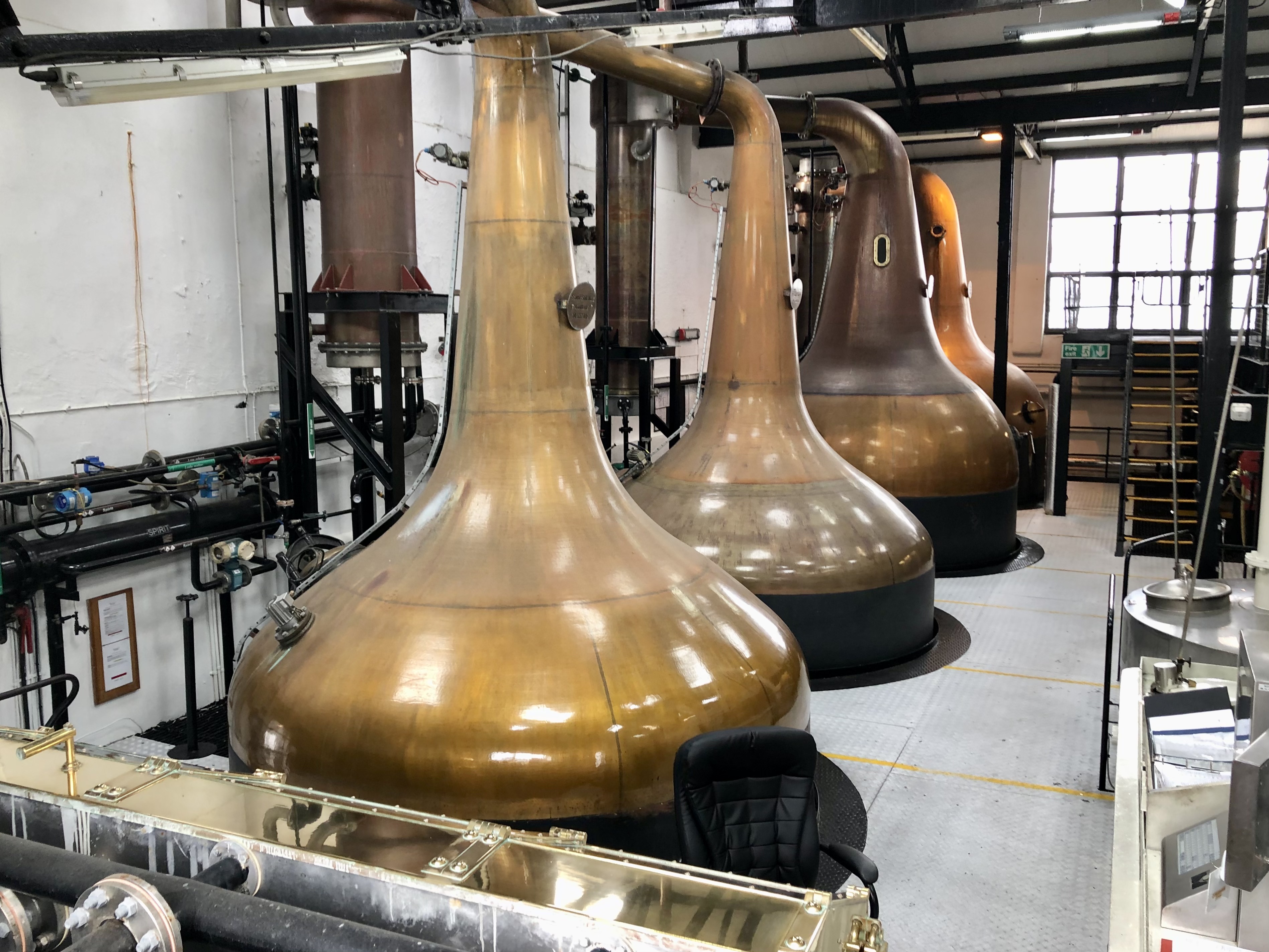
But we are not talking about beer, here. Whisky is a distilled spirit. Distillation is the process of boiling the wort in a still to extract the alcohol by raising the temperature of the liquid to 173 or so degrees Fahrenheit, which happens to be the point at which alcohol (but not other liquids, like water) vaporize. As the alcohol vaporizes, it forms a gas which rises in the still. When that vapor contacts the cooler parts of the still like the curved neck above the main chamber, it turns back into a liquid and is captured. Some whiskies are distilled multiple times. The more a whisky is distilled, generally the lighter and more purified it becomes.

Once the distillate is refined to the satisfaction of those making the whisky, it is moved to a cask and aged for a while. That cask is likely a previously used cask, say to make bourbon or sherry or wine or something else or maybe even a combination of different casks. The longer the whisky sits in casks, the more complex it becomes and the more it takes on the flavors or characteristics of those casks. That's probably enough about the process. For now.


The stills at Bowmore (top) and the fermentation tanks at Lagavulin (bottom). Islay.

So, we didn't make it to one or two distilleries on this trip. We actually made it to four. We tried to balance variety with history with learning with tasting with cost in our tasting experience. The logic here was there's no point doing (and paying for) the same thing (i.e. a distillery tour) at every place. We figured they would all be pretty much the same. We made reservations for activities at three distilleries: a straight ahead tour and tasting at Lagavulin on Islay; a warehouse visit and tasting at Bowmore on Islay; and a tasting at Tobermory on Mull. 

We also figured we might be able to squeeze one more experience in on a walk-in basis. Our plan was to visit Ardbeg for some lunch and a whisky taster for dessert but Ardbeg decided to be closed the days we were on Islay. We pivoted and went elsewhere. That turned out to be a smart move.

Because Ardbeg was closed, our whisky journey started at Lagavulin.

Lagavulin is located on the south coast of the Isle of Islay (Islay by the way is pronounced eye-luh) and sits right between Laphroaig to the west and Ardbeg to the east. All three sit right on the coast and have done for a little more than 200 years (Lagavulin was founded in 1816). They are sited that way because way back when they were established, the way supplies got loaded in and whisky got loaded out was by boat. 

This siting also creates one of the most striking images of distilleries in Scotland. The buildings at all three are painted white, and the structure closest to the water displays the name of each distillery in large black letters. Today, that would be called a super graphic. Back in the day it was necessary for ships to find the right distillery, I guess. These gorgeous clean structures with these giant words are like beacons to tourists on ships and boats today skirting the south coast of Islay. We saw them on our way over from the mainland calling to us to come and experience the uisge beatha. The image couldn't be more perfect. 


Ardbeg from the water and Lagavulin from the land. Islay.

There is something incredible about the aroma of visiting a brewery or distillery. It's the smell in the air of malted grain. Some people think it smells like bread. I think it smells more wonderful than that. I will always remember passing through Burton upon Trent as a child and inhaling the gorgeous smells coming from the Bass brewery. Who knew later in life I'd fall in love with the product itself. And setting foot on the property at Lagavulin brought all that back immediately. It is one of the best smells out there.

Our tour and tasting at Lagavulin got us something else: an introduction to peated whisky, something whisky lovers crave as unique and signature to the product. Maybe it's worth spending a few paragraphs on that whole issue.

Remember the drying of the malted barley that whole process description earlier? Well, one of the most common fuels used in the whisky kilns in Scotland is peat, an organic matter composed of partially decayed vegetation that has accumulated over centuries in bogs all over Scotland, and particularly on Islay. In many areas of the country, it is the best fuel available, for drying malted barley or any other use you might have for burning fuel (staying warm comes to mind here).

Now when the peat is burned, it infuses a smoky flavor and smell into the barley, and the grain retains that odor and taste all the way through the distillation process. It makes the whisky taste and smell smoky. Now why you would want your drink to smell and taste of smoke, I can't imagine. I don't get it at all. I mean it really is, to me, not good. I do not want this in my whisky.

Lagavulin apparently produces whiskies on the medium part of the peat spectrum. We were provided with an 8 year whisky; a 16 year Distiller's Edition whisky aged in American oak (presumably bourbon) and sherry casks; and a cask strength which was a mixture (not a blend) of 8, 12 and 16 year whiskies. They all tasted smoky, but the Distiller's Edition was mellowed and complicated by the aging process, perhaps by the sherry casks. It wasn't so bad for a drink that smelled like smoke. At every place we stopped, we were provided with pipettes to add a drop or three of water into our whisky. It helped mellow out the taste of all the Lagavulin whiskies. Water removes smokiness, I guess.

Peat. In the old kiln (no longer in use) at Lagavulin, Islay.

Our visit to Lagavulin gave us a lot to think about as we headed north on Islay to check in to our hotel and find a place for some dinner. Would all whisky taste so smoky? Was our time on Islay, and to a lesser extent on Mull, (not to mention the hard earned money we'd already committed to future distillery visits) a complete waste? Because clearly drinking smoke wasn't for me. All of that was on my mind throughout our dinner at the Lochside Hotel near our hotel in Bowmore when we ran into someone who changed the course of a portion of our trip for the better. We'll call her Nicole, because that was her name. Nicole was tending bar at the Lochside after our meal, where we stopped for a dram or two following our meal.

While perusing the pages long whisky menu at the Lochside, we availed ourselves of some of Nicole's knowledge. She explained the variety of whisky available on Islay (the Lochside has whisky produced on and off Islay but we stuck to Islay that night) including the peated-ness of the product produced by each of the nine distilleries. We tasted her brother's favorite whisky (a Bowmore finished in a bourbon cask which tasted too much of alcohol if I'm remembering right) while also learning that there are some distilleries that don't dry their malt using peat. Come again? Unpeated whisky? Let's try some of that.

Nicole pointed me towards Bruichladdich, a distillery located north of Bowmore which makes an unpeated whisky along with one of the most heavily peated whiskies in Scotland under their Port Charlotte brand. The Bruichladdich section of the Lockside's whisky menu is 29 items long. I picked the first one, the Classic Laddie, because it was unpeated and, well, also because it was cheap at just £5.25. The Lochside can sell you a dram (that's 1-1/2 ounces which is extremely small) for £265 if you really feel like splurging.

The Classic Laddie, by the way, was just what I wanted. A clean, slightly sweet spirit that tasted of barley. This deserved a little more study. Nicole changed the course of my whisky tasting. These chance encounters...I'm telling you. So valuable. Talk to people on vacation, folks!

The bar at the Lochside Hotel, Islay. Plenty of local whiskies to choose from.

There were a couple of questions I had for folks at these distilleries we visited. One was "why does this stuff cost so much?" We'll come back to that one later on in this post. The other was what does this whole "single malt" thing mean (OK and maybe what the heck is blended whisky and why do people get so upset about it?). Wonder no more...

Single malt whisky is made from malted barley and distilled in a single pot. That means single malt is produced from barley only and made by a single producer in a single pot. Not too complicated, right? This is the stuff everyone out there that loves whisky seems to be fixated on. I never knew what a "single malt" was before my trip this year to Scotland. I'm willing to bet most people who insist on having single malt don't know that either. That's cynical of me, maybe. But probably not.

Blended malt whisky is mixture of two or more single malts from different distilleries or different pots. They were very careful at Lagavulin to distance our last whisky from this term, maybe because it was produced in the same pot?

Here's where it gets tricky. Single grain whisky is made from a mixture of grains (so not all barley; I mean why would you do that???) but made in a single pot by a single distiller. Blended grain whisky is a mixture of two or more single grain whiskies. And blended whisky is a mixture of single malt and single grain whiskies, meaning it's a bunch of whiskies (not all of which are made from barley entirely) from different distillers mixed together. Johnnie Walker is perhaps the most famous blended whisky. It's not site specific. 

Everywhere we went on this trip produced single malts. And nobody talked about it that way. I guess it was assumed. I mean, why would you do anything different?

Tobermory Distillery, Isle of Mull.

Our experience at Lagavulin and our conversation with Nicole stuck with us through the trip. We had to find some unpeated whisky. We already had a reservation for a tasting at Tobermory Distillery on the Isle of Mull (Tobermory makes both peated and unpeated whisky) so we knew we'd get a taste of whisky that didn't smell and taste like smoke eventually, but we wanted something immediately.

The answer was right there in the Lochside. Let's go to Bruichladdich. We managed to squeeze a rushed visit in after a morning wildlife boat trip. It was just enough time to find a bottle that I really enjoyed: Bruichladdich's Islay Barley 2013 edition, which like the Classic Laddie I had at the Lochside is an eight year old barley-forward and not smoky liquor but with a little bit of a salty finish. And yes, I did bring a bottle home. One of the things I wanted to come back with on this trip was a bottle of whisky. That's the only souvenir I really wanted from Scotland. Mission accomplished. It really is some delicious stuff. It's clean and uncomplicated tasting; just straight ahead barley. I love it!

To be honest, I would have liked to have spent a little more time at Bruichladdich but they weren't offering anything other than tastings (which were free) when we were there and we were under a time crunch to get back to another pre-booked experience at the Bowmore Distillery and there was absolutely no way we could miss that reservation just to keep finding good whisky at Bruichladdich.


Bruichladdich Distillery, Isle of Islay (top); the only whisky I brought home (bottom).
I have to admit that it's fun to explore whisky tasting, but just going into distillery after distillery and slamming back a few drams is going to get you only so far in the day. You are likely to end up passed out in the middle of the afternoon. So to slow things down and to allow a little more time for us to ask questions and learn about what we were seeking, we booked some longer tours that would require some walking and listening and looking before we started tasting. We did this same sort of thing in the Napa Valley in 2018 with wine.

At Lagavulin, our pace was slowed by a distillery tour. At Bowmore, it was a warehouse visit, which is what we needed to leave Bruichladdich to get to. Many distilleries offer tours with visits to their warehouses with tastings straight from the casks. Bowmore's warehouse visit was a little different. Their No. 1 Vaults is a 240 year old warehouse. It's one of the oldest whisky warehouses in Scotland (our guide, Margaret, actually claimed it was THE oldest in the WORLD). I thought if I was going to do a tour ending up in a warehouse, it should be this one. It would just be a privilege to spend a little time in a place so historic.

It also came with a questionably high £55 price tag. That's about $65 for a couple of tastes of whisky (it actually ended up being four...). It was my splurge on this trip. I thought there was no way it was going to be worth it. I was wrong. Way wrong.


One of the first questions Margaret asked us when we began the tour was "What do you want to see?" My thought here was "what do you mean? aren't we going to the warehouse to taste whisky?" Apparently not. For £55, apparently we can go anywhere we want. Malting floors, fermentation tanks, still room, you name it. Let's do it all.

At this point in our trip, we had already walked through most of the whisky making process at Lagavulin, but we hadn't been to a malting floor, which is literally a floor of a building covered with malted barley about 8" thick. It's an incredible sight. The base of beer and whisky covering an entire floor of an enormous building. Talk about amber waves of grain. It was impressive. It was appetizing. We even got to use the tool that the grain minders use to turn the malt periodically for five to seven days while it's germinating. How awesome was that? No way do I want a full time job turning malting barley but I'm glad I did it once.

I'm not sure, by the way, if walking all over the barley with our shoes on is the healthiest thing to do. I guess it gets ground into grist and boiled and then strained later on in the process. I did pick up a kernel of barley from the sea of grain in the drying room and ate it and I got through that just fine.


One of the malting floors at Bowmore Distillery, Islay. The tool used to turn the malt is in the lower picture.
From the malting floors, we headed through the distillery and then to the No. 1 Vaults, a warehouse that sits below sea level and which maintains a temperature of between 5 and 8 degrees Celcius (that's 41 to 46 or so degrees Fahrenheit for those of us in the United States) with no artificial heating or cooling. In front of us stood two casks and 10 glasses of whisky (5 people on the tour; 2 glasses per person).

In the day or so before we visited Bowmore, we'd sampled 8 to 16 year old whisky. At Tobermory just one day later, we'd have whisky aged between 11 and 18 years. Waiting in the Vault for us were two whiskies that had spent 21 and 23 years in their casks. And counting, since the whisky was still in the casks when it was drawn out for us. One of the casks spent its former life holding wine in Burgundy; the other did time holding sherry in Spain.

I realized before I arrived in Scotland that whisky and other distilled spirits goes into the casks clear in color and without much taste and that the real flavor, smoothness and character of the spirit comes from the time in the barrel as the liquor absorbs the flavor from the wood. But if I were to say before I sipped those two whiskies in Bowmore's warehouse that I really understood the depth and complexity of flavor that time could impart would have been a lie. My time in the No. 1 Vault changed my perspective on whisky.

The only thing I can liken this experience to is going to a gourmet restaurant. You pay a lot of money; you taste something that you likely have never tasted before and might never again; and you walk away with a memory that you treasure and that leaves you longing to go back. That's what this was like. The whisky was peated but absolutely not smoky; the time had dulled all that flavor, although Bowmore admittedly is not a heavily peated whisky. In its place were sweet, complex, caramel-treacle-toffee flavors that were just incredible. Worth standing in a cool bunker for about 45 to 50 minutes to taste and savor. It was absolutely not what I expected. I was shocked it was this good. But I'd do this again in a heartbeat if I were back on Islay ever again.

Part of the tour, by the way, did include filling a 200 ml bottle with whisky from one of the two casks to take away so we will actually one day get to taste the 21 year old aged in the Sherry cask again. It's a cool souvenir from an experience like this.

Taking some of that sweet Bowmore whisky home with me. 
I have no idea how much a bottle of what we tasted in the No. 1 Vault would cost in a store and I didn't ask. But people pay a significant amount of money for whisky produced in Scotland. We saw a bottle in the Lagavulin gift shop with an almost £2,000 price tag. That's about $2,400. My favorite whiskey (note the "e" there) that I enjoy regularly is Powers' Three Swallow Irish Whiskey that I buy for $45 or so a bottle at my local ABC Store. How can a 700 ml bottle of whisky produced in Scotland possible cost more than 20 times that amount? And it's by no means the most expensive whisky out there.

I asked this question of our guides almost everywhere we went. Why on Earth does this stuff cost so much? I even offered an answer with my question (that there are people foolish enough to spend this amount on it). I never got a satisfactory answer. I get there are limited editions that drive prices up. I get that some bottles sell on the secondary market for more than retail that has led some distilleries to up their initial prices. 

But I cannot understand spending over $2,000 or more or way more for a bottle of liquor. If you told me the stuff we had at Bowmore retailed for (and I'm just picking a number with no sense of it being accurate here...) $500 then maybe I'd consider buying a bottle and going through it slowly over a decade or more. MAYBE. And I might have to have had some sort of financial windfall right before that decision. But $2K? There's a liquor store in D.C. that I sometimes go to that has four different whiskies (one is actually a Bruichladdich) that are on sale for more than $2,000, with the top price being $7,000. It's absolutely crazy. I'll stick with my $45 Powers and £60 Bruichladdich Islay Barley.

So that's my 2022 whisky experience. I went to Scotland knowing pretty much nothing about the whole thing and came back with a bottle of something I really love. After we left the Hebrides, I didn't drink a single drop of whisky. That's not surprising since I love beer more than whisky and I picked up COVID somewhere along the way that derailed a lot of things that I love for a few days. But this part of this trip was absolutely eye-opening. Totally glad we went to Islay.


How We Did It

According to a few sources online, there are more than 130 distilleries in Scotland. No matter where you head in the country, it seems, you should be able to make it close to at least one without any difficulty. Having said that, there are also a lot of people out there looking to visit these things. We made reservations (as we always tend to do for these types of experiences). If we hadn't, we would have been turned away from at least a couple of places. We saw people denied space at both Lagavulin and Tobermory. If you can figure out schedules and stick to them, reservations are sometimes essential.

We tasted whisky in five places in our two weeks in Scotland: four on the Isle of Islay and one on the Isle of Mull. Of the four places on Islay, we made reservations for two and winged the other two. We got to all five places using a rental car or on foot from our hotel which we drove to in our rental car. I can't offer any advice on getting around Islay or Mull without a car, although there are definitely buses on Mull which could take you from the ferry terminal to Tobermory.

We planned our time on Islay around the two tours we definitely wanted to take: a distillery tour and a warehouse visit. There are these types of tours at a number of different distilleries. We chose the distillery tour at Lagavulin because it was on the south coast and it worked with the rest of our schedule. We chose the warehouse visit at Bowmore because it's one of the oldest whisky warehouses (or perhaps the oldest) in the world and I wanted to visit it.

I thought the Lagavulin Classic Tour was a good introduction to the whisky making process and the price was reasonable at £22. We got a sample of three different whiskies at the end of the tour along with some description of what we were about to taste, which I found useful. The Bowmore No. 1 Vaults Warehouse Tasting is pricier at £55 but it is the single experience at a distillery in our time in Scotland that I would repeat in an instant given the opportunity. Lagavulin is about a mile and a half from the Port Ellen Ferry Terminal; according to Google Maps, that's a 6 minute drive. I wouldn't debate that. Bowmore is located in the town of Bowmore, which is about a 15 minute drive north of Port Ellen.

We walked into the Bruichladdich Distillery and had no issues getting a tasting pretty much immediately. I'm not sure if I did it right or not but I tasted three different whiskies at Bruichladdich and paid absolutely nothing. I know I bought a bottle to go but my perception is that this had no bearing on the lack of payment for my samples. Whisky tasting can get expensive. I appreciated the freebies at Bruichladdich, especially since I liked one enough to purchase a bottle. Bruichladdich is about a 15 minute drive from Bowmore.

If you are in Bowmore (the town, not the distillery), it might be worth stopping by the Lochside Hotel for a dram or two at night. The list of whiskies at the bar is impressive. We stopped by the bar two nights in a row, once after dinner at the Lochside and once after dinner elsewhere. If Nicole is at the bar and you need some whisky advice, I'd definitely recommend staying a while and chatting. If you plan to eat at the Lochside, I'd suggest reservations. We didn't have any and we got a table, but we saw reservation-less folks turned away the next night.  Personally, I didn't think the food in the restaurant there was good; I'd eat elsewhere and hit their bar later.

Finally, we also visited the Tobermory Distillery in the town of the same name on Mull. I didn't spend much time blogging about that experience but our guide for our tasting (Alistair, if I'm remembering right) was honestly the most knowledgeable guide we had at any of the distilleries we visited. The information we got at Tobermory was better than any of the other stops. Alistair seemed to know the answer to every question. It's small but definitely worth the visit.

I have not included any opening times or tour times for anything we did. Maybe it's just coming out of the COVID pandemic or something but the tour options and times seemed to keep moving around. Just check the websites of each of the distilleries individually when you understand your schedule is my advice there.