Saturday, July 16, 2022

The False Men


Before my last trip to Scotland in 2007, I hastily tried to add something to my agenda at the very last minute. I'd seen a picture of a circle of stones somewhere, somehow in some book or on some website about Scotland and decided it would be cool to visit an ancient site like that on one of our few days in country. I assumed these things were everywhere and so logically there must have been one somewhere close to where we would be driving. 

It didn't work. We ended up at some ancient burial mound site somewhere in the Scottish Highlands and it was not very satisfying. Nothing like the image I'd seen. No circle of stones. No stones at all if I'm remembering right. Just a couple of tombs that looked like mounds of soil. That's what I get for trying to jam something into an itinerary at the last minute.

The real reason my last minute wish list item didn't work, of course, is that my logic was just wrong. The stones that I'd seen are NOT everywhere in Scotland. What I'd seen was something called the Standing Stones of Callanish, and as it turned out, they were nowhere near the Edinburgh-to-Inverness-to-Glasgow route I drove on my 2007 trip. In fact, they are not even on the Scottish mainland. They are on the Isle of Lewis, one of the most remote islands off the coast of Scotland that are not the Orkneys or the Shetlands. It would not have been easy to add them to an already full agenda in 2007 or any year. Or even, for that matter, an itinerary with some holes. It would take some effort to get to see these things. No surprise at all that we missed them in 2007.

Fast forward 14 years or so and we are thinking about a trip to Scotland. My first thought was of the Isle of Lewis. If I was going back to Scotland, I was going to the Isle of Lewis. No way was I missing these stones again. They were the first thing I added to our 2022 itinerary.


So what's the big deal? It's a series of stones that are just standing upright in the Scottish landscape? Like Stonehenge? What's so special about that?

Well, no, not exactly. And yes, sort of like Stonehenge. But different.

Both the Standing Stones of Callanish and Stonehenge are circular formations. Stonehenge is actually a double circle and the Standing Stones are a circle embedded in a cruciform formation. Both have evidence of some sort of burial within their rings (at Callanish this is a cairn near the center of the circle). Stonehenge is massive. It's way bigger overall and its stones are significantly larger than those at Callanish. They are taller, thicker and way, way heavier. They look like a major construction project. Whoever built Stonehenge made a concentrated effort to invest a lot of time, labor and effort into making something really enormous. It is also clearly made by man very consciously and carefully. It's impressive. Like really impressive. 

So why, you might wonder, having already been to Stonehenge, would I want to go to Callanish and having seeing something way bigger in every respect. 

Good question. Sometimes it's not about the size.


The central circle (top) and the top of the central stone (bottom).
Callanish is different. Yes, it's smaller overall. Yes, the pieces of stone are smaller. But the effect is different. The stones at Callanish look like someone very large and powerful (let's say God...or maybe A god...) hurled giant fragments of rock down onto the Isle of Lewis with a ton of force. And they stayed there. It's way more romantic than Stonehenge even though Stonehenge clearly took way more effort to construct. I'm sure they didn't actually get planted in the ground this way but it's the image that comes to mind. More romantic, I'm telling you.

I also suspect the wildness and remoteness of Lewis helps a lot with this romanticism. It is difficult to imagine Stonehenge truly in the middle of nowhere like it must have been when it was built. Despite being on a great grass plain, it's near enough to the town of Salisbury that it's not that far from civilization and the nearest pub. The Standing Stones are truly remote. There is nothing resembling a town really anywhere near them.

There are a couple of other things about Callanish. First, nobody really knows how these things got there or what they were used for. Seriously. There is no substantial evidence of where these stones came from or how they were placed where they are still placed about five millennia or so after they were planted into the Earth. And the reason for putting them there? Total mystery.

I know, I know, there are similar sorts of questions (like the how they were erected and exactly what its purpose was) about Stonehenge. But, we do know at least where Stonehenge's raw materials came from and there is a lot of circumstantial evidence about Stonehenge's relationship to the sun on the solstices. Callanish? Not so much.


The cairn (or tomb) within the main ring of stones is visible in the top picture.
According to the signage near the Stones themselves, the central ring of 13 stones have been in place since about 3000 B.C.E. (there is a visitor center near the stone circle and I'm sure it's packed with more information but it's not open on Sundays and we visited on a Sunday so we had to live with the signage near the stones). That's about the same age as Stonehenge. The cairn or tomb was added later, just like the evidence of burials at Stonehenge seems to have followed the actual building of the henge. But the similarity between what's known (or what feel pretty sure about what we know) about the two sites stops pretty much there.

The biggest question is about the point of it all. There are a ton of theories about the purpose and design of the Standing Stones, some of which seem to be clinging to hope and based purely on coincidental evidence. There are ideas about some (but not all) of the stones being oriented according to true north. There are other notions about stones being rotated to align with cardinal directions. But the most popular theory seems to be something about alignment with a lunar phenomenon known as the "maximum standstill" which occurs every 18.6 years. Really? 18.6 years? Is that really intentional? I get that the concept of years as we measure them might not have existed 5,000 years ago, but really? I can't see it. Seems like grasping at straws.

The Standing Stones of Callanish with a scale figure. Big enough to not move easily.
The other thing about Callanish is how intimate your experience can be. This post is not intended to be a comparison between Callanish and Stonehenge (although I guess it totally is), but as accessible as Stonehenge is, the volume of people visiting that site has forced the actual circles of stones to be fenced off. Its popularity has also ensured that you will never be alone. Just to get there, you have to pass through a visitor center and board a tram to visit the actual stones. And you can only do that during opening hours.

That's not how it works at the Standing Stones. They are just there in a field. And they are open 24/7. They are never closed. We visited at a reasonable time in the morning (we did think about getting up at sunrise but since sunrise was at about 4:30 a.m. when we were there that idea got put aside pretty easily) and had the place to ourselves. OK, so that's not exactly true. There was another couple just leaving and there were a ewe and lamb standing on the path when we got there. I think I can deal with two other people and two sheep in a place this impressive. 

You can also walk right up to the stones and lay your hands on them. I tried not to but honestly I had to just touch one for a few seconds. I know it's a little irresponsible but I just had to. These things have been standing upright in this location for 5,000 years. It is difficult to stand next to these stones and not wonder what these monuments have seen over all the time they have been in this place. Lewis is a wild place. The weather is harsh and I am sure building materials like stone are in short supply. It's amazing they are still even there. 

This visit to the Standing Stones of Callanish represented 15 years of pining for a lost opportunity. It was different than I imagined it. I thought they would be a little bigger, to be honest. But the remoteness and the ancient-ness is what I wanted and the payoff was huge. Sometimes the struggle to get somewhere makes the reward of actually being wherever "there" is totally worth it. The remoteness of Callanish definitely fit into that category.

The crazy thing is, they are not the only ones there. 


Callanish II. The Standing Stones are barely visible between the two full stones in the top picture.
If you make it to Callanish, you might find the famous circle of stones that I've been posting pictures of on this post so far referred to as "Callanish I". That's because there are several other stone circles within a five mile radius of THE Stones. And some are really, really close. We decided since we came all the way to Lewis that we would have to try to see at least one more of these circles and we found Callanish II super close to the main circle down a lane or driveway and a quick walk across some sort of field. And there, sure enough, are five more stones (NOT the size of the main circle) just standing in the middle of another flat piece of Lewis.

Callanish III is visible from Callanish II, although after we'd seen II and found out it had none of the pull of the Standing Stones, we passed on the walk over to III. How amazing is it that there are all these stone circles spread all over on part of the Isle of Lewis still there so long after their creators made them? I think it's super awesome. We might have spent more time seeking more circles out but there was other stuff to see (including some incredible looking sheep) and a ferry to catch. And no way did we want to be late to the ferry!!!

I have found that there are stone circles in other parts of Scotland. I'm not sure exactly where they are but you don't have to go to Lewis. But I'd totally recommend it. I may never get to a spot this remote in Scotland again. It cost us time and money to get there, but it was completely worth the 15 year wait.

Our sheep guides. They quickly climbed over the stone wall to the left. Who knew they could do that?
The title of this post is a reference to a local legend about the Stones. Seems that when the Christians were trying to get people to convert to Christianity, they invented a story (read: they lied) that they told the local peoples to convince them to join their flock. Their origin story of the Stones in this lie was that the rock pillars in the field were actually giants who were turned to stone when they refused to convert to Christianity. They called these giants in stone form the false men. I feel bad using a lie told by Christians (and God knows, Christians can lie with the best of them and always have been able to) to fool local people as my title here, but the name is just so good that I had to use it.


How We Did It

It takes a lot to get to the Standing Stones of Callanish. They truly are in one of the most difficult places to reach that I have been. Having said that, it was pretty easy relatively speaking if you have a car. But it's not quick to get there.

There are two ways to get to Lewis: by air and by sea. If you opt for the air route, you'll have to take a flight to Stornoway from one of four other places in Scotland: Edinburgh, Glasgow, Inverness or Benbecula. I had to look up where Benbecula is; it's an island to the south of Lewis. If you fly, you'll still need a car to get to the Standing Stones. They are about a 20 minute drive from Stornoway. The drive is remarkably easy. We found driving on Lewis to be pretty simple compared to some other places in Scotland (like the Isle of Mull); the roads are generally two lines wide (meaning one lane each way; not all Scottish roads have a lane for each direction of traffic) and there's pretty much nobody there.

We (meaning the two of us with our car) took a ferry from Ullapool on the mainland to Stornoway. This ferry runs twice per day round trip. Our original plan was to day trip to Lewis from Inverness by taking the ferry to Lewis; driving to see the Stones; and catching the next ferry back. The problem with that is the turnaround time for the ferry most days is just one hour in Stornoway and you have to check in 45 minutes before departure time. The turnaround time on a Saturday is 2-1/2 hours which might make a day trip possible but it is still really pretty tight. We elected to stay overnight since we were not visiting on a Saturday.

That Ullapool to Stornoway ferry information, by the way, is only applicable from late March to late October. In winter, the frequency of the ferries drops. Check the Caledonian MacBrayne website for the latest information. The ferry from Ullapool to Stornoway is 2-1/2 hours each way.

Also, the ferry isn't cheap, especially for cars. We talked to a dude from Salisbury (ironically) looking for wildlife at Tiumpan Head on Lewis after we visited the Stones (we were at Tiumpan Head looking for whales which of course did not appear) who complained about the cost of the ferry and then acknowledged what choice to you have but to pay if you want to visit. He's right. There's pretty much no choice. It's pricey to get to Lewis. The good news is that it's not pricey once you get there. If you don't want to take the ferry from Ullapool to Stornoway, you can get to Lewis by taking a ferry to the Isle of Harris (although not from Ullapool) and driving to Lewis.

There is a visitor center near the Standing Stones. It's open Monday through Saturday 10 a.m. to 5 p.m. We visited on a Sunday so I can't vouch for how good it is. You don't need to visit the center to visit the stones. We parked at the visitor center parking lot. Not sure if that is kosher when they are open but there was clearly nobody there to care when we showed up. It did appear that there were other spots nearby to park a car.


Saturday, July 9, 2022

Alba


Over the past two or so years, our travel habits have changed a lot. I think that's to be expected in the middle of a global pandemic. Countries have been replaced by states. Short distance air travel has been replaced by hopping in the car and driving. Cities and museums have been replaced with National Parks and the great outdoors. And continents? Is there such a thing as another continent? We've only ventured outside North America once since January of 2020.

And yes, we are still very much in the middle of a global pandemic. There may be effective safeguards against hospitalization and death that are available to some of us, but that COVID stuff is still out there.

We have been very fortunate with our trips in the last couple of years. We have had months at a time where we didn't go anywhere, but ultimately we have found ways to travel, and travel safely. I don't think that we have reduced the number of trips we've taken. In fact, we may have actually increased the quantity of our getaways. It's shocking to write that, but I think it's true. 

And therein lies the biggest change in our travel habits during the pandemic. We've touched a lot of places for a little bit of time each, but we haven't really spent a long time anywhere being in a place. It was time to buck that trend.

Scottish music. The Ben Nevis pub, Glasgow.

Now, one could argue that touching a lot of places lightly has been a general theme of my travel over the past nine years. I wouldn't debate that. We covered Italy in nine days in 2015 by staying in three cities for three nights each; we even spent one of our two and half days in Florence by taking a day trip out of town. We did something similar the previous year by insisting on squeezing three nights in Marrakech into a trip to Spain that lasted less than a week and a half total. We've also only spent two weeks away twice over that same span: in 2018 in Kenya and Tanzania and in 2019 in New Zealand.

I've loved those quick trips where we've packed a lot in. I like collecting countries and cities, after all. But I've also treasured a deep dive trip every once in a while. Paris in 2016. Peru in 2019. Our two weeks away in each of Kenya / Tanzania and New Zealand. Even during the pandemic once; the last time we settled and stayed anywhere in the last three years long enough to focus for some time was in Yellowstone and the Grand Tetons National Parks in October of 2020. Focusing on one place for a while is different than touching somewhere lightly before moving on. It was not only time to buck the short trips trend, it was time for a deep dive.

Our destination: Scotland. The Picts and Gaels called the place Alba after they joined their kingdoms together in 889. Time to explore Alba for a while, and in some good depth.

Dunnottar Castle, south of Aberdeen. One way in and out and the sea on all sides.

Scotland is about the size of South Carolina. When I say "about" the size of South Carolina, I really mean just a bit smaller; like just a bit less than 95% of the size of South Carolina. We planned to spend 14 nights in Scotland. I know there is no way I could spend 14 nights in South Carolina on a single trip (or maybe ever; sorry SC!). If you had asked me a few years ago about spending two weeks in Scotland, I might have been shocked to have been able to do that. Having said that, I feel we barely scratched the surface of Scotland this year. There is so much there to see. 

This was not my first trip to Scotland as an adult. I'd been in 1997 to Glasgow and in 2007 to Edinburgh, Inverness and Glasgow. But when I'd been to those cities, I'd pretty much stayed there. My vision didn't really expand beyond the city limits and I missed so much. I also didn't give much thought to anything not on mainland Scotland, and that was for sure something we wanted to remedy on this trip. We spent about half of our 14 days in the Hebrides and that part of the trip was so much different than being on the mainland. 

We saw these two weeks as a way to get to know Scotland a little more intimately than I had before. And honestly, I think we nailed it in our two weeks in country. Not trying to be cocky, but I really think we did. We hit history. We ate the food. We listened to music. We dug into Scotland's influence on the world. We spent a lot of time on all sorts of boats. We even busted a myth or two, not the least of which is this clan-based tartan thing, which is not based in history but instead was made up and assigned by the Victorians 100 years or so after the British government outlawed tartan completely to completely repress the Highlanders.

The Firth of Forth Bridge. 1882-1890. Sir Benjamin Baker and Sir John Fowler.

Scotland's history is wild. It's full of conflict and resistance and warfare and passion. There are intact and ruined castles all over the country which stand as a testament to that part of the country's past. And when I say all over the country, I really do mean that. We had seven castles on our agenda, although we only made it to two. 

It's also full of industry and exploration and scientific advancement in a way few other countries its size can boast. The Firth of Forth bridge, David Livingstone, James Watt, Albion Motors, the Falkirk Wheel, shipbuilding on the Clyde, Robert Stevenson. We didn't plan to necessarily touch all of this, but somehow we did. And more.

All that history is set in a place which is wild and rugged and remote and full of life and all of it worth exploring, even if you have to drive down countless one-lane (but two-way) roads to get there. We concentrated on finding some of that life that's out there, particularly focusing on the millions of seabirds that nest on Scotland's coasts in a time of the year where they are actually doing that rather than heading out to sea alone as they do for the rest of the year.

I also think we saw more sheep than we have ever seen in two weeks in our entire lives while driving around Scotland. And I don't mean just like regular white sheep with the occasional odd black sheep mixed in for good measure. I mean white sheep and black faced sheep and sheep with horns that curled around two and three times and sheep that had two sets of horns growing from their heads. I mean crazy sheep stuff. If there was any doubt that we'd been able to achieve a deep dive into Scotland in our two weeks there, the variety of sheep we saw had to erase any of those doubts.

I also managed to get one other thing out of Scotland: COVID-19. Yep, after eluding infection while traveling carefully all over the United States (and one week in Portugal) in the past two plus years, it finally got me in a place where very few people live and that supposedly had a low rate of infection. It hit me on this trip when we were mostly complete with our time in Scotland, so it didn't really affect our time in that country. I guess now I can say I've survived COVID for real, two weeks after I boasted in my annual birthday blog post about managing to avoid getting the virus. Irony.

Blog posts to follow.

The cover photo of this post is Loch Ness. Yes, we went looking for Nessie. No we didn't find her. I'm amazed people still report sightings of the monster (or whatever it is or is not) even today. As of our visit in late June, there had been four reporting sightings in 2022. Crazy stuff. Maybe there is something to it after all.

What a welcome to Scotland. Tunnock's sweets, courtesy of the voco Grand Central in Glasgow. Much appreciated!!

Wednesday, June 22, 2022

54

Today is my 54th birthday. As I do every year on this day (and hopefully will continue to do for a while longer) I give thanks to have made it through another year. There's no question that this pandemic that seemingly won't ever go away has once again affected my travel over the last year, although the two shots of vaccine I received before birthday number 53 and the two boosters after those first two has made getting out of town this year way less stressful. As far as we know, we've been untouched personally by COVID. We know we are more fortunate than others in that regard. I also appreciate the United States recently scrapping the testing requirement to come home from abroad recently.

Year 54 was a relatively busy travel year. I can count 10 trips that we've completed in the past 12 months. That's an incredible number. We hit Maine, Philadelphia, a mini-Midwest swing from Milwaukee to Chicago, Richmond, Portugal, the Hudson Valley, New Mexico, New York City, Southern California and a Memorial Day weekend visit to South Dakota and Nebraska. But most of those trips were four nights or fewer in duration and the three that exceed that number were for five, eight and eight nights. We went a lot of places, but we didn't stay long when we went. 

That got us a lot of coverage, but I lacked a wanderlust type trip this past year. The last amazing trip for me remains our October 2020 trip to Grand Teton and Yellowstone National Parks. We have to change that soon. We have to get ourselves immersed in a completely incredible environment sometime this year. Maybe even more than once.

You might have noticed Portugal on my trip list over the last year. Yes, we made it out of the country, the first time I've done so since January of 2020 when we went to the Bahamas. It was great to dip a toe again into international travel and go back to Portugal for the first time in over 40 years (!!!). We actually had a second overseas trip in December planned to Vienna, Austria before the Omicron variant shut that city and its Christmas markets down for the season. Maybe this year...

We came across ex-muffler man Big Josh on our way out to Joshua Tree National Park.

So what did I love this year? So, so much. There were genuinely amazing days that I will hopefully remember for the rest of my life. Puffin watching in Maine. Exploring an icon of modern architecture near Chicago before hitting a blues club. Hanging out on a farm learning about how cork is harvested. Exploring Porto for too few hours. Spending a whole week just before Christmas in my spiritual homeland of New Mexico. Finally visiting Joshua Tree National Park. Rapid City, South Dakota. I get the last one is like a complete non sequitur but that place is seriously amazing.

It also seemed like we had a number of iconic food moments this past year. Maine lobster rolls. Pastéis and grilled sardines in Lisbon. Biscochitos in Albuquerque. Port in Porto (yes, Port counts as food here!). Sausages in Milwaukee. In-N-Out Burger. And a special shout out to the tuna crudo at Eventide Oyster Co. in Portland, ME; the shakshuka at Los Poblanos Inn in New Mexico; and everything we ordered at Rooster and the Pig in Palm Springs. Food is really important when we travel. We've been really, really lucky this year. If you are ever in Palm Springs, I would definitely encourage you to visit Rooster and the Pig. Just incredible food. 

Of course, I can't close my annual birthday post without a goals check for this five year period. As of a year ago, I had just two goals left before I turned 55: complete my quest to visit all 50 states and make it to Angkor Wat. I made progress this year, but admittedly not a whole lot. No trip to Cambodia yet but I did move my states visited total from 47 to 48 by spending a few hours in Nebraska. Just Kansas and Oklahoma to go there. The good news is they are next to each other. The bad news is I have no trip planned to either state. Or Cambodia for that matter. I'm down to my last year. 

So what does year 55 hold? Well I guess it better hold a trip to the American Midwest and to a certain ancient Hindu temple in southeast Asia or I'll have to admit some failure on my goals. Maybe I'll be forced to take the COVID mulligan. I'd rather not. Hopefully we can make it on our Austria trip that was cancelled last December and the cover picture of this post (where I'm usually holding a beer) might give some insight to another of our trips. Other than that? Just rolling with the travel restrictions as they are lifted and applied. We are no longer planning a year ahead of time at this point. Too much past disappointment. 

There's no doubt that there's a lot of uncertainty out there when it comes to where we can go. Hopefully this year comes closer to what we've experienced before 2020. Onward! I can't wait to see what this year brings. 

Found this polvo (octopus) on the side of a building in Porto.

Thursday, June 16, 2022

Devils Tower


There is an old Kiowa legend about seven little girls, some bears and a giant rock that grew from the Earth. Seems the girls were playing at a good distance from their camp one day when they came across a group of bears, and the bears (being bears) gave chase, presumably seeing the girls run and thinking they were prey.

In case you didn't know, you are not supposed to run from bears.

Now it may come as no surprise to you but bears can run faster than little girls. And seeing their pursuers gaining, the girls climbed onto a low rock and prayed to the rock to save them. It did (these sorts of things tend to happen in legends). The rock started growing right as the girls stood upon it and raised them high above the Earth and saved them from the bears, with the animals clawing and scratching uselessly as the rock rose from the ground.

The girls never went home. Their families looked for them and found only broken bear claws turned to stone where the rock had grown and bore them out of danger. The bears never got to the girls either. Instead of going home or being eaten, the girls fled to the night sky. They can still be seen today in what we now call the Pleiades, seven stars that make up part of the constellation of Taurus. 

The rock that saved them is still out there too, complete with deep vertical claw marks made by those bears all those years ago. The rock today is known as Devils Tower and it sits on about the most northern part of the United States that the Kiowa ever lived. Today it's in Wyoming, and within easy driving distance of Rapid City, SD, where we made camp for the Memorial Day weekend this year. I'm not spending a long weekend in Rapid City and not driving 90 miles or so to go see Devils Tower.

You think that story is farfetched? Maybe. Maybe that's why it's a legend. But do you know it's not true? You never know what actually happened in the past. 


Truth be told, I've had Devils Tower on my list for years. I considered it as a stop on my cross-country drive in 2011 that on some level was the origin of this blog. But in that year, it was either Devils Tower or the Battle of Little Bighorn. We opted for the Little Bighorn to pick up Montana and see the spot where George Armstrong Custer (one of my most reviled historical figures) met his end. Devils Tower would have to wait. It's been worked into various trip itineraries since that year but it was just too far away to hit on our Yellowstone 2020 trip (Wyoming is a big state). As I've already stated, no way could I be in Rapid City for four days and not drive to Devils Tower.

It may come as no surprise for you to learn that scientists today have another explanation for the Tower's formation other than the prayers of some little girls. It may also come as no surprise for you to learn that volcanic action may have been involved. While there is some debate about the exact cause, the data suggests that the Tower's volume was established by some underground (at that time) volcanic eruption that caused a mass of rock to form within and below a softer layer of the Earth's surface. Over the centuries and millennia, the soft stuff eroded away and eventually got to such a level where the Tower became visible.

I know what you are thinking...how do the scientists explain the giant bear claw marks along the shaft of the Tower? Good question. Apparently when the mass of volcanic rock cooled, it contracted and started to fracture. The fracture lines were remarkably geometric, cracking the cooling lava into a series of hexagonal shaped mini-shafts, sort of like a stack of giant pencils grouped together. The bear claws at the base of the Tower are pieces of these giant pencils that have snapped off over the millions of years that the Tower has been visible.


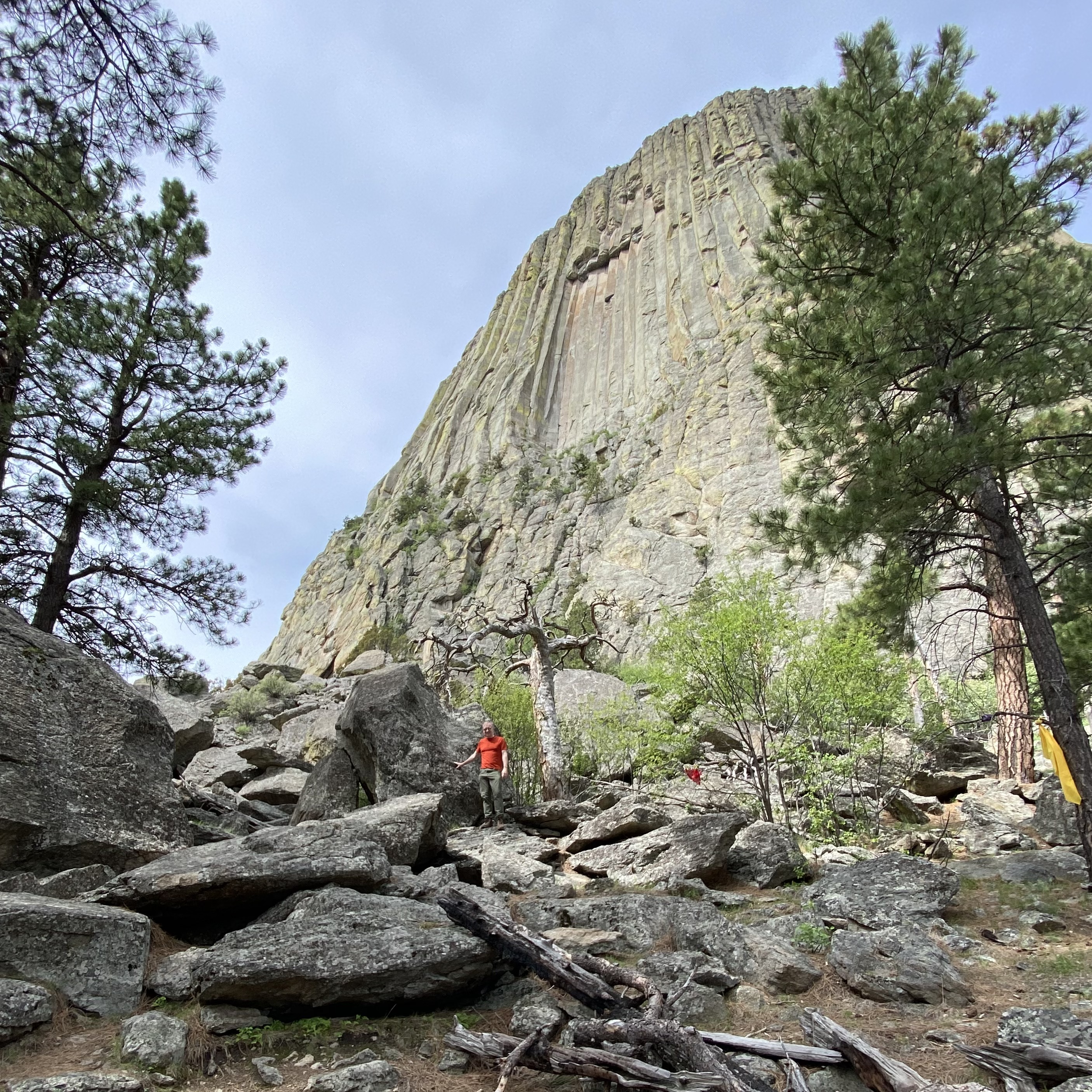
Some of the "bears' claws" that fell off the Tower over the centuries. See below for a scale figure.
This is not, by the way, the first time we've encountered a geological phenomenon like this. There is a part of Yellowstone National Park that has a formation like this and we walked all over a series of hexagonal-shaped rock stones at Giant's Causeway in Northern Ireland in 2019. The stones at Giant's Causeway were maybe two feet or a bit less to a side. Devil's Tower's hexagons are a bit bigger. OK...so a lot bigger. We'll get to that.

As a National Park property (Devils Tower was the first National Monument in 1906 and is still in that status), the focus for us was all on the Tower. There's no practical way to climb this thing without some pretty advanced climbing equipment and presumably some training, so we were left to walk around and near the Monument itself. There is an awesome, 1.3 mile long paved trail (the Tower Trail, if you must know) that comprehensively and uncomplicatingly (yes, I made that word up) leads you around the entirety of the Tower. It's not too steep and it's well shaded. There are longer trails at the park itself but this one seemed perfect for us.

The trail takes you through a Ponderosa pine forest which is just incredible. The way the path winds through the forest gives you an ever-changing view of the Tower itself while also at spots giving you amazing vistas over the forest and plains around the park. There's nothing fancy here. It's a walk around a giant rock, but the rock is a pretty amazing one and there are definitely notable stops along the way.

Some of these rocks around the Tower are pretty sizeable.
Perhaps one of the more astonishing places to stop is a side trail that points you to some old wooden ladders towards the top of the Tower. We were not actually able to spot the ladders from the ground through the custom built viewing tubes (for lack of a better word) due to poor eyesight (seriously, we just couldn't see...come try my glasses on sometime if you doubt me) but apparently climbing Devils Tower was an actual thing at one time. Like for actual regular people who needed no greater qualifications that climbing a ladder.

We did, by the way, see some 21st century people climbing Devils Tower. I've had notions at times (like maybe a decade or so ago) about climbing a mountain. Looking into what it would take to climb Mount Rainier before deciding it was likely too much for me was about as far as I took this idea. But there is no way I'd do what these people on the side of Devils Tower were doing. There is seemingly no way up the rock faces of that Tower and these people are out there with some ropes and some helmets. I'm sure it's less complicated than my worst fears but it's not for me. No way. I've walked to Machu Picchu and felt incredible about it, but climbing Devils Tower ain't my thing. Not ever.

The figures in the photograph below do, if nothing else, show the size of the hexagonal extrusions that make up the Tower. These "pencils" are way bigger than the ones we walked over at Giant's Causeway.


Have you been reading this post wondering why it's called Devils Tower? We did when we arrived there and started driving through the actual park. Seems that if you are there at sunset the actual Tower sometimes seems to glow an orange color and I guess someone, somehow associated this glow with Satan. Why, I have no idea, but that's the reality of the name, I guess. It's because of the color.

Devils Tower as a place to visit is not complicated. But it certainly is impactful and I believe that there is great value in going to places like this so you can see for yourself what it's like there. This is, in fact, one of the cornerstones of my philosophy about travel itself. As much as you can read about places and see photographs or movies or videos and talk to other people who have been there, there is absolutely no substitute for actually being there yourself.

If you had asked me to relate the character of Devils Tower at this time last year, I likely would have described it as an orange-red rock in the middle of some barren deserted landscape. It's clearly not. I guess I could have learned some or all of that by studying pictures and reading descriptions online but there's nothing like going somewhere to really learn about somewhere. Devil's Tower is not orange-red; based on our visit it's green, flecked by lichen growing on the rocks. You can see the lichen on some of the fallen "bears' claws" scattered around the Tower.

The lichen on the rocks makes Devils Tower look green.
The land around Devils Tower is also anything but barren. That's maybe pretty obvious from the pictures added to this post. The Tower sits within the forest around it. The rock does not sit clear of the pines that cover the land on all sides. Instead it is viewed between the pines as you walk around it. It's also not on a flat plain; it's actually on a ridge in the land, so when you drive up to the Tower, you drive onto a plinth on which it sits.

The thing is also absolutely enormous. We first caught sight of the Tower when our navigation app read 17 miles to the Visitor Center and I suspect we could have seen it from a lot further away if the contours of the land we were driving on didn't obscure the Tower from view.

I'm not sure if I'm ever going to be back near Devils Tower again. This is likely my one and only visit. I can't imagine spending much more time in southwest South Dakota and southeast Wyoming in my life because it's just too remote and inconvenient to get to, and there are way, way more places above it on the list. I am, however, fairly sure that this won't be the last time I'll ever see these hexagonal rock formations in nature. After all, we still need to make the trip to the other end of the Giant's Causeway at some point in the future. 


How We Did It

Devils Tower National Monument is open 24 hours per day every day of the year. Pretty simple opening hours there. We timed our visit to coincide with the opening of the Visitor Center at 9 a.m. and to beat the rush that we perceived might be hiking the Tower Trail. I don't think we needed to do either.

Sometimes Visitor Centers at National Parks add a ton of value. I felt this way pretty strongly about places like Little Rock Central High School National Historic Site. I didn't feel that way about Devils Tower. I'm not saying skip it, but if you wanted to get there earlier than the Visitor Center opened, I don't think it would affect your experience there.

We also didn't think it was that crowded. Most of the time we spent on the Trail we found ourselves alone or a good distance from any other people. Sure, it was a weekday and was not yet Memorial Day (although it was the Friday before that holiday) but we were surprised by the lack of people at the site. 


Tuesday, June 14, 2022

Carhenge

As of the beginning of last month, I had just three states left to visit to lay claim to having set foot in all 50 of our United States. Then we visited Nebraska. Now I have just two remaining. Kansas and Oklahoma, if you must know.

It is not enough for me to cross a state's border, get out of the car and declare myself having crossed one more state off the list. No!!! For me, I have to have done something or visited somewhere significant in my time there to truly claim that I have been there. This is sometimes difficult, especially when we get down to Nebraska, Kansas and Oklahoma on the "to visit" list. Not dissing those states exactly, but it's not like we are heading to New York or Los Angeles or somewhere like that.

Finding something meaningful to do becomes even more difficult when we aren't really visiting the state that we try to cross off the list, which is what happened with Nebraska. If we wanted to visit Nebraska to just get credit for having spent time in Nebraska, we probably would have flown to Omaha, downed a steak dinner and a Reuben sandwich (it was invented there) for lunch the next day and gone home. But we weren't visiting Nebraska; our trip last month was to South Dakota, but our itinerary would take us to within 45 miles of the northwest Nebraska border.

Come on...we had to make it to Nebraska. All we had to do was find something significant in the northwest corner of the state. And grabbing lunch at Runza would not count.

We settled on Carhenge. Yes, Carhenge.

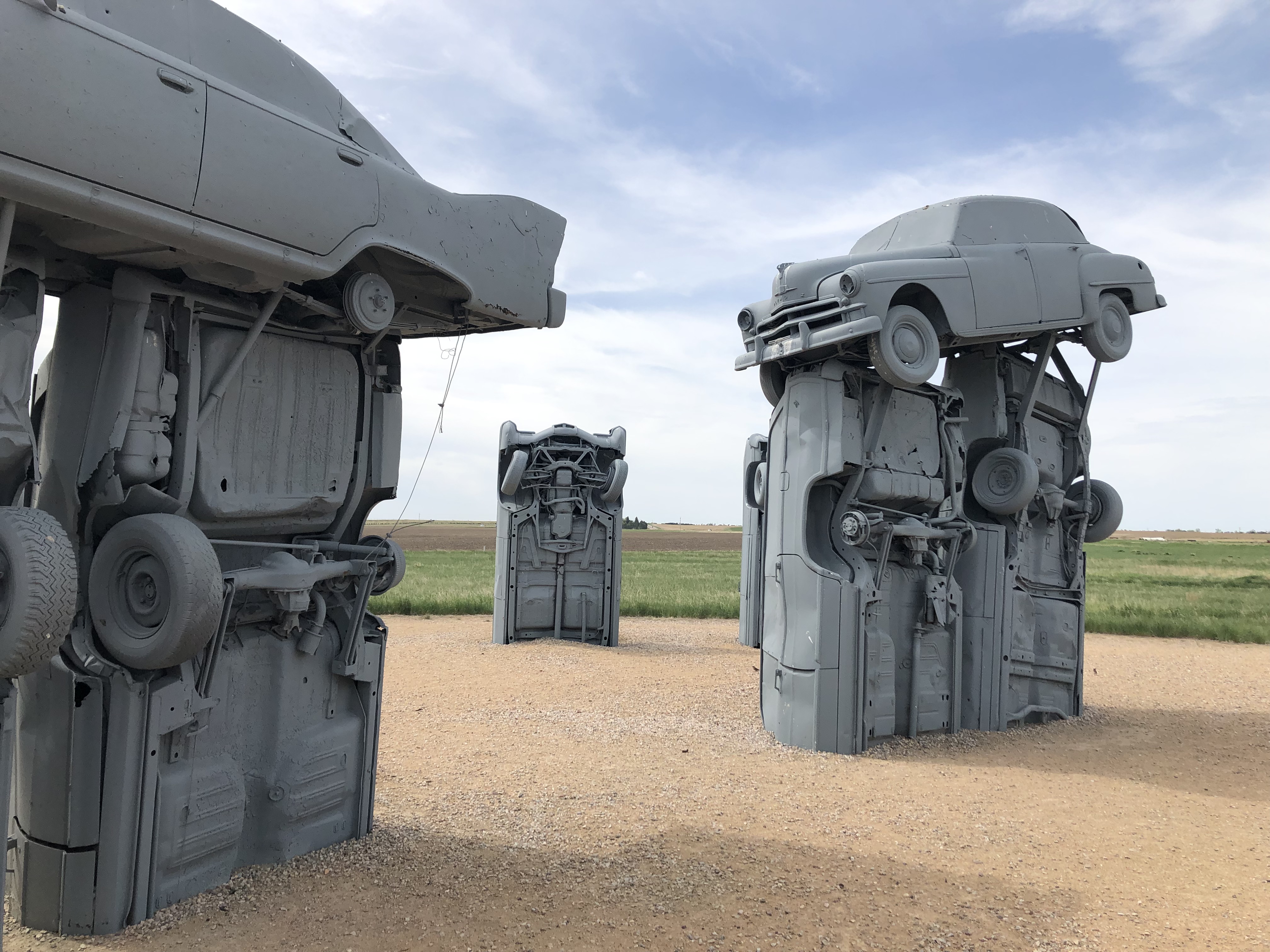
The best car (in my opinion) at Carhenge. The 1954 or 1956 Cadillac used as a lintel atop two Ford wagons.
And second best...the 1950 Chrysler DeSoto.

There is something uniquely American about building a replica of Stonehenge out of cars in the middle of the United States. I know that makes relatively little sense but I don't think you could really get away with doing something this simultaneously pointless and awesome at the same time in any other country in the world. And the central part of our country seems to be peppered with these types of things. World's largest ball of twine. The Blue Whale of Catoosa. World's largest pistachio (there are a lot of "world's largest" out there...). Muffler men. Cadillac Ranch. They and many others like them of varying quality and interest are all part of the American road trip experience. Or something like that. When they work, they are amazing. 

Carhenge is the brainchild of Jim Reinders, an engineer from Alliance, Nebraska who spent seven years of his life working in England. When he returned home, somehow he decided he needed to create what he referred to as "Stonehenge West" and his medium of choice happened to be cars. 

Apparently Jim had a lot of cars lying around and I guess it's way easier to move cars to a field in rural Nebraska than it is to move giant slabs of stone. He started with 25 cars and managed to get all of them into place in a six-day long family reunion over the summer solstice in 1987. Can you imagine showing up to a weeklong gathering with family and finding out that someone's got an idea that you are going to be standing cars in the ground and placing others on top of them in an effort to personalize your cousin Jim's field? That must have been a fun week.

Keep in mind here that it's not just putting cars in place as is. All the windows are covered with sheet steel (I'm assuming it's steel...also assuming they were covered for safety reasons) and then the whole things are painted grey to match the actual stone circle on Salisbury Plain. I guess those things are a fairly light lift compared to the actual moving of the cars.

Random American cars topped by a 1975 Gremlin (left) and 1962 Plymouth Valiant (right).
1960 Ford Galaxie (left) and 1961 Cadillac DeVille (right) emerging from the ground.

Now, if you know anything about me and cars, you'll know I'm not much of a cars guy. But I do have a love for specific models and a certain era of automobile design from the 1950s to the 1970s. And Carhenge has a number of these. How Jim Reimers decided the best use of a 1950 Chrysler DeSoto or a mid-50s Cadillac was to blow out the windows, paint them solid grey and make them part of his backyard sculpture is beyond me. Of course, I don't have the benefit of knowing the condition of these vehicles before he moved them to his field and started stacking them on top of each other.

I do appreciate the fact that he seems to have kept the most interesting models for use as the lintels in the circle and used the more generic sedans and wagons to hold those more distinctive automobile bodies on full display. I'd love to have most of these cars in great condition in my driveway. Even the 1975 AMC Gremlin on the north side of the circle. Of course, I can't drive my own car that I'm in love with often enough these days to even put 500 miles on the odometer in a single year. Clearly my theoretical collection of classic cars would need a much bigger stable than my current garage and driveway setup.

And if you are being impressed with me spouting off years and models of cars painted all the same color, don't be. The gift store sells a map of the sculpture with all the cars identified.

Check out the tail fins on the 1957 Plymouth (I believe) on the right. Damn those things are gorgeous.
How I know what I know about cars at Carhenge.

It may seem crazy to you that I drove (...or more accurately sat in the passenger seat...I drove back) 2-1/2 hours to get to a field with a bunch of cars altered and painted and stuck in the ground in a circle. It is for sure a serious drive from Rapid City, but it got me a new state and it's free. I can legitimately claim I've now visited Nebraska and I didn't spend that much to get there. Just $4.50 or whatever it was that weekend per gallon of gas.

It also works. Somehow it makes sense. It's well enough done and doesn't look sloppy. I'd debate the precision of its similarity to the actual Stonehenge but I suppose precision is not really the point here. It really doesn't possess any of the presence or mystery of Stonehenge either, but you can at least walk around and between the henge and touch the cars, all of which you can't do at the real thing. It's all pretty much stupid, I know. But it's completely middle American and I love it. 

The gift shop is also awesome. In addition to the map of the place identifying all the cars, we will have a brand new Carhenge Christmas tree ornament hanging from a branch on our fake Christmas tree this December. How cool is that?

Lest you think a visit to Carhenge stops at the henge of cars, you'd be wrong. Seems Jim had a few more ideas up his sleeve for other ways to make cars into art and he's located these north of the circle in their own separate area of the property. There are a couple of time capsules up in that area along with a group of four cars called the "Fourd Seasons". There's also a "car"-nestoga wagon which perhaps obviously is a car modified to resemble a Conestoga wagon and a graffiti-tagged "auto"-graph car which adds color to the place.

None of these additions (there are also others not by Jim) has the impact or the scale or the inspiration of the original idea. None of them bests Carhenge.

Thus mostly ended our trip to Nebraska. Mostly. We got hungry and you know we just couldn't get out of the state without hitting a Runza. 

What's a Runza, you might ask? Well, it's a ground beef and cabbage sandwich that's supplemented with other ingredients depending on what variety you decide upon. I went with the southwest, which I'm not sure was the correct call. The sandwich was good but not great but I'd give it another shot if I ever found myself in rural Nebraska again. I'd probably pass on the frings (fries and onion rings combo) but the service in the Chadron, NE restaurant was fantastic. Best fast food service experience of my life. Jackson represented Nebraskans very well.

Carhenge and Runza. That's my Nebraska experience. I'd call it good enough.


How We Did It

Carhenge is not a complicated place to visit. Just plug it in to your navigation app of choice and pull off into their parking lot. It's open dawn to dusk. The gift shop is only open late May to September but the hours when they are open are great: 9 a.m. to 7 p.m. daily. There's no admission charge for Carhenge but donations are appreciated. We made sure to buy plenty of swag in the gift shop. I mean when else are you going to get the chance?

The Chadron Runza is open daily 10 a.m. to 9:30 p.m. If I ever find myself back at a Runza, I think I'd go with the Cheeseburger Runza. Say hi to Jackson for us if you visit in Chadron.


Saturday, June 11, 2022

Stolen Land


I swore I wasn't going to visit South Dakota and come back and write a blog post about Mount Rushmore. I swore it! No way was I going to do that. Couldn't imagine any scenario where I'd be putting keyboard to screen to bang out a post about a glowing review of some huge sculpture of privileged, rich men carved into a mountain sacred to so many Native American peoples taken from them against their will. Wasn't going to do it. Especially since I'd already been there before. I was not discovering this thing for the first time on this trip.

I had a better idea. I was going to write about how the Black Hills was sacred land. I was going to write about how the Treaty of Fort Laramie of 1851 promised the land to the Lakota in perpetuity. I was going to write about gold and Deadwood and the (new) Treaty of Fort Laramie of 1868 which took that land promised in perpetuity away forever. I was going to write about the Six Grandfathers and how Doane Robinson (the idea man) and Gutzon Borglum (the sculptor) desecrated the mountain. Finally I was going to write about Crazy Horse and how he was being memorialized like four presidents on Mount Rushmore. I was going to cover everything. All of it. And almost all of it was bad and wrong.

But then a couple of things happened. First, Deadwood is not the place I loved the last time I visited in 2011. It's a huge family tourist trap, a far cry from the small town caught between low table minimums and historic preservation that somehow maintained some sort of image as a dangerous frontier mining town that captured my imagination 11 years ago. And by "dangerous frontier mining town", I mean dangerous without the actual danger.

Second, the Crazy Horse Memorial seems to be getting nowhere on a campus that seems (to me) to be more about pulling in tourists than putting everything behind making the famous Lakota emerge from Thunderhead Mountain. I'm serious. The sculpture that is supposed to be carved out of the mountain is maybe 20 percent complete and it's been going since 1948. How many centuries is it going to take to get this thing complete? I know cathedrals in the middle ages took hundreds of years to complete, but I guess I feel that things should be quicker these days.

And third, the sculpture at Mount Rushmore is actually pretty skillfully executed. If you can ignore the whole stolen land thing. And we are not going to ignore that here. Or the KKK thing.

I could write for a long time about the history of crimes, including theft and murder, committed against the Lakota and other tribes in and around the Black Hills by Europeans who settled what is now the United States. I'm not going to do that. Instead, I'm going to borrow from another source, for two reasons. First, I can't write more succinctly what I'm about to borrow. And second, I love it when trips that we take randomly reinforce immediate, future vacations. Which is exactly what happened in Los Angeles in late March.

On that trip, we visited the Academy Museum, a multi story downtown museum that outlines the history of motion pictures. One of the exhibits in the Museum is a single exhibit display about the history of painted backdrops. The backdrop on display just happens to be of Mount Rushmore. The description of the backdrop reads as follows.

The Mount Rushmore National Memorial has a controversial and painful history. It sits within the Paha Sapa, translated into English as the Black Hills, an area sacred to the Lakota, Cheyenne, and Arapaho people. The Lakota call it Wamaka Ogna Ke Icante (The Heart of Everything That Is). The land was reserved for the Lakota Sioux under the 1868 Treaty of Fort Laramie, an agreement the US government violated in 1877 following the discovery of gold.

In 1924, sculptor Gutzon Borglum was invited to create a monumental tourist attraction in the Black Hills. The site selected was Mount Rushmore, known to the Lakota as Thunk'sila S'akpe Paha, or the Six Grandfathers. Borglum began work in 1927 and died shortly before the monument's completion in 1941. 

For the Lakota community, the National Memorial desecrates their sacred land, an offense compounded by the fact that the Presidents Washington, Jefferson, Lincoln and Theodore Roosevelt all participated in the oppression of America's Indigenous people.

Mount Rushmore has been an ongoing site of Indigenous American protest, most notably in 1970 and 1971. In 1980, the US Supreme Court awarded $105 million in compensation for the loss of the Black Hills. The Lakota rejected the money in favor of the return of the land - a demand that stands to the present day. 

Stolen land. Told you. I don't know how I sum up the history around Mount Rushmore any better than that with more words. It's pretty much as short and effective as it can be. 

Now is when I embarrass myself and go back on all that because I actually find something to admire at Mount Rushmore.

It is difficult for me to describe what it is that sucked me in and captured me at Mount Rushmore. It's not uber-patriotism or anything like that. I wasn't born here but I am proud to be a naturalized American while also understanding that this country has flaws like any other. I love this place but I don't fall for shows of nationalism that places like Mount Rushmore inspire in some people.

I am also not a huge fan of any of the presidents depicted on Mount Rushmore. I can get behind some to a lot of what Lincoln and Roosevelt did and believed in and I can appreciate the role George Washington and Thomas Jefferson played in founding this nation while also fundamentally disagreeing with a lot of Jefferson's ideals. When it comes to Jefferson vs. Alexander Hamilton, I'm team Hamilton all the way. Jefferson in my opinion did irreparable damage to this country that we still haven't gotten out from under. And no, I'm not going to cover that in this post.

And then there's the thought behind the idea. This thing was carved to give people something to visit in South Dakota. Plain and simple, it was conceived as a tourist attraction. Like that's necessary? There's so much amazing stuff to do and see in southwest South Dakota. Who needs four giant faces to get people to travel there? Certainly not me.


I think for me it comes down to presence and execution. I know that given the history of the land in question here, I should absolutely not be swayed by artistic merit and the way the trees frame the sculpture perfectly in some spots, but I am. 

It is difficult, after having visited places like Arches National Park and Zion National Park and having gazed with wonder on the Three Gossips and the Court of the Patriarchs, for me to state that the desecration of the six grandfathers by having some dude carve likenesses of Washington, Jefferson, Roosevelt and Lincoln into the side of the mountain actually improved the view. I don't know what it was like before they were there. I can look at pictures but can't really state what it was like because I wasn't there before they were carved. Nature makes some of the most gorgeous formations and views without any assistance from man.

All the time.

Having said that, the faces on Mount Rushmore are beautifully sited and they change dramatically (and fortunately to obscure Jefferson a lot) as you move around and in front of the mountain. There's some value in putting something recognizable as a point of reference to stare at and appreciate as the views of the thing shift with your position in the park around the National Monument. I don't like writing these words. Most of the siting of Mount Rushmore is unquestionably due to nature and not to the hand of man.


There is also real skill in both the carving of the mountain and the execution of the project itself. This whole thing took just a bit more than 14 years. That's staggering for a work of this size, type and location, although it was moved significantly along during the Great Depression when any job was a good job, no matter the danger. But you couldn't put just anyone on this project, right? I know it's a huge scale but ultimately, we are talking about art here, right? 

Before visiting South Dakota this time around, by the way, I guess I assumed that the carving here was executed by Gutzon Borglum alone. But there is a picture in The Rushmore Hotel in Rapid City (where we stayed) that shows the mountain covered with scaffolding and various people working on the sculpture. I have no idea what possessed me to think one man could execute this thing by himself. Just pointing out my error in case that wasn't obvious here. Still, 14 years for a work of this scale and skill is astounding. As an exercise in project management alone, it's impressive.

The skill required here really hits home when looking at the glasses of Teddy Roosevelt. Don't get me wrong, there's a lot of amazing sculpture in the rest of the four faces, but the glasses do it for me. We are talking about portraying an essentially invisible accessory resting on a face. It's a frameless pince-nez, not a pair of thick rimmed glasses or anything like that. But it's totally believable that there are giant spectacles on the face of Theodore Roosevelt. I can't imagine that kind of detail is easy. If you assume Borglum wasn't personally executing that specific piece of the sculpture, it's even more impressive.

Mount Rushmore was about the third thing we did when we landed in South Dakota (lunch and the Crazy Horse Memorial preceded it). I drove out of there impressed but also determined to not write about this place in any context other than the history of the Black Hills in total.

Needles Highway changed my mind.


Needles Highway is a 14 mile long stretch of South Dakota Highway 87 leading out of Custer State Park north towards Rapid City (or at least that's what it did for us). It's a gorgeous drive that is going to take you a while and is worth every minute of it. It climbs and curves through a coniferous forest and shows off some of the amazing natural beauty of the Black Hills.

At four spots in the drive, the road cuts right through some giant boulders. I mean that literally. There are enormous solid rocks in the landscape that rather than remove or crush or dynamite these things out of the way, whoever made the decision to make this road just carved a hole wide enough for a single lane of traffic right through the rock. Each one is an incredible feat of engineering and it's impressive to be driving through a tunnel made just that way.

The last of the four (heading north) tunnels is named after Doane Robinson, the guy that came up with the idea of carving four president heads into mountain sacred to the original inhabitants of that land. To get your car aligned with the axis of the tunnel, you have to make a little bit of a left swing to take the right turn into it so (a) you don't risk scraping the sides of your vehicle getting through the thing and (b) you can see if there's anyone coming the other way. 

When you align your car with the Doane Robinson Tunnel, it frames Mount Rushmore perfectly. All you see through the opposite end of the tunnel is the four faces carved into the Six Grandfathers. It's an awesome framed view. Think about the effort and thought required to do that. It's almost unbelievable that someone could pull that off. Ignoring all the context of the bad stuff around this sculpture (and I actually believe I have covered most of that so far), that view made me write this post. For the complete Mount Rushmore experience, you should drive north on Needles Highway. This was a complete accident that we did this. It was an awesome surprise.

Ironically, the framed view through the Doane Robinson Tunnel was originally of the Six Grandfathers. The highway was completed in 1922, before Mount Rushmore was started. Presumably the tunnel was not originally named after Robinson, either.


The view of Mount Rushmore through the Doane Robinson Tunnel. And the view on the other side.
Before I end here, let's talk a little bit about sculptor Gutzon Borglum. I don't understand the thought process Borglum went through before taking this commission. Maybe he did it for the fame or the money. Maybe he felt it was the right and glorious thing to do. Maybe he didn't think or know anything about the site being sacred to Native Americans. Maybe he knew all about that last issue and took the job anyway. Heck, maybe he loved South Dakota so much that he wanted to create its greatest tourist attraction. I don't know what the motivation in him taking the commission was and I'm not going to spend any time figuring it out, although the next paragraph will offer some pretty damning information. Borglum's not really worth much of my effort but I do want to close this post by telling some truth about this guy.

This was not the first controversial job he engaged in. Before he spent 14 years at Mount Rushmore, he spent some time in Georgia, where he was hired as the sculptor for Stone Mountain, a rock which today is carved in bas relief showing the Confederates Robert E. Lee, Stonewall Jackson and Jefferson Davis, who rebelled against the United States to preserve slavery, or the right to own black people, in their states. If you want to engage in any sort of debate here about the reason for the United States Civil War, read my Richmond statues post first. Borglum was fired at Stone Mountain. Not out of any sort of moral principle (he was  a member of the Ku Klux Klan, after all) but due to financial disputes.

We didn't know all this about Borglum before we visited Mount Rushmore. I thought it was important to relate. It certainly colors my own appreciation of that work. It's disappointing that someone with ideas like that could make something so impactful. Maybe I should have refused to write anything complimentary about Borglum's achievements. I decided not to do that in the end.


How We Did It

Mount Rushmore National Memorial is open daily starting at 5 a.m. It closes at 9 p.m. in the fall and winter and 11 p.m. in the spring and summer. Check their opening hours page for the exact dates of spring/summer and fall/winter. There is a $10 fee to park at the Memorial and the fee is non-negotiable. Not even the National Park Service Annual Pass gets you free parking at Mount Rushmore. There is no admission charge beyond the parking fee.

There are other things to do at Mount Rushmore other than walk around and gaze at the sculpture. Park Rangers conduct guided tours of Borglum's Studio and something called a Lakota, Nakota and Dakota Heritage Village. We got to Mount Rushmore at about 5 p.m. and found only the Memorial itself open. It should come as little surprise that that Heritage Village is only open for five non-continuous hours four days a week (but not weekends) for two and a half months of the year. As if the Native Americans needed that additional slap in the face here.

The sculpture is also illuminated nightly and there's some sort of ceremony in the summer months around the illumination. We got out of there before the lights were turned on.

If you want to get to the Doane Robinson Tunnel along Needles Highway, you'll have to do it in the summer months. The highway closes with the first snowfall of the season and doesn't re-open until April 1 or later. Trust me, it's worth it.