Tuesday, May 18, 2021

Civil Rights

Taking a trip into the deep south of the United States to explore some of the sites that defined the American Civil Rights Movement in the 1950s and 1960s is not a lighthearted proposition. It involves dealing with some pretty unpleasant issues like abduction, torture, death, subjugation, humiliation, voter suppression, beatings, abuse of power with no consequences, rape, castration, lynching and much more. It's uncomfortable. It's upsetting. It's shameful. The stories of the Civil Rights Movement are brutal and disgraceful to the ideals that the United States claims it stands for. But after the presidency of Donald Trump and the events of 2020, it seemed like the right time to take this trip. We dipped our toes into these waters in March with a trip to Richmond, Virginia and then a bit further west to Farmville. Memphis, Arkansas, Mississippi and Alabama would be for the most part an entirely different sort of America from Richmond.

I think it's worth spending a few words on just how segregated America was in the 20th century. There is a chapter in Isabel Wilkerson's book Caste where she writes about a meeting held by a committee of Nazi bureaucrats in Berlin in June of 1934 to determine how to institutionalize the inferiority of Jews into the Third Reich. They started by studying the United States. You read that right; the Nazis admired the racial separation in the USA. They were apparently fascinated by the way America could be held up worldwide as a beacon of absolute democracy while simultaneously legally separating black people from the rest of its society. This was their starting model. They studied how America classified people as black vs. white and thought that might inform their own efforts to classify Germans as Jewish or non-Jewish. Ultimately, they rejected America's classification rule that even one drop of African blood in your ancestry meant you were black; they thought it was too harsh. 

Don't believe it? I don't mean the June 1934 meeting (they took minutes after all). I mean America as a legally separated and unequal society. There was a time when I was a lot younger that I wouldn't have either. It sounds farfetched. It sounds like some sort of delusional conspiracy theory. But it's real. Think about it. Talk to people who don't look like you. Put yourself in someone else's shoes. America, the self-proclaimed land of the free and home of the brave, was an obviously segregated society. 

And guess what? It still is. Maybe not so much legally today but all men (or women) are still not created equal even in 2021. If we had made this trip 60 years ago, it would have been way more obvious. We'd have been in a part of the country where laws and the attitudes of society would have made it clear that white folks and black folks are distinctly different classes of people who should not under any circumstances mingle in any way resembling equals. It sounds stupid, doesn't it? It was very, very real.

16th Street Baptist Church, Birmingham, AL where four little girls were killed in a bombing in 1963.
Statue of Rosa Parks, Montgomery, AL near the spot where she boarded a bus and refused to give up her seat in 1955.

So I can admit I'm not likely the best person to write about the Civil Rights Movement. I'm a white man who grew up in the mostly white suburbs of Hartford, Connecticut. I had no non-white friends growing up in this country. My upbringing was free from prejudice based on my appearance. Race relations were not something I had to deal with before attending college, so I formed my own opinions from the zero experience I had with it as I grew up. I'm only writing all this because I feel inadequately experienced to write about the subject I'm writing about today and for the next few weeks. I do not claim to be an expert or feel anything like the pain someone non-white might feel on a trip like this. On the other hand, nobody else is going to write about my trip and experiences in my blog. So I bring whatever unconscious bias to my experience based on my background.

Our journey this month started in Memphis. From there we made day trips into Arkansas and Mississippi and retreated back to Bluff City for the night. Eventually, we drove east and south for good, stopping overnight in both Birmingham and Montgomery, Alabama. The number of sites we visited was extremely limited. We only had a bit more than a week down south. At the same time, we stopped at so many places that bore the scars of segregation. It was staggering. It was everywhere. And that's because it really was everywhere. It was an integral part of society. Everywhere. And yes, even today.

I am not going to write about every site, every building, every museum that we visited. Instead, I'm going to concentrate on the experiences that had the greatest impact on me rather than giving a blow-by-blow of every stone of history we unturned. That's not intended to diminish or minimize some of what we saw. Instead, I see it as placing emphasis to differentiate the most uncomfortable, upsetting and shameful events that we learned about. And I really do mean those words. For the most part, the most cruel, the most visceral and most bloody events are the ones that I'll elaborate on in more detail. They stuck with me the most.

Separate and very unequal drinking fountains at the Birmingham Civil Rights Institute.

This was not my first shot at some of the places we visited. I'd toured through the National Civil Rights Museum in Memphis in 2018 and walked around Kelly Ingram Park in Birmingham a little more than two years before that. Those experiences, along with our March trip to Richmond and Farmville this year, allowed me to start to connect the dots of this movement in ways I could not before this spring. My second trip through the National Civil Rights Museum was invaluable as an overview of the history not only of the Civil Rights Movement but of the events decades and centuries that laid the groundwork for a United States distinctly separated along racial lines.

There's also nothing like being where history happened. I know it's been between 50 and 70 years since the events we learned about occurred in the towns, cities and countryside we drove through, but the atmosphere, the vibe and the details made an impression and heightened the experience. Reading about history is one thing. Being where it happened drives concepts and moods home like nothing else.

We love to travel and we were for sure looking forward to this trip after many months effectively confined to our home during the global pandemic of the last 15 to 16 months or so. At the same time, there was a good amount of apprehension. We knew it wouldn't be as enjoyable as a trip to see wildlife or nature or sports or architecture or any of the other amazing things we've done over the past almost eight years I've been writing this blog. But it had to be done. We did manage to sprinkle in some other themes like music and food. I'll blog about those too.

The focus here for sure was on a lot of suffering. The difficult part about the entire trip is there was never any real victory. Sure, some laws changed in significant ways but there was never a feel good moment when it felt like the war was won. It is difficult to claim that countless black men and women dying and suffering other inhuman abuses was worth it to get to the passage of the Civil Rights Act of 1964, which is where a lot of the narratives about the Civil Rights Movement end. On the other hand, their deaths and suffering definitely paved the way for change, as callous as that seems. As we've seen in 2020 and 2021 and 2019 and pick any year really between now and then, the issue of racial inequality in this country is still not solved. At what point do we stop taking incremental steps forward and then ignoring the issue for a couple of years at a time?

Most posts I've written on this blog have been fun and easy to write. These next few posts will not be like those other posts.

The balcony outside Room 306 of the Lorraine Motel where Dr. Martin Luther King was assassinated in 1968. Memphis.
I Am A Man Plaza next to Clayborn Temple in Memphis used as a rallying point for the 1968 sanitation workers' strike.

How We Did It

There is so much to explore in the South related to the Civil Rights Movement. There are museums and statues and buildings and memorials and signs and just open fields or corners of streets seemingly everywhere that had an impact. Something happened seemingly everywhere. Some of these places are shown in or suggested by the photographs above. I'm also electing not to devote future posts to these places.

For a pretty complete overview of the Civil Rights Movement from the landing of the first slave ship in Jamestown, Virginia in 1619 to the assassination of Dr. Martin Luther King, Jr. in 1968, I'd suggest a visit to the National Civil Rights Museum at the Lorraine Motel in Memphis. The centerpiece of the Museum is the motel wing including the balcony where Dr. King was shot by James Earl Ray's bullet from an adjacent boarding house (the boarding house is also part of the Museum). That event is the terminus of the Museum's timeline and the end point of the exhibits. There is a ton of information to digest in the Museum; we spent a little more than five hours (that time admittedly includes a stop for lunch at the nearby Central BBQ) on this trip. You could easily spend a couple more hours and still miss some things. The Museum is currently open Thursday through Monday.

If you are ever in Birmingham, Alabama, the Birmingham Civil Rights Institute offers similar subject matter as the NCRM but with a distinctly Alabama focus. We spent a little more than 90 minutes in the Institute which is located across the street from both the 16th Street Baptist Church and Kelly Ingram Park (which contains a Freedom Walk documenting some of Birmingham's troubled history). The Institute is currently open Thursday through Saturday.

The 16th Street Baptist Church was the target of a Ku Klux Klan bombing in 1963 that killed Addie Collins, Carol McNair, Carole Robertson and Cynthia Wesley (aged between 11 and 14). Under non-global pandemic situations, there are tours of the Church available. The KKK members who planted the dynamite that killed the girls were not even charged until 1977 and it took almost 40 years to get a conviction despite pretty overwhelming evidence of who was responsible for the crime. 

One of the best museums we visited on our trip was the Rosa Parks Museum in Montgomery, Alabama. It details the story of Rosa Parks, who refused to give up her seat in the non-white section of a Montgomery city bus in December of 1955. It's a little confusing to visit (you have to buy a ticket then go outside to the other side of the building then go back to the original side where tickets are sold) but it tells the story of Mrs. Parks and events leading up to the more than one year long Montgomery Bus Boycott in an interactive way that we didn't get in other museums on this trip. There's a Rosa Parks statue on the corner of Dexter Avenue and Commerce Street near where she boarded the bus.

The last picture in this post is of the I Am A Man Plaza in Memphis. It's a monument to the men involved in the 1968 Memphis sanitation workers who went on strike to protest unequal pay and benefits for non-white sanitation workers. It's located at the side of the Clayborn Temple in Memphis where the workers gathered before marching to protest the unequal treatment they received. During the protest, most strikers wore signs reading I Am A Man. Clayborn Temple is located at 294 Hernando Street just a short walk from Beale Street in downtown Memphis. The Plaza tells the story of the strike through a timeline around the Plaza's edge.


Wednesday, March 10, 2021

No Monuments

This post is about a trip to see nothing. But it's also about something that's really pretty important.

Most of the trips I've blogged about in the last almost eight years have involved me traveling hundreds of miles from home, usually by getting on a plane and traveling over most or all of a continent or even further over some body of water. Sure, admittedly I've made some trips by rail or by getting in a car and driving but those are the exceptions. In other words, I'm typically writing about places not near to where I live. I've never really thought about blogging about somewhere I could go on a day trip. Until now, that is.

Richmond, Virginia is a bit less than a two hour drive from where we live. Under normal public health circumstances I never would have thought about heading somewhere as close as Richmond for a getaway. But with the seven day rolling national average of new COVID-19 cases just a bit higher than I'm comfortable with right now, there's no way I was getting on any sort of shared transportation and going far away. Plus, we had $100 of Best Western gift cards with March expiration dates. Better to use them to defray the cost of going somewhere new than lose them. So Richmond it was. And because we stayed overnight, I'm still not writing about a day trip.

So as I already said, this post is about a trip to see nothing.

It is about nothing because one of the reasons we traveled to Richmond was to see some things that are no longer there. They are gone. And it is the very fact that they are gone that is important. But we really wanted to not see them.

But first some context. History time.

In April of 1861, the Commonwealth of Virginia seceded from the United States. They followed the lead of South Carolina, Mississippi, Florida, Alabama, Georgia, Louisiana and Texas and were followed by Arkansas, North Carolina and Tennessee. Those eleven states formed the Confederate States of America. The governors of Kentucky and Missouri tried to join them but their citizens were having none of it. When it came time to pick a capital, those eleven states picked Richmond. So yeah...we visited the former capital of the Confederate States of America for a weekend. Nothing like a little sedition on a winter weekend.

The Civil War between the Union and the Confederacy that followed secession by the southern states was about slavery, or the rights of one (white) human being to own as property other (black forced violently against their will from their homes in Africa) human beings. I thought it was important to state that as plainly as possible. Some folks out there will insist the War was about states' rights. Sure, maybe it was. But if you want to spin it that way then the specific right that was being fought over was the right of one human being to own as property other human beings. The War was about slavery.

It was also a treasonous rebellion and those who took part in the War for the South fought against their own country. I thought it was important to state that as plainly as possible too.

It is sometimes difficult for me to imagine Virginia where I live today as part of a breakaway state wanting no part of the United States hell bent on insisting that slavery was just and right. But I'm sure it was pretty fanatical about that idea back in the 1860s and I'm sure there were plenty of folks in Richmond that believed that the idea that black people were inferior to and should be enslaved by white people was for sure worth going to war about. 

Ultimately the South was on the wrong side of history and of human decency and their war didn't work. They lasted as a nation until May 5, 1865, when President Andrew Johnson declared the Confederacy dead after the surrender of most of their forces to Union Generals Ulysses S. Grant and William Tecumseh Sherman over the prior month. The South started a war they couldn't finish. The North was happy to finish it for them.

Then in the decades following the Confederacy's defeat, there started to emerge a legend in the South called the Lost Cause, an idea that the reason for secession and war was just and righteous. This idea was adopted by former Confederate officers and politicians in the South and was amplified by organizations such as the Daughters of the Confederacy. The idea here was that the actions of the leaders of the South, which in reality was nothing but out and out treason against the United States government, was not only justified, but was the right and correct thing to do. And so was slavery.

In many cities and towns in the South, this idea drove citizens to erect monuments to the people who fought in rebellion for the Confederacy. Richmond was no exception. In 1890, the city unveiled a monument to General Robert E. Lee, the commander of the Army of Northern Virginia. Imagine a country allowing one of its cities to erect a monument to celebrate the life of a traitor against his own government. It happened. In Richmond and a whole host of other places. 

Imagine also how former slaves would feel about somewhere they live celebrating the life and "achievements" of someone who went to war to keep them enslaved. That also happened. In Richmond and a whole host of other places.

Richmond didn't stop with the Lee statue. No sir! Over the next 39 years, the city put up statues celebrating J.E.B. Stuart, Jefferson Davis, Stonewall Jackson and Matthew Fontaine Maury. Not fully familiar with all of those names? Don't worry, I'll tell you a little about them later. Together the statues made up a stretch of one of the most prestigious streets in the city named Monument Avenue.

Monument Avenue was my number one reason to visit Richmond. Not to see the statues. But to see nothing. To see where they used to be. Because most of them are no longer there. Finally a small part of the United States has come to its senses. Mostly. 

I told you this post was about nothing and something really important at the same time. 

Stonewall Jackson was here. Monument Avenue and Arthur Ashe Boulevard.

So before we get to that, let's learn a little about who we didn't see, shall we? And I know some readers here will be thinking that it was a different time and we can't apply 21st century norms to something like betraying your country to participate in a war about slavery and it was history that actually happened and the statues should remain as part of the historical narrative of the South. Three thoughts here: 

(1) I don't think there are too many statues of Adolf Hitler in Germany or Saddam Hussein in Iraq or Benedict Arnold or King George III of England over here in the United States. Countries don't generally erect statues to commemorate defeated foes or traitors or leaders who lead their country to ruin. 

(2) The idea that slavery was wrong was actually around back in the 1860s. It's not, believe it or not, a 21st century notion. There were plenty of abolitionists around trying to stop it forever in this country and elsewhere in the world. If that doesn't convince you, think about how you would feel if you and your family were someone's property to treat however they liked; they could abuse, starve, beat, rape, work to death or even on a whim kill you or your family for no reason and with no consequences. They might also sell some of you and keep others of you. How would you feel about that? Ready to celebrate the leaders of a war to preserve that idea?

(3) Yes, we can. 

So about those monuments.

Of the five statues on Monument Avenue, Confederate generals Robert E. Lee and Thomas "Stonewall" Jackson are probably the best known. Waging war on your own country has a way of making people famous, I guess. Both owned slaves (I'm sure that's a shocker!) and both willingly joined the Confederacy. I'm sure if you dug a little on line, you'll find all sorts of articles and accounts out there that neither man really made his feelings about slavery known. Those same articles might say that both men were devout Christians; that Jackson braved breaking the law by teaching slaves to read; and that Lee eventually may have shown abolitionist tendencies.

Don't believe it! It's a crock! The fact that neither man made their feelings about slavery known to all who they met doesn't mean they were against it. Their actions spoke volumes. I mean if you need any more proof than they were slave owners and that they took up arms against their own country to preserve that right, then I'm not sure what to tell you. So Jackson "only" owned six slaves maybe. That means he claimed as property six other human beings. Six!!! One is too many. He had six. 

And Lee's "abolitionist tendencies"? Let's hear from the man himself in an 1856 letter:

"The blacks are immeasurably better off here than in Africa, morally, socially & physically. The painful discipline they are undergoing, is necessary for their instruction as a race, & I hope will prepare & lead them to better things. How long their subjugation may be necessary is known and ordered by a wise Merciful Providence."

So it's God's fault, is that correct? Seems it works that way for Jackson, too. Apologists for Jackson point to his Calvinist beliefs (that everything on Earth is as it was desired by God and that if slavery exists then it must be the will of God) that prevented him from questioning the very institution of slavery. Those same beliefs didn't lead him to believe that it was wrong for the South to secede for some reason. I mean before he participated in that it was part of the United States. Remember two things: these two owned slaves and they took up arms against the United States so they could continue to do so.

J.E.B. Stuart was here. Monument Avenue and Stuart Circle.

If Lee and Jackson are the most recognizable names on Monument Avenue, J.E.B Stuart and Matthew Fontaine Maury are likely the most obscure. Both were Virginians who resigned their commissions from the United States military when their home state seceded from the Union. Stuart became a General in the Confederate army. Maury was in charge of the Navy. Both, of course, like Lee and Jackson, fought like hell against their own country's government. Maury actually accomplished something notable in his career before he opted to join the South in rebellion: he made significant advances in naval meteorology and navigation. He's probably worthy of a statue if it wasn't for that whole being a traitor thing. You know...THAT.

Unlike Lee and Jackson, neither Stuart nor Maury owned slaves, although there is some debate about Stuart (he may have owned two and freed them before the Civil War started). But Maury did have some pretty out there ideas about preserving the economic boon of slavery (read: free labor) while removing the guilt of slave owners in the South. His idea? Move all the slaves to Brazil and set up plantations as money making ventures for American plantation owners. Keep the slaves in slavery; just move them elsewhere. Not sure this is what I consider enlightened.

And then there's Jefferson Davis, the President of the Confederacy. Davis was a former United States Army officer; plantation owner; United States Congressman; United States Senator; and Secretary of War under President Franklin Pierce who resigned his Senate post when the State of Mississippi seceded. Shortly thereafter, he was elected President of the Confederacy.

Like Lee and Jackson and Stuart and Maury, Davis willingly fought against the United States of America. Also like Lee and Jackson, he was a slaveowner, apparently at one time owning more than 100 slaves. More than 100 human beings. Think about that. Davis did think about it. A lot. Some of his thoughts are in the quote below.

"African slavery, as it exists in the United States, is a moral, a social, and a political blessing. You cannot transform the negro into anything one-tenth as useful or as good as what slavery enables them to be."

Do these guys deserve statues in prominent places in American cities? Not in my view they don't. And apparently, not in Richmond's view either in 2020 and 2021, although I'm sure there's less than unanimous consensus about that. 
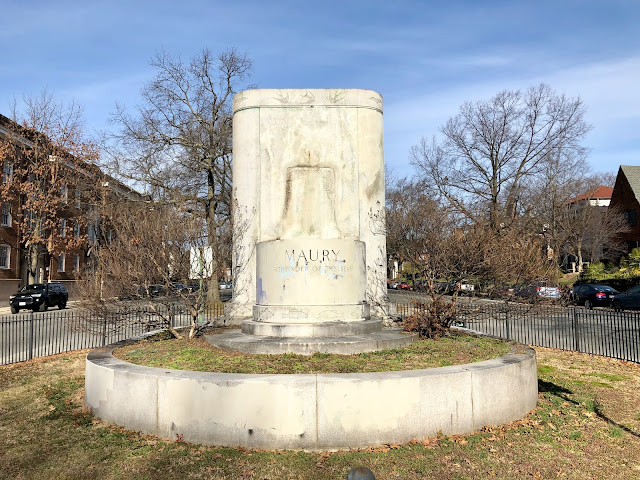
Matthew Maury was here. Monument Avenue and North Belmont Avenue. 

So why are these statues no longer on public display in Richmond? Well, on June 10 of last year, the statue of Jefferson Davis on Monument Avenue was torn down by a crowd of people protesting the murder of George Floyd by the Minneapolis Police Department. It was followed less than a month later by the City-ordered removal of the statues of Jackson, Maury and Stuart under a new law that allowed cities in Virginia to remove Confederate statues starting in July 2020. The removal of Lee's statue was ordered six days before the removal of Davis' but it's still there. Apparently it's coming down for real this summer.

What I expected to find in Richmond on our tour of Monument Avenue on the first Saturday of March this year was something similar to the last three pictures posted above. Simple monumental pedestals with their statues gone. I expected they would be the rough shape and size they are in the case of Stonewall Jackson and J.E.B. Stuart because those two were topped with equestrian statues. I expected evidence of a little graffiti long since removed, although I was a little surprised to find some still in place on Stuart's pedestal.

I also expected to find some untruths. I got one of those at Stuart Circle. According to the inscription on the now untapped pedestal, Stuart "gave his life for his country." OK, sure. I'd say he lost his life in rebellion fighting against his country but shades of grey maybe. Or maybe not. Won't debate it here. In my visit to see the spots where Jackson, Maury and Stuart used to be on display, I got exactly what I expected.

At the monuments to Jefferson Davis and Robert E. Lee, I got something I didn't expect.

The Jefferson Davis Monument, without Davis but not much diminished.

The first monument we stopped at was the one to Jefferson Davis. We didn't plan it that way. We just hit Monument Avenue pretty close to it and so went there first. It is a shocking monument. I can't remember being this offended by something like this ever. Clearly visible on the center column of the monument are the words "President of the Confederate States of America." This is not just a monument to Jefferson Davis, it's clearly a celebration of the presidency of the Confederate States of America, a "country" that went to war with the United States. The monument is located in Richmond in the Commonwealth of Virginia. And last I checked, Virginia is part of the United States. 

To me, the Davis monument is different than the other three discussed earlier in this post. It's celebrating the existence of a nation that fought against the United States to maintain separation from our country because they wanted to keep black people as slaves. The Jackson, Maury and Stuart monuments are less clear about what those people did. Davis' monument is celebrating the idea of secession. How is that allowed?

There's one other thing that unnerved me about the Davis monument. Unlike the statue-less bases of Jackson, Maury and Stuart which look silly in their plain-ness without their namesake likenesses, Jefferson Davis' monument doesn't suffer much from the missing statue which I assume was mounted on the top of the column in the photograph above. The monuments to Jackson, Maury and Stuart are clearly diminished by the lack of the statues. The Davis monument isn't. It looks like it's still complete. If it were me in charge of Richmond or Virginia, I'd be looking to take more of this thing down. The removal of the statues of Jackson, Maury and Stuart shames the legacy of those men. More needs to be done to Davis' monument to get there.

Looking north up Monument Avenue towards the Robert E. Lee Memorial.

Then there's Robert E. Lee.

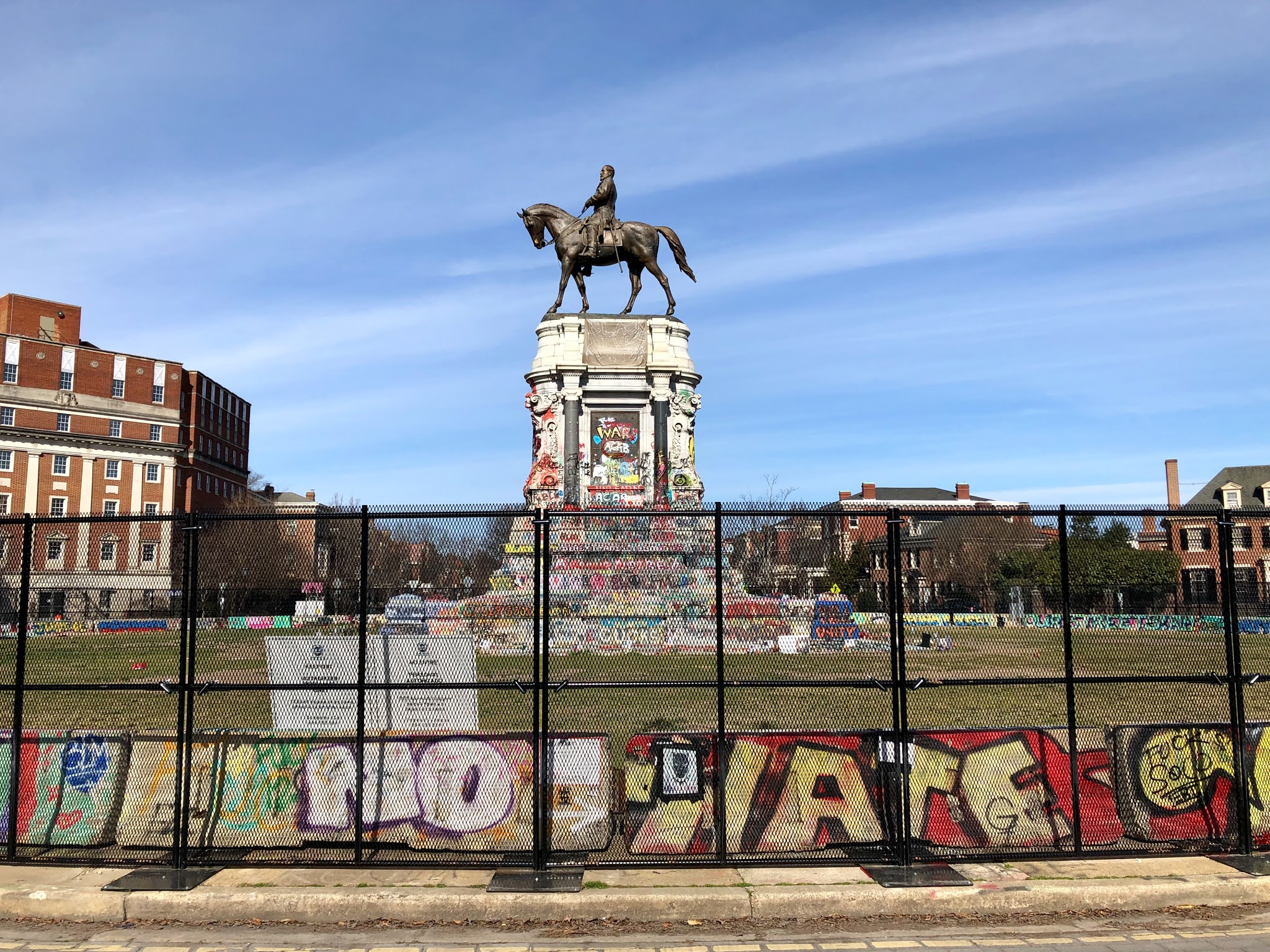
The Lee Memorial is the biggest of the five on Monument Avenue and it's located on the biggest plot of land, a massive traffic circle at the intersection of Monument Avenue and North Allen Avenue. It was the first erected and it's clearly the most important. It's also today the only one that still has its statue and it's the only one you cannot walk up to, because there's a fairly sturdy metal fence erected at the perimeter of the traffic circle.

Like the monuments to Davis, Jackson, Maury and Stuart, the Lee Memorial was defaced with graffiti. Unlike the other four, the graffiti hasn't been removed. Neither has the Black Lives Matter banner been stripped from just below the statue. And it's glorious. It's absolutely uplifting in its democracy.

Robert E. Lee was in charge of an army that fought against the United States. If he had won, he would have preserved the institution of slavery and helped establish a nation with that belief at its core, that black people were inferior to white people and they deserved to be owned as property. Some folks have made their thoughts known about this at every level of his Memorial in a rainbow of lurid colors.

But there are other truths about our society spray-painted on the Lee Memorial that have nothing to do with the Civil War necessarily. The idea that it's OK to discriminate against people that some folks may be uncomfortable around. The idea that some of society's institutions either deliberately or unconsciously work to preserve the current power structure. The idea that politicians are openly and unabashedly working to disadvantage people unlike themselves. There are a lot of different messages written on the Lee Memorial. Some of them are rude. Some of them are obscene. But almost every word of it rings true to me. I'm not going to re-write them in this blog but I'm sure you can zoom in and read some of them. Look up the ones that aren't familiar to you.

The Lee statue is still in place. I'll be happier when it comes down if that really happens this summer. I hope the city doesn't clean the rest of the Memorial or the concrete barriers spray-painted around the perimeter of the circle. I expect that they will. I can't imagine a city being OK with swear words written large and clearly on its public monuments.

I think the great thing about what's happened to the Lee Memorial is that it has been transformed from something inherently objectionable into something really powerful and optimistic. The defacing of the Memorial is a clear and obvious rejection of everything it stood for originally and the point of the thing has been completely re-messaged. It's more powerful to me leaving it in place as is (without the statue of course) than tearing it down completely. This is public art that really means something. I hope it stays but I'm not counting on it.


So that's what we saw on Monument Avenue. Before we left Richmond, though, we wanted to take a look at one more statue. 

The no longer available for public viewing J.E.B. Stuart statue is notable from a composition standpoint. Stuart's horse, were it still in place, is facing south with its head tilted slightly to the left and its front right hoof raised, which traditionally means the rider died as a result of wounds sustained in battle (which Stuart did). Stuart atop his horse, again...were he still in place, is not looking forward as he is mounted but instead his torso is twisted and he's facing west which allows the viewer to see his entire torso and face unblocked by any other part of the statue. Its a dramatic pose that you wouldn't normally see a rider strike.

In September of 2019, a second statue with this same pose was erected in Richmond in direct response to the artistry of Stuart's statue. This one, titled Rumors of War, was commissioned by the Virginia Museum of Fine Arts and stands just in front and to the right of their building just west of the Fan District. The horse's pose is identical to Stuart's horse, right down to the angle of the head and the full extension of the tail. The rider strikes a similar pose to Stuart but the likeness is quite different. Instead of a white man fighting to preserve slavery, Rumors of War features a young, dreadlocked black man in a hoodie and Nike sneakers.

Rumors of War was sculpted by Kehinde Wiley, the same artist who painted President Obama's portrait that hangs in the National Portrait Gallery in Washington, D.C. It is of course intended as a direct response and contradiction to everything that Stuart's statue represents and it completely works, in a similar way to the graffiti and Black Lives Matter banner that you can see at the Lee Memorial. The irony is lost just a little bit now that Stuart's statue is no longer in place but that's really not a good enough reason to allow Stuart to return.


I think art that references past works directly or indirectly to provide a different interpretation of the original subject is so smart. Both Wiley's work and what the people of Richmond have done to the Lee Memorial do exactly that. And in completely different ways. The message is powerful in both cases, although it's a lot easier to see in the case of the Lee Memorial. Time will fade the full meaning of Rumors of War. The longer Stuart's statue is gone, the more difficult it will be to remember what the statue is referencing and refuting.

I'll be interested to see what happens in the near future to the Lee Memorial. How long will Richmond allow a vandalized, obscenity covered public monument to stay the way it is now? Will they actually take down the statue this summer? And if they do, will they use that opportunity to clean off the pedestal? Either way, will they continue to leave in place the concrete barriers, spray-painted or not, and the metal fence around the perimeter of the circle? Removing the graffiti or removing the pedestal entirely and re-purposing the circle might be more attractive, but erasing what's happened to something that never should have been there in the first place would be disappointing, I think. It's powerful the way it is. Remove the statue and erase what probably never should have been done in the first place but leave the rest please.

Not particularly elegant in its expression but neither is fighting to preserve slavery.

How We Did It

There is nothing complicated about finding the five monuments or former monuments on Monument Avenue. Just make your way to that street in your preferred mode of transportation and start heading either north or south. You can't miss them. They range from Stuart Circle on the south end to Arthur Ashe Boulevard on the north end. In sequence south to north you'll find Stuart, Lee, Davis, Maury and then Jackson.

If you want to see Rumors or War, might as well do it before or after you see (or don't see, I suppose) Stonewall Jackson. The Virginia Museum of Fine Arts is located on Arthur Ashe Boulevard about a quarter of a mile west of where Jackson used to be. 

One of the best things about this tour is that it's all free. It took us a little more than an hour to see all six. We definitely spent the most time at Lee's Memorial. It definitely has way more to look at and take in than the other five. 


Tuesday, November 10, 2020

From The Tetons To Yellowstone


It is very strange for us to spend an entire week of vacation the way we spent a week in Grand Teton and Yellowstone National Parks. Generally speaking, we crave variety when we travel and spend our days rushing from one different thing to the next different thing to take in as much as possible. Call it attention deficit disorder or a fear of being bored or impatience or wanting to suck the marrow out of life every day we are not at work, but the notion of spending a week focused on just two National Parks is craziness for us. But that's just what we did. 

Not that Yellowstone and Grand Teton are lacking in variety.

We definitely had an agenda. Elk. Moose. Bison. Geysers. We felt pretty sure we'd get all of these and we were right, although the quality and quantity of moose sightings exceeded our expectations and was definitely very much appreciated. But we also didn't want to be too myopic on this trip and lose sight of the big picture. We wanted to see more wildlife than just elk, moose and bison. We wanted to exist in a place that man has left largely untouched. We wanted to be awed and relaxed and forget about how badly our species has messed up this planet. At least for a week.

We got all of that.


One of the reasons we could stand to spend a week out in northwest Wyoming was simple: these places are enormous. There's just a whole lot of territory to cover. And that means that filling a day is easy, especially when some drive times to the places we wanted to go are 2-1/2 hours or more. I knew this before I went out there because I'd spent a little more than a day in Yellowstone nine years ago and missed a ton. But it really hit home when we spent the better part of two days in the Tetons and pretty much four whole days in Yellowstone and STILL missed a ton. Maybe MORE than a ton.

I asked some friends before we left for this trip for some advice on must dos in Grand Teton. A boat trip across Jenny Lake sounded like a can't miss thing to put on our list and then check off at some point in our couple of days in the Tetons. But honestly, we just didn't have time. And it was probably due to the hours we spent down Moose-Wilson Road watching moose and bears. We also missed about half the length of Antelope Flats Road, all of Mormon Row in the same area and a whole bunch of turnoffs and side roads that could have really been worth exploring. We also didn't do any hiking in the Tetons.

I think we did a better job of covering ground in Yellowstone, although we didn't drive between Lake Village and West Thumb (in favor of another pass through Hayden Valley) and the road between Canyon Village and Tower-Roosevelt was closed to all traffic (it's closed all of 2020 and 2021). We missed a side road here and there I'm sure, especially when we were in thermal areas information overload mode. It makes sense we'd cover Yellowstone more comprehensively. We did spend almost three times as long in that Park than in Grand Teton.

I could easily have spent probably two more days, most of it in Grand Teton, than we did. I'm shocked to be writing those words. 

The Teton Range looking west from the Mormon Row area.

The Grand Canyon of the Yellowstone, Yellowstone National Park.

So how did we spend our time? Mostly driving around and gazing at the scenery and the wildlife.  Pretty simple.

On the scenery side of things, Grand Teton is dominated by the Teton Range on the west side of the Park. These peaks are so striking and they seem to be visible from just about everywhere you go in the Park. They form a sort of staged backdrop to the incredible landscape in the main part of the Park and they are reflected in the Snake River and other bodies of water you encounter as you make your way around the loop in the south section. They are without doubt the singular most distinct memory I have of Grand Teton.

Yellowstone is completely different. Whereas the Tetons are fairly homogeneous, Yellowstone is like a theme park with different worlds seemingly invented by a park designer to get the visitor the maximum range of landscape experiences. Geyser basins, valleys, rivers, canyons, mud pots, cliffs, mountains, scorched vistas, water containing multicolored collections of microscopic organisms and one really, really big lake. Yellowstone has all of that and way more.

We traveled most of Yellowstone for the first time in the dark, getting up before dawn to get to Hayden Valley or Lamar Valley before the wildlife got moving off the wide open spaces and into the Park's forested areas. It was astonishing to see some of the places we'd driven and how close to the edges of roads with some sheer drops. It sounds like a stupid statement but Yellowstone is way more varied than it looks at night but one of the aspects of Yellowstone that I found fascinating was the fact that we traveled through such diverse landscapes in the dark without realizing it.

The Teton Range reflected in the Snake River near Schwabacher Landing, Grand Teton National Park.
First mountain goat I've seen in the wild. Yellowstone National Park.
The river valleys in both Parks were some of my favorite places to hang out. This year has in many ways been one where we've visited river after river all over the west of the United States and the Snake and Yellowstone and Madison Rivers we saw out in Wyoming were just as striking as any others we've seen. I love the way the valleys are so broad with a lazy waterway winding its way down the middle with mountains or forests on one or both sides. It also doesn't hurt to have a bison or elk or two or three or ten dotting the valley.

I also appreciated the mountains. I mean we were in the Rockies for crying out loud. I loved the very small mountain area of Yellowstone for a number of reasons, not the least of which is we managed to spot a couple of mountain goats hanging out among the rocks. And it's difficult not to gaze in wonder at the Tetons at every opportunity. These things look like God just deposited a series of perfectly crafted peaks on a great plateau in the Rockies. We couldn't help taking picture after picture of these mountains from about every spot in the Park we could see them.

And of course, nothing could be further from the truth about how the Tetons got where they are. They came from below through tectonic action, not from above by divine act.

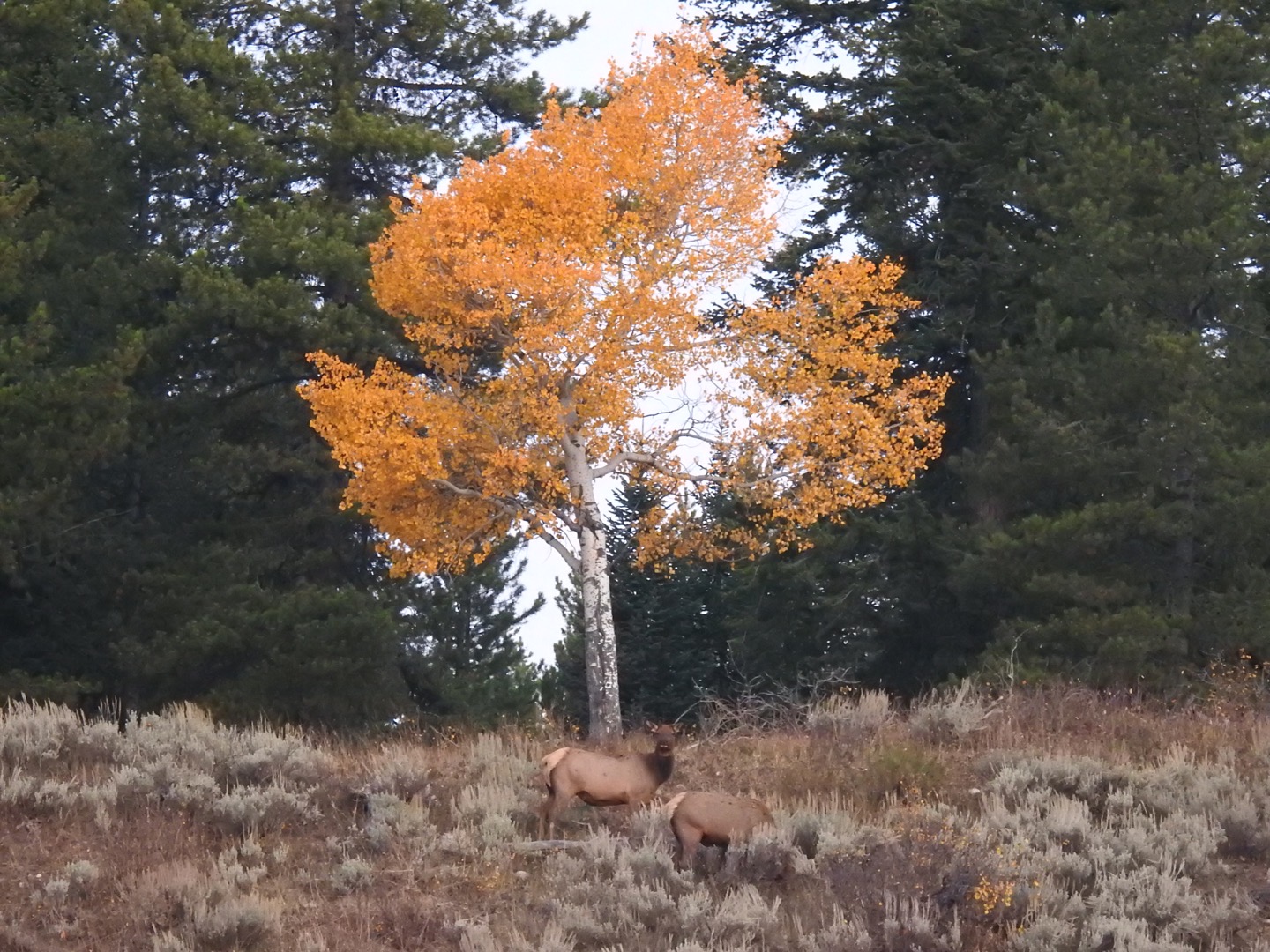
Fall colors with two elk. Grand Teton National Park.
Coyote. Lamar Valley. Yellowstone National Park.

I also think that visiting in the fall helped our trip. The last time I was in Yellowstone it was as green as can be from the grass in the valleys to the evergreens and deciduous trees everywhere else where anything could grow. In the fall, there are trees here and there with bright oranges and yellows to inject a dash of color into the sameness in the forests and the grass in the valleys is a pale straw color, which among other things is perfect for hiding coyotes.

I don't know why I am still amazed at nature's camouflage. I have watched lions the color of grass and leopards in trees in Africa and marveled at how the colors and shadows of their natural environments hide those animals. I've also written just last month how the color of the bark and the darkness of the trees in Yellowstone obscure animals as massive as elk. I guess I just didn't expect coyotes to be so invisible in the fall grasslands of Yellowstone. Maybe it's the Road Runner cartoons.

Ultimately, we did spend the majority of our time in both Grand Teton and Yellowstone either watching wildlife or moving from one place to the next in hopes of seeing wildlife. I've already written about the moose, elk and bison we saw last month in separate posts because those were the most visible species. But that wasn't all we saw. 

Bald eagle in flight over the Snake River. Grand Teton National Park.
Bear no. 2. Grand Teton National Park.
If there was a hope we had in our animal search in Yellowstone and the Tetons, it was that we would see plenty of bears. By plenty here, I don't mean plenty like we saw plenty of elk or bison. Maybe 10 was a stretch goal? We saw three earlier this year in Rocky Mountain National Park in a single day in a park where bears aren't that common. I felt I was being realistic in hoping to exceed that total in six days in a place where there are more bears. And by that I mean more total quantity (although the precise numbers in RMNP aren't known) and more species (two vs. one). There are more than 700 grizzly bears in Yellowstone alone; Rocky Mountain likely has less than 1/4 of that total number of just black bears. Of course, it's a bigger area. Much bigger.

If there's one thing we pretty much counted on not seeing, it was wolves. Wolves were re-introduced to Yellowstone in 1995 and their numbers as of the date of our visit were reported to be 99 total. I'd seen every species we hoped to see in Grand Teton and Yellowstone before with the exception of mountain goats and wolves. No way did I hope to see either. I didn't even realize there were goats in Yellowstone or the Tetons, or at least not visible from a car, but we saw our first couple ever. But wolves? The odds seemed stacked way against us. Yellowstone was full of surprises.

There were really no disappointments on this trip but if there was an unpleasant surprise, it was that we only saw two bears in the whole week we were roaming around the Parks. They were both pretty poor looks. The best photograph we got of either bear (and frankly they may have been the same bear in the same area of Grand Teton at two different times) is above. We struck out entirely in Yellowstone.

I know. I know. I'm whining. Or Crying. Wahhhh!!!!! I didn't see more than two bears on my week trip to one of the premier destinations in the United States. But it's true. We wanted more bears. We thought we'd see more than two. For the record (and based on the narrative of people around us who may or may not know what they were talking about), it was either a grizzly and a black bear or two different black bears or the same black bear twice. Personally, I'm leaning towards a grizzly and a black bear, although the best photographic evidence of bear no. 1 (the "grizzly") is below. That bear, by the way, was moving fast. Good thing it was a good distance away.

Grizzly or black bear? I'm leaning towards grizzly.
But we did see wolves.

I know I've already said this but I thought there was no way we were going to see any wolves whatsoever. We're talking 99 dogs in an area almost twice the size of Rhode Island. What are the odds?

But we didn't just see one or two wolves. We saw a lot of wolves. On three different days in two separate locations in Yellowstone National Park.

My first tip for seeing wolves in Yellowstone based on our very, very limited exposure is to visit the Lamar Valley in the northeast corner of the Park. I know, it's remote and if you are staying in West Yellowstone, Montana (like we were), you'll need to get up super early to get over there when the wolves are still active in the morning (we left one morning at about 5:30 a.m.). But we were two for two in Lamar. Two visits, two sightings of multiple wolves.

Admittedly, both sightings were at a very great distance. Probably at least half a mile away. The animals were like ants on the landscape, even when using binoculars or the zoom lens on our camera which we have been so impressed with in the past. But they were clearly wolves and it was remarkable to see them move across the landscape as a pack, not in a group like I expected but single file with a really good amount of space between them. I think one of the most remarkable benefits of observing wildlife with your own eyes in a natural environment is seeing behaviors that wouldn't necessarily stand out if you were told about those behaviors in a TV show or something like that. How wolves move is indelibly stamped on my brain from our visits to Lamar Valley.

If you do go to Lamar Valley, or anywhere else in the Park really, be prepared to share space with people with some fantastic and very large zoom lenses and telescopes. Their equipment dwarfed what we thought was the ultimate travel camera for seeing and photographing wildlife. Their gear was much better than ours. Although I wouldn't want to lug their stuff on a plane as cabin baggage. 

Wolves in Lamar Valley. Yellowstone National Park.
Lone wolf. Hayden Valley. Yellowstone National Park.

My second tip for seeing wolves in Yellowstone is to get lucky. I know...it's a terrible tip. But in a way it applies to all wildlife watching. We didn't get lucky with bears. We got super lucky with wolves.

We always have an itinerary for our trips. Most of the time, we follow those agendas to the letter and build in enough float to linger or improvise. Sometimes, we read the conditions on the ground and decide to go a different way. We did the latter in Yellowstone and it completely paid off. Our original plan for Yellowstone had one trip to the Hayden Valley, but after driving through once, we not only adjusted our route back to our hotel to take another pass on the same day but we decided an early morning visit on a different day might pay off somehow. That's where we got to see a wolf at a distance of about 20 feet.

There were a number of wolf false alarms (or was it crying wolf?) in our time in Yellowstone. There were at least four or five or maybe more times when we heard someone calling a coyote a wolf. So on our second day in the Hayden Valley we were not quite ready to believe that the dog-like creature trotting about ten feet off the road just before the sun was really up was a wolf. But after a second or two lapse of brain processing time, it was.

Right there in front of us (and a caravan of 15 or so cars) was a yearling wolf separated from her pack. Super close. Way closer than the 100 yards of separation recommended by the Park for this kind of an animal (although that doesn't really count when you are in a car). Honestly, this was such a thrilling sight that for the 20 minutes or so we followed this wolf, we forgot all about the whole no bears thing. This is one of the apex predators in the Park and it's right there in front of us.

This was absolutely amazing. So amazing in fact that our fellow tourists stopped their cars as close as they could and piled out of their passenger side and driver and back seats to snap the best possible pictures. I'd love to say that we exercised a little more caution (and I think we did - keeping the car between us and the wolf or opening the door but standing on the step of our SUV) but it's super easy to get excited and lose track of what the rules are. I mean it's a wolf less than 30 or maybe even 10 yards away.

Wolf. Carcass. Hayden Valley. Yellowstone National Park.

If there has to be a singular experience that represents this trip (and I'm not sure there has to be), this was it. To get this good a view of a wild wolf is something that's not going to happen each time you visit Yellowstone. It truly was so lucky, although getting up early was definitely a part of making our own luck.

We don't have great pictures of our lone wolf. The lighting was not ideal and she moved pretty fast which made taking amazing pictures with our camera a little difficult. I still think we got a couple of pics that I'm proud of for us to remember what we saw.

Two Parks. Six days. It's still crazy to me that (1) we spend this much time doing sort of the same thing over and over again and (2) that we still missed so much. No hikes. No Jenny Lake. No bears (well...two), no Tower-Roosevelt, tons of missed side roads and drives. But wolves, fighting elk, moose, herds of bison, geysers, multicolored pools and those gorgeous Tetons in the fall? Tremendous. What a week. 

Everyone should go to Yellowstone at least once in their life. If you go, make your own luck. Get up early and stay for multiple days.

One last look at the Tetons. From Mount Moran Turnout. Grand Teton National Park.

How We Did It

Both Grand Teton and Yellowstone National Parks are open all year round but access to certain parts of both Parks are severely limited in the winter season. Check their websites for current conditions by clicking the names of each park earlier in this paragraph.

Both Parks charge admission, although there are days of the year when admission is waived. You might also save a few bucks by purchasing U.S. Parks Annual Pass which will get you into all National Park Service properties and a whole host of other sites for free. The Pass, which we purchased last November, costs $80 as of this writing. The 2020 entrance fee for Grand Teton is $35 and you can add another $35 for Yellowstone. It won't take but one more Park visit somewhere else to make buying a Pass worthwhile. The $35 admission fees to both Parks are good for seven days each.

Note there is a large amount of territory in the south end of Grand Teton that is outside of the entrance gates so depending on where you want to go, you might be able to visit Grand Teton for free. You can get to our favorite moose and bear watching spot down on Moose-Wilson Road without paying. Or at least you can if you are traveling from the south.

We found the best places to see wildlife in Yellowstone to be Lamar Valley and Hayden Valley. Get up early for the best sightings or stick around until dusk. We considered hiring a guide for a day to help us find wolves but found pricing to be north of $500 per day. We took our chances on our own and I think we made out pretty well. We actually followed a couple of guided tours in Grand Teton for a while and they didn't seem to have any better luck finding animals than we did. I guess a huge advantage of being with a guide is that they likely have better gear than you do. I'm happy with the $500+ that's still in my bank account.

We also found it really useful to ask what people were looking at. We got a lot of help from strangers pointing out what they were focused on when we were just lost. You might not have that long to see some of these animals. They have a way of disappearing into forests quickly. Ask for help.

You can see that gorgeous Teton mountain range from just about any spot in Grand Teton south of Jackson Lake.


Thursday, November 5, 2020

West Yellowstone Motels

Every so often a trip throws me an unexpected curveball. Sometimes those curveballs lead to disappointment; sometimes they end up being really nice surprises. I never would have imagined I would have found one of the latter when we pulled into West Yellowstone, Montana to check into our second of three hotels on our Grand Teton and Yellowstone swing. But that's exactly what happened.

I may have mentioned once or twice on this blog that I am somewhat obsessed with neon and signs, either separately or together (together is very definitely better). So when we left Yellowstone National Park's West Entrance and turned right onto Boundary Street in West Yellowstone, I thought I'd about died and gone to heaven. Staring straight at me in the early evening light were three vintage motels with their neon ablaze. It was glorious.

My expectations for our time in West Yellowstone were pretty low. I am not trying to put the place down but I figured this was a place where we'd just eat and sleep and get out back into the National Park as quickly as we could. I expected that the place would exist solely to cater to tourists wanting exactly what we wanted at the lowest possible price and I think I was pretty much right. There is little reason for the town of West Yellowstone to offer deluxe accommodations or cutting edge food. The attraction that's going to keep people coming back is the Park, not the town. And the Park's not going anywhere any time soon.

But that reality is probably precisely what has kept in place what I found when we turned on to Boundary Street. No way would these motels with their glimmering, multi-colored, straight-out-of-the-mid-20th-century neon stick around for what is probably 50 or 60 years if West Yellowstone was constantly replacing their hotels with bigger and better and more modern establishments.

Boundary Street is a bit of a tease. We explored the town looking for more than those first three motels we saw when we made that right turn and failed. We found a couple of more motels worth writing about but they were not lit up in the same way. Although one motel could be, they just need to turn the lights on.

So let's start with those couple...

Beyond the initial three motels we saw, we found the Ho-Hum Motel, with the neon owl sign above affixed proudly to the North Canyon Street end of their main block of rooms, and the non-neon Pony Express Motel shown below. I know the Pony Express is not immediately impressive to the eye but there's one piece of fading Americana that amuses me to death every time I see it. We'll get to that.

I photographed the Ho-Hum owl during the day because for some reason (and I'm assuming it was not just the two nights that we checked), the motel does not turn on the lights at night. I would have loved to have seen this sign's colors, even if it had been just the owl lit up (since the rest of the sign does not appear to illuminate). This was super disappointing to me. Maybe it's broken? 

As a side note before we move to the Pony Express here, who names their Motel "Ho-Hum"? It literally means "boring". I'm assuming the name does not affect the occupancy rate.

So about that Pony Express sign...

When we moved to the United States in 1979 and started taking family vacations, I remember seeing the same sign at many of the hotels and motels we stayed at on our trips: "Color TV". Yes, at one time it was common to find only black and white sets in motel rooms (just like we used to have at home when I was growing up) and having a color box could be a real differentiator. Now, of course, the notion today of having anything but a color flat screen television in a motel room is ridiculous. But some motels still have the sign hanging around and I love it when I find these relics.

I know you can't see it well in the photograph below but the Pony Express' "Color TV" sign is in awesome condition, features different colored letters to emphasize that they are really serious about their color television and to top it all off the sign includes "by RCA" at the end. I love this. But like the Ho-Hum owl, it also doesn't light up. So like the Ho-Hum photo, this one is also taken during the day.

Those first three motels we saw when pulling in to town were Al's Westward Ho Motel, The Dude Motel and the Round Up Motel. From a multiple colors of neon perspective, Al's and The Dude are the two best signs in West Yellowstone. Al's mixes script and block capital letters into a simple sign that works well next to the simple, gable-roofed motel office. I love the simplicity of execution here, especially the top of the sign where the "Al's" is featured against what I can only assume is a hat-shaped background.

The Dude sign is better than Al's. It is difficult to argue against the beauty of a sculpted neon sign and while the majority of The Dude's sign is non-neon flat backlit translucent, the dude himself is a work of art in neon tubing. This is by far my favorite sign in West Yellowstone. There's no comparison. I would need the Ho-Hum owl to get lit up to enter any semblance of argument about that issue.

And then there's the Round Up. If there's a better argument for what neon can do to fancy up a place than the Round Up Motel, I'd love to see it. The Round Up's office is about as unremarkable a building as you could find. The only way it could really be less well thought out as a piece of architecture is if whoever designed this thing just left out the windows. But stick an L-shaped (in plan view) neon sign next to and over the top of the brick box and it becomes something to look at and appreciate. 

I love the simple lettering on this sign and the way the "Round Up" is slightly angled and encircled by a lasso rope, reinforcing the name itself. I'm sure this sign cost a pretty penny when it was installed and for me, it's money well spent. It makes the whole building sing.

West Yellowstone will likely never be much more than it is today. It's a town of 1,200 permanent residents serving up to 12,000 tourists per day. But I was wrong about this town. I expected to find a place not worth mentioning in the story of my travels. Ho-hum, if you will. But these motels represent the best of what we found just outside the West Entrance of Yellowstone National Park. And with that statement I'm not setting a low bar. I love these motels. They are a well-preserved throwback to a different time in American history. I hope they keep these things lit for a long, long time.

One more appreciation to close this post. Our last three trips have been mostly focused on nature and I've written a lot about the American landscape and wildlife this year. I appreciate these buildings and these signs tapping into a love of writing about design. Definitely worth a post. Thanks, West Yellowstone!

Close up of The Dude sign with that fantastic neon.

How We Did It
Since we didn't expect to find what we found in West Yellowstone, this post required no planning whatsoever. It was one of those awesome discoveries that we never expected.

Four of the five hotels highlighted in this post are on Boundary Street, although only one (Al's Westward Ho Motel) has that street address and two of the hotels are actually the same property. At some point, the Round Up and The Dude, merged into a single property called The Dude and Round Up Motel. If you make that same right we made coming out of Yellowstone's West Entrance, the Pony Express is the last of the four you'll come to.

The Ho Hum Motel is not on Boundary Street in any way. It sits on West Yellowstone's main drag of North Canyon Street. Click on the name of any of the hotels in this How We Did It section to visit the hotel's website. The Ho Hum link will take you to their Facebook page; their profile pic is the neon owl all lit up. And all in red, which is surprising.

We didn't stay at any of these places. I'm a Best Western and Hilton guy so we opted to stay at the Best Western Weston Inn, which was fine but decidedly way less exciting in the neon department. Plus, I didn't know these motels were here in the first place.