Monday, October 17, 2016

Liberté Égalité Fromagerie


Charles de Gaulle, the French General and President, once famously uttered the words "How can anyone govern a nation that has 246 kinds of cheese?" The first thing I said when I booked my airfare to Paris earlier this year was "I'm going to eat so much cheese!" I consider my quote just as valuable as de Gaulle's. Take that as you will.

We landed at Charles de Gaulle airport (funnily enough) outside Paris at about 7:30 am on a Saturday morning this past September after an overnight, non-stop flight from Dulles airport near my home in northern Virginia. About four hours later I was strolling down the rue Moffetard with a baguette in one hand and a crottin of goat cheese in the other experiencing a kind of bliss that only things like English beer and French cheese can bring to me. This is a kind of heaven on Earth experience I love every time I do it. I know it will never get old.

I believe every trip to Paris or France should involve cheese. And not just a nibble after dinner or a walk around a grocery store or fromagerie picking up some samples and popping them in your mouth to distract yourself. I mean like whole meals of the stuff with several different varieties, preferably with a fresh crusty baguette, although honestly I consider the bread optional. It definitely helps with blue cheese though; offsets the salt in some varieties very well.

We designed our cheese experience in Paris a few weeks before we set off on this trip. We allowed ourselves to wing it a little bit, figuring we'd run into one or two or forty or fifty fromageries just walking around at breakfast or lunchtime (we did). But we also signed up for a cheese tasting since I'd never done that before in Paris and we circled on a map a couple of what were allegedly the best of the best merchants in the city to seek out a particular kind of cheese: young raw cow's milk (read: unpasteurized) cheeses that had been aged less than 60 days.

Why this specific type of cheese? Well quite simply because you can't get it in the United States. It's banned. It has been since 2004. The Food and Drug Administration has determined that there are just too darned many bacteria living in cheese made from unpasteurized milk and so they prohibit the importation and sale of such cheeses right after they are made. 60 days later is fine, but not 59 or less. Go figure. And hold that thought. We'll come back to these later.

Part of the cheese selection at Chez Virginie in Montmartre.
First setting foot inside a Parisian fromagerie (or cheese shop; fromage is French for cheese) is a magical experience. It's not like heading down to Whole Foods to buy a wedge of gruyere. If you are lucky, you will be faced with every shape and size and color of cheese known to man and a lot of it will probably be unknown to you. Sure there are some familiar things like wheels of brie or camembert and maybe some sort of cheddar and some logs of chèvre. But there will also likely be aged bright orange hard cheese, cheese wrapped in clear film to prevent it from running away, small cylinders or cones or donuts of whitish looking things (hint: it's cheese) covered in what looks like some sort of mold (it is); and maybe even some things that more resemble scotch eggs than what we think of as cheese. Don't be afraid. It's really good!

And the smells will be incredible. I know it's funky when you first walk in but there's a freshness and sourness and tang and overall cheesiness to assault your senses which is wonderful. Faced with that smell and the sight of the whole array of different shapes and sizes, you know this is going to be good. Some fromageries are set up with all the cheese on one side of the shop; the most fun ones have it on both walls and the back of the store meaning you are literally surrounded with the stuff. Then you can truly feel like you are in cheese heaven.

The magic for me started that first morning in Paris. We stayed this trip on rue Monge in the Quartier Latin and as soon as we had a quick nap, we walked a few blocks west to rue Moffetard, a sort of all day, everyday (well, except Monday) open air market featuring creperies (lots of them), bars (lots of those too), boulangeries (bread shops) and of course a fromagerie or two. I just picked some cheese that looked like nothing I could get in the United States and just started eating and walking. This to me is the best way to start. Don't get something that looks familiar. Take a chance and get something different. You might be pleasantly surprised.


Now, trial and error might work on day one, but cheese week in Paris this time around for me needed some structure, so four days and two meals of only cheese and bread later, we arrived at Parole de Fromagers, a cheese merchant right near the Marché des Enfants Rouge (the oldest covered market in the city of Paris) to take our experience to the next level.

Parole de Fromagers is not just a cheese shop. They are actually cheese agers or what is known in France as an affineur. What this means is they are allowed to age the cheeses they get from cheesemakers to fundamentally change the flavor. They essentially take off the "best by" date and guarantee the quality of the cheeses based on their own aging techniques. We stopped into their aging refrigerator in their sixteenth century cellar right when we got there. What we saw there might make the FDA shudder: cheeses stored openly in a tight room wth air directed over the top of them; cheeses buried under straw or with pieces of straw inside them; and cheeses with either patches or entire shells of greenish blue glistening or powdery mold. To me it looked amazing.

But we didn't come to Paris to watch cheeses age; let's get to the good stuff. Our tasting guide that day was Pierre, Parole de Fromager's in house aging expert with a little wine knowledge on the side gained from his generations old family winemaking business. Cool stuff, folks. Pierre taught us that day how to taste cheeses, which is something I will never think about in quite the same way again.

Pierre Brisson telling us all about how to taste and eat cheese.
When we finally sat down at the table, in front of us were seven different pieces of cheese and sure enough one of them was wrapped in plastic to keep its shape. And yes, it did start running as soon as the plastic was removed. We started with the mildest tasting, a sharp goat cheese aged in their cellar with a strong hint of mushrooms (and thus covered with a blue-green powdery mold), and worked our way to the strongest tasting, a salty bleu d'Ecosse from the southwest of France which definitely needed to be eaten in quantity with the nearby baguette. This mild to strong technique is the way I've always tasted beer; going the other way doesn't allow you to taste the milder stuff properly.

I won't give a blow by blow of our experience but I will cover the highlights. The tasting method we were taught involved sight, smell and taste. After being taught how to cut cheese properly (rind to rind to get all the flavor profiles in a single cut), we started our experience by inspecting both the rind and the paste (the inside of the cheese or pretty much just the cheese) to observe the texture of each before smelling each component of the cheese individually. When tasting, we were told to spread the cheese around our mouths with our tongues and then breathe in and out through our noses while holding our tongues away from the roofs of our mouths. Sound like some hocus pocus? It generally worked, even for me with my limited palate. You really could taste the cheese better this way.

Some other highlights of the individual cheeses? Pierre showed us how the shop makes the aged cheeses more appealing to the customer by tapping on the first goat cheese crottin; he essentially made it rain with mold onto the table. Less mold = more appealing. Unsettling perhaps but we ate every morsel of that stuff. We tasted a young raw cow's milk brie (we'll get to the raw cow's milk thing I promise) where the smelling really helped; the aroma of cauliflower and ammonia helped us understand the first wonderful bite but this was definitely something to be taken in moderation. By the fourth of fifth bite all you could taste was ammonia. This was the only cheese our group did not finish.

We also ate a Beaufort d'Été, a yellow cow's milk cheese (think cow when you see yellow) which was buttery and fruity and overall just the picture perfect cartoon-like taste of cheese, and a washed rind cheese that we ate with a spoon (this was the runny one). As crazy as it sounds, we discovered during the smelling portion on this one aromas of yeast and hot chocolate. I'm not kidding. I'm not saying the cheese tasted like hot chocolate because it was fairly mild and creamy but it definitely smelled like hot chocolate. We ate this cheese with a sweet red wine that made both the wine and cheese taste better. We also found out that eating it with bread destroyed the taste. The baguette tasted and acted just like a sponge inside your mouth. Yuck!

I'm not usually the kind of guy who goes in for this sophisticated tasting notes thing but I'm telling you Pierre opened up my eyes that day. It was the cauliflower, ammonia and hot chocolate that got me. For better or worse.

The 24 month aged Comte in Fromagerie Laurent Dubois complete with crunchy amino acid clusters. Yum!!!
Our tasting at Paroles de Fromagers was my third (of four) meals of just bread and cheese in the week. Hey, there's a lot of other great food to eat in Paris. We can't eat the same thing for every meal. But let's get back to this whole young raw cow's milk cheese thing, shall we? Because this was the holy grail we came to find in France.

In our second day in country, we went up to Sacré-Coeur, the gorgeous white and gold church in Montmartre which overlooks the entire city of Paris. After climbing to the highest point in the dome for a less than impressive view in the morning mist (you can't get all the way to the top, just so you know), we took a walk over to 54 rue Damrémont, the location of Chez Virginie, a fromagerie that we had read specialized in the sort of contraband cheeses not permitted in the good old U. S. of A. that we were seeking on our trip.

Chez Virginie is an amazing place. It's a tiny little shop with very little floor space that appropriately devotes much more surface area to their product than it does to customers or the people who work there. The spread is incredible. There are cut and whole cheeses in every color and texture and each is immaculately presented.

I can speak enough broken French to get by but I can't ask for some young raw cow's milk cheese. So after a quick "parlez-vous anglais?" we got to the business at hand. These guys were great. After getting my preferences down (definitely some soft blue with strong flavor and maybe something a bit stiffer in texture) I was pointed to a couple of different cheeses that they felt met my requirements. What I emerged with was a slice of Bleu de Bonneval, a wheel of Saint-Félicien and the directions to the nearest boulangerie.


While I struck out with the Saint-Félicien which was a bit too goat's cheese textured, the Bleu de Bonneval was a grand slam home run. It is an off white cheese with large irregular gashes of blue and a yellow and green striped rind. It was soft and creamy which was just what I asked for with a sharp finish and I could taste the blue on my tongue while I walked around Montmartre the rest of the morning. This is what I came to France for. This was the perfect blue that I was seeking.

Now, whether it being a young raw cow's milk cheese made it this way, I can't say. Sure you can get a cheap thrill out of breaking the FDA taboo but I'd obviously have to compare it to some other older cheeses to get a really good benchmark. The only thing I can say is that having more types of cheeses available to me gives me more variety to pick and choose which are my favorites. The Bleu de Bonneval is definitely on that list. And I didn't get sick or die or turn into a piece of mold or whatever else our American regulatory agencies feel is going to happen to us.

The blue we ate from Chez Virginie I think was one of the top two cheeses I consumed in my week plus in Paris. The other hands down winner was the 24 month aged Comte from Fromagerie Laurent Dubois in the 5e Arrondissement which was just plain buttery and cheesy and so delicious. If you love cheese, I'd encourage you to find your own cheese trail in Paris. Next time I go I'm sure I'll consume as much or more as I did this time and I'll do it totally differently. After all, if de Gaulle was right, I just scratched the surface on this trip.

Final note: I know what you are thinking. How much weight did I gain in France? Let me just say that Paris is an incredible walking city. I came back from Paris weighting exactly what I did when I left home. Seven to ten miles of walking each day will do that for you. If some of that walking is done with a baguette and a hunk of cheese, I'm all for it. Bon appetit, everyone!

Baguette and Fourme d'Ambert Grand Affinage (blue cheese) for breakfast near the Maubert-Mutualité Metro.

Saturday, October 15, 2016

Statues Of Liberty


Should the title of this post be Statues of Liberty? Or Statue of Libertys? It's certainly not Statue of Liberties, is it? I'm going with my first impulse here: Statues of Liberty it is!

I love the Statue of Liberty. I love it as a symbol of the United States of America and New York City. I love it as a beacon of hope for immigrants flocking to our shores in the late 19th and early 20th centuries. I love how Lady Liberty is raising a torch to light her way through the darkness while stepping out of broken shackles that used to confine her (this is admittedly impossible to see when visiting as a tourist). I love how strong and fearless and uncompromising her face is to all that would doubt or question her ability to exist or triumph. And I actually love the fact that at one time, nations (in this case, France) were giving other nations 150 foot high statues that they expected the recipient to place somewhere nice. Good thing it's attractive!

If you want to see the real deal and have never been over to Liberty Island to see the Statue in person, get yourself to New York, grab a ferry from Battery Park (or you could go from Jersey, I guess) and spend a half day or more over at Liberty Island. If you've already seen it but have never made it to the crown, plan ahead and get a ticket to get you to the highest point you can go to today; it's worth it. Heck, even if you've been to the crown, go again. But if you've done all that and still love the Statue and want more Statue of Liberty-ness, go across the Atlantic Ocean to Paris. Yep, that's right, Paris. In New York, you can see one Statue of Liberty; in Paris you get more than five.

Before the Statue of Liberty made its way across the Atlantic and got deposited for good in New York harbor, it was in Paris. From the time it was conceived as an idea by Édouard de Laboulaye in 1865 to Frédéric Auguste Bartholdi's initial sketches and models to Gustave Eiffel's structural engineering of the Statue to the moment it was disassembled from its full built form in 1885 and placed on a ship to New York, everything significant that shaped the Statue's ideals and design happened in or near Paris. So it stands to reason that the Statue exists there today, at least in some form, right? Want to be a Statue of Liberty complete-ist in the capital of France? Here's where you need to go.


Musée des Arts et Métiers, 3e Arrondissement

Any discussion of visits to Statues of Liberty in Paris has to start at the Musée des Arts et Métiers, which is essentially the engineering museum in the city. Why? Because inside there's one that Bartholdi himself touched. And it's one of only two on display in Paris that you can say that about. This one is older than the other which makes this one the most important in the city.

What you'll find buried inside the museum (and I mean waaaay inside the museum) is a 1/16 scale plaster model of the Statue that Bartholdi himself sculpted in 1878. This one had the master's hands on it before the actual Statue was created and so has a special place in the canon of Statues in Paris. Bartholdi's widow donated the model to the museum in 1907, three years after her husband's death. This is the genuine article that the sculptor himself used to make the final version which stands in New York. This thing is legit. It has to be considered the most important of the five plus you will find in the city.

You can see this Statue by ponying up the 8 Euros admission to the museum. If you don't want to do that and you haven't picked yourself up a Paris Museum Pass (do it; it's totally worth it), you can settle for checking out the same size bronze replica in the courtyard right outside the main entrance to the museum. This version was cast from Bartholdi's model in about 2010 by the Fonderie Susse, a foundry established in 1758 which specializes in such castings; they were around a long time before Lady Liberty was even conceived which alone is impressive. There were 12 castings made from the original around the turn of the 2010s; the museum got theirs for free in exchange for letting its creator sell the other 11 for a cool $1.1 million apiece!! 

Note: The photograph at the top of this post is the 2010 version sitting outside the Museum. 


Île aux Cygnes, 15e Arrondissement

What do you get as a gift for someone (or some country) who has everything? How about the exact same thing they gave you about four years earlier only about 1/4 of the size? Sounds good! Meet the Statue of Liberty on the Île aux Cygnes in the middle of the Seine.

So maybe my language in the last paragraph above is a little misleading. This version of the Statue, which is the biggest full version you can find in Paris, wasn't a gift from the United States to France. But it WAS commissioned by the American community in Paris in 1889 and presented to the French on the occasion of the 100th anniversary of the French Revolution. You give us a statue on our 100th birthday? We're going to give you the exact same thing back on your 100th birthday. Original, no?

It's a long walk over to Île aux Cygnes from the nearest Metro station but for the avid Statue aficiondo, it's a must see. It should be pointed out there are a couple of differences between this replica and Bartholdi's original. First, the pedestal is obviously way different. The one in Paris is much simpler than the neoclassical indulgence that Richard Morris Hunt cobbled together for New York. Secondly, the inscription on the tablet in Lady Liberty's left arm is different. Instead of reading "JULY IV MDCCLXXVI" in copper, it reads "IV JULLIET 1776" (Julliet is French for July) and "XIV JULLIET 1789" in some sort of gold color. July 14, 1789 is the day the notorious prison the Bastille was stormed during the French Revolution. You'll see the first difference from afar; you have to get close to see the second.

This is the biggest Statue of Liberty you'll find in Paris. Hopefully it's sunny when you go. I'm sure it photographs way better on an uncloudy day.


Musée d'Orsay, 7e Arrondissement

Slightly younger than the 1889 Île aux Cygnes version but definitely second on the importance meter of Statues of Liberty in Paris? The one in the main hall of the Musée d'Orsay on the south bank of the Seine. The Musée d'Orsay occupies the former Gare (or railway station) d'Orsay built between 1898 and 1900. It was converted into a museum in the 1970s after it was determined the best course of action for the station was to knock it down. Thank God they didn't.

Why is the one inside this museum so important? Well, plain and simple, it's the only other one that Bartholdi made that you can still find on display in Paris. This one was created by Bartholdi for the Exposition Universelle, a kind of world's fair held in Paris in 1900. It didn't originally stand in the Musée d'Orsay (since it wouldn't be a museum for about 80 years after Bartholdi knocked this one out) but instead was placed outside the museum in the Jardin du Luxembourg. It was moved to the main hall of the Musée d'Orsay in 2012 because it had started to show the effects of over 100 years of steadily more acidic rain and exposure to other sorts of elements.

Want to get a look at this version? 12 Euros, please. Unless you spring for a Paris Museum Pass. Again, totally worth it. Again, do it!!!


Place de l'Alma, 8e Arrondissement (Flamme de la Liberté)

Wonder why I've been using the terms "more than five" or "five plus" in this post? Here's why: there's a partial Statue of Liberty in the city of lights. 

After Bartholdi created his 1900 mini Statue for the Exposition Universelle, things quietened down on the Statue of Liberty front in Paris. I suppose two world wars that took place very definitely in France had a lot to do with that in the first half of the 20th century. But then in 1989 we saw yet another version of the Statue crop up. This partial version is an exact full size replica of the flame (not the torch, just the flame) held aloft by Lady Liberty in New York's harbor. It was presented to the city of Paris by the International Herald Tribune to commemorate the newspaper's 100th year of existence.

Two editorial comments on this one. First, what a self-indulgent gesture. I mean I get that 100 years of publication is an amazing feat and good for them. But donating a statue to a city and asking them to put it somewhere prominent? What's up with that? Secondly, what's the story with groups giving Statues of Liberty or partial Statues to Paris? There has to be a more original gift. 

The Flamme de la Liberté sits on the Place d'Alma on the north bank of the Seine within sight of the Eiffel Tower. Unfortunately after it was placed there, something happened to make the site famous; and not something good. The flame sits right on top of the tunnel where Diana Spencer, Princess of Wales was killed whilst trying to escape paparazzi pursuing her for a scoop of some sort. The monument is thus now a celebration of the International Herald Tribune and a memorial to Diana. The site is now covered with mementos and notes to her.


Jardin du Luxembourg, 6e Arrondissement

Remember the Jardin du Luxembourg, the original location of the 1900 Bartholdi replica of the Statue? You should because this post isn't that long, quite frankly. Well, when it got relocated to the Musée d'Orsay, the Park got a new one and this is the newest publicly displayed Statue of Liberty in the City.

Just four years old as of this writing (so erected in 2012), this is an exact replica of the Bartholdi 1900 version. It sits towards the western edge of the Park just north of the pétanque courts near the park's southwest corner. I would think this version would photograph beautifully in the morning light since it faces east. We went in the afternoon.

This is not an exact replica of the one in New York. The inscription on the tablet clearly reads, "13 de Novembre 1889." Not sure I completely understand this one. Any help out there?

I'm pretty confident we visited way more Statues of Liberty this past September in Paris than most people can stand. But if you want to do them all, your roadmap is above. And if not, if you maybe want to visit one or two, or even just want to wow whomever you happen to be with when you see one of the five plus over there in France, now you have the skinny to impress.

As if it weren't obvious or I haven't stated it point blank in this blog enough, I love the Statue of Liberty. My love was re-kindled just a bit in France last month. I won't do this tour again, but if I'm close by one of these, I'll swing by to gaze at Lady Liberty for a few minutes before moving on. Happy hunting, Statue fans!!

Saturday, October 8, 2016

People In Glass Houses


In December of 1994, I took a trip to Paris armed with a couple of guidebooks, a list of buildings and a map of the city. I had spent my nights after work in the fall of that year marking up the map by hand to point me to all the buildings on my list when I arrived in the city. I was ready and organized. It was the first vacation I had booked after graduating architecture school and I was determined to see as many great works of architecture as possible in the week or so I had over in Europe.

The focus of that first Paris trip was getting to the works of Hector Guimard, Auguste Perret and Le Corbusier, three architects practicing at the end of the nineteenth and into the twentieth centuries at a time when the industrial revolution was forcing architects to come to terms with new materials, new methods of construction and ultimately new ideas about space. It is absolutely the most exciting period of architectural history to me and I was determined to start to discover it in person in Paris that year. Even today, with my enthusiasm for architecture and its history a little dulled, I continue to be fascinated with the decades between about 1870 and 1940.

One of the non-Guimard / Perret / Corbusier buildings on my list in 1994 was the Maison de Verre or House of Glass, a residence / office built in the late 1920s and early 1930s for Dr. Jean Dalsace in the seventh Arrondissement of Paris. The house at the time of my first visit was privately owned and generally inaccessible to the public. But I had purchased a guidebook that suggested if you called the caretaker or something sketchy like that, you might be able to get inside if you called at the right time. I called from a payphone when I arrived in Paris and was asked to call back later. I never did. And so I went home to the United States with a few photographs of the outside of the house but without setting foot inside.

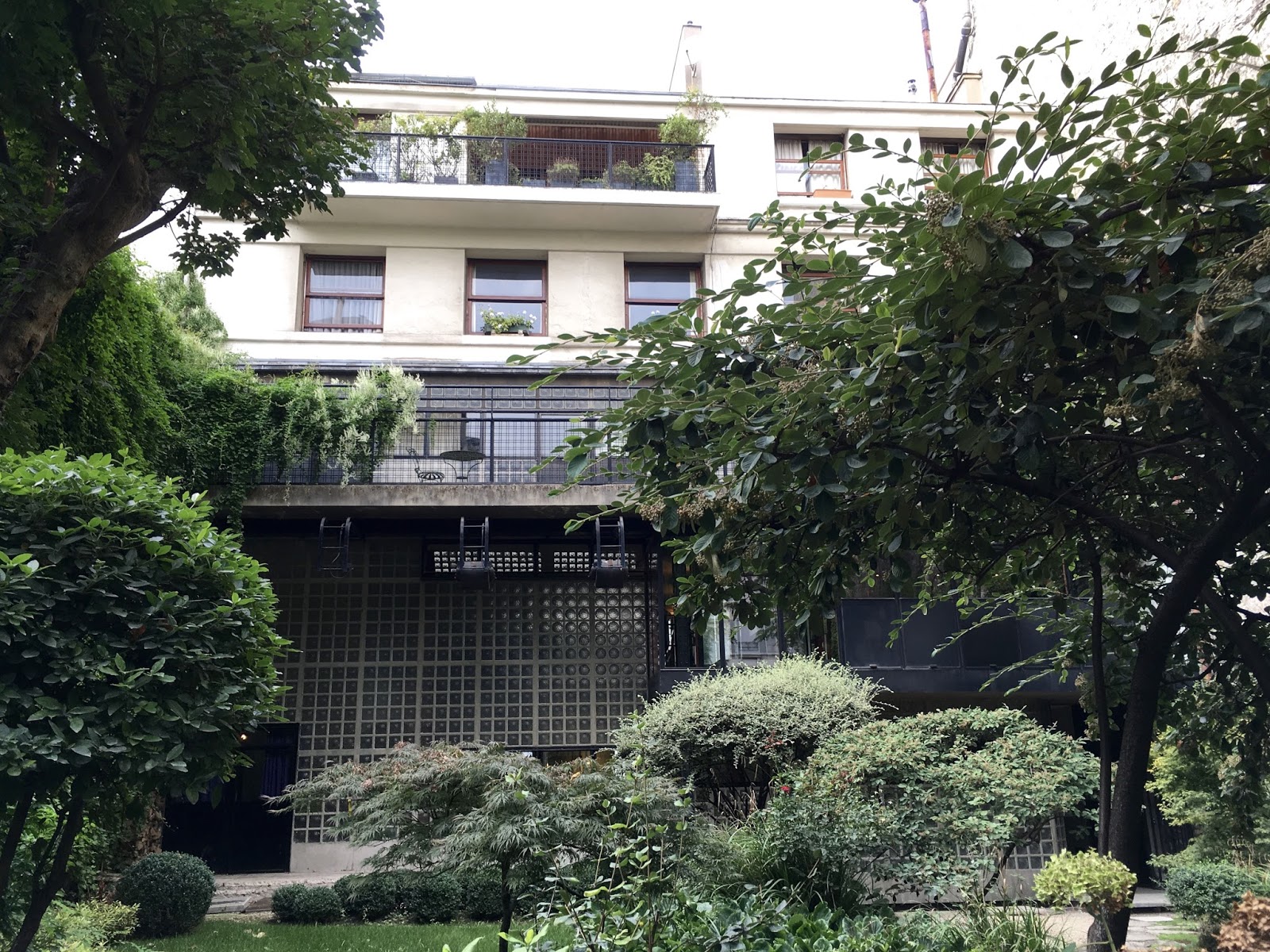
The rue Saint Guillaume facade of the Maison de Verre.
Ten years later I made a return trip to Paris, this time with a smaller list of buildings, intent on building on my 1994 trip and digging a little deeper into the city's architecture. This meant more Guimard and more Perret (I skipped Le Corbusier that trip). But I also put the Maison de Verre on my 2004 list and had what I am sure was a different telephone number to call and see if I could see what I didn't see in '94. This time, I didn't even make a call. I came, I saw, but I didn't see the Maison de Verre.

Fast forward to September 2016 and my third trip to Paris. This had to be the year I got inside the Maison de Verre. And it was. After 22 years and a couple of half hearted attempts, I finally made a real effort and checked this building off my list.

The history of the house starts in the late 1920s when Dalsace's father-in-law bought a new residence for the young married couple of Dalsace and his wife. And by new I mean an 18th century urban mansion separated from the city by a thick wall and entrance portico that led to an internal courtyard. But it was new to the Dalsaces.

Apparently living in a mansion in the middle of Paris wasn't all that to the young couple. The siting of the residence and the closeness of the adjacent buildings prevented their new house from getting a lot of sun. So their thought was let's knock this thing down and start over with something that's a little more modern and progressive. After all, those kinds of ideas were perfectly in line with their lifestyles. Dr. Dalsace was a gynecologist and member of the communist party who supported the idea of planned parenting in the early 20th century. Paris at that time might have seemed like a pretty progressive place but not that progressive just yet. Certainly their taste in design matched their societal beliefs.


The house beyond the rue Saint Guillaume facade.
The problem with this let's knock the whole thing down idea? The building had a tenant on the upper floor apartment whose lease was protected even in the event of property transfer. And she refused to move. So knocking the mansion down wholesale just wasn't an option. To solve all their problems of lack of light, wanting something more modern with progressive ideals and considering the top floors of the existing building had to remain, the Dalsaces turned to the husband of their daughter's English teacher, a guy named Pierre Chareau.

Chareau was not a trained architect (he apparently failed the entrance exam) but judging from the end product, it didn't seem to matter. What the Dalsaces ended up with from the mind of Chareau (who spent his career as a furniture and interior designer) was one of those architectural masterworks that gets generated from someone throwing the full force of everything he'd (or she'd) been thinking over the years at their first big project. I'm in love with this period of architectural history and with the city of Paris and I can't off the top of my head name a single other Chareau designed building. Not one. This was his big shot and he certainly made the most of it.

Before we go on, I should probably put some sort of a disclaimer out there. There is a good deal of doubt as to how the Maison de Verre got from nothing to what it is now. It's clear from planning records that the first permit application in 1927 was denied for being incomplete and that this was remedied the next year. It's also fairly certain that the exterior of the house was finished sometime in 1931 and that the Dalsaces moved in sometime in 1932. But it is not clear if there were ever any construction drawings prepared for the building and the decision logic behind certain design gestures is either lost or never existed.

Most of this uncertainty is generated from the fact that in 1940, the Nazis invaded Paris which forced Chareau (who was jewish) to flee the city with what we assume was pretty much nothing. He certainly wouldn't take the time to pack a set of drawings from his masterwork in his bags before he left. It is reasonable to presume that whatever Chareau left behind in Paris (for both the Maison de Verre and other projects) was destroyed either by the Germans or someone who found them later. And if there were documents or Chareau could maybe remember how the house came together, nobody thought to ask him and record it before he died in 1950.


What is clear (and not just from the sign on the front of the building) is that the house was a collaboration between Chareau and Bernard Bijvoët (pronounced bie-vut) and Louis Dalbet. Bijvoët covered the trained architect part of the equation and Dalbet was the master metal worker responsible for the extensive metal work on the interior of the house. Together they pulled off something special here.

The house is organized around two sequences of entry: one for patients visiting Dr. Dalsace's gynecological practice and one for residents and guests of the house. The ground floor of the building is dedicated almost exclusively to the medical practice. Everything above the ground floor is for the people living there, including the live-in chauffeur and maid who shared the entrance with the family. I wrote that last sentence deliberately, not to remind you that we are dealing with a wealthy family here (which we are) but to note that sharing an entrance with staff of the house was really a progressive idea. While it may seem bourgeois to us today to have live-in servants, to 1930s Paris it might have been shocking to have the staff share an entrance with their employers.

The ground floor is remarkable in a number of ways and it's full of Chareau's beliefs about how modern materials and processes which were children of the industrial revolution might transform how buildings work. Space is defined not by traditional thick plaster and wood walls but instead by changes in floor level or material or by screens and walls that move. Walls are thin (like single sheet of metal or plywood thin) and doors don't have frames (they pivot on poles that span from slab to slab). Building services are either built in (electrical outlets are in the floor or exterior walls), become part of the circulation sequence (you can walk on a heating duct), or are applied after the fact as discreet elements representing what they are (electrical outlets not in the floor or exterior wall are supported on polished metal tubing that becomes an architectural feature).

And then there are the windows which are operated more like they are part of an ocean liner or train car than a traditional house. You engage in opening and closing windows either by sliding them up and down (a la a steam train passenger car) or by operating a series of cranks and wheels that might open a single window or a collective bank simultaneously. Ventilation is brought into the house in a similar way in the main living space. All the ideas here are operating on a kit of parts concept using standardly manufactured items to generate affordable housing rather than custom building everything from scratch. Of course, the very design of the Maison de Verre was a completely custom endeavor that ended up costing far more than conventional construction and was never again duplicated. Chareau wasn't the first or last architect to design something with this ideal in mind. He also wasn't the first or last to fail at it.


You can see similar ideals in the exterior of the house and its distinctive glass block facade both in the front and at the garden or rear elevation. Glass block (and indeed large sheets of purely transparent glass) was a new invention in the early 20th century and Chareau seemed determined to use it to establish a new vocabulary for his architecture. These blocks are not the glass block of today which are manufactured by essentially gluing together two hollow thin walled glass halves together to make a whole unit. Instead, the block used by Chareau were solid glass pieces with a scoop of material removed while not yet cooled. The result is something much heavier than today's glass block.

Heavy glass block caused two concerns in the design of the house: first, they are made of glass and what happens if they crack (because glass does crack)?; second, these things are heavy and cannot support themselves so they need some help. Both problems were solved by supporting 20 to 24 glass blocks in a concrete frame which would provide support for all that weight and would minimize movement to prevent cracking. Yes, I know at the front of the building they appear to be set into steel frames (see above photographs) but they are not; the concrete is just painted black. You can see this pretty clearly in the rear of the house where Chareau and Co. decided to leave the concrete unpainted (see next photograph below).

The all-glass facade caused other issues, namely when the interior of the house was lit in the evening, you could actually see a lot of what was happening inside the private spaces of the family. To overcome this issue, Chareau devised a frame at the front of the building with high-powered stage-type lights to flood the front face of the house with light at night, simultaneously preserving the privacy of the Dalsaces and dramatically lighting the front of the house. If you look carefully at the pictures above you can see the frame supporting the lights with two ladders. These ladders were there for the express purpose of changing the light bulbs when they burned out.


Take a closer look at the front of the house and you can see still see the upper floor apartment where the woman who refused to move out lived. You can see it clearer at the back of the property. And the Maison de Verre was truly constructed under this portion of the original building, which was propped up temporarily while all of Chareau's ideas were brought to bear beneath.

From the interior of the house, you can see the fact that this house was built underneath a portion of an older existing mansion pretty clearly in the main interior reception and living space, a gorgeous two story open volume punctuated by four exposed steel I shaped columns propping up what remained above while simultaneously providing support for the cantilevered floor slab all the way to the self supported exterior glass block wall.

The main living space of the house is truly one of the great spaces of modern architecture. It's not as brilliant in its confinement and release of space as some of the houses of Le Corbusier or Frank Lloyd Wright. Instead, it's more impressive based on what it's made out of in a larger envelope created by someone who clearly understood the concept of modern architectural space. If there's no other value in getting inside the house (and there certainly is), standing in this main space is worth it alone.

If you make it inside one day, take a look at the four main columns propping up the old building. They appear to be painted red (which apparently is a rust protective coating) and black. But they are not painted black; the black you see in interior photographs is actually an added piece of slate, which I find fascinating because it seems antithetical to Chareau's desire to design a house built of mass produced items. But touch is an essential part of experiencing a building and I'm sure from seeing this detail, Chareau understood this, just like Alvar Aalto used to wrap metal door pulls and handrails in leather. 

It's this kind of detail along with seeing Chareau's almost obsessive use of pivoting mechanisms and other sorts of odd devices used to solve the interface between living in and building this house that provide the detail to the overall experience of being there. And that makes shelling out 40 Euros per person worthwhile (yes, you read that right). The only way you can get this sort of appreciation is by walking through that front door and exploring. On the third try, I'm appreciative that I finally got my shot. I understand more now, which is sort of the whole point.

This post was 22 years in the making.
Access to the Maison de Verre today is both simpler and more complex than it was in 1994 and 2004. Although I suppose I don't know that for a fact since I never actually got inside on either of my first two trips to Paris. The house is currently owned by the Rubin family, who actually live there for part of the year. So it's literally someone's house and not just a museum, in other words. But in what is a stroke of very great luck for architects who can make it to Paris, the Rubins have decided to open the house for one afternoon each week to a handful of visitors.

Now getting into the house is not as simple as showing up on the afternoon when the place is open. You need to request access ahead of time in writing stating your interest in the house (send it to mdv31@orange.fr). It's also not cheap; a 90 minute or so tour of the house costs a cool 40 Euros as I stated above (20 Euros for students). But considering you are stepping inside one of the most unique works of residential architecture in the 20th century that cannot really be understood from reading a book, and considering the Rubins are letting strangers into their private residence, it's totally worth it. This is not something you are likely to do twice; spend some Euros and go if they will let you in. It is a total privilege to spend an hour and a half at this place. I'm thrilled I finally made it inside.

Last note on this post: I know there are no interior photographs here. The Rubins request that visitors not photograph the interior. It's annoying but it's their stuff in their house and that's the rule. So I followed it. You should too if you visit.

Wednesday, September 28, 2016

Under The Sea, Part Dos


I've been lucky in 2016. Actually I think I've been lucky my whole life but specifically this year I've had the very great fortune to have been snorkeling in two amazing locations on our planet on two completely different trips. This past February, I discovered multicolored fish in an extinct volcano off the coast of Maui just days after watching manta rays performing underwater acrobatics at night near Kona on Hawaii's Big Island. Last month, I hit the Galápagos. Along with a mask, snorkel and fins, and of course a wetsuit which is like my 2016 snorkeling security blanket.

The Galápagos Islands and Hawaii are both volcanic archipelagos located in the Pacific Ocean. The Galápagos sit right on the equator; Hawaii is a bit further north but still below the Tropic of Cancer. But below the surface of the ocean they are quite different. The Galápagos are mostly rocky outcroppings of a giant underwater shelf sitting right below the water's surface; Hawaii's seas get much deeper much quicker. What that means is that the depths of oceans to be found right off the coasts of Hawaii's islands don't exist in the Galápagos. Everything's pretty shallow and right there for us surface swimmers to see. That's a good thing. And what a lot there is to see.

In four days in the Galápagos, we got in the water and snorkeled on three of them: once at Kicker Rock off the west coast of Isla San Cristóbal; once near Isla Plazas; and finally a swim near the south coast of Isla Santiago. The pictures in this post, once again taken with my trusty GoPro, are from our first and third snorkeling adventures. Our time near Santiago provided us with the best shots and the most amazing experience.

Sharks circling below the surface of the water at Kicker Rock.
I'll admit I had some hopes and some anxieties about snorkeling in the Galápagos. My number one hope was that we would find some hammerhead sharks to swim with; my number one fear was that we'd end up in the water with some different kinds of sharks, ones that looked decidedly more dangerous than hammerheads. I'd checked the statistics on hammerhead shark attacks and found no record of any fatal encounter with humans ever; I didn't bother doing a check on all other species and just feared the worst. Of course, what I wanted most didn't happen; what I wanted least did. Isn't life like that sometimes? And of course, it was all OK.

We didn't waste any time swimming with sharks of the non-hammerhead variety and our guide Lorenzo seemed thrilled to see them. In fact, he seemed to want to get as close to them as possible and to make us go with him. Hasn't this dude seen Jaws? I get that these sharks are a lot smaller than great whites or tiger sharks but they still look decidedly shark-like and dangerous. But sure enough, there we were in the shadow of the split down Kicker Rock looking down in the water watching sharks circle. And there were a lot of them. Sure, none of them came anywhere near me but there were not an insignificant number of them about 15 or 20 feet below my flippers. Kind of freaky.

Kicker Rock, which got its name for its resemblance to a giant boot (I don't see it honestly) didn't provide us with much good snorkeling and it wasn't because neither of the snorkels provided to me were working properly. It's a good distance out off the shore of Isla San Cristóbal and its sides below the surface are straight down, which means no reef near the top of the water to watch fish feeding. The only place with any wildlife is the nutrient-laden channel between the split rock and in the mid-day sun the shadows cast by the rock make seeing anything much in the water all but impossible for those of us with less than adequate eyesight. Probably better for diving, which I don't do. Let's move on.


If Kicker Rock was a disappointment, snorkeling off the shores of Isla Santiago was fantastic. Here we found enormous schools of multicolored fish of multiple species feeding in the reefs between 4 and 20 feet below the water. And they were everywhere you looked and the ocean was perfectly clear that day which allowed me to shoot some great videos and still photos. We also got a great look at some starfish in a number of different spots. This was by far the best snorkeling I'd had in my adult life, which admittedly has a small sample size.

And of course there were more sharks. And just like at Kicker Rock, our guide (different guide; Omar this time) seemed obsessed with finding us some sharks. And this guy was hard core about it. Like chasing sharks out from below rocks near the ocean floor hard core. We found at least two mini-schools of Galapagos sharks, which are about six or eight feet long and look decidedly like sharks, which is a little concerning in water that shallow. My only source of comfort here was looking around at all the other food around me which seemed to me to be a lot easier to handle for a creature that size, even if the alternative (me) was the slowest moving thing in the water for several miles.

Indeed the only time I really got nervous around these things was when I saw a school of about 40 or 50 fish suddenly scatter right in front of me. I thought this had to be evasive action from a predator and I was right. About five seconds later a smallish sized sea lion zoomed past me in the water, oblivious to my presence, which was incredibly cool. Yes, I swam with both sharks and sea lions this August, even if I wasn't really so much swimming with them as near them.


Our snorkeling trip that last day in the Galápagos occurred right near an area where some penguins had been seen nesting recently. It would have been such a thrill to see penguins swimming in the ocean with us but just like we missed out on the hammerheads at Kicker Rock, we didn't find any that day off Santiago. Instead we had to settle for sharks and sea lions. Not too shabby I think.

That last trip took about 45 minutes to an hour and we were swimming and surrounded by marine life pretty much the entire time. It was certainly a lot more convenient snorkeling off a boat that we were staying on than it was in Hawaii, where we had to get up before dawn or wait until the sun set to get to a boat to take us out to a good spot. As it turned out, 2016 is the year I swam with sharks for the first time. And actually, if it's the last time, I'm good with that too. I'm OK doing this once with some friendly ones and quitting while I'm ahead rather than seeking a bigger thrill.

Shark week? Maybe not. But thrilling just the same.

Friday, September 16, 2016

Paris


So I realize I haven't yet finished writing about my trip to Ecuador (I still have one more to go) but unfortunately, I'm off somewhere else so that will all have to wait. Sometimes things just work out that way.

In the very first post I wrote in this blog, I talked about a commitment to myself I made way back in 1994 when I first got out of school to make sure I got on a plane at least once a year and go somewhere new. It's been one of the best ideas I've ever had. But I didn't start out on day one of my post-college career with that idea. That pledge I made was a result of almost not taking a vacation at all during the first year I worked and I learned a valuable life lesson in almost missing out.

My first year out of college was all about work, work, work! I was living in the tiny village of Cooperstown, New York working for $10 an hour starting to learn how to be an architect. The best thing about that job was that I got a lot of opportunity to grow my career and that I got paid time and a half for each hour of overtime I logged. And I made sure I worked a lot that first year, so much so that whenever any sort of idea of taking time off came up, I talked myself into the fact that there was too much to do at work and I just couldn't leave. As a result, I ended taking my 12 days of use-it-or-lose-it personal and vacation time on the last 12 business days of 1994. And you know what happened while I was gone from work? Nothing. The place didn't self destruct, nobody took my job and our clients got served just as if I was there. From that point on, I have never put work ahead of vacation. It's not worth it.

So where did I go at the end of December 1994 with my precious 12 days off? Paris. I booked the flight and hotel through a travel agent (remember those?) on Main Street in Cooperstown and it cost me pretty much all I had. I think the total for a flight out New York and a room at the Hotel D'Amsterdam came to just about $1,300 and it literally almost completely drained my checking account. I was actually worried if spending all that money was the right thing to do but in a move that was completely out of character for me at that time in my life, I threw caution to the wind and didn't look back.

I loved every minute of it. I have by no means been to anywhere near all of the cities on Earth but of the ones I've been to, Paris is my absolute favorite. Hands down. There is a sense when you are in Paris that you are in the middle of all human history and culture in Europe. There is no place I have been that is simultaneously so historic, so self-important, so cultured and so focused on being alive than Paris. On that first trip in 1994 I discovered the architecture of Le Corbusier and Hector Guimard (including riding the tiny tiny two person elevator at Castel Beranger); I fell on my knees in front of Auguste Perret's apartments on the rue Franklin (Perret is a personal hero of mine); got up close and personal with some gargoyles at Notre Dame de Paris; and pretty much existed on crepes from street carts.

Ten years after that first almost broke the bank trip, I went back. But this time in the spring and not with my last 12 days of time off at the end of the calendar year. If you have never been to Sainte-Chapelle right across from Notre Dame de Paris on the Ile de la Cité, I suggest you do so the next time you are in Paris (he says like he knows people who just randomly hang out in Paris...). I've been to any number of gothic churches in my life and nothing has been so spectacular as Sainte-Chapelle. The explosion of color is just amazing in such a small space. That 2004 trip featured my one and only visit to Sainte-Chapelle in addition to exploring art nouveau furniture at the Musee D'Orsay, eating entire meals of cheese and of course heading out to Raincy to visit Perret's Notre Dame du Raincy for a little hero worship.

So now it's 12 years later and I haven't been back to Paris since. And that's just too long. So next week, I'm heading back there; to where my love of traveling after graduation started for me. One of the things I find most wonderful about Paris is that there is so much to do and experience there that is mind blowingly awesome that it's hard to imagine ever being bored. On this trip I'm armed with a whole set of new experiences that (for the most part) I've not touched during my first two weeks in that city. Paris is the place. I can't wait to set foot in this city again.


Closing note: The photos in this blog post are from my 2004 trip to Paris and I just have to say what was I thinking with my personal appearance? I'm wearing clothes that are clearly far too big for me and they are either making me look overweight or I just was. I'm a total mess. I've talked myself into the fact that I look better at 48 (today) than I did at 35 (then). Maybe I'm kidding myself. Regardless, I vow to never wear an entire wardrobe that is too big for me ever again. Au revoir.

Wednesday, September 14, 2016

The World's Best Brownie


Let's start this blog post with a quiz. Quick: name a staple of Italian cuisine, an Irish vegetable and a Swiss confection. Did you say tomato, potato and chocolate? I might have if someone had posed that question to me. It seems logical, right? I mean what would pasta and pizza be without the tomato? Didn't the lack of potatoes in Ireland in the late 1840s and early 1850s cause a mass migration out of that country? And what are the Swiss known for if not clocks, chocolate and refusing to get involved in anything that doesn't concern themselves even if they should sometimes exercise a higher social conscience?

Know what all these things have in common? Before the sixteenth century, the Europeans didn't know about any of these foods. They had no clue. They only got a hold of these three by "discovering" the Americas. I find it strange that each of these foods is now so undeniably linked to countries that appropriated (and that's a kind word) them in the last 500 years or so.

So why am I quizzing people about food when I'm supposed to be blogging about my August trip to Ecuador? Well, it's certainly not so I can write about tomatoes and spuds; those things grow just about anywhere you plant them in the United States where I live. But not the cacao plant, which requires wet, tropical environments to thrive. And Ecuador as it turns out is one of the top ten cocoa producing countries in the world. I've never tried to go seek out a cacao plant on a vacation before but I thought that might be worth doing on a trip to a country so involved with supplying the world with chocolate.

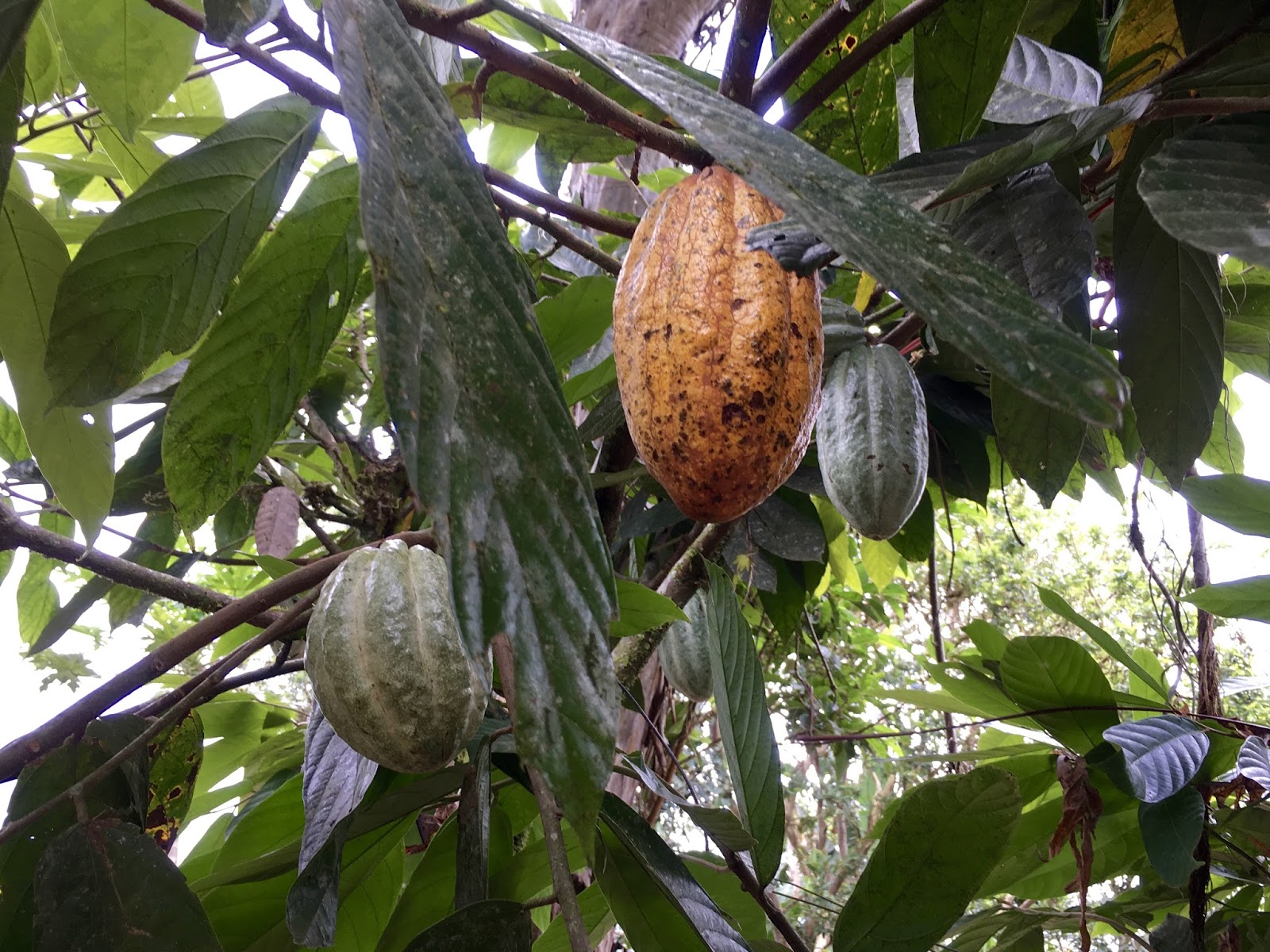
Cacao fruits growing in Mindo. The top photo shows a cacao fruit, dried cocoa beans and some cocoa nibs.
Now it wasn't always this way in Ecuador. The Incans, who had expanded their empire north into Ecuador from their home base of Peru just before the Spanish arrived, were not a big chocolate civilization. Nor were their predecessors (in other words the folks they conquered) the Quitu. No, to get at chocolate's roots, you need to look a bit further north to present day Mexico where the Aztecs, and before them the Mayans, held the plant and its fermented and dried bounty in the highest esteem.

Before I go too far, maybe I should offer a little bit of a disclaimer before going forward. The tone of this post might make the Spanish acquisition of chocolate from the Aztecs seem like a friendly exchange of goods. Nothing could be farther from the truth. When the Spanish arrived in the new world, there was a lot that blew their minds and the tomatoes, potatoes and chocolate were about the least tempting of what the Aztecs and Incas had in their possession. I'm sure the food (which also included the never before seen crops of corn and peanuts) was great; but the real prize for the Spanish was the seemingly incalculable quantities of gold and jewelry that the natives possessed.

I'm sure it didn't take long for the Spanish to start planning how they could dispossess the locals of their wealth, either by conning them out of it or just slaughtering the lot of them. They ended up using sort of a mix and match approach here and despite the vastly superior numbers, neither the Aztecs nor the Incas were any match for the Europeans' guns and horses, neither of which they had seen before. And if the shooting and the mounted conquistadors didn't do the job, the smallpox, influenza, cholera and all manner of other diseases took care of most of the rest. Eventually they got everything they wanted, which was pretty much all of it.

Right before (and I really do mean like immediately before) they decided to start killing and duping the locals, some of the Spanish were treated like gods by the people they met in Central and South America. When the Aztec king Montezuma II, ninth ruler of Tenochtitlan, met conquistador Hernán Cortés, he welcomed him and his army into the city and held a banquet in their honor, including providing them with some of the first chocolate that any European man had ever tasted. This was not the chocolate that we know and love today but instead a bitter brown drink that was typically reserved for royalty. It was this sort of roots level stuff that I hoped to find in Ecuador.


Now, our time in Ecuador was mostly spent in the Galápagos and the country's capital of Quito and we knew we weren't finding any sort of cacao plantations in either place. The Galápagos are windswept, barren, volcanic islands 600 miles into the Pacific Ocean and Quito sits at about 9,350 feet above sea level. Neither environment is suitable for growing chocolate trees. We'd have to go somewhere in between: still in the tropical mainland but at a much much lower elevation than Quito. In short we'd need to take a little road trip.

About two hours north and west of Quito is the village of Mindo, a community that seems to be built these days on ziplining, bird watching, tubing and butterfly gardens. There also happens to be a chocolate factory there named (inventively enough...) Mindo Chocolate. It was here we decided to head to learn more about chocolate in the place of its origin, and although I'm sure we didn't taste anything like the Cortés was fed in Tenochtitlan about five centuries ago (or maybe we were), we got to taste plenty, including some of the bitterest liquid I've ever tasted.

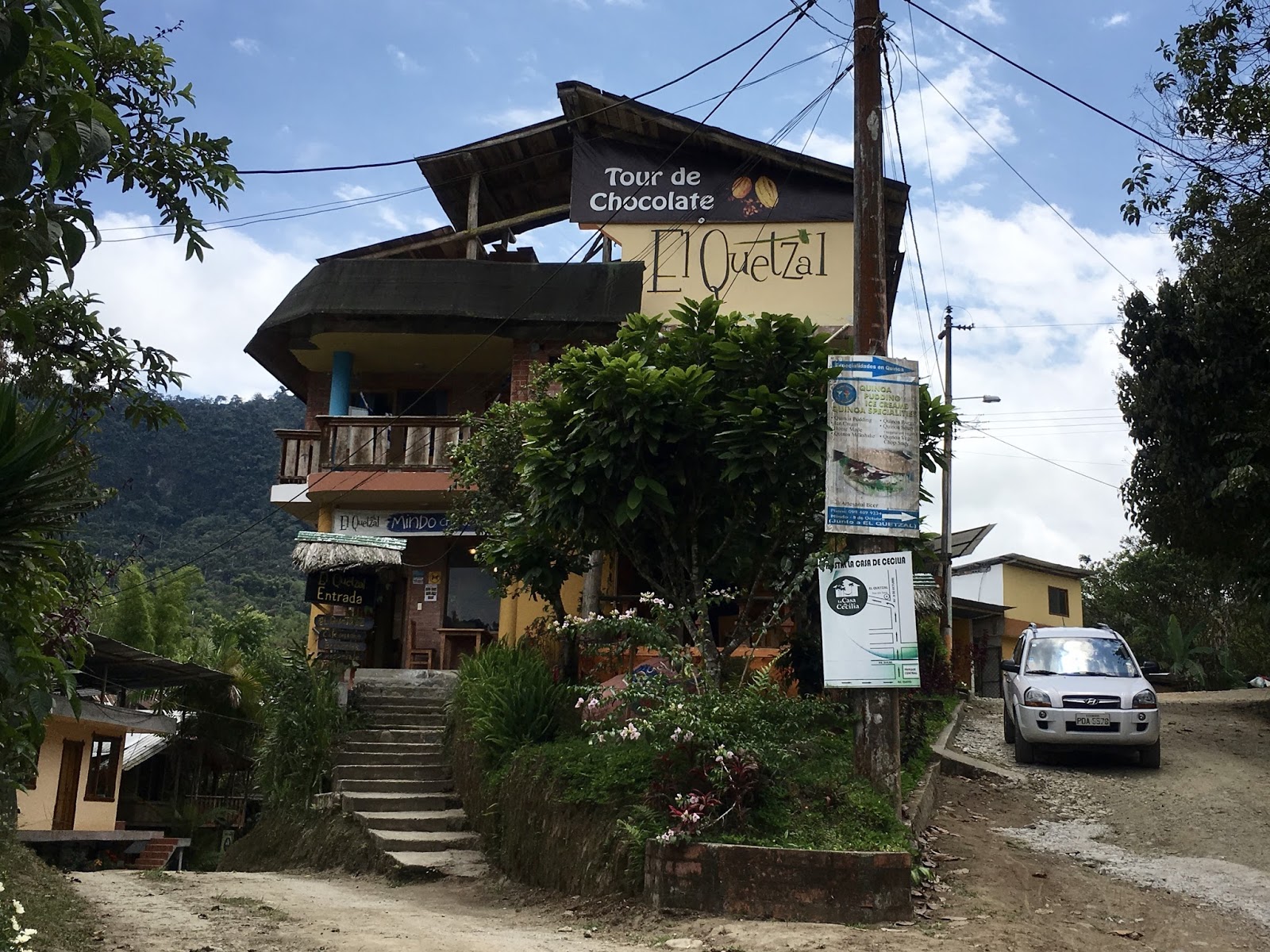
Mindo Chocolate's factory, if you can call it that, is located in the back of the El Quetzal de Mindo restaurant and B&B just off the main drag in Mindo and it's worth a stop. We didn't partake in the ziplining or tubing down the rivers in Mindo but we did visit a butterfly farm and see some amazing hummingbirds. But the half hour to 45 minutes we spent at Mindo Chocolate was the best thing we did all day, and that includes our stop at the equator on the way back into town.

The tour at Mindo Chocolate takes you from the cacao plant in the ground all the way to the final product and you get to taste everything along the way, which is everything from enlightening to suck all the moisture out of your mouth bitter to I-can-understand-why-people-are-addicted-to-chocolate amazing. It's educational and delicious at the same time. What more could we want out of vacation?

Cacao beans being fermented before drying.
Every so often I think about the foods we eat and the drinks we drink and wonder what on Earth would make us put whatever it is we are eating or drinking in our mouths to begin with. Some foods are easy to understand: find an apple or mushroom on the ground and eat it; if you don't get sick then it's OK to eat again and if you do then stay away in future. Other foods that involve a fundamental transformation of the ingredient into something decidedly unappetizing make me think a little harder. Beer comes to mind here. After spending time in Mindo, chocolate definitely falls into the latter category too. For the record, I'm glad my predecessors on this planet tried both.

So how do we make the fruit of a tree into a chocolate bar? Or, if you are an Aztec, into a bitter drink that you only allowed royalty to drink? Let's see if I can explain. And terminology is a little bit important here. It all starts with the cacao tree which when mature grows cacao fruit or pods. There's a picture of some pods earlier in this post. They ripen about six months after flowers first appear on the tree and at that point they are harvested and cut open to reveal a series of white seeds called cacao beans. When we first started our tour at Mindo we were invited to pop one of these seeds into our mouths. They tasted sweet and fruity and felt (as we expected) a little slimy. They are not digestible in this form so we spit them out but these seeds are what hold the chocolate.

After the seeds are removed they are fermented for four days under banana leaves (see above photo). Apparently the fermentation removes some of the bitterness from the beans, which is important considering what we tasted later on in our tour. After four days the seeds are laid out to dry on wire mesh racks for about 15 days in the dry season and about twice that long during the rainy season. The result after this step? A surprisingly sweet and deep chocolatey snack. I'd like to say that I could sit down and gorge myself on these things but I suspect the pleasant taste I got out of one little nibble wouldn't continue if ate three or four of these things. And the chalk-like texture might ultimately be a problem.


This is the point in the process, I am assuming, that someone long ago put one of these things in his or her mouth and decided it was worth figuring out how this happened so they could, by some degree of trial and error, reverse engineer what nature had let happen naturally. So just to be clear here, what I think happened is that someone once upon a time found a brown thing on the ground, which turned out to be a dried seed of the cacao tree which had been, prior to drying out, fermented under banana leaves for a while, and took a taste. And they liked what they tasted and proceeded to figure things out from there. Make sense? Sounds reasonable to me.

At this point we still don't have chocolate. There are a couple of more steps. First the beans need to be roasted, which is done in a rotating cylinder that could easily fit in one corner of my living room. 30 minutes of heat applied while in the drum, then a rest for about two and a half hours and your beans are roasted. Kind of like coffee I guess. After that they are ready to be crushed and have the shells separated from the cocoa nibs. This takes place in a wind tunnel type apparatus about the same size as the roaster. Now that we have the nibs, we are pretty close to getting something resembling the chocolate we know and love.

The "factory": a room about the size of my living room where the beans are roasted and separated to nibs.
Next step? Grinding the cocoa nibs into a paste called chocolate mass. The paste is a transformation of the nibs into a semi liquid consisting of cocoa solids and cocoa butter which are on the verge of separating into their component parts. You can use the paste to make chocolate if you wish. Keep going and they will in fact separate. Cocoa butter is the fat component which is used to make white chocolate; cocoa powder is used to make hot chocolate for drinking or chocolate bars when it is combined with a fat like butter.

Centuries ago, the Aztecs likely got about as far as the grinding and separating process and sometimes might have added honey or some other naturally sweetened nectar to the powder or paste to make it sweeter. The Swiss picked up where the Aztecs left off, figuring out how to transform what the Spanish brought back from the new world into the chocolate bars we eat today.

So after all that learning, who's ready for some chocolate? Well if you are, you'll have to get some for yourself. Back in Ecuador I sure was and following our tour we got to try all of the eight varieties of bars that Mindo Chocolate produces. We also might have brought a few back with us to the United States.

But before we got a taste of the finished product, we were treated to a couple of tasting experiments. We were presented with a small plate which had on it a tiny plastic spoon with a cup of some chocolate liquid and a square of brownie sitting next to it. The liquid was pure cocoa without any of the butter and it was the most vile tasteless stuff I've ever called anything to do with chocolate. It tasted more like liquid metal than it did like chocolate. On the other hand, it tasted fantastic when it was combined with a small amount of ginger syrup, which was sort of the point of the exercise.

We were then asked to taste the brownie which mercifully WAS sweetened. In fact, it was way way way better than I ever could have hoped. If there's a better brownie on the face of this Earth, I'd like to see it because this thing was out of this world good. If brownies can generally be divided into fudge and cake categories, this was neither. It had all the richness and gooeyness of a fudge brownie but without being heavy like fudge brownies are. This thing was melt in your mouth amazing and I mean that literally. The secret? It was made with the paste that comes from grinding freshly roasted cocoa nibs. Everyone should make brownies this way from now on. This was the best thing I ate in Ecuador without a shadow of a doubt. Who knew I'd go all that way and end up raving about an all-American dessert.

Thus ended my chocolate education. For now. I'm richer for it. I suspect I'll be dining on more chocolate soon enough on the other side of the Atlantic. But that's potentially another story.

The world's best brownie.