Wednesday, September 7, 2016

I Love Boobies


Oh, come on! You didn't think I could visit a country that has three species of birds with the name boobies and not write a blog post with this title, did you? Wasn't happening. And get your minds out of the gutter.

Of all the different types of wildlife we were looking forward to seeing in the Galápagos Islands, we were perhaps more excited to see the birds known as blue footed boobies than any other species. Sure the iguanas and the sea lions and the flamingoes and the crabs were all very interesting, but we wanted to see boobies most of all. And not just any sort of boobies. Not the nazca boobies (although we saw them and they are gorgeous birds) or the red footed boobies (didn't see those; we didn't visit the right islands), just the blue footed ones. Sure, we'll take the rest but a trip to the Galápagos without seeing blue footed birds just would have been a huge disappointment. Spoiler alert: we were not disappointed.

So why blue footed boobies? Well, it's certainly not just so I can write a blog post with the word boobies written about 50 times and yes, I promise, I'll lay off that joke. Soon.

I don't know how many David Attenborough and National Geographic specials I have watched over the years about the Galápagos, but invariably the stars of the show are the blue footed boobies. They are a little comical looking; have slightly ridiculous names and mating rituals; and look like they are about as likely to land on the surface of the Earth safely as our Avianca flight back from Guayaquil to Quito which aborted the landing twice (yikes!) before decided to land on the opposite end of the runway (not fun). 

And of course, it's because they have blue feet. How many other species of animal are you going to see with blue feet?

A blue footed booby plus chick.
I know what your first question about these birds is (because it was one of ours): why are they called boobies? Well, first of all it has nothing to do with breasts. Sorry to burst your bubble on that one. Our naturalist guide, Omar, explained to us that it's an English bastardization of the Spanish word for clumsy, which is how the early Spanish sailors referred to the birds because of their odd walking gait and their not so graceful landings. Turns out that story checks out, which is a good thing since as a naturalist he's supposed to know what he's talking about here. The actual word that caused the boobies to get their name is bobo, which translates literally (according to Google Translate) as "fool."

If you visit the Galápagos Islands today, you may very well think these birds are fools for their complete lack of fear of man. I mean you can literally walk right up to them and they'll stare at you in disbelief that you mean to do them any harm; we didn't, of course, but early sailors had an easy time catching and eating them. Today, as it turns out, life in the Islands is pretty cushy for the boobies. Other than maybe frigatebirds, the Galápagos hawk and maybe a human-introduced rat or two, the boobies have no natural enemies. And they are only likely to get picked on by the three predators I just mentioned when they are newborn chicks. Beyond that, they can fend for themselves.

My expectation in visiting the Galápagos this year was that I would get to see one or two boobies and then hear stories about the habits that we wouldn't be able to see, mostly on the courtship, mating and nesting side of life. I figured all that stuff would be done out of sight or harm's way. Certainly not in full view of a group of American, British, Canadian and Australian tourists who would predictably stare, point and take as many pictures as possible before we had to move on down the trail.


My expectations were wrong. Our first land encounter (we'd seen them in the air previously) with a blue footed booby was on Isla Lobos just off the west coast of Isla San Cristóbal. We came across an adult with two chicks standing on the rocks by the ocean with the other parent presumably off fishing for food for one or maybe both chicks. This is what we came to see. Picture after picture was snapped. We even found a booby nearby sitting on a nest. Very cool!! What's next?

Well, next came the kind of thing you get to see in the Galápagos: a very close look at a pair of booby couples mating. Like right next to us, maybe three feet away, oblivious to our presence as all wildlife (well, except the Sally Lightfoot crabs maybe) in the island chain treats humans standing right next to them. This is the absolute beauty of the Galápagos. Nature is so up front and in your face in all its glory. It's literally like being in one of those David Attenborough or National Geographic specials. This stuff doesn't happen away in the bush or behind a wall of cacti or anything, it's all right there for you to see it.

Perhaps it's worth spending a few minutes on the booby mating dance after seeing it happen because it's just amazing. And not surprisingly, it's all about the feet. Generally speaking, the bluer the feet, the more attractive the mate. I've read that if you starve a booby for a couple of days, the color disappears from its feet. Blue feet = healthy mate. Pretty simple, right? 

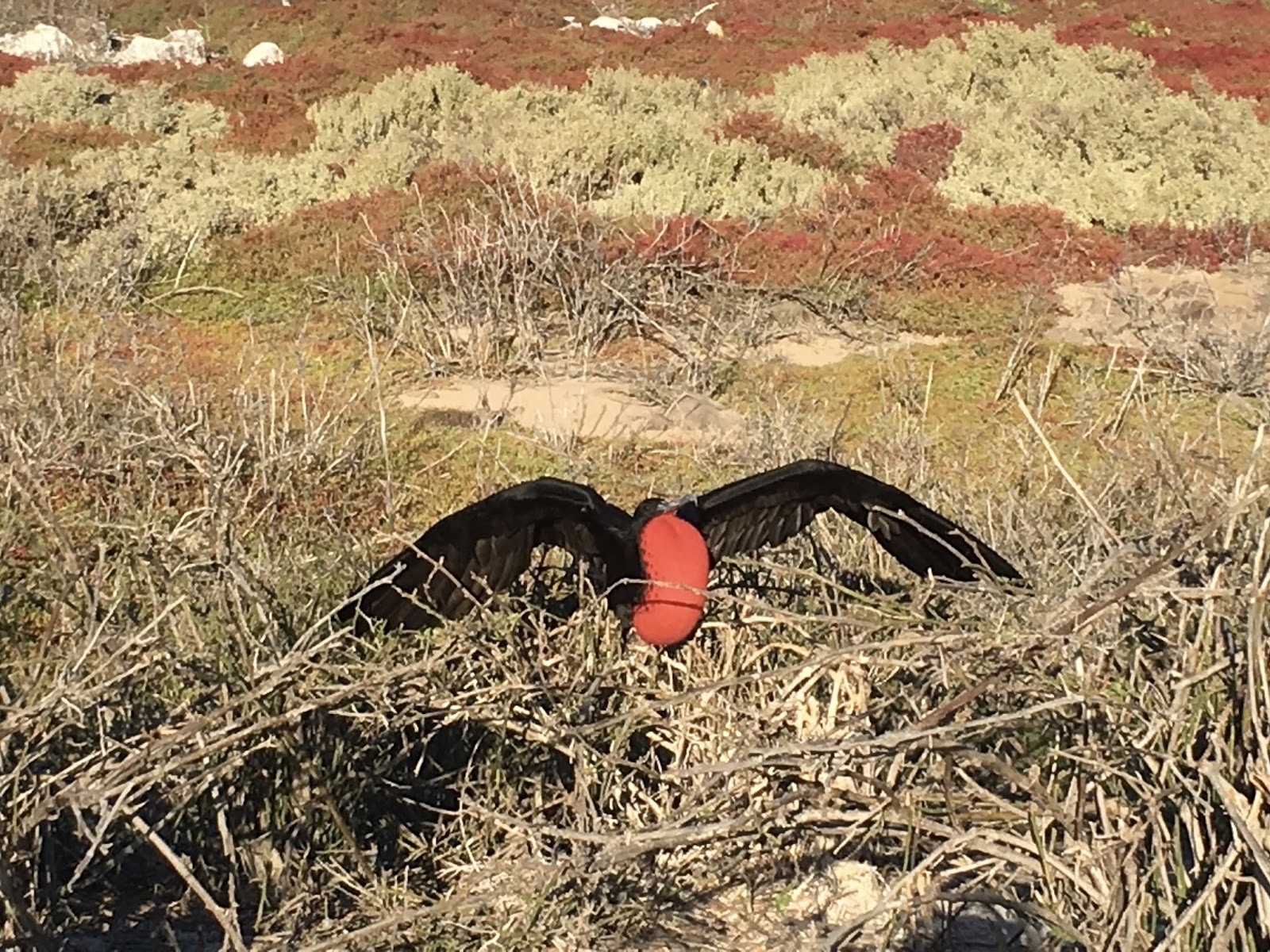
Mating takes place between a pair of birds and they are "monogamous" for one season, although mating for a few months with one bird before moving onto greener pastures or playing the field isn't exactly monogamy now is it? The mating ritual starts when the male gets the attention of the female and approaches her, with his shrill but muted whistles being answered with some clicking noises from his potential mate. Following that there may be some twig bringing from both the male and female, where one bird will pick up a stick in mock nest making and drop it at the feet of his or her belle or beau or maybe some wing-spreading and sky-pointing, like in the (somewhat fuzzy) picture immediately below.


But in order to woo a female, a male booby needs some pretty blue feet. Nothing else is really going to work. So he'll spend a lot of time showing off his shoes, mostly by performing some sort of high-stepping ritual designed to call maximum attention to his tootsies. The prospective couple will then walk together to see what kind of color they have and circle around each other doing the same sort of checking out routine. Eventually the female will signal her interest or lack thereof to the male and I guess it's game on from there (although we missed any sort of X-rated booby action on our trip).

Sometimes, there's a competition between males for a female. The pair in the third picture in this post briefly had another male trying to horn in on his buddy's action in an attempt to steal his girl. For a while, it looked like she might ditch her initial suitor for Johnny-come-lately but ultimately the first man in got his girl, although she didn't look too enthused to me, like I know as a rookie booby watcher. I guess he must have had some attractive feet, or at least more so than his rival.

From there, it's a matter of getting pregnant and laying a couple of eggs and in the most booby-like fashion, they just make a nest right on the flat ground where any sort of prey can get at it with no sort of protection except a ring of bird poop and one of the parents staying home at all times. You can actually tell how old a booby nest is by the concentration of poop around the nest. Awesome stuff, you guys!

Barely visible ring of poop = new nest. 
Bright white ring of poop = chicks are almost ready to hatch.
Typically, a brood of booby chicks will be just two birds. The 'rents are generally speaking going to be happy if one of the two makes it to adulthood. Yes, in what is the cruelest truth about booby society, the birds have a second chick as an insurance policy. Maybe the first one will get sick or snatched or injured and won't make it. In that case, the younger sibling is up and will get fed like his or her older brother or sister used to. 

This is not unusual in the bird world. Survival of the fittest is the name of the game here and parents are willing to settle for one of their two kids growing up to make something of themselves rather than having just one and having something go wrong. The truth is most booby couples can't fetch enough fish for a family of four. They have to make a sacrifice, which is typically the weaker of the two kids. There was an especially heartbreaking couple of chicks we came across where one was clearly smaller than the other and the larger was stepping on his or her kid brother or sister. Now maybe it was an accident but on the other hand, life is cruel, folks. Even when the perpetuator of that cruelty is a comical looking blue footed bird.

A booby family. Odds are they aren't all making it. 
You still feeling bad about the two chick system? Me too. It's not nice to think about.

During our four days in the Islands, we saw boobies in a lot of places. But not just on land. The booby is for sure a bird which means like most birds, it flies. And in the air, it is as graceful as it is clumsy on the land. Watching boobies fish is a rare treat. These things are amazing anglers. They circle in the air while looking straight down into the water. Once they have spotted a fish below the surface of the water, they gather themselves before folding their wings into their bodies and assuming the shape of a dart and descend at up to 60 miles per hour towards the sea. They hit the water flawlessly every time. If they were in the Olympic diving competition, they'd draw perfect 10s every time. As awesome as it was seeing these awkward clowns roam about on land, it was equally awesome watching them hunt for fish.

We saw some cool animals in the Galápagos and I could have spent some time writing a lot about every species we saw. In the interest of (somewhat) brevity, I've elected to turn the spotlight onto what likely are one of the most fun creatures you'll see there and leave it at that. This is my last post about what we saw on the Islands, although there's probably something lurking around here that talks about what we saw off the Islands. I hope if you are interested in heading 600 miles west of the coast of Ecuador, you'll go see and appreciate what we saw there just as much as we did. Incredible experience, especially with the boobies. For sure, I love the boobies. 

OK, now I'm done with the joke.

Tuesday, September 6, 2016

The Equator...Sort Of


This post is written in honor of the first time I have ever crossed over the equator on the surface of the Earth. And no, that's not me in the photo above; it's a statue. Enjoy!

The equator, that imaginary line which marks the division between the northern and southern hemispheres, runs through 13 countries in Africa, Asia and South America. These thirteen countries are, in alphabetical order, Brazil, Colombia, the Democratic Republic of the Congo, Ecuador, Gabon, Indonesia, Kenya, Kiribati (who knew there was a Kiribati?), the Maldives, Sao Tome and Principe, Somalia, the Republic of the Congo (yes, there are two Congos) and Uganda. Think of it as the halfway point down the Earth. Or up the Earth if you are from the southern hemisphere.

If there is a country on the planet where the equator has more caché than in any other spot on the globe, it's Ecuador, a nation whose very name is derived from the zero latitude line's name. So it would seem natural that the government of Ecuador would want to build some kind of spectacular edifice to the fact that they, more than any other country in the world, are number one when it comes to the equator, right?

Actually, the notion of any government in the world wanting to build an equator monument strikes me as a little silly and a complete waste of money. Nonetheless, that's just what Ecuador did in 1936 to commemorate the 200 year anniversary of the French Geodesic Mission, an expedition to Ecuador (although it wasn't called Ecuador way back in 1736; it was called the Territory of Quito and it was owned by Spain) to measure the length of a degree of latitude at the equator. I'm not sure Ecuador really cared about the Mission's anniversary all that much; they probably just wanted a tourist attraction, although that is complete speculation on my part.

45 or so years after the original structure was built, the Prefecture of the Province of Pichincha (the province where Ecuador's capital of Quito is located) upped the ante a bit by replacing the 1936 monument with a bigger (and presumably better and more spectacular) monument. The place where this monument is located today is called Ciudad Mitad del Mundo or the City of the Middle of the World. Poetic, right?

Ecuador's equator monument. It was gorgeous the entire day except for the time we had to take this picture.
The 1980s version of the equator monument is pretty grand (see above despite the dark picture). It consists of a very large four sided, tapering podium supporting an enormous globe at the end of a procession of statues of of folks who participated in the original Geodesic Mission. The monument is not the only built item within the site. There are pavilions celebrating the contributions of Spain, France and Ecuador to the mapping of the equator as well as restaurants, stores, a bullring (go figure!) and a line on the ground representing the equator where tourists can put one foot in each hemisphere. It's sort of an all-in celebration of the equator lending its name to the country of Ecuador.

But there's a problem with all this. The actual monument doesn't sit on the equator. 

You are kidding me, right??? 

Nope! I guess the tools they had in 1936 to provide an accurate location of the line weren't good enough because they missed it by about 250 meters, which is a bit more than 800 feet or about three football fields (minus endzones) for those of you who measure distance in football fields. 

Hmm. I know what you are thinking. And just so we have this straight...the government of Ecuador spent a bunch of cash to build something which ultimately the local prefecture knocked down so they could spend even more money on something bigger (and therefore automatically better) and the whole thing is wrong??? That's correct. You got that just right.


The real middle of the world, if you are heading out from Quito to wherever you are headed, is just a bit further up the road. Go past the Mitad del Mundo, drive a bit up the hill and follow the road as it curves to the left and you will see a sign advertising the Intiñan Museum. Take a left here. NOW you have arrived at the equator. I think.

What you find at the Intiñan Museum, depending on your perspective, is a campy museum designed to appeal to foreign tourists who hold the equator and the Amazon jungle in some sort of mythical magical esteem or the most awesome and spectacular $4 attraction on the planet. Put me in the latter camp. I loved this place. We got every cent and more of value out of our 30 minutes to an hour here.

So what does your four bucks get you? Well, not only admission to the place where you can stand with one foot in each hemisphere for real (take THAT Mitad del Mundo!) but you get guided insight into the indigenous tribes and animals of the Amazon and you get to test out the equator's powers for yourself. Want to balance an egg on a nail? Or see water swirl in two different directions based on which side of the equator line you are standing on? Or watch people close their eyes and try to walk a straight line but fail because of the equator? Step right up and lay your money down, folks!! This is the place. You can even get a certificate with your name on it if you manage to make the egg stand upright on the nail (I failed).

Balancing and egg on a nail at the equator. Apparently not one of my superpowers.
OK, so I didn't really fall for all of this in the way it seems. Trying to walk with your eyes closed on a straight line to me seems like pretty much an impossible task whether or not you are on the equator. So it's no surprise that people couldn't do it. The big surprise with this one was that the participants seemed surprised that they failed BECAUSE of the equator. I'm also skeptical of the so called Coriolis effect which causes water to swirl noticeably counterclockwise two feet into the northern hemisphere and noticeably clockwise four feet to the south. Our guide admitted that this effect is only noticeable far away from the equator and pretty much told us she was faking it but challenged us to figure out the ruse. I haven't bothered. It doesn't matter that much to me.

As for the egg on the nail stuff...people with (apparently) greater balancing ability than me achieved what was an impossible task for yours truly. I don't know what that means, although admittedly everyone that I saw succeed at this task used a different nail than I did. Not trying to be a sore loser; I believe my inability to make an egg stand on its end was all mine. But some of the other tricks seems suspect so my usual trusting nature is put to the test here.


The real treat for me at the Intiñan Museum was not the cheap equator-attributed parlor tricks or the fact that I got to put my left foot in the southern hemisphere and my right in the northern hemisphere and get a thumbs up picture with a cheesy grin on my face (see above). Although admittedly, I was pleased with myself for this picture. The real attraction for me was learning a little more about what goes on within the borders of Ecuador, although this was a little hit and miss too.

A live snake, some wooden toucans, a couple of painted parrots and a stuffed cat as a way of showing me the fauna of the Amazon jungle didn't do much for me here although the discussion we had right before that about the local fish that are attracted to ammonia was extremely educational. If I ever go swimming in the Amazon river (and why would I ever do that unless I absolutely had to do it to survive or get away from something dangerous), there's no way I'm urinating while I breast stroke away from whatever's chasing me.

But the best thing here was even more grisly than the fish discussion: SHRUNKEN HEADS!!!

I have never that I can remember seen a shrunken head before visiting Ecuador, although it's quite possible I've blocked that out. According to the Intiñan Museum, the only people in South America that engage in this practice are located in Ecuador and apparently the museum guides have no idea exactly how the locals do it. They have captured the generally macabre process in a very cheerful mural shown in the photograph above. They know the recipe for a mini head involves removing the skull from the wrapping of skin (eek!); followed by some sort of cooking; then sewing the mouth shut; and finally putting some hot rocks inside the cooked envelope. But it's the exact mix of the cooking broth that so effectively preserves the head that they don't understand.

The local tribe shrinks heads both of their slain enemies and their most important deceased fellow tribesmen. The Intiñan Museum showed us two: one on display all the time (seen in the picture above next to the shrunken sloth head, which apparently was used for practice) and one of a former chief which is kept in a wooden box and which we were forbidden to photograph. The heads are for sure tiny but they look more ape-like than human (although I guess we are apes too). The skin has a generally unhealthy sort of purple-gray color and the nose seems more flattened than a human nose. 

The local Amazon tribesmen warriors sometimes wear these things as necklaces to show off their prowess in vanquishing their enemies and apparently at one time there was a hot black market for them which was causing the locals to kill people just to make the heads for sale. I think for my part I'd be good never being near one of these again and I certainly wouldn't ever want a necklace with one on, but I'm glad I got to see a couple. Shrunken heads, cheesy dioramas and stupid equator tricks = four dollars well spent.

I am fairly positive I won't have that many opportunities to cross the equator on the surface of the planet again. Of the 12 other equator countries, only one (Uganda) is on my wish list (Brazil is not, although the wish list keeps changing so you never know...) so this past month could conceivably be it. If it is, I savor this experience and I'm glad the Intiñan Museum was there for me to gorge myself on equator-ness. I also know I got good value for my money while I was there, even if my own two-bit research on the place cast some doubt as to whether I was really at the equator. Do I believe the Museum or Apple? Dilemma!

We checked the Intiñan Museum's equator line with the iPhone. Uh oh...

Saturday, September 3, 2016

What's For Dinner (In Ecuador)?


One of the things I like to proclaim louder and prouder than most things in my life is that I have no regrets. Generally speaking, that is completely a true statement. I'm totally a butterfly effect kind of guy; I believe any small change in my past might have had disastrous consequences to my present. And to be honest I wouldn't want to take a chance on changing anything big about my past if it affected my present. I just plain like where I am in life right now. So I feel I cannot regret any past decisions.

But I have a confession to make. I have to admit that I have a very teensy tiny regret or two about the places I've been in the past three plus years and some of them have to do with food. Let me explain. I went out with my friends Mike and Bryan the last night we were in Munich determined to sample some pork knuckles. We chickened out. Not just one of us; all three. Over pork knuckles. Can you believe that? What a total hypocrite. 

But then less than a year later it happened again. That time I avoided the snails in Marrakech's Jemma El Fna after talking about them enough to make it all but impossible to renege. But I did anyway. The snails haunt me more than the pork knuckles.

Fast forward to 2016 and I'm in Ecuador and the dish I've been claiming I'm going to eat without question is Guinea pig. No doubt about it. No turning back. Not backing out this time. Guinea pig is for dinner! For sure! I'm having some. And this time, I didn't back down.

My Guinea pig, whom our new friend Heather named Freddo, maybe to make me feel a bit guilty. It didn't work.
Sound strange? Well, honestly, it might be a bit. And not because I (and everyone else in Ecuador who eats these things) am eating something that looks like your childhood pet named Fluffy.

Long before the Spanish reached South America and started stealing and killing pretty much everything they could find to steal and kill, indigenous peoples in the area were eating Guinea pigs, which are called cuy in the local language Kichwa after the noise the rodents make when they are sitting around doing...well, mostly nothing. The Andes Mountains are a difficult place to raise traditional livestock such as pigs, chickens or cattle, but sustaining a family of these small creatures in the average everyday home is pretty easy. They can eat pretty much anything that is discarded from a meal eaten by people, they don't take up much space and they can multiply like crazy.

All that made them ideal for families to keep a few around for meat when times got tough or in most cases perhaps just for everyday food since I imagine life for folks trying to survive in the mountains of Ecuador under the Incas or whomever else might be in charge was probably pretty rough anyway. Today, the animals are considered a delicacy and people pay top dollar for these things in restaurants whether they be roasted, baked or deep fried. If you are paying $10 (Ecuador uses the American dollar as currency) for a plate of chicken with rice, expect to pay about triple that for a whole cuy. Guinea pigs are so revered in Ecuador that the painting of the Last Supper in Quito's main cathedral has Jesus and his disciples dining on them. Some real poetic license there I think.

My guinea pig experience happened on a Thursday night at Mama Clorinda restaurant at the corner Reina Victoria and José Calama, just one block northwest of Plaza Foch on the northern side of Quito. The restaurant came recommended both by our hotel and by our driver, Javier, who picked us up at the airport upon our initial arrival in Ecuador the previous Saturday night. Two unsolicited recommendations had to mean something good, right?

Mama Clorinda deep fries their Guinea pigs and serves them in the traditional flattened (maybe you could call it butterflied?) style with head and all along with a side of potatoes slathered with some sort of peanut based sauce, avocado, tomato and a couple of slices of hard boiled egg. They also supply you with a pair of thin disposable plastic gloves because honestly there ain't no way you are getting all that flesh off that tiny skeleton with a knife and fork. The only way to get any meat at all off it is to pick up the carcass and start pulling it off the bones with your teeth.

Tucking in to some cuy at Mama Clorinda's. The plastic gloves are an essential accessory.
So here's the part where I tell you these things taste like chicken because that's what all non-traditional meat tastes like, right? Well, yes, that's what I'm doing because honestly they do. I'd describe the taste and texture of the meat of my fried Guinea pig as sort of like fattier chicken thighs. And I don't mean succulent slow cooked chicken, I mean barely just roasted enough chicken thigh meat from the underside of the bird that I usually forget about when I strip a cooked chicken.

The back legs were the best part and I realize there isn't much meat on the legs of a rodent (they aren't rabbits with huge hind legs for leaping) but the leg meat was the easiest to pull off the bone, was actually delicious in spots where it was a little drier and there was more meat than anywhere else. Unfortunately, a Guinea pig has only two back legs and when all is said and done there is no more than a half mouthful of meat per leg.

The most frustrating part to eat was the main body of the animal, which constituted the center four pieces of my dish shown in the picture above. The meat, skin and bones over the ribcage of the cuy were maybe a quarter of an inch thick and the flesh was nothing more than a fatty membrane stretched over the creature's frame. In truth I tried to get nourishment out of this part of the meal and was thwarted each time. The batter or whatever it was on the skin didn't make for any sort of good eating chicharones either. Maybe I'm just not a skilled eater of little animals with tiny skeletons; eating these things is extremely fussy and ultimately I may be a failure at this in life.

After I'd gnawed at the body for maybe 15 minutes or so and devoured all the "succulent" leg meat that my dish would give up to me, I was left with a deep fried head of the animal, complete with ears and its teeth still in its mouth and obviously visible on a quick tete-a-tete inspection. We had a guide, Andres, our last two days in Quito who told us his 96 year old grandmother loves the head of the Guinea pig. He even implied that might have contributed to her long life while admitting he couldn't come to terms with eating a cuy's noggin. I'm with Andres. When I took the gloves off I left the head unbitten. Just too much for me to deal with there.

A couple of days after my meal, I was scolded by a local a little for eating Guinea pig in the city. She claimed these animals need to be eaten in smaller towns where they can be prepared properly. She might be right and I guess if I ever find myself in a small town in Ecuador near someone cooking up some roasted cuy I'll talk myself into giving it another go, although I'm still not sure about the head. If I never get another chance, at least I didn't refuse to partake in this dish. No regrets on this one.

Freddo about 20 minutes after his arrival at our table. No way I was eating the head.

Thursday, September 1, 2016

The Galápagos


Fly or sail along the equator about 600 miles off the west coast of Ecuador and you will reach the Galápagos Islands, a chain of 21 or so (depending on the opinion of the source) volcanic or formerly volcanic islands. They are without a shadow of a doubt Ecuador's number one tourist attraction yet in spite of the draw, the country self-limits the revenue generated by the Islands by allowing just 150,000 visitors in any one year. And they require each visitor be accompanied by an approved guide. Pretty serious stuff.

Despite the fact they are islands in the tropics, the Galápagos are fairly inhospitable: they are effectively lumps of hardened lava sitting in the middle of the ocean with little fresh water, few hotels, no gorgeous beaches, and the seas you sail or motor across to get between the rocks that make up this archipelago are not always the friendliest. In fact, the Galápagos are pretty ordinary in every way save one: they house one of the most remarkable collections of endemic wildlife in the world. And that keeps people, including me this summer, coming to the Islands every single year.

The Galápagos are perhaps most notable as the primary source of inspiration for Charles Darwin in the development of his theory of evolution of species by natural selection or genetic alteration. Darwin spent all of five weeks in the Galápagos way back in 1835 but the conclusions he gleaned from the data gathered in that little more than a month would have a profound impact on human thought as it related to the creation of the Earth and everything living on it. The isolation of the Islands had yielded a unique set of circumstances that allowed similar species of creatures to evolve in quite different ways.

Sea lions asleep on the beach on Isla San Cristóbal. There are humans within about 10 feet of them.
In a way, Darwin (and the rest of us that followed I suppose) got really lucky here. Think about it. Mankind in a similar form as it exists now has been living all over the world for a couple of hundred thousand years and has been interacting with (and mostly ruining) each ecosystem and environment it has come into contact with. But because the Galápagos are almost completely inhospitable to man, the extent of human interference on the Islands is limited to just a couple of hundred years, not long enough to change the behavior of entire species. In fact, it's barely long enough for mankind to start screwing up the environment there without doing massive irreversible damage, although we have managed to make two or three species of tortoise extinct and did see fit to introduce goats (which eat the same plants as tortoises) and rats (which eat anything if they are hungry enough) to throw off the delicate balance of nature. But we'll come back to all that.

While there appears to be some evidence of indigenous people from around the Pacific visiting the Galápagos more than 600 years ago, the first written account of the Islands was created in 1535, just about 480 years ago. In that year, Tomás de Berlanger, the first Bishop of Panama, was sailing south to Peru when the winds that were driving his ship south calmed and he drifted off course and ended up at the Galápagos. While the freshwater on the islands saved the lives of both him and his crew, his report back to his superiors was that the islands weren't worth visiting or settling and, oh by the way, that there were a good number of giant tortoises living there. Nobody seemed to care much in the 16th century about rushing right out to see a bunch of really big tortoises, I guess.

After de Berlanger's visit in the 1500s, man eventually did find a use for the Islands (read: we found a way to exploit the natural resources). Pirates and privateers used the islands as a place to hide after committing crimes on the high seas and presumably hunted the local animals for food. Later on, whalers removed an estimated 200,000 giant tortoises from the Islands for use as fresh meat to feed the crews when they were out to sea. The tortoises can survive for months without food or water so they were simply stacked in the ship's hold upside down until they were needed for dinner. 200,000 is about six and a half times the current population by the way; not a small number at all.

Giant tortoises in the cool mud in the highlands of Isla Santa Cruz.
The almost wholesale removal of the tortoises could have been disastrous and could have changed the natural history of the Islands if it had continued long enough. Fortunately it did not. Later settlers in the Galápagos seemed less interested in eating tortoises than their own livestock they imported with them and that turned out to be a good thing, because settlement in the Islands was really pushed pretty hard at one point. Sure settlers brought other problems but at least they weren't eating the tortoises.

The Galápagos were annexed by Ecuador in February of 1832, a little more than three years before Darwin arrived. For the next 100 years or so they variously tried to sell the islands, encouraged settlement by people from all over the world (which sort of worked) and then resisted selling them to the United States which coveted the Islands as a strategic point to monitor the Panama Canal. Ecuador did allow the U.S. to construct an airfield during World War II but in 1959, they made a quite different decision and designated the Islands as a national park. And that's where they stand today with a population of remarkable creatures and whatever humans were around when the national park decision was made.

The Ecuadorians are pretty darned serious about this national park concept. They have restricted immigration and settlement in the Islands to those born there or those marrying someone born there to limit the human population and protect as much of the place as a sanctuary for the birds, mammals, reptiles, fish and whatever else lives there that doesn't walk on two legs. As of 2016, there are about 25,000 permanent human residents in the Galápagos Islands. Just five of the major islands (Islas Baltra, Floreana, Isabela, San Cristóbal and Santa Cruz) are inhabited. The largest town in the Islands is Puerto Ayora on Isla Santa Cruz with about 12,000 residents; the second largest is Puerto Baquerizo Moreno on Isla San Cristobal with about 6,000 inhabitants. The country's commitment to keeping people out is extremely impressive, especially since the Islands represent a quick buck in terms of tourist dollars.

A male frigatebird with its wings spread and red wattle inflated in an attempt to woo a female frigatebird.
A brilliantly colored Sally Lightfoot Crab scurrying across the volcanic rocks.
Our Galápagos journey this past August started on Isla San Cristóbal in the town of Puerto Baquerizo Moreno before stopping at Isla Plazas, Isla Seymour Norte, Isla Santa Cruz and Isla Baltra along with assorted other rocks not counted as islands of the Galápagos in any of the books I read before or during our visit. Just for some size perspective, the largest of the 21 Islands is Isla Isabela with an area of 1,792 square miles; several of the smaller islands have areas of less than one square mile. Comparatively, Isabela is about half the size of Hawaii (The Big Island) and my now hometown of Arlington, VA is about 26 square miles. We're talking some small islands here, folks.

They are also really spread out. After a night on shore on San Cristóbal, our other three nights in the Islands were spent on a ten cabin catamaran which cruised during the day and then really traveled during the night. Our first night on ship featured an overnight sail (or motor, if you prefer) between San Cristóbal and Isla Plazas that started at midnight with the engine very loudly starting up and ended at 6 a.m. with the anchor dropping equally loudly and seemingly right in our cabin. Since you are required to travel with a guide and there is so much distance between islands, the only way to get a good look at what's in the archipelago is to sleep on a boat. Day tripping from islands just doesn't get you the same look at what is so amazing out there because there's so much distance to travel.

A pile of marine iguanas sunning themselves before getting ready to feed. Sombrero Chino.
So enough history and statistics, let's talk about what it's like to be in the Islands. Having just been on several days of safari last year in Botswana and Namibia, the natural inclination is to compare the Galápagos to the African bush since both trips involved a lot of looking at wildlife. That would be entirely unfair to both Africa and to the Galápagos. Comparing the two is like comparing apples and bananas; both have their good points and bad points but other than being fruit, the two are pretty much not similar at all. As an aside here, let me say the bananas in the Galápagos were absolutely incredible. And I pretty much HATE bananas.

But back to my point. Unlike Africa, there are no giants in the Galápagos. Well, not really. I mean sure the tortoises are huge for their species but it's not like they are elephants, hippos, African buffalo or lions. I mean really spectacular large animals which are complex and fierce and which all have the power and means to kill a human pretty easily. You also don't get species after species after species popping up day after day. In Africa last year, we kept a list of all the new animals we saw each day and we added at least four species to our list each of the six days we were on continent. All that is not why you travel to the Galápagos.

Instead what you get is a super intimate look at a limited number of species of animals, most of which can be found nowhere else in the world and pretty much all of which are completely unafraid of mankind. And by that I really mean completely unafraid. Like you can walk up to sea lions and iguanas and even birds and they won't move. They don't register man as a predator because relative to their time on the islands, we haven't been hunting or killing them. Comparing the experience in Africa means you sacrifice quantity but what you get is a huge increase in quality. This is a place to watch wildlife in the most intense way.

A pelican with Isla San Cristóbal in the background.
The other advantage the Galápagos have over Africa is that you can explore on the land and in the sea via snorkeling or scuba diving. You can't really snorkel in the African bush. Sure there are rivers but hippos are scary enough when I'm in a boat and there's no way I'm getting in the water when there are crocodiles around. The Galápagos waters are filled with colorful fish, sea lions and sea turtles and the waters are mostly crystal clear. You also get to have up close and personal encounters with six foot long sharks which presumably are harmless to humans. At least that's what I was thinking when one swam straight towards me.

But the most impressive aspect of this trip has to be that the Galápagos are a massive show and tell for the concept of evolution due to their isolation. Darwin's ideas of natural selection are so clear and obvious. It all totally makes sense in a way it likely does nowhere else on the planet. Consider the marine iguana, a species that likely arrived in the Islands on some piece of driftwood somehow. They are reptiles like other iguanas and lizards but they get all their food from the bottom of the ocean. No other species of iguana voluntarily enters the ocean and most would likely perish as soon as or quickly after they did, either from lack of body warmth, lack of ability to get out of the water, lack of food, lack of ability to swim or by ingesting salt water into their body.

But the Galápagos marine iguana goes into the ocean every day to feed and comes out safe every day, Well, unless they fall victim to some sort of predator I suppose. They are equipped with tails for swimming and claws for climbing unlike any other lizard in the world. Their digestion system allows them to eat lichen from the ocean floor along with a healthy amount of seawater which is expelled through special glands near their noses. No other lizard can do such a thing. And they have simultaneously solved the body warmth and developed a camouflage protection mechanism by evolving to match their skin to the color of the volcanic rocks, a dark grey color that lets them heat up quickly in the sun and hides them from predators. You won't find an animal anything like the marine iguana anywhere else in the world because there is no set of circumstances that would have forced iguanas to evolve in this way anywhere else on the planet.

A land iguana near his cactus, Isla Plazas.
There are other similar stories to tell. The only species of cormorant in the world that doesn't fly is found in the Galápagos because there is no need to fly to evade predators. The cacti on the Islands are different depending on the presence of land iguanas. Where there are no land iguanas, the cacti grow close to the ground because there's nothing there to eat them; where there are land iguanas, the cacti have trunks to keep their paddles out of the reach of land iguanas and their trunks have bark that will shed if an iguana tries to climb. So how do the land iguanas eat if their food has evolved to stop them from eating? Well, now they just wait for cactus fruit to drop. Each cactus has an iguana (and only one iguana) underneath it where they wait without food or water until the cactus is ready to give up its bounty.

The tortoises have also evolved based on their diet of choice. On islands where plants that tortoises like to eat are low to the ground, the tortoise has what I would call a traditionally shaped shell, with its perimeter at a similar height above the ground all around the tortoise's body. But on islands with plants a good way off the ground, the tortoises have a more saddle shaped shell with a peak just above the head which allows the tortoises to stretch their necks up and eat food higher off the ground. Take a tortoise with a different shell and drop it on an island with food a couple of feet high and he's not likely going to last very long. He'll starve to death.

All of this is on display in a spectacular way in the Galápagos. It's like a laboratory where you can see, hear and (at times most especially) smell all of this taking place right before you. And everything I've written ignores Darwin's finches, the same bird with different beaks depending on the microenvironment in which they live and the animal more than anything else that coalesced Darwin's theory of evolution. The finches are admittedly the least obvious example of evolution in action for me because there are rarely multiple types of finch sitting next to one another and the differences are so subtle to be barely perceptible to me.

Our time in the Islands was spent drinking this all in. I had hoped to see as many different animals as possible on this trip but I knew seeing them all would be all but infeasible. While sea lions, tortoises, blue footed boobies, frigatebirds, iguanas (both land and marine), crabs, swallow-tailed gulls (the birds in the first photograph in this post) and pelicans are visible almost everywhere, there are other species which are more selective about where they call home. These rarer species include the Galápagos penguin, the hammerhead shark, flamingoes, flightless cormorants and albatrosses. I would have honestly loved to have seen a hammerhead shark or an albatross. Unfortunately, I struck out on both counts, being unlucky at Kicker Rock off the west coast of Isla San Cristóbal with the sharks and not visiting Isla Española which is the only spot where the waved albatrosses inhabit.

Flamingoes, Isla Santa Cruz.
But if I hadn't seen any of these more unique species, I think I would have been a little disappointed and I did get to see just one less than 24 hours before our departure from the Islands. The last landing of our trip to search for wildlife was on Isla Santa Cruz just before sunset. Our trek took us over a beach known as Bachas Beach where from the depressions in the sand sea turtles had been laying eggs recently; you could see the turtle shell imprints in the dunes where the females had pulled themselves out of the hollows.

Behind the beach is a brackish lagoon and as we looked over the sea turtle nests we saw a couple of bright pink flamingoes skimming the surface of the water for the shrimp that gives the flamingoes their distinctive color. We spent the next 30 to 45 minutes watching these two birds roam around the lagoon quite indifferent to the appearance of 17 gawking tourists standing on the beach watching them eat. It was for sure the most concentrated experience watching a single type of animal on the entire trip. The fading light and the way the setting sun set the pink color of the birds aglow just put a wonderful cap on our whole Galápagos experience. I'm glad we came across these two. I missed out on flamingoes in Africa and Florida in the last couple of years. Ecuador made up for those misses.

The Galápagos were unlike anywhere else I've ever been in my life and it's all because of Charles Darwin and the commitment of the government of Ecuador to keep these Islands the way they are. I've compared this experience a lot to visiting Africa; and while I think almost every week of heading back to the Dark Continent for more experiences, I likely won't rush back to the Galápagos any time soon just based on the enormous list of other places I want to experience. But I know pretty well that I won't get what I got out of this trip anywhere else on the planet. I'll keep the door cracked a little; I'd honestly still love to see albatrosses and Isla Isabela looks incredibly different than the other islands we visited. It was a privilege to visit.

Sea lion resting his head on a bed of vegetation, Isla Plazas. Taken from about three feet away.

Wednesday, July 20, 2016

Charles Darwin


Every so often in my travels there emerges a trend or theme which ties multiple trips together. I love it when this happens because I get a larger understanding of whatever it is that I'm traveling to see (remember: traveling = learning for me). Sometimes it's intentional; other times it's just a matter of luck or coincidence. For example, over the past three years, I've visited Roman ruins in Barcelona, the north of England, Herculaneum and, of course, Rome itself. These trips haven't been part of some larger plan to see ancient Rome's remains; we've just happened to encounter these things in a bunch of different places around Europe.

In 2015, the trend of the year was slavery. Great theme, I know. I used my trip to Victoria Falls on the Zimbabwe - Zambia border to learn about David Livingstone, a man who I knew as an explorer without realizing he was actually a missionary and fierce advocate for the end of British participation in the east African slave trade. The base of his statue at Victoria Falls features the word "liberator" in very large letters. A couple of months later, I visited Andersonville National Historic Site, an out of the way field in rural Georgia which was the site of the notorious Civil War prison Camp Sumter. And you can't learn about the Civil War without thinking about slavery.

If there's a trend this year, it might be Charles Darwin.

Darwin, of course, is the English naturalist generally credited with developing the theory of the evolution of species based on natural selection or genetic alteration. His groundbreaking ideas on species'  adaptation to survive were published in his 1859 book On The Origin Of Species, and chaos and accusations of heresy ensued from there. If this is all news to you, perhaps you've seen the Darwin fake-Jesus-fish-with-feet on the backs of cars driving around your hometown and that context rings a bell. Somehow the same debate about evolution vs. creationism is still going on 160 plus years later. I thought we were over that. Oh well...

If there is a place in the world Darwin is perhaps most instantly associated with, it is the Galapagos Islands, a volcanic archipelago about 500 or so miles off the coast of Ecuador. Darwin visited the islands to make natural and geological observations as part of a circumnavigation of the globe aboard the H.M.S. Beagle in 1835. His observations there, particularly of finches, informed the beginnings of thoughts in his head that ultimately led to his publishing his theory of evolution. 

Next month, I'll be in the Galapagos Islands on my first ever trip to South America. Exciting stuff. But before flying south for a week to see the islands that inspired Darwin more than any other place on Earth, we took advantage of a couple of days in London earlier this year to learn more about Darwin by visiting two sites related to his time after the voyage of the Beagle. And yes, we totally know we are doing Darwin's life backwards. Sometimes learning through travel takes you in the wrong sequence.

No pictures inside Westminster Abbey = no picture of Darwin's tomb.
Stop number one? Westminster Abbey in the heart of London. And when I say that we did Darwin's life backwards, I really mean it. This is where his body ended up after he died. I'm not sure that he had anything to do with Westminster Abbey during his life. But like it or not, he's there now. And likely always will be.

Darwin is not the only person buried in Westminster Abbey. Far from it. Everyone from Queen Elizabeth I to Neville Chamberlain to Sir Isaac Newton to Charles Dickens and well over 100 more are laid to rest under the floor there. In fact, there are so many tombs and markers in the place that it's sort of like sensory overload. We visited Westminster Abbey to find tombs besides Darwin's, notably (to finish off last year's slavery theme) David Livingstone and William Wilberforce, and missed them completely. We even walked right over Livingstone's. We also couldn't find Wilberforce's tomb despite some directions; one of the ladies working in the church had to help us. She also noted that nobody ever asks to find Wilberforce since presumably few visitors know who he was. Don't know either? Look it up.

Among the chaos within Westminster Abbey, Darwin's tomb is surprisingly easy to find. It is instantly noticeable and very different from most of the others. It's really really simple and its plain appearance makes it stand out. We found it without any problem at the north side of the nave just west of the quire. It's a plain rectangular slab of white marble with seven words and four numbers carved in it: "Charles Robert Darwin Born 12 February 1809 Died 19 April 1882". Apparently, it reflects very well the way Darwin led his life.

The day after our trip to Westminster Abbey, we ventured a bit south of London on a train to South Bromley, where we boarded the 146 bus and took it to the end of the line to the small village of Downe. A little walk down a very narrow English country road for a bit less than a mile will bring you to Down House (yes, the house and the town are spelled differently), where Darwin lived for the last 40 years of his life. If there's a place that can maximize your understanding of Darwin's life in a very short period of time, I can't imagine any place doing it better than the museum at Down House.

The front of Down House.
Down House is part historical exhibit and part museum and it's just a fantastic learning experience. The lower floor of the house is set up just as it was when Darwin lived there with his wife Emma and their seven children and the upper floor is filled with displays about Darwin's life. While the downstairs and the exterior gardens are impressive in their size and interesting I guess for what they are, the good stuff where we could learn about Darwin's life was upstairs. We spent way more time up their than on the narrated audio tour on the ground floor. If seven children seems like a lot by the way, consider the fact that the Darwins actually had three additional children who died young.

The most immediate impression I got from Down House about Darwin's life was just how much luck there is involved in our time here on Earth. After finishing the equivalent of high school, he was pretty much a bored, distracted rich kid who could just as easily have made nothing out of his life as become what he did. There were so many ways he could have been thrown off track from the difference he made in the world. The best thing for Darwin might have been that he wasn't forced into decision which he regretted because of the money in his family.

Darwin was descended on his father's side from noted English physician, philosopher and abolitionist (good for him here) Erasmus Darwin. On his mother's side of the family, the money came from his Josiah Wedgwood, founder of the famous pottery firm. Erasmus Darwin and Josiah Wedgwood were grandfathers to Charles, so whatever cash they made and continued to make were very available to their grandchildren. Charles could have done nothing with his life and still made out just fine.

But he didn't. He went to Edinburgh University to study medicine to perhaps follow in his grandfather's footsteps. But that just didn't take. Instead of studying to become a doctor, Darwin spent his time in University hunting, riding, shooting and studying natural history. Maybe it's revisionist history or fake foreshadowing built into the exhibit at Down House, but to me studying natural history doesn't fit with the other interests in Darwin's life. The exhibits at Down House describe Darwin as a collector of pretty much everything but especially beetles which he "collected fanatically." Who does this? When I was a kid I collected candy wrappers and football cards. Darwin's off collecting beetles.

So it probably seems at this point that Darwin is a shoo-in to be some sort of naturalist or botanist or geologist, right? Nope. His father, in a way only connected people can do with their offspring who fail out of college, got Charles accepted at Cambridge University on a path to enter the clergy. While at Cambridge, Darwin continued to be fascinated with the natural world, attending lectures and studies outside his coursework centered around the studies of geology and living things.


The garden side of Down House. Yep, all the pics are outside. No photographs allowed in the house.
Then came Darwin's big break. About the time he was done at Cambridge, Captain Robert FitzRoy of the H.M.S. Beagle was looking for a gentleman naturalist to accompany him on a two year long voyage to map the east coast of South America and then continue on around the world. The invitation to join FitzRoy on this trip was delivered to Darwin through John Stevens Henslow, a professor at Cambridge that Darwin knew from his time not studying anything to do with his father's choice of professions. After an objection from his father and an endorsement from his grandfather, Darwin was off. The Beagle left England in December 1831. Darwin was 22 years old. The Beagle wouldn't return to England until October of 1836 when he was 27. So much for a two year sail.

Darwin collected specimens and took notes every place he stopped along his way around the Earth, including two to three weeks in the Galapagos Islands. By "collected specimens" I of course mean he killed living creatures and took them back to England with him for later study. In his time ashore in various foreign lands, there was no a-ha! moment about anything to do with evolution. He returned to England, married his wife (and first cousin!) and moved to Downe where he spent the rest of his life.

Downe was where the theory of evolution all happened for Darwin. And it started to happen pretty quickly. But nothing was really revealed for the rest of the world to see until 1859, 17 years after he moved into Down House. There are reasons for nothing happening and something happening. Darwin had started formulating his ideas into something concrete in the early 1840s. He actually wrote a first draft in 1844. But negative public response to Robert Chambers' book Vestiges of the Natural History of Creation, which was published anonymously in 1844 and which argued some of the same ideas floating around in Darwin's head, caused him to pause so he could anticipate arguments that he would receive after publication of his own book.

He waited. A while. Then in June of 1858, Darwin received a letter from Alfred Russel Wallace, a fellow British naturalist, asking advice on a theory of evolution remarkably similar to his own. Worried that his work would be pre-empted by someone else, he rushed to finish and published the next year. In doing so, he stamped his name all over evolution. If he'd failed to act, people might be sticking Wallace fake-Jesus-fish-with-feet on the backs of their cars.

That's my own version of Charles Darwin's story. If you want to learn much more than I've written here about him, I strongly recommend a visit south of London to see his house. It will not only teach you about the life of one of the most influential thinkers ever, it will get you out of London for at least a half a day's trip. As small as the village of Downe is, there are two pubs in town to feed you or quench your thirst while you wait for the 146 bus to pick you up and take you back to South Bromley. We opted for the George and Dragon where we had a steak pie and a pint of Timothy Taylor's beer. You won't go wrong with the George and Dragon.

Next up for me on the travel front? A flight to Quito, Ecuador. The day after that I'll be in the Galapagos Islands looking for blue-footed boobies, giant tortoises and iguanas just like Darwin found almost 200 years ago. I'm not expecting any theories that are going to change the course of human history to come from my visit, but I do hope it will change my perspective just a little, which is really what I hope to get out of all my trips. See you on the other side. I'll be armed with a little more knowledge about Darwin than I had earlier this year.

The George and Dragon. I recommend a meat pie and at least one pint of cask ale.