Saturday, June 14, 2014

Barcino


Living in the United States, it's often difficult for me to conceive of cities existing and being inhabited for millennia. The oldest continuously occupied settlement in the United States is generally acknowledged to be either Taos or Acoma Pueblo in New Mexico, depending on what source you read and whom you choose to believe. But since most of us don't spend a whole lot of time hanging out in Pueblos in the American southwest (although I have visited both), our historical context for the places we live and work is generally one to five hundred years old. I am a little shamed by my lack of historical awareness; after all I spent the first 11 years of my life in England surrounded by towns and cities far older than the oldest white settlements in this country.

Compared to Barcelona, most of England and all of the United States, including Taos and Acoma Pueblos, are babies. 1,000 years or 1,500 years of history is nothing to Barcelona which was founded in the third century B.C. by the Roman Empire, although none but the very prescient likely referred to the founding year of the city in quite that way. Barcelona (or Barcino as it was known Roman times) remained under Roman control from its founding in about 218 B.C. until sometime around the year 415 when the Visigoths occupied the city, ultimately forcing a partnership between the Visigoths and Rome for control of the city resulting in, among other things, the marriage of the daughter of Emperor Theodosius I to the Visigoth chief Ataulf.

Walking around Barcelona today, especially north of the Gran Via where our hotel on Carrer de Mallorca happened to be, it's difficult to see the city as existing 2,200 plus years ago. The city looks just as modern as somewhere like New York; there are boutique shops seemingly everywhere and the fabric of the city looks like somewhere planned well into the late 1700s or later. So when I read in my Lonely Planet guidebook that there were sections of the old Roman wall constructed in the fourth century still intact around the Barri Gotic, I knew I had to see some piece of that old wall for myself.

Roman wall and defense towers, Carrer Sots Tinent Navarro.
So after a day and a half of racing around to see the works of famed Art Nouveau architect Antoni Gaudí and a quick siesta after a lunch of chorizo sandwich and a typically bland Spanish beer, it was off to find a piece of the wall. I targeted the west side of the old city because there appeared to be three sections of the wall pretty close to each other. I figured these things would be difficult to find and if I missed one or two, maybe I'd get lucky and see the third.

As it turned out, finding the first piece of the wall we targeted was very easy. While it was down a pretty deserted single lane alley (for lack of a better term), the presence of a wall 16 centuries old seemed to be pretty obvious. But even better than finding the first piece of wall, there was interpretive signage next to it describing the history of the particular section and a map (below) showing all the other pieces. Turns out the Roman ruins are a legitimate tourist attraction. What started as a check the box, one off exercise suddenly became an afternoon treasure hunt. After all there were only eight pieces of the wall in a fairly compact section of the city. Surely it wouldn't take too much time to see them all. Having nothing to do until dinner, we set off.


The first part of the wall we visited was section number 6 on the map above. That piece of the wall was a section featuring some of the original defense towers constructed to keep the barbarians trying to sack the city at that time away from the inhabitants within the wall (ultimately of course this didn't work). Other sections of the wall are substantially similar. There is a corner piece of wall that shows a circular defense turret and a portion of the main city gate and aqueduct that brought water into the city from the north. Not all that exciting in and of themselves other than their age.

What is fascinating about these relics is the way the wall exists today. In some cases, the wall is free standing, like some of the defense towers. In other locations, it is actually used as the lower section of exterior wall of some later building or an arch in the old wall makes up a window of a newer structure, so the wall becomes in a sense a palimpsest of sorts, having its own story to tell through its own incompleteness. And the people around these historic sections of antiquity seem unfazed or unaware, strolling by on the way to some other business or having coffee in some alley cafe shaded by a wall generations and generations old while some tourists from America gawk at the pretty much completely unattractive rubble walls.

Roman aqueduct and old city gate, Placa Nova.
Cafe shaded by a section of the old Roman wall (on the left),
The star of Roman Barcelona and of our own mini scavenger hunt, though, is deep inside the old city walls and it's much older than the wall itself. The main temple in old Barcino was dedicated to Caesar Augustus and was constructed in the first century B.C. It sat on the main square of the city on a ten foot high stone podium and was one of the most important and imposing buildings in the city at that time. The exact history of the temple since Roman times is not exactly known, although there are accounts which imply the temple was intact in as late as the eleventh century. At some point in time, likely during medieval times, much of the temple was demolished to make way for other buildings. But not the whole thing.

As buildings were constructed in the middle ages, it seems that demolition of whatever was in the way was conducted selectively. If it didn't need to go, I guess you just took down what you needed to build on your own plot and left the rest intact. The process of man re-shaping the city eventually eliminated all but three of the columns in the southeast corner (or rear) of the old temple. At some point the columns turned from trash to treasure. They were reunited with a fourth column that had been relocated to elsewhere in the city and preserved in the courtyard of a residential neighborhood. The space that holds the columns is now open daily to visitors. This is the real deal.

If the existence of pieces of the wall next to cafes and as parts of churches amused me, finding these four columns intact and preserved was absolutely astonishing. There's only so long I can stare at four columns and a piece of architrave in a confined space, so after reading about the temple and its history, I was on my way. I believe the Roman wall and temple are the most complete Roman buildings I have seen to date (pathetic I know) and I feel the couple of hours spent tracking down each of these pieces was well worth it. I feel I understand a little more about the city of Barcelona for my troubles.


The Temple of Augustus, or what's left of it anyway.
The search for Roman ruins had one other side benefit. Since I didn't really plan on seeing all of the pieces of wall and the temple, I didn't really map out my route that well. Indeed, I never even marked all the spots on the hotel-provided map I'd been using to get around the city. Instead, I found everything by taking a picture of the map on the interpretive signage and then walking down the unmarked streets on that map while looking at the image on my iPod. The resulting route was a little chaotic and definitely one of discovery.

On our way from the temple to wall piece number 3 (which makes up the first ten feet or so of the south wall of a much newer building), we stumbled upon Gaelic BCN, a tiny but cool looking bar in an alley (appropriately called Carrer del Paradis) advertising good tap beer and tapas. After completing the Roman ruins quest, we made a beeline for this place as the first stop for dinner. We needed some food but I was especially impressed by the place advertising beer. I hadn't seen that much in Spain so I hoped my hunch paid off.

It did. In the hour plus we spent here, in addition to some lively conversation with our Columbian bartender, I had some of the best beer in my time in Spain. Barcino Brewers and Barcelona Brewing Company are two Barcelona-based microbreweries brewing beer in the spirit of the American craft brew movement. While at Gaelic BCN, I sampled Barcino's Gotic Pale Ale and Barcelona's La Bella Lola and Cerdos Voladares, a blonde ale and IPA respectively. All were good but if I'm having only one again based on my first bottle, I'll go with the Gotic Pale Ale. I love the label too. 

I like how the unexpected turns on vacations often lead to some of the best experiences. I'm sure this place wouldn't have been the same if we'd planned to go rather than just happening by. It's now one of my best memories.

Barcino's Gotic Pale Ale (empty) and Barcelona Brewing's La Bella Lola (in the glass).

Monday, June 9, 2014

Gaudí

Casa Batllo at night. My first Gaudi building close up.
At about 7:30 pm on Friday, May 30, I finally made it to Barcelona to see some of the works of architect Antoni Gaudí for myself, the last major stop on my 20 year long, but admittedly very discontinuous, Art Nouveau tour of the world. About an hour later, I had already stumbled upon Casa Milà and Casa Batllo blocks from our hotel and the trip was already worth it. The next day and a half would be spent exploring Gaudí's masterworks in a pretty intense crash course in Catalan Art Nouveau with some stops for tapas of varying quality and Spanish beer of consistently low quality along the way.

My journey from Washington DC to Barcelona had already taken me through Madrid and Marrakech on five planes, a few trains and a couple or three cars over the previous week. The first day of travel on this vacation featured a full out sprint to the wrong gate at the Frankfurt airport followed by a slower run to the right gate and a very nice granting of a request by the Lufthansa desk personnel to the pilots to open up the plane to let us on. The last day traveling to Barcelona found me in the old, cramped Casablanca airport on a four hour layover biding time until they finally let us out of there. I was a little freaked out by the fat guy and his friends who downed a half bottle of duty free Scotch with lunch in the food court. It takes all sorts...

This trip to Barcelona for me was all about architecture. Back in the day (all of about a decade ago), I used to take at least one of these kinds of vacations per year, exhaustively combing through architecture reference books and old magazines from my bookshelves to assemble the most comprehensive building list possible in each place I planned to visit. Holidays at that time were full on architecture geek tours. I even used to produce bound volumes of research on buildings so I could study up before going and have a record of what I'd seen afterwards. These spiral bound books and thousands of slides are still in my condo, proof of my passion for those trips.

But over the years, my enthusiasm for architecture has waned as I have developed other obsessions and interests. I was pretty sure I wouldn't be falling on my knees like I did in Paris in front of August Perret's apartments on Rue Franklin or bouncing with joy like I did when I first saw Charles Rennie Mackintosh's Glasgow School of Art, but I was extremely excited nonetheless to see Gaudí's works. The late 19th and early 20th centuries represented a period of enormous change as architects abandoned traditional architecture based in classicism and adopted new materials and manufacturing processes and developed new ideas about how to form spaces to produce Modern architecture. It is the period of architectural history that I am most interested in and Art Nouveau played a key role in the evolution. Despite my loss of fervor for my profession, I remain passionate about that period of architectural history.

Before I really start writing about all the places I visited, let me say two things. First, the architecture tourist in Barcelona has it good. Gaudí produced three true modern masterworks (Casa Milà, Casa Batllo and the Expiatory Church of the Sagrada Familia) and they are all open to the public. His most important landscape work, Parc Güell, is also open to the public. That's pretty extraordinary.

Secondly, these places are packed with tourists. And I don't just mean architects. The city of Barcelona has done an amazing job of promoting these treasures and getting people to their city to visit them. I've been on countless modern architecture house tours all over the United States and Europe and I've never seen the number of people in a place like there were in Casa Batllo the Saturday I visited. And these places are expensive. It costs 21.50 Euro to get into Casa Batllo. That's almost $30! How cool is it that people are spending some serious money to visit modern architecture sites? Very cool is the answer.

The very long line to get in to Casa Mila.
My strategy for visiting Gaudí sites in Barcelona was to hit what I thought would be the most popular places early in the two days I was in town, meaning Parc Güell and the Sagrada Familia, and fill in the rest of one of the days with his private residences Casa Batllo and Casa Milà, which I figured would be less popular. I was right and wrong in this strategy. I bought timed admission tickets for Parc Güell and the Sagrada Familia in advance for the first time slot of the day. By the time I left the Sagrada Familia, the place was packed; I'm definitely glad I got in first. Not so much at Parc Güell. While the Parc was filling about an hour after I entered, I think I could have visited later and had a similar experience as I did at 8 am. Plus I guess I could have grabbed an extra hour of sleep.

In addition to Parc Güell being not so crowded early in the day, my thinking that the other two sites on my list would be less crowded was dead wrong. Both of these places were pretty full too. Casa Batllo was probably the more crowded of the two but the place was small enough that good pictures could be taken if you just waited a bit for people to get out of the way, and most visitors were courteous enough to wait while I snapped a pic or two. Casa Milà was less crowded except at the roof level, which is really the signature portion of that building. It was absolutely impossible to capture the roof terrace level without a pile of tourists in the way. If I had to do it all over again in two days, I'd definitely buy early morning tickets for Sagrada Familia but spend the second day first thing at Casa Milà. Live and learn.

All told, I managed to get to five Gaudí sites: the four mentioned above plus Palau Güell, a private residence for the family of Gaudí's most loyal client, Eusebi Güell, an industrialist who managed to profit greatly from a number of businesses established during the industrial revolution. Among his many business interests, he established the first Portland cement company in Barcelona. Hey, that's a big deal for me. The Palau Güell, designed and constructed from 1885 to 1890, was an early work of Gaudí's but the last of a half dozen or so building commissions he would receive from Güell. Gaudí graduated from architecture school in 1878 and his partnership with Güell started that same year. He sort of struck it rich with Güell right away.

The Palau Güell is located less than one block off Barcelona's famous La Rambla. Compared to Casa Milà and Casa Batllo, which are modernist compositions of rooms that rarely have a straight line in them, Palau Güell is decidedly un-Gaudí-like. The rooms in the Palau are all rectilinear and the prevailing mood is medieval and Gothic. Wooden coffered ceilings in several of the major spaces look like they are pulled out of old castles and the Gothic tracery in the windows in the front of the Palau facing Carrer Nou de la Rambla speak to one of Gaudí's original architectural inspirations. The use of materials is also clearly not consistent with later works. There is wood in the Palau just like there is in his later works but it's overly dark and the leather that shows up throughout the building will be gone from Gaudí's works 20 years later.


The dome of the Palau Guell.
More than anything else though. the Palau Güell is a useful study in what is to come later. The shutter mechanism custom designed by Gaudí for the Hall of Intimates foreshadows the mullion-less window and atrium ventilation systems at Casa Batllo. The use of leaded glass and wrought iron appears in spots. And the catenary curve, such a signature of Gaudí's work in a number of later buildings, makes an appearance in the main floor antechamber and visitors' hall but more prominently in the catenary hyperboloid dome over the chapel. The dome is broken on four sides, allowing light into the center of the house from above.

But the real treat is on the roof, where it's almost like Güell told Gaudí to just do whatever he wanted. As he did later in the Casa Milà and Casa Batllo, Gaudí made works of art out of every chimney on the building (and there are a lot of chimneys in this building), using the trencadís technique native to Catalonia, a process of decoration using a mosaic of broken tile shards. When we entered the Palau, we were informed that the terrace and roof were not accessible due to the rain falling when we purchased tickets. But the rain had abated when we reached the roof and thankfully, we were able to walk around up there. It would not have been the same without the roof access. If you go, make sure you make it to the roof. Wait for the rain to pass if that's the issue.

The roof of the Palau Guell.
The Palau Güell was the second Güell commission I visited on my trip. I spent the first couple of hours that same morning at the Parc Güell, a public park north of the city that started life as a luxury housing development, the brainchild of Eusebi Güell. The idea was to develop the site into sixty houses each on its own lot. The site was situated next to some  existing upper class housing developments and the view from the site and it's remoteness from Barcelona's factories at the end of the 19th century must have made the site seem like a no brainer for housing development. Ultimately, only two houses were ever built on the site and the park was eventually turned over to the city for use as a public space.

While Gaudí was awarded the commission some years before, the park was first developed in 1900 and the first Gaudí buildings, the two entrance pavilions, one intended for use as the property porter's house, were completed just before the end of 1902. The remaining Gaudí contributions to the park were completed before the end of the first decade of the 20th century, likely closer to 1907, and they stand today very much the same as they did then.

Parc Guell's porter's house.
The two entrance pavilions flank the main gate to the park. The gate and the south wall of the park are Gaudí designed and the wall features the words "Parc" and "Güell" numerous times on alternating medallions of trencadís tile work. Beyond the gate lies a series of steps leading up to a plaza supported by a field of columns also designed by Gaudí. The plaza was conceived as the main public space in the housing development and the main water tanks for the entire estate were located below the plaza so the space was both functional from a social and utilitarian perspective.

Halfway up the first flight of stairs is the famous dragon sculpture, again covered with trencadís just like the walls of the plaza above, with water spouting from his mouth. This sculpture, which is sold in miniature form in all sorts of souvenir stores all around Barcelona, has become an icon of Gaudí design and is worth a pic or two or at least a selfie. My early 8 am start time allowed me to get a good look at this sculpture without anybody else around; an hour later the steps were mobbed with a tour group and every last one of them it seemed had to get themselves a picture with the dragon.


All the Gaudí works at the park are in the Monumental Zone of the park, which requires a timed admission ticket. The park is a good walk from the Metro and it's all uphill. Be prepared for some walking and take the exterior escalators to save some steps. Barcelona is the only city I've been to that has exterior public up escalators next to sets of steps. You'll be glad when you get to them. The porter's house at the entrance of the park is open as a museum, with a series of exhibits about the park's construction, including a very informative time lapse projection show describing the history of the development.

After the first couple of hours at Parc Güell it was on to Gaudí's two most important residential commissions, Casa Batllo and Casa Milà (also known as La Pedrera), both designed and constructed in the first decade of the 20th century. Both were multi family dwellings. Casa Batllo featured the residence of the Batllo family on the main floor with a major outdoor space on a private terrace and a series of two per floor apartments above the main floor. The roof of the building was developed as a shared rooftop terrace. Casa Milà on the other hand was entirely an apartment building. Each floor of the building featured four luxury apartments with a shared light well between each pair of apartments. The roof terrace, just like at Casa Batllo, was developed as a shared amenity for the building. Casa Batllo was a renovation of an existing building; Casa Milà was a new building completely designed by Gaudí.

The front facade of Casa Batllo.
Casa Batllo (pronounced "buy-oh") is a classic modern residence museum. It allows you to tour through all the spaces in the Batllo family residence in addition to climbing the stairs of the building to the roof around the central split double lightwell which is the pivotal organizing element in the building's design. Along the way up to the roof, you pass the front doors of each of the former apartments and get to walk through the attic space, which is an important service space in the Casa Batllo constructed with catenary vaulting. The catenary vaulted attic space can also be seen in Casa Milà, where it becomes much more important. Casa Batllo as a museum is all about itself, which considering the subject matter is entirely appropriate.

Casa Batllo is a building constructed seemingly out of a madman's fantasy. There are no straight lines in the rooms of the building at all, either in plan or section. Each space in the building seems to have grown rather than been built but along the way it all seems to make some sort of perverse sense. The spacious lightwell, which is brilliantly designed by Gaudí with its own custom drainage and ventilation system, is the component which makes the whole design work. The lightwell is twice the size of the one in the original building before Gaudí started the renovation which allows natural light into the interior spaces of the building all the way on the ground floor.

The design of the building is definitely adventurous and I can imagine the Batllo family must have been extremely trusting in Gaudí to allow him free reign in the design. We do not get a really good sense of what it must have been like to live in the building because there are some pieces missing. The outdoor terrace structure, allegedly a catenary curve construct which shaded the Batllo family's private outdoor space, is gone. And unfortunately, all the rooms in the building are devoid of furniture. I am sure these two omissions have as much to do with the amount of people in the building as anything else. The visitation numbers would likely have to be cut in half if they had left these pieces in the building.

The grand front facade windows in Casa Batllo.
Despite what is not there, I did get a sense that Gaudí's design did work from a livability point of view. Allowing temperature and ventilation control from the lightwell via hand operated baffles between the well and the apartments must have been welcome at the beginning of the 20th century in what must have been cold and dirty winters when the only means of heat were burning fuel in your own residence. I also thought the system of mullion-less windows Gaudí designed in the undulating window wall at the front of the building were brilliant. I wish they had been open when I visited; I would have loved to see the entire front of the building opened up around the bone-like columns in the building's facade.

The roof terrace, just like at the Palau Güell was also a special experience. Similar to the Palau Güell, Gaudí groups the chimneys in the building together to form rooftop sculptures complete with trencadís tilework. But the most wonderful feature of the roof terrace is the roof over the building's water tanks at the front of the building. It's almost as if there is a dragon sleeping on the front of the roof with shimmering orange, green and white tilework making up the scales and back ridge of the beast. It's at once an allusion to St. George, Barcelona's patron saint, as well as making the whole facade of the building feel alive, from the gaping maws of the skeletal window openings to the scaled body of a mythological creature on the roof.

The roof terrace of Casa Batllo with the lightwell in the foreground and the dragon's back roof behind.
Detail of the dragon's back roof with a four armed cross next to it.
Despite the missing furniture, Casa Batllo was my favorite Gaudí building that I visited in Barcelona. It seemed to me that the architect was allowed complete control of all design decisions at the height of his creative powers and that everything came together perfectly. It really was a masterwork developed with the full support and endorsement of his client. After finishing up at Casa Batllo, it was on to Casa Milà, a mere three blocks up the street.

If there was an immediate disappointment with Casa Milà, it was that the whole outside of the building was under some sort of reconstruction, was completely covered with a fine mesh with the facade of the building printed on it and was therefore not visible to us. The construction activity also affected the quality of light inside the building. It was therefore difficult to understand how full of light the place would be; it all seemed sort of dull inside. Oh well. These things happen I guess.

Casa Mila, covered with a construction tarp featuring a silk screened image of Casa Mila. Sneaky!
The portions of Casa Milà that are open to the public include (in this order) the ground floor of one of the main atria, the roof terrace, the attic of the building (which doubles as a museum) and two of the apartments on one floor, one of which is fairly intact, complete with furniture (much appreciated after the Casa Batllo experience) and the other of which is partially converted to the gift store. Every place has to have at least one store, right?

Overall the design of the Casa Milà proved to be more restrained than that of Casa Batllo, presumably because the client was interested in leasing apartments than getting a masterwork of one of the world's great Art Nouveau architects for their own residence. The rooms in this building do actually have some straight lines in plan and elevation and the detailing is much more conservative. There are sinuous curves in the doors and transoms and some nature like sculpting in the plaster ceilings but the spaces look less cave-like (for lack of a better word) than the rooms at Casa Batllo. I think it was interesting that the apartments, which are enormous - complete with maid's quarters, are presented with decidedly non-Art Nouveau furniture. I imagine that presentation was pretty close to reality.

The interior of the apartments at Casa Mila.
The roof of the Casa Milà is similar to the roofs at the Casa Batllo and Palau Güell, with grouped chimneys with mosaic trencadís. But unlike the other two properties, the ground plane of the Casa Milà undulates, adding a third dimension to the experience that combined with the chimneys opens up vistas and conceals monuments around the property as you move around the roof. The roof on a gorgeous spring day just after lunch was packed with visitors. It was difficult to get a good shot of the terrace without throngs of tourists.

The structure that allows the roof surface to undulate is a series of catenary vaulted arches in the attic space below, similar to the Casa Batllo but way more complicated. Instead of a single row of consistently shaped arches, the arches at Casa Milà grow and shrink to define the walking surface above. The attic space at Casa Milà doubles as a museum and contains a wealth of information about many of Gaudí's buildings. The museum shows videos, early studies and models of his designs, including images of the weighted models Gaudí created to study the use of catenary curves in building structure, and a before and after model of the Casa Batllo. The transformation is astonishing. I think I got just as much out of the attic space at Casa Milà as I did out of the rest of the visit.

The roofscape of Casa Mila. Above...
...and below. Showing the catenary curves made of Catalan tile.
At this point, day one of my Gaudí tour was in the books. One day, four Gaudí properties. This was a bit of a packed agenda but totally achievable in a single day. Start early. The only major work left to see was the Expiatory Church of the Sagrada Familia. Just like day one, day two featured an early start, a 9 am entry time into Gaudí's most significant and visible work. The early start was definitely worth it on day two.
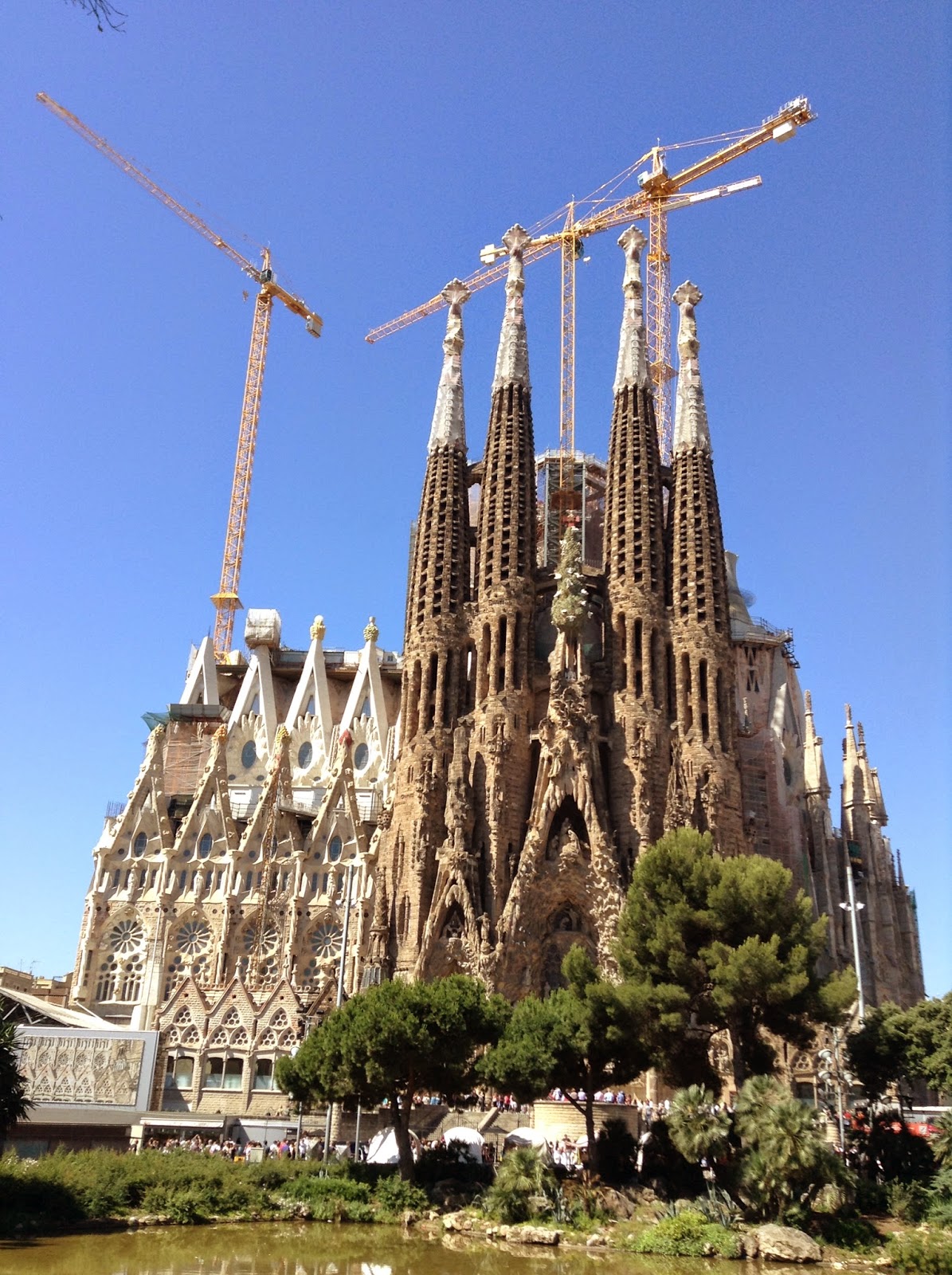
Sagrada Familia, with cranes.
Construction on the Expiatory Church of the Sagrada Familia began in 1882. Its projected completion date, depending on which graphic you believe in the church itself, is somewhere between 2020 and 2030. Antoni Gaudí became involved with the project in 1883, when he was 31 years old; it consumed the rest of his life and ultimately has kept going far beyond his death 88 years ago. The fact that we are still building this church based on his models and studies is a testament to the lasting power of his genius. The church was finally consecrated in 2010 as a minor basilica, the same year the building was enclosed.

At the risk of repeating myself (even though that's exactly what I am doing), let me say again that I am stunned at the amount of visitors this place receives. I opted for the admission with tower visit (I picked the nativity towers since those were completed by Gaudí) but didn't get the audio guide. All that cost me the tidy sum of 19.30 Euros, which is a little more than $26. $26 to visit an unfinished church. I'm amazed non-architects pay that much in such quantities. Again, hats off to the Barcelona tourism folks and good for architecture! I visited two Gothic churches in the city in my couple of days in town. Both were constructed primarily in the 1300s and both are free. Enough ranting.

The Sagrada Familia is at its heart a Gothic church, because pretty much all churches in western civilization are based upon that sort of model. But when it's finally finished, this church is going to be super complicated. At the time of Gaudí's death, only four of the 12 facade towers were complete. These towers, on the nativity facade, can be seen in the photograph above. They are darker brown in color. At the present time, four similar towers have been completed on the passion facade, which is on the other side of the building from the nativity facade. The final four towers on the glory facade have yet to be completed. The glory facade towers are the most complicated and will, when complete, define the entrance to the church. The twelve towers in total represent the twelve apostles.

Those twelve towers, however, are the smallest of the towers on the church. The main tower over the crossing of the church is almost double the height of the facade towers. Around the main tower there are planned four additional intermediate towers which will be about 1.5 times the height of the facade towers. Based on the photo above, there is a lot of work to do. When the building is complete, the towers already completed, which look so huge today, will seem small when compared to the final product.

View of the nave of the Sagrada Familia.
Despite my ranting that I can't believe people pay a lot of money to visit this church, it is pretty amazing. It is really a modern version of a Gothic church. It's at once the same and completely different from those amazing buildings constructed all over Europe in the middle ages. The form is obviously pretty much identical and without looking closely at a photograph of the main nave of the church (like the one above), one might think it is a building straight out of the 1300s.

But start to look closer and you will start to see subtle differences that make all the difference. Gaudí's understanding of forces and structure was far more sophisticated than the master builders of six or seven hundred years ago. Columns in the old Gothic cathedrals, which are straight up and down although they have lateral forces to resist in addition to gravity loads, are canted in Gaudí's church. The Gothic builders accommodated the lateral forces with flying buttresses. The Sagrada Familia doesn't have any because it doesn't need them. 

The shape of the vaults is also purer in the Sagrada Familia. Gaudí's three dimensional force models informed his design of catenary vaults, structurally far more efficient than other forms used in Gothic cathedrals. A catenary is the natural form of a hanging cable; equally distributed loads on structure can be most efficiently resisted with a catenary curve.

Gaudí also takes advantage of concrete construction, a material poured into a negative form, to create a new vocabulary for individual structural components. Columns are no longer similarly shaped stones laid on top of one another. Instead, columns can twist to resemble plants and other natural forms. Vaults no longer need to be ribbed and laid by hand. Instead hyperbolic paraboloids can be used, taking advantage of less material to generate structurally more efficient vaults. The medieval builders didn't stand a chance.

The evolution of the church's design and the model based methodology used by Gaudí are on full display in the museum in the church's basement. You could honestly spend a day or more in this museum and learn more than you probably ever wanted to know about the building. The most informative part of the museum to me was seeing the way Gaudí's influence changed the original concept of the church from Gothic to something else so thoroughly and suddenly. There are three side by side large scale sectional models that illustrate this transformation pretty effectively.

The imagery in the stained glass and sculptures adorning the building is consistent with the church's antecedents  religious themed stories from the Bible abound. Gaudí does, however, wrap more natural motifs into the facade, introducing trees and birds which give a more Art Nouveau feel to the building. These are very well seen from the nativity facade towers, which I would recommend adding to the cost of your admission, even though when I visited the upper sections of the towers were closed.
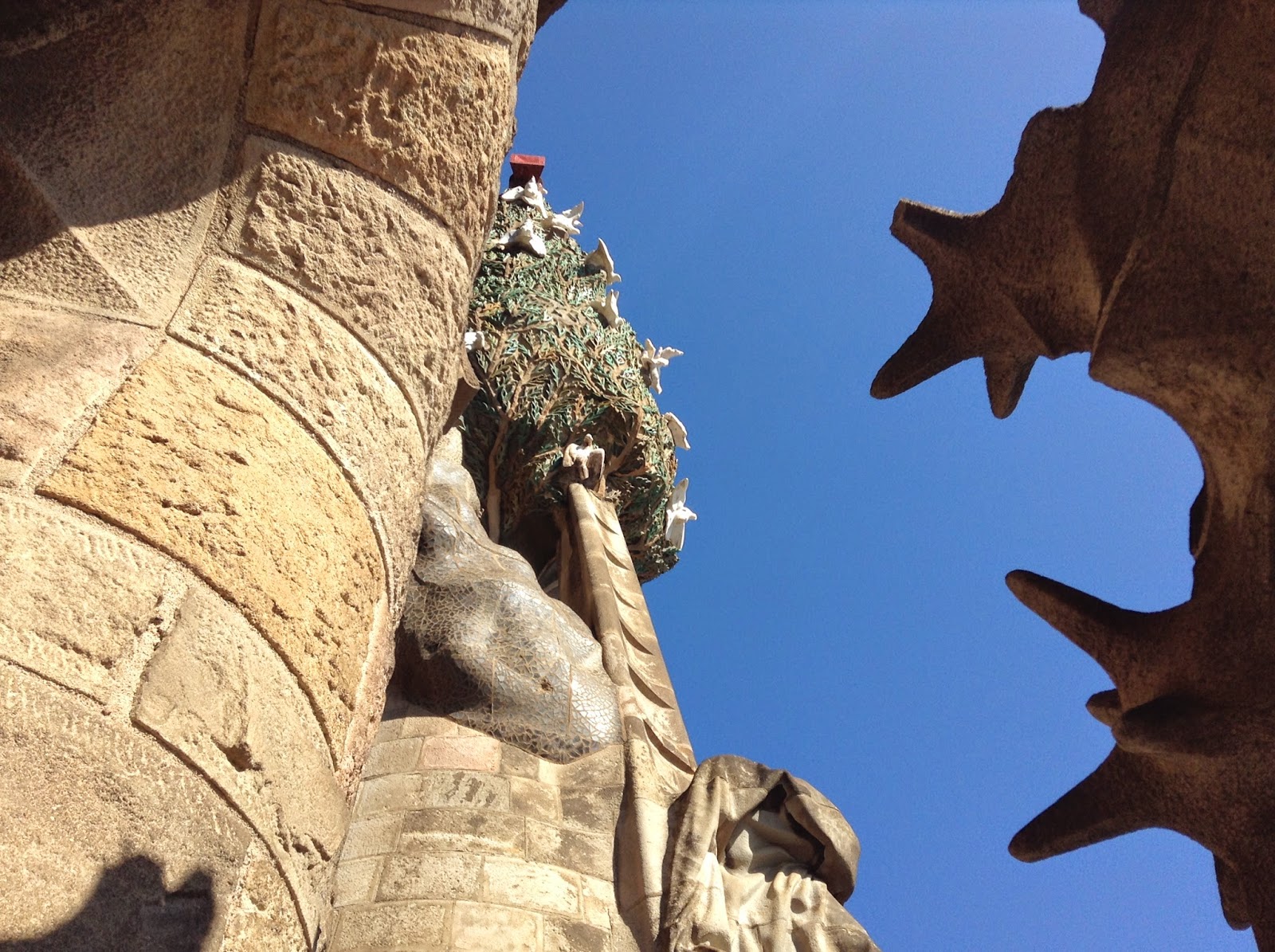
View of the tree in the center of the nativity facade, from the facade's towers.
The stair of the nativity towers.
I'm glad I visited the Sagrada Familia as the last piece on my Gaudí pilgrimage. But perhaps more than the church itself, I was most excited about seeing the school house on the property. Also designed by Gaudí, the building consists of only three rooms but boasts an amazing hyperbolic paraboloid roof constructed of straight wooden beams with a layer of Catalan tiles for the roof structure. I've tried at least twice to use the roof of this building as a model for a canopy design in a school, once at my first job in upstate New York and once with my current employer years and years ago (I failed both times). It's rare that I get to see an actual building that directly inspired my design thought process on a project.

The school of the Sagrada Familia.
With my visit to the Sagrada Familia school, my Gaudí journey was almost complete. I definitely appreciate the contributions that Gaudí left to this world. It took me way too long to get here but at least I made it. There's one less bucket list architecture trip to undertake now. The final stop on my Gaudí journey was to the crypt of the Sagrada Familia. In the far side of the crypt nearly beneath the nativity facade towers is the grave of Antoni Gaudí. Definitely worth the last stop on the trip.

The final resting place of Antoni Gaudi.

Thursday, May 22, 2014

Art Nouveau

2004: Hector Guimard's Castel Beranger, Paris, France.
In my opinion, I am one of the most rational straightforward thinkers and live-rs I know. I love order and straight lines, generally maintain a low profile, don't self-promote much, wear pretty simple clothes and live modestly without any sort of frills or decoration (take that last piece however you will). So, in what might seem like a bit of a non sequitur in this paragraph, it might come as a complete surprise to people that know me that I absolutely love Art Nouveau architecture. It's curvy, flower-y and totally based in nature. And I absolutely love it. On a totally intellectual level, of course.

I fell in love with Art Nouveau in Susan Henderson's modern architecture class in my first year of graduate school at Syracuse University, a class that made an indelible impression on me despite the fact that I had difficulty paying attention or staying awake some days. There's no question that class put me to sleep more than once; it was those comfy chairs in the auditorium in the Newhouse School at SU (I have no idea why the class was over there and not in the Architecture School's Slocum Hall; it just was). The chairs in that auditorium were so comfortable that I almost fell asleep during an exam once. No lie.

That class taught me all about the formative strands of Modern architecture of which Art Nouveau was just a part. As material technologies evolved and the world mechanized, artists and architects embraced iron and later steel to express what they used to carve in stone or wood at the same time the craftsman was being replaced by the factory. That pre-Modern environment allowed architects like Claude-Nicolas Ledoux to strip down traditional classical forms and the Dutch pre-Modernists to design austere, geometrical buildings using new concrete technologies. It also allowed Art Nouveau to flourish across Europe for a couple of decades at the end of the 19th and beginning of the 20th centuries. It was a period that I find very rich before the Modernists came in and made everything totally geometric. Wow I didn't sound like an architect in that last sentence. Oh well!

1997: Charles Rennie Mackintosh's Hill House, Helensburgh, Scotland.
While I was at Syracuse, I had the opportunity to travel abroad for a semester. An opportunity that I turned down, with some later regrets. But since I graduated from school, I have made it a point to visit a lot of this architecture that I love so much, almost all of which is in Europe. In 1994, I visited Hector Guimard's buildings in Paris, my first live Art Nouveau experience. I followed that trip with numerous trips across the United States to see Louis Sullivan buildings in Buffalo, New York and the midwest; two trips to Glasgow (in 1997 and 2007) to see the works of Charles Rennie Mackintosh; a tour of Finland to see the Finnish version of Art Nouveau in 2000; and finally a 2002 vacation in Belgium and Holland to see Victor Horta's works, among others, in Brussels and all the Dutch pre-modernists I could see in a few days in the Netherlands.

Throughout all of my travels, I kept saying I wanted to go to Barcelona more than anywhere else to see firsthand the works of Antoni Gaudi. But year after year, I kept not going, preferring to drive across the United States or visit Las Vegas more than a dozen times or drink beer in Germany and Austria for a week and so on and so on. But tomorrow I am finally going to Barcelona, or at least a little bit closer to it before finally setting foot in that city one week from now. I am finally going to see the last major piece of the Art Nouveau that I love so much. Admittedly, Vienna is still out there for me, but Barcelona's got the real goods.

I'm not just going to Barcelona. How could I considering my pledge to see more of the world? My journey to Barcelona will take me through Madrid for three nights before heading to Morocco for the same duration. So in addition to checking one item off my architecture bucket list, I also get to explore Spain's capital and set foot on a new continent, even if north Africa seems like dipping a toe into the water. Of course I have a whole itinerary planned with float (all good itineraries need float) for each city. I hope to capture the spirit of each place and drink in all the flavor and history I can. The last time I was in Spain, I was about one year old. I'm looking forward to going back. I've been talking about this trip for too long. It feels good to be traveling again!

2002: Gustave Strauven's Maison Saint Cyr, Brussels, Belgium. 

Thursday, January 9, 2014

Blatant Commercial Plug


Last month's trip to Iceland cost me almost as much in winter gear as it did in hotels, airfare and guided tours combined. That fact still astonishes me. I'm amazed that I convinced myself that I needed special winter gear for a place barely colder than my home of Arlington, Virginia just because the country I was headed to had "Ice" in its name. After all, I spent almost 10 years in Syracuse and Cooperstown in upstate New York where it snowed almost daily and where the temperature sometimes would not exceed freezing for a month or more at a time. Heck, I used to walk between the two houses that served as the office where I worked in temperatures way below freezing without a jacket several times a day.

Who knows, maybe I'm getting soft in my middle (hopefully) age here and just have a need to stay warm all the time. Or maybe I was just skeptical that the insulating layer of blubber I've been working on for the last few years wouldn't stand up to a few hours outdoors walking on a glacier or something like that. Regardless of the reason, I decided caution was the better part of valor and shopped and shopped and shopped for some winter gear before heading north on December 10 of last year. I thought that my story here might be worth telling. I'll be very brief, I promise.

First let me say this stuff is difficult to shop for. All the people that work at the stores we went to are way into hiking or mountain biking or skiing or trekking or whatever (which automatically intimidates me because they are probably way fitter and more environmentally responsible than me) and there are so many shirt, jacket and bottom wear possibilities that I just didn't know where to start asking questions. The whole keeping warm outdoors concept seems to be one of layering but without context of past outdooring experiences (and let's face it, it's me we are talking about here) it's next to impossible to ask for help without any sort of prior experience. I just wanted someone to tell me what would keep a 205 pound, 45 year old man who generally runs hot what would keep him warm for a few hours outside at about 64 degrees latitude. Is that so much to ask? Apparently so.

REI. Patagonia. Eddie Bauer. Hudson Trail Outfitters. L. L. Bean. Arcteryx. Mammut. I checked out all these brands or places in an effort to find what I thought I probably didn't need anyway. All I needed was a few hours warmth out of my clothing. How difficult would that be? After probably altogether too much looking, I settled on a variety of brands (including a Washington Wizards knit hat purchased at the NBA store on line) for my trip. But I felt most comfortable going with Patagonia for my outer layers, which featured a Super Cell Waterproof Jacket over a Nano Puff Hoody up top and some Torrentshell Stretch Pants to protect whatever kind of jeans or underlayers I decided to wear. They were a bit more expensive but it seemed based on talking to about everyone in outdoor wear in northern Virginia that you got what you paid for. I felt this stuff would keep me dry and protected from the wind and would provide lightweight upper body protection against the cold. That was the theory at least.

Our first day in Iceland featured a three hour whale watching tour on the northern Atlantic Ocean. Of course, I came equipped in all my new gear which I was convinced would keep me cozy against whatever the icy sea had to offer. I was wrong. It was so freaking cold that I had to pack into a full body boat suit (for lack of a better term) provided by the boat which was pretty much like wearing three or four sleeping bags. I've never been warmer in my life, even if I did feel like I was ready for a cameo on The Deadliest Catch and there was some strange smell in there that I tried to ignore. I was finally convinced I needed some warm weather gear for this trip. I just wasn't sure it was what I bought. I was freezing in my new stuff.


But the next day we took a trip to Gullfoss (which translates to Gold Falls), a waterfall about an hour and a half northeast of Reykjavik. Considering our trip that day included four outdoor stops to commune with nature, including the falls, I of course wore all my new Patagonia stuff. I spent enough on it after all. When we got to the falls, it was just after noon, or about an hour after sunrise, and it was cold and the wind was howling. I mean really blowing hard, like you had to lean into it to walk straight and clomping down the wood staircase one step at a time was difficult because the wind threatened to take you, your companion or an article of clothing away in a particularly vicious gust now and then. 

As we approached the falls, which features two drops totalling just over 100 feet in height and which are spectacularly beautiful, it got so cold and windy that the spray from the falls froze in the air and the wind blew it right at you as if in an attempt to get you away and back to our nice warm tour bus. But amazingly I didn't feel any of that in my Patagonia gear. I mean I felt the pressure from the wind and I heard the ice mist hitting my jacket and pants but no wind got through those clothes I was wearing and I couldn't feel any wetness from the spray on my body. It was that moment that I thought I had made a good choice in shopping before this trip and that I really did need to do it.

I am sure most of the other brands would have kept me as dry and warm as Patagonia but I know for sure I'm sold on this brand. It's been pretty darned cold here the last week or so in the D.C. area and I can tell you I love my Patagonia stuff as much here as I did in Iceland. But I'll never forget that experience at Gullfoss. I'm glad I was well equipped. So thank you, Patagonia. Here ends my shameless blatant commercial plug. I feel it's deserved.

Gullfoss without me in the way. So much more beautiful.

Wednesday, January 8, 2014

The Best Hot Dog In Town


One of the reasons I love traveling so much is that it allows me to sample some food that I ordinarily wouldn't be able to eat in my sheltered little world around Washington, D.C. When I first booked my recent trip to Iceland and started hunting around for what new culinary delicacies I might encounter there, I was intrigued. While I had no desire to sample any hakarl (a type of kidney-less shark that has to be fermented for six months before it is edible) or rams' testicles, I thought I might get to try some puffin, some Icelandic lobster or maybe even some whale, although the ethical issues with whale meat might have scared me off. In my wildest imaginings, I had visions of McDonald's serving Puffin McMuffins for breakfast. That's before I knew McDonald's had come and gone to Iceland, apparently scared off by the country going almost bankrupt in 2008.

But between a packed itinerary for that vacation and a lot of other goings on in life, I just didn't see that a lot of research into food in Iceland would pay off much. So while I ended up sampling skyr, Icelandic meat soup, rye bread baked underground using geothermal heat and a bag or two of paprika flavored potato chips, I missed out on puffin, lobster, whale and some foods that would literally make my stomach turn. I regret not spending some time looking into restaurants before arriving since our one excursion to an actual restaurant, Icelandic Fish and Chips, was pretty much as disappointing as you could get.

But despite all that, there was one food experience in Iceland I was determined to NOT miss out on: eating a hot dog on the street. That's right, a street hot dog. Apparently, Icelanders are nuts for hot dogs to the point of it being a bit of a national obsession. And if you are going to have a hot dog in Iceland, you have to do it at Bæjarins Beztu Pylsur, a hot dog stand located in what looks like a triangular leftover parcel of land a couple of blocks from the harbor in downtown Reykjavik. There are three other locations in the city but the one to go to is the original at Tryggvatagata 1.


It has been reported that greater than 50% of all Icelanders have eaten a hot dog from Bæjarins Beztu Pylsur, which translates to "the best hot dog in town." How someone came up with this statistic, I have no idea. In August 2006, the British newspaper The Guardian named it the best hot dog stand in Europe, for what that's worth. And if all that weren't enough, apparently Madonna, James Hetfield and Bill Clinton have all stopped by for a bite. With this sort of mythology surrounding it, and having already hit up Tail o' The Pup and Pink's on separate trips to Los Angeles, I knew I had to stop by before we left town.

As luck would have it, we stumbled upon the stand quite by accident on our first day in country after getting off our non-whale watching trip at a time when we were just looking for a snack to tide us over before our jet-lagged bodies gave out and we succumbed to sleep. It was cold and snowy and already really dark at 4 p.m. and either the weather or the hour had scared away the line that everything I had read about this place said we would encounter. Admittedly, two other people showed up right after we got there but when we ordered two hot dogs with everything, we were the only ones there.

Ordering with everything is supposed to be the way to go here so we complied with local custom. Everything in this case means raw onions, fried onions, ketchup, remoulade and sweet Icelandic mustard. About 15 seconds after ordering, I was presented with two hot dogs which looked decidedly not like they had "everything" on them. I had apparently missed the two applications of onions which were concealed below the frank but indeed everything was there. It all happened so fast. Finding the only table there covered with a thin film of snow, we elected to eat standing up.


The hot dogs we ate here were a quick cheap meal that provided a bit of warmth both in terms of the temperature of the food and the feeling that we were doing something uniquely Icelandic and they were very welcome. The taste itself was not as salty as a regular hot dog, either through a lack of salt in the sausage or through being masked by the sweetness of the mustard, which definitely shone through the sauces. There was also something crunchy in the toppings which was either the raw onions, or something in the remoulade. The texture was almost like tiny sushi roe combined with Rice Krispies. Not as sketchy as it sounds.

I've eaten a lot of hot dogs in my life. Possibly too many. And I'm just not sure I have a perfect hot dog. Most hot dogs I've eaten have been microwaved or boiled in my own place and slathered with mustard and sauerkraut. I just haven't had a lot of restaurant dogs. By default, this was without a doubt the best I had in Iceland. I'm not sure it beats Pink's for flavor but the no wait line here vs. the hour and a half wait for a hot dog on a hot Los Angeles May night was definitely better. More than anything else, I feel stopping by here was something that had to be done to feel like I really had been to Iceland and I'm glad we could fit it into what was an extremely packed agenda. I'll go back for another next time I'm in town.

Wednesday, January 1, 2014

Black Death


Sometimes it seems like half of what I write about in this blog is food and booze. Not that there's anything necessarily wrong with that. I wouldn't have traveled to Kentucky this past fall if it weren't for bourbon and I wouldn't have had the same memories of Bavaria if I hadn't eaten so many sausages and drank so much beer. And so I think it's appropriate that my recent trip to Iceland gave me a great story involving both food and booze. This post deals with the booze part of that couple; a post covering the food will follow very soon.

Different parts of our globe are often identified with the distilled spirits they produce. At least for me they are; I just can't separate the booze from the geography I guess. When I think Russia, I think vodka. Scotland has Scotch, Kentucky has bourbon, the Caribbean has rum, Mexico has tequila and mezcal and on and on and on. Six months ago, I never would have identified Iceland with a distilled spirit. After having spent about a half a week on that volcanic rock in the Atlantic, now I do. Now when I think Iceland, I think brennivin.

Two shots and a water, as recommended.
Iceland, like a number of other countries, has had an interesting history of temperance and alcohol bans over its history. Just like in the United States, the country experienced a period of prohibition beginning in the early 20th Century. The initial period of prohibition lasted from 1915, when all alcohol was banned (booooooooo!), until 1921, when Spanish refusal to purchase Icelandic fish unless Iceland imported Spanish wines forced the reinstatement of wine as a legal beverage. Way to go, Spain! Woo hoo!

The re-introduction of sprits to Icelandic society was next. A national referendum on prohibition in 1935 allowed the legal sale of distilled beverages in the country for the first time in 20 years and at that point, most of what the temperance movement in Iceland had sought to ban was now legal. This is where brennivin takes off, but I'll come back to that in a paragraph or so.

I guess once wine and spirits were legalized, both the drinkers and the non-drinkers quit arguing for a while, preferring the status quo to continued struggle, because the sale of beer remained banned until 1989. No, that's not a typo. Icelanders lived without legal beer, that most wonderful of all drinks, for an astounding 74 years and two months until March 1, 1989 (now known as Beer Day). Ironically, the straw that broke the camel's back there was the Minister of Justice's 1985 ruling that bars could not add liquor to legal non-alcoholic beer to simulate real beer. I guess the silliness of the whole endeavor was sort of obvious after that.

Here goes nothing. Skal!
Once the ban on spirits was lifted in Iceland, it was time for brennivin to step forward as Iceland's national drink. Brennivin is technically a schnapps, which is a fermented beverage where the base of the alcohol (in this case potatoes) is fermented with the liquor's flavoring as part of the fermentation process, as opposed to being added later. The primary flavor in brennivin is caraway seeds, although there are other herbs and spices in there, most notably cumin and angelica. Sounds yummy, right? 

Folks in Iceland started distilling brennivin as soon as the government of Iceland told them that they could but the packaging was a little bit different than it is today. The current packaging features a mouthwash-green bottle (brennivin itself is clear) with a black label featuring the silhouette of Iceland on it; the original bottle label was also black but it prominently displayed a skull and crossbones label. Both the black color and the ominous label were designed to discourage people from drinking it (clearly not the American version of capitalism). The label had the exact opposite effect to what was intended. Brennivin sold well and it ended up with the nickname "black death" which has stuck to this day. 

After learning about black death, I knew I couldn't leave Iceland without a taste, so on our first night in country, exhausted after an overnight flight which featured about five hours of uneasy sitting up sleeping, I walked into a bar on Laugavegur (Reykjavik's main shopping drag) for a shot (or two). My choice of establishments was Lebowski Bar, which as the name suggests, is dedicated to all-things-dude inspired by the Jeff Bridges movie The Big Lebowski. While I understand there are many folks out there who love this movie, I'm not a Big Lebowski guy so to me it was a bowling themed bar, complete with moving neon bowling balls and pins on the outside and Brunswick plastic laminate bar tops. I got it. But I was there for the brennivin, not the decor.    


Brennivin is kept chilled so it was not visible walking into the bar but I knew they would have it. My request for two shots of brennivin was granted, with a question from the bartender: did I want a glass of water with my brennivin? After asking if I needed one, and being assured by the bartender that he always keeps a glass of water handy when drinking brennivin, I agreed to two shots and a water chaser. Time to taste.

I have to say my expectations were pretty darned low here and they were exceeded mightily. I expected any liquor with a nickname like black death to be awful but I was pleasantly surprised. If I can paint any sort of picture as to the flavor, I'd say it was pretty much like drinking rye bread, a result more of the caraway than anything else; the cumin and other flavorings did not make themselves evident to my weak taste buds. While rye bread flavored alcohol might not sound that thrilling, I was really OK with it. I can think of way worse things to drink. And brennivin is 75 proof so its relatively low alcohol content makes it really drinkable with no burn going down the throat. I'm sure I could down a lot of this in a night in Reykjavik if I needed to prove my worth to Icelanders. And I did not need the chaser. After my two shots were down, I left the water as poured on the bar and walked back into the dark and cold, ready to return to my hotel confident I'd crossed one of the essential experiences off my Iceland list.

Oh, and they sell this stuff really cheap at the airport. I have a half liter chilling in my fridge as I write this. Come over and taste it with me if you are ever close by. Skal!

I like to stop at the duty free shop. At least I do in Iceland when there's brennivin to bring back!