Saturday, September 28, 2024

Wooden Ships

We have traveled to a ton of places over the last 11 or so years. Six continents. 25 plus countries. Who knows how many cities and towns. Mountains. Rivers. Highways. Beaches. Volcanoes. Parks. Much more. Most of those places we've visited just once, and they will either stay that way or we'll say hello again once that destination gets back to the top of our list. It's a long list. Some places may need to wait a long while. Or forever. Hey, we have other things to see.

But that last part is not true of everywhere we've traveled. There are spots in this world that we've found ourselves in much more than once, compelled by some force or experience to go back and do it once again or polish off those things that we missed the second or third or fourth time. In some cases, when we've spent so much time in one place, it's started to feel like a second home. New York definitely leads the pack there. We don't do much tourist-y stuff in New York anymore. We just want to be there, spending time in our favorite haunts because we are in love with the place.

London is getting there. We are definitely running out of obvious, in the guidebook stuff to soak up in England's capital. Four visits in 10 years will do that. But we are not quite there yet. It's not New York, and I mean that on so many levels. Our time in London in September of this year found us turning over a rock or two to get one or two more drops of juice out of the place, including two experiences that built on a couple of days we'd spent elsewhere on the globe in the last 12 months. This post is about one of those.

Earlier this year, we spent some time in Southeast Asia. Part of that trip involved spending some time in Malaysia where we visited a tea plantation. It was honestly the most interesting and coolest thing we did in Malaysia. I'm not kidding. It was truly awesome. I'm not knocking Malaysia by saying the best thing we did was go to a sort of farm (although we WERE disappointed a bit in Malaysia). Visiting the tea plantation was well worth the trip. 

When we think of tea today, of course, we often think of England, and not because that's where tea is grown, because it categorically is not grown in England. But whether you grew up there or when you are visiting and just have to have a cuppa with breakfast or crave some afternoon tea or a cream tea now and then, tea is now for sure, no doubt an English thing. We did, on just this one trip, partake in all three tea experiences mentioned in this paragraph so clearly we have bought into this drink association.

So how did the English get to love tea if you can't grow tea in Great Britain? Why, by exploring and then colonizing the world, of course. They first found the stuff in China, and started importing it into the country in the 1650s. Considering the speed at which information moved back then in the middle of the seventeenth century, it seems to me that tea caught on in England pretty quickly, perhaps spurred on by a mention of the drink by Samuel Pepys in his writings or Charles II's wife Catherine of Braganza being a bit of a tea fanatic. 

The East India Company started bringing back tea from China in 1669 and Thomas Twining opened his first tea room in London in 1706. From that point on there was really no looking back. Tea would be intertwined into the national identity to this day. Eventually in the mid-1800s, the English started growing it in spots around the world that they claimed for their own whether whoever was there already wanted it or liked it or not. That's how tea plantations started in India, Sri Lanka (then Ceylon), Kenya and yes...Malaysia.

But even after they started growing tea for themselves, they still needed it from China.

So how did one transport tea from the far east (or Africa) back to England between the 1650s and the 20th century? On a ship. How else? I mean this is before air travel or reasonably safe and efficient and speedy overland travel. You wanted to get somewhere on the globe from Point A to Point B a few hundred years ago relatively quickly? You boarded a boat. 

Speed counted here. Between 1861 and 1866, the first tea ship into port each season would earn its owner an extra shilling for each ton of tea on board. But beyond that, generally the faster you can move product from source to market, the faster you will turn a profit and the faster you can turn around and go get another load. In the second half of the 19th century, ship owner "Jock" Willis commissioned ship designer Hercules Linton to design the fastest tea ship in the world. 

They named the ship the Cutty Sark, after a line in Robert Burns' poem "Tam O'Shanter". The Cutty Sark is still around today. It's in Greenwich, just a 40 minute or so ride down the Thames from the center of London. This, I had to go see to add one more level to the understanding of tea, which we had started to explore in February.

The tea clipper Cutty Sark, Greenwich. No, it's not early evening; it's England.

I had been to Greenwich once before. It was a while ago (in 2007) and I know sometimes my memory is lacking but I couldn't recall seeing a full size original tea clipper hanging around the place when we went to visit the Royal Naval Museum, the Royal Observatory and the Queen's House all those years ago. It seemed to me that I should have noticed something this big just out in the open near the commuter and tourist boat dock along the Thames. 

Turns out in this case my memory wasn't wrong. The Cutty Sark was in Greenwich in the summer of 2007 but it was under restoration at that time. Even worse, the ship was the victim of a fire in May of that year which halted and delayed the restoration so it was likely (a) under wraps and (b) under heavy protection and immediate recovery beyond just being under wraps. It's no wonder I missed it in 2007. I wouldn't in 2024.

The hull of the Cutty Sark, suspended over the exhibit floor.

The Cutty Sark was custom built to transport tea. It was designed with a fast hull with sufficient cargo space to hold a lot of product but also with a low draft so that it wouldn't get snagged on the sand bars which were present at the mouths of the rivers in China which it would need to navigate to stock up on tea. And the speed thing that I mentioned earlier? The design worked. When it was built, the Cutty Sark was the fastest ship in the world. It almost seems crazy that it was custom built for tea. I mean it seems like that sort of a cargo wouldn't be that valuable to warrant the fastest ship in the world. But then again, we are a long way removed from the late 1800s.

The majority of the volume of the ship was reserved for cargo space. Everything that involved the crew sailing the ship took place on the main deck, or the top level of the ship. The enclosed living space dedicated to the captain, officers and crew of the ship are tiny. Privacy was non-existent for most all of the men on the ship that were not the captain. The two lower levels, the lower hold (below the water line) and the 'tween deck (with floor pretty much at the water line), are huge and existed strictly to make money. They would be packed as tight as possible with crate after crate of tea on the journey from the far east to England. 

How much tea could the Cutty Sark transport in a single voyage? Enough tea for an astonishing 200 million cups with a total value in today's currency of 18.5 million pounds. In one trip. Seems like the owners of the Cutty Sark which they custom built for this purpose had figured out the game pretty well. They launched the ship in 1869. 


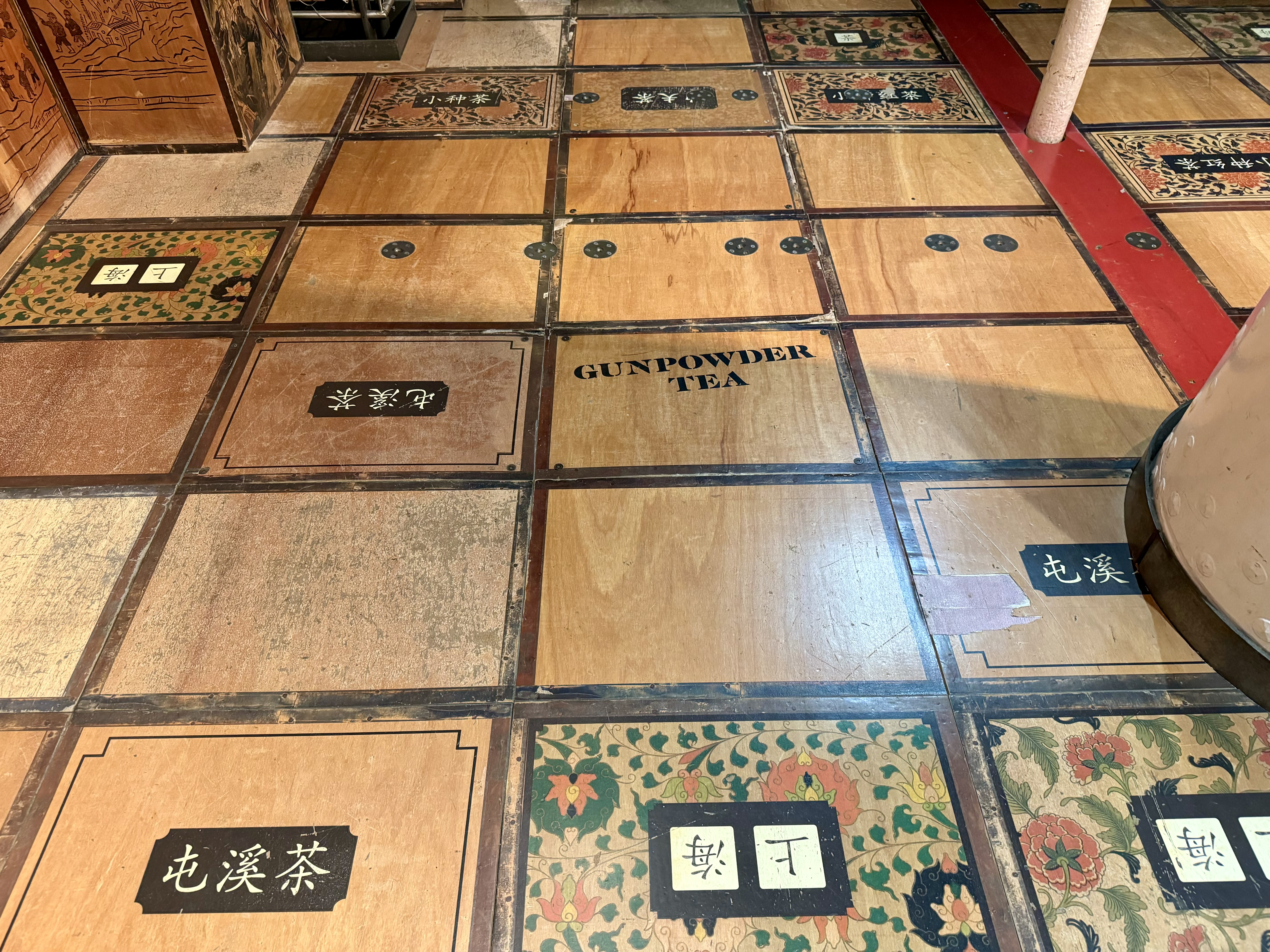
The two cargo holds of the Cutty Sark: the lower deck (top) and the massive 'tween deck (bottom).

The Cutty Sark's life as a tea clipper lasted less than 10 years. In 1878, the ship stopped hauling tea from China to England and started transporting wool from Australia. 

In the year the Cutty Sark was launched, something else happened that would change the tea trade from China pretty quickly: the Suez Canal opened, creating a route to China that was 3,800 miles shorter. Steam ships now had a schedule advantage over sailing ships, which could not sail (but could be tugged) through the Canal. Combine a shorter route with a much less treacherous journey that avoided Africa's Cape of Good Hope and smaller insurance premiums and the tea clipper idea was dead. How fast was the Cutty Sark? Didn't matter. It wasn't 3,800 miles faster.

Today, the Cutty Sark is restored back to its early 1870s appearance, which for me was perfect because that's exactly the period in which I was interested. That restoration first occurred in the 1950s, long after the ship was transporting tea from China or wool from Australia or then ferrying cargo back and forth across the Atlantic Ocean from Portugal to South America. 

The masts, rigging and deckhouses which housed the crew on the main deck had to be entirely reconstructed, but 90% of the hull, which was made from Indian teak and American rock elm, is original as is some of the iron frame which was used as the primary structure for the decks. The original iron today is painted white in the restored ship. There is a whole lot of iron painted white in the two pictures above.

The Cutty Sark today is in permanent dry dock. Those sailing days are long over. The ship is suspended on steel columns and enclosed by a glass roof structure that pretty much mimics the level of the ocean when the vessel was afloat. The main and 'tween decks and the lower hold are all accessible to visitors and there is a below grade museum level that allows you to pass on foot directly below the hull. 

The fact that you can see the entirety of the exterior and interior of the ship is pretty special. The hull is massive, which considering it was designed with a low draft to allow passage over sandbars just indicates how much below water stuff there is on other ships out there not designed with the same feature as the Cutty Sark. The cargo spaces look as big inside as the hull looks outside. There is so much space in these interior holds. It must have been pretty impressive to see these things packed full of merch.

But the most interesting area for me was the main deck, where the captain, crew and officers lived, worked and slept, although I'm sure it was way more work than anything else, particularly for the crew. A one-way voyage on the Cutty Sark, despite being the fastest ship in the world, was almost four months long. That's four months on the open water sailing every day and working on the ocean's schedule. This is not a 9 to 5 gig that some of us enjoy in 2024. This must have been hard and demanding work with emergencies and conditions to react to at a moment's notice. 

The safety record on the ship was impressive; they only lost five crew members on the open water. But that doesn't mean it wasn't extremely hard work.


The saloon used by the ship's officers at mealtimes (top) and an officers' bunk room for three (bottom).

The only person with a private cabin on the ship was the captain. All other officers and crew quarters were shared. Each man aboard would need to have clothing for the coldest and hottest weather and would obviously need to do their work outdoors every day with no modern luxuries as simple as sunscreen. Some crew members could afford changes of clothes. Others couldn't, which must have really been inconvenient when your clothes were soaking wet in a storm. 

The majority of "free time" was spent indoors in the deckhouses with fellow crew members. According to signage on the main deck, time not working was usually spent mending gear or playing board games, if someone had managed to bring one on board. Tobacco and, in rare situations, alcohol sometimes provided a different sort of relief from what I am sure was a lot of pain, aches and abject boredom. I can't imagine how difficult this sort of work was. I get bored at home on weekends sometimes and I have a ton of things to entertain myself. This must have been excruciating. 

I love it when different trips in the same calendar year provide us opportunities to learn about different angles of a similar subject. This was completely unplanned. We had no idea when we visited a tea plantation in Malaysia that the Cutty Sark would be on this year's United Kingdom agenda. Similarly, we had no idea there was a tea clipper in dry dock in Greenwich when we planned a day trip down the Thames (we'll get to the other reason we visited Greenwich). Luck happens sometimes, although this was really a "make your own luck" situation by us continuing to explore different places in the world.

Every so often there is a little nugget of something in a place I have visited that fascinates me. That nugget on the Cutty Sark is the two suspended discs in the officers saloon in the picture above. They look like they might be there to hold candles or some other form of light, but they are not. They were installed in the saloon to hold bottles and drinks so that liquids (presumably some of it wine or liquor) would not spill when the ship tilted with the action of the water. I find these sorts of simple inventions intriguing. That's the last word on this one.

The Cutty Sark with modern London in the distance. 

Sunday, June 30, 2024

Five Oh

At some point for some Americans, visiting all 50 of the states that make up our nation becomes a thing. I'm one of those Americans. I guess it became a thing for me in about the mid-1990s when a trip to the upper Midwest had me traveling to and through Minnesota, Iowa, Wisconsin and Illinois in a single week. Now, I realize four of 50 in seven days or so might not seem like a lot of progress, but at that point, I thought the end goal of the whole half century was probably achievable if I set my mind to it. 

So I did. Not every year, necessarily. It came in fits and starts. I made a push in 2001 when I knocked off Colorado, New Mexico, Wyoming and Nevada in two jaunts out west and really put the pedal to the metal on a cross-country drive in 2011 when I picked up Missouri, South Dakota, Montana, Idaho and Oregon. That gave me 40. Within spitting distance, as you might say.

It's been super tough since then. It took me 32 years to get to the first 40. 12 years after that east coast to west coast drive, I had only picked up eight more to get me to 48. Louisiana. Utah. Alabama. Hawaii. Alaska. North Dakota. Arkansas. Nebraska. All in the books. And if the age math doesn't make sense (since I'm 56 now), I didn't start this thing until I got to the United States in 1979 when I was 11.

And so at the beginning of this year, it was down to the last two: Kansas and Oklahoma. If there was a silver lining to those two being the last two, it was that they are next to one another.

The Outsiders House Museum, used in the filming of the movie of the same name, Tulsa.
With just two left, it was kind of time to end this thing. 

So last month, we hopped on a plane at National Airport in Arlington, Virginia, and landed in Kansas City, Missouri. The next day, we drove west to Lawrence and then Topeka in Kansas and then headed south for Tulsa. At 6 p.m. on Friday, May 24, we hit the border of Oklahoma. 50 states. Done!

I feel like I really accomplished something here. I mean, how many people really do this in their lives? I know maybe two or three people who have done this. It's definitely a club that not a lot of people will join. Most Americans will never get there. I made it at 55 years old (OK...almost 56), although (again) I didn't even get to this country until I was 11. There's no doubt that this is a marathon-type of task. I'm glad I did it because I've been chasing it for so, so long.

But honestly, this didn't feel like I thought it would feel. I wasn't super elated and I didn't really feel an amazing sense of completing something epic when I crossed into Oklahoma, although one could argue that's exactly what I have done. Maybe it's the fact that that 50th trigger was literally driving over an imaginary line and stopping at a pretty graphically uninspired-looking sign (see above). Maybe it's because it's been so long coming and had started to feel a little like a bit of a chore. Or maybe, it's because it was Oklahoma, and Kansas before it, and these two were clearly last for one reason and one reason alone: we really couldn't think what we'd be doing there if we ever visited.

I know that's unfair. And I now know it's a total misjudgment. At least of Oklahoma (sorry, Kansas) where we spent three days exploring after crossing the threshold.

Buck Atom, Route 66, Tulsa. One of the many repurposed muffler men out there in the West.
Let me say three things before I move on and/or forget to write these three things.

First, I tried to do this the right way. I didn't count fly throughs and I wouldn't count a state as visited unless I did something tangible and memorable when visiting. No just driving over the border for some lunch or driving through a state. Stopping and visiting something related to tourism or real life in the state was required. 

Second, all the "we" words in the narrative about getting to the border of Oklahoma is important because it wasn't me getting to 50 states. We've spent a lot of effort over the last couple of years getting my wife caught up to me so we could do this together. At the beginning of this year she had one more state than me left: the two I was missing and Missouri. Which is why we went to Kansas City first.

Third, this quest has been very much an immigrant's quest. I remember very distinctly our arrival to this country in Boston on July 25, 1979. Or maybe that's not quite right. Maybe it's that I remember three things very distinctly about our first moments in Massachusetts. These are (1) I'd never been anywhere so hot; I think the temperature and humidity were both north of 90 that day; (2) I'd never been in a car with air conditioning, which, you know, was appreciated that day; and (3) I'd never been anywhere so green. England is often referred to as green but I'd never seen forests like I saw alongside of I-90 that day. 

I love this country and I'm glad I've seen a bit of all of its 50 states.

The scissor-tailed flycatcher, Oklahoma's state bird. Somewhere near Pawhuska.
So about Oklahoma being awesome...I think I would have been way more excited to enter my state number 50 if I knew how much I'd get out of my time there. I mean it ended up being one of those places that astonished me. I connected so well with a lot of what we found and did there. 

It happens. Every so often we find someplace that we end up loving way more than we possibly could have imagined. I think the last place we felt this way about was Rapid City, South Dakota. If I had known everything we'd find in Oklahoma, I would have been elated to cross that border. Like most places we travel that we haven't visited before, we usually end up finding something that changes our perspective. That too was true of Oklahoma.

So why was Oklahoma amazing? How about music? How about birds? How about pop culture? 

We actually had a bird quest in Oklahoma. We were on a mission to find the state bird, the scissor-tailed flycatcher somewhere in the state. And we found one. Or more than one. Several actually, along with some eastern meadowlarks, a nighthawk, our first indigo buntings of the season and what is likely to be our new species obsession: the painted bunting. We've already earmarked a swamp in the Everglades where these birds, which look like they've been hit by a rainbow that stuck, spend the winter months. These trips keep popping up.

We found music in the Woody Guthrie Center. We skipped the Bob Dylan Center, but swung by the Church Studio where Leon Russell, Willie Nelson, Eric Clapton, Tom Petty, J.J. Cale (of course!) and others have recorded without going in (closed on Memorial Day). We also found a cool place to hear live music in the Mercury Lounge where we also appreciated their very loud and clear message of inclusiveness and not being a jerk. OK, so the Lounge used a different word.

And for pop culture fans (and for very different sorts of pop culture fans actually) we toured The Outsiders house in North Tulsa and spent a half day or so out in Pawhuska, which is the center of The Food Network's Pioneer Woman (a.k.a. Ree Drummond) empire. Both are very different kinds of pilgrimages. The Outsiders House is just a labor of love that's been embraced by about everyone who had about anything to do with the movie adaptation of Tulsa's own S.E. Hinton's novel which she started writing when she was 15. The staying power of that work and the movie Francis Ford Coppola made out of it is impressive.

The interior of Greenwood Rising, preserving the memory of Tulsa's Black Wall Street.
And if all that weren't enough, Route 66 goes right the way through the state, entering Oklahoma at the very northeast corner and extending all the way to the western border before passing into the Texas panhandle. And the eastern end of that road has what have to be some of the Mother Road's kitschiest and most classic attractions. 

Blue Whale of Catoosa? Visited! And let me say that attraction is the most amazing and most useless thing all at the same time. Why someone would build this thing in the first place is way beyond my ability to comprehend but I'm glad it's there. And I'm glad we visited to see beyond the one classic view of this place (which I have duplicated by my own hand below). Yes, it's silly and nonsensical and yes, it's totally worth visiting.

A little bit west of Catoosa in Tulsa (and a little bit off Route 66 to be honest) is the Golden Driller, a monument to Tulsa's original source of wealth. This one built in 1966 is actually the third golden driller and it's the largest free-standing statue in the world at 76 feet high. Yes, that's a real oil derrick his elbow is resting upon.

Then right in the middle of Tulsa on Route 66 there's a former muffler man turned space voyager outside Buck Atom's Cosmic Curios. One day, there's going to be a blog post from me about muffler men. These things are icons of the American west road trip. I just need to see enough to write something meaningful (right now I'm at two).

Look, I get that there's nothing to do with these things except just look at them or walk into them a little bit (Blue Whale) and then turn around and walk out again. But this stuff is part of American roadtripping history. Before videogames or iPads or GPSes and whatever else occupies our time when on the open road or tells us where to go, these side of the road attractions were landmarks when traveling between Point A and sometimes very distant Point B. They matter.


So admittedly not everything that we encountered in Oklahoma was wonderful. It never is when we travel. There's always something, it seems. Our something in Oklahoma had nothing to do with the people that we met or what happened to us while we were there. It had to do with the place's history. Tulsa is the site of one of the worst race riots in the history of the United States. And considering our country's history with race riots, that's saying a lot.

Oklahoma was settled effectively by sanctioned land grabbing. I'm dumbing this down a lot but the state was opened up to settlement on a first come, first served basis for anyone who wanted to plant a flag in a plot of land and farm it. There was literally a single start time where settlers lined up at a sort of starting line and rushed to get their land once the gun went off. Sure, some jumped the event by a day or so (the "Sooners") but the starting line thing is basically how it worked. Or at least that's how I understand it. I am sure I am way, way off.

Not all the land in what would become the State of Oklahoma (state number 46, in case you were wondering...) was desirable. So when it came time to welcome resettled native Americans and freed former slaves into the state, the leftover, less desirable land got given to those groups. Only it turned out to be not so undesirable because the powers that be had actually conveyed oil rich lands into the hands of those they meant to really not give anything valuable to. 

Oil led to wealth, and failing to find white businesses to take their money (every time we find out about segregation in this country, it's so disappointing, stupid and shortsighted), the black oil-rich landowners built their own business community which thrived better than most other places in the State of Oklahoma and really likely most places in the United States.

Then in 1921, a misunderstanding, a few lies and rumors and a whole lot of white jealousy and hate exploded into the wholesale destruction of the neighborhood that had been built in the Greenwood section of Tulsa, along with some out and out murders and really no consequences faced for those that started or participated in all the crimes committed against the city's black residents that day and night. It continues to amaze me how people can unleash this kind of violence on fellow people because their skin is a different color. 

The whole ordeal, including the events and conditions leading up to the riot and the completely unsatisfying aftermath, is documented in the pretty new Greenwood Rising Museum. Stroll around outside before or after your visit and read the plaques in the sidewalk detailing all of what used to be there and was never rebuilt. It's important we not forget these things.

And I thought there was nothing to do in Oklahoma. No reason to visit. Wrong! Wrong! And wrong! Oklahoma gave a good accounting for itself. It was worth saving until last, even if that wasn't my intention in any way.

The Blue Whale of Catoosa. A Route 66 classic since 1972.

But my most vivid memory of Oklahoma is also my worst memory of Oklahoma. 

On our first full day in the state, we took a drive from Tulsa to Pawhuska to do all things Pioneer Woman and maybe a couple of other things prairie-like for the day. Our route out there took us from Oklahoma State Routes 75 and 11, passing small town after small town on the way to a town about the same size as all those we passed. At one point on our drive, we encountered a detour that wasn't on Google Maps. No issue, it was simple enough to drive around. As we detoured, we rubbernecked a bit and tried to see what was going on. We ultimately passed by supposing that the center of town was off limits for some Memorial Day weekend event and we kept going to Pawhuska.

While in Pawhuska, we learned that a town named Barnsdall nearby had been hit by a tornado just the previous week. The stories sounded heartbreaking. An octogenarian who refused to leave town found 2-1/2 miles from the town courtesy of the tornado. A four year old who walked away without a scratch while both his parents were in the ICU and not yet conscious. Homes wiped out leaving survivors with nothing. We wondered if Barnsdall was the town with the detour and that it was not some celebration that was causing the re-routing of traffic, but the scene of a natural disaster. 

Sure enough, on our way back down Route 11, we passed by Barnsdall with an unexpected detour. From the west side of town you wouldn't have known anything was amiss and when we passed along the south perimeter, we could see a tree or two downed.

But when we came around the east side of town, we saw what had happened. We came across downed trees at first and seconds later noticed an entire swath of wooded area with trees that were stripped bare. There was not a single leaf or any small branch of these things, just trunks and substantial limbs completely denuded. Behind the trees, clearly visible, was a hill of shattered and shredded building materials. Anything and everything that can be used to make a house just in an untidy pile and not suitable for any sort of reuse. We had driven right by all this on the way to Pawhuska and hadn't noticed any of this.

The worst was beyond the naked trees: an entire section of town gone. That mountain of building materials? What used to be people's homes on what now were just empty lots. There was nothing except a masonry church. Everything else was gone. The devastation and precision with which this funnelcloud took from the families who used to live there was shocking and jarring. I've seen news footage of the type of destruction that can be caused by a tornado. It's way worse in real life. What are these survivors supposed to do? Mother Nature is still the boss, no matter how much we think we own this planet. It's a heck of a memory to leave Oklahoma with but at least I got to go home. My heart goes out to that town. Chilling.

No pictures of this one. Didn't think it was appropriate. But there is plenty of footage of the aftermath on the internet. I'll leave it to you to search for it. Tulsa and every part of Oklahoma we visited was amazing. Barnsdall is my most lasting memory. Sometimes when we travel we find things that we don't expect. It's all worth it, even if it's sometimes heartbreaking.

Foreshadowing. Not Oklahoma. Seen at the Kansas City airport.

Saturday, June 22, 2024

56


Today is my 56th birthday. Another year of exploring our planet and year 11 of blogging about it is complete. So much for stopping at five years. I'm glad I didn't. This blog makes me keep pushing myself further and further to do more and more. And yes, I'm still up for writing down a lot of what I've experienced so I can keep re-living what I've done and seen and heard and smelled and eaten over and over again if I want to.

This year has been a different year of travel for me. Now, I realize I've already written about how it's been different in a couple of posts but indulge me again, if you even remember those posts (I know...you don't). So sure, we've expanded our horizons a lot this year. No new news there. Standard amazing stuff. Five new countries. Two new states (that's significant and we'll get to that soon). Tons of new birds. A second trip ever to Asia (for me, at least). Expensive wine in the Napa Valley and cheap (but still really, really good) wine in Croatia and Greece. Boston. All sorts of new music and food and other things. Awesome stuff! Read all about it in the posts from the last year. Please.

But I've also spent time traveling for work. Like way more than I've ever done. Like eight trips to New York and two to Chicago (albeit one was not MY work trip). I don't think that's affected my travel planning yet because everywhere I've been since my last birthday was planned before I got this new assignment. But the back end of this year might be a bit muted because of it. I did say MIGHT. It's definitely packed full of time in New York.

I love Chicago and I really love New York a lot. So I've tried to sneak in some stuff that I would normally do if I were going to those cities for fun. My first Chicago dog. Public transportation as an experience. Incredible (non-Chicago dog) food. Memorials. World class architecture. World class opera. Birdwatching. Movies. These trips haven't been as much fun as the rest of my trips (you know...because of the work) but I've tried to do more than just go work, eat and sleep. They have been fun and they have been tiring. The fun part is more important. And yes, I have sneaked a couple of posts in here and there. And I might not be done.

Charlie Parker Memorial, Kansas City MO. One of a few jazz pilgrimages I've made this year (for my dad).
So let's check up on goals, because that's what I do in these birthday posts after all. When I started this thing at 45, I made myself a series of goals to keep me focused and set some themes for my first five years of travel. I aced them all. Finished not just on time, but early. 

So at 50, I did it again. And I wasn't so successful. I got some of what I wanted to accomplish but I missed two things: (1) a trip to Angkor Wat in Cambodia and (2) completing my quest to visit every state in the United States. On this last one, as of a year ago, I was missing two states: Kansas and Oklahoma.

I blamed COVID for me missing my goals. I know...it's a bit flimsy but legit traveling outside of the United States was somewhat challenging for a bit there. So last year, considering I failed at my 50th birthday promise, I set no new goals until I finished what I pledged to get done a year ago.

The good news is I'm done. I set foot in Angkor Wat very early one February morning and followed that up in May with a flight to Kansas City, Missouri, picking up a car at the airport and then proceeding to drive to both Kansas and Oklahoma. Angkor Wat done! All 50 states done! Time for some new goals. And no, I haven't blogged and posted about the 50 states, but I will.

Only on the goals thing...no. I'm not making any more goals. I'm just going to go where I want to from now on. No checklists, no milestones, no goalposts, no nothing. Just going with the flow. Why? Well because I realized this year it's been seven years since I've really spent time in Japan (my layover this year doesn't count officially) and it's been even longer since I spent time in Paris. I love Paris. I love it so much I would live there in a heartbeat if I really thought I could. The lack of goals isn't going to stop me from pushing. I feel confident enough that I'm going to want to add new places to my list without a goals list. If I get complacent, I'll start making goals again.

So what does the next year look like? I have some ideas. I feel pretty good about some time in England and a return trip to Japan. I also would love to explore Central America a bit more and hopefully (God, please) some serious toucan and Mayan encounters. Other than that? I don't know...is there time for anything else? I'm hoping for some travel with friends. We did too little of that these past 12 months although we managed a couple of long weekends. I always think our travels are enriched by the presence of people we really love spending time with. I need to start exerting some serious peer pressure soon for Japan next year.

With or without friends, we are going to continue to keep going. Can't wait to see what happens before 57. Onward. And happy birthday to me. I'm in New York. How can it get any better, really?

Kuala Lumpur's Petronas Towers at night.

Saturday, June 15, 2024

The Layover


I will admit that I have a travel fantasy. It's nothing outrageous or risqué or complicated or anything like that. It's actually pretty simple: that one day, some way, somehow I'll have a connection between very long flights to distant points on the globe that will be long enough for me to actually leave the airport and do something in my connection city. Yes, it's a layover fantasy. It's like adding a little bonus trip for free! Who wouldn't want that?

Told you it wasn't very complicated. And I should point out that this is not a one time fantasy thing. I hope for this frequently when I travel and I'll keep wishing for them no matter how many I actually get. I just want one every so often. Is that too much to ask?

Apparently it is, because it rarely happens. More often than not I'm making a tight connection rather than being blessed with a layover so long that I can get through customs and immigration and make my way from the airport to something and then do the whole thing in reverse and get to the gate in time to go to the next stop. That's a lot to do, and you better be pretty darned confident all that can fit in your layover window. It's not an easy thing, for sure. 

And OK, OK, it's happened once. In all my years of flying all over the planet, I've gotten one layover where I could go explore somewhere. On our return journey from Africa in 2018, we managed to get an eight hour or so connection in Amsterdam that allowed us to stuff our backpacks in an airport locker and go visit the Van Gogh Museum and maybe a souvenir stand or two. But that's it. Just once.

Until this year. Our flight home from southeast Asia this year had a layover that was a sure thing for the bonus excursion in a country that wasn't even on our itinerary. Kuala Lumpur to Tokyo's Haneda Airport then 18 hours before heading back to Dulles and home. 

Bonus trip time!

Family Mart egg sandwich on white bread with the crusts cut off. Breakfast can't get better.

So...what to do? Well, first of all, the 18 hours we had were from about 9:30 on a Saturday night to 3:30 on a Sunday afternoon. That meant we needed to get some sleep in that window and that meant a hotel. So 18 hours isn't 18 hours of doing stuff. There's traveling to the hotel, checking in and getting some sleep. So realistically speaking, we had the morning to about noon or maybe a bit later because we'd need to stop back at the hotel to pick up our carry on baggage on the way home. That meant our options were really pretty limited.

Now, we've been to Tokyo before. We know a thing or two about the place and what our options might be. We figured two meals (breakfast and lunch) and maybe one or two quick attractions, and they would have to be open pretty early if we wanted to squeeze two things in. Things like karaoke, museums and samurai lessons would just be totally out of bounds. Not enough time or not the right time. We'd also need to pick something that was fairly close to public transportation lines and not too far from the airport. We'd have very little choice of location. We'd have to pick something that would be in a spot we could get to and then get back and catch our flight. 

We settled on a couple of Buddhist temple or Shinto shrine visits. These things are everywhere in Japan so there was bound to be one or two or five or forty close to our hotel and a train line and they are open early so we could definitely squeeze two in and still get breakfast and lunch. Our itinerary was set!

There was one more motivation behind visiting a couple of temples and/or shrines: we could add a couple of new temple seals (or goshuin) to the goshuin-cho that we picked up in 2017 on our first visit to Japan. These miniature works of art are perfect mementos of our trips to Japan and a record of all the temples and shrines we have visited in our life.

Giant lanterns hanging at Sensō-ji.
Before we go on, can I just say how amazing Tokyo is? I mean, it's the absolute best. 

It's about 10:30 p.m. or so and we are checked in to our hotel and on the streets of Tokyo in search of a bedtime snack and maybe a birhu or two. The hotel is cheap and close to the airport. It's actually a JAL (Japan Airlines) hotel. It's nothing fancy and the room is small. But it's absolutely immaculate in how it presents itself to us. The room is perfectly made up. There are pajamas and slippers available for us, there's a super efficient spot for everything in the room and, of course, there's a bidet built into the toilet seat and there's a long shoehorn. This has nothing to do with the hotel or the hotel staff. It's Japan. It's Tokyo.

Out on the streets, there's a 24 hour ramen shop across the street from the hotel and there is a 7-11, a FamilyMart AND a Lawson Station within very, very close walking distance of the hotel. Moreover, the place is just perfect. Everything is in the exact spot it should be. Everything is clean. Everything is safe. Everything works. There's whatever you need when you need it and it's all there for everyone. This has nothing to do with the neighborhood we are in and it absolutely has nothing to do with chance. It's Japan. It's Tokyo. 

I'm telling you...this place is the best. Better even (and I hesitate to say this because it's apples and oranges for sure) than New York City. I have no idea how we haven't been back to Japan for seven years. Crazy!

Spoiler alert: we already have our next Japan trip booked.

The torii at Tomioka Hachiman, marking the threshold between the sacred and the secular.

So a quick and quiet night's sleep and we are ready for some breakfast, a couple of temple or shrine visits and some lunch before back to the airport and home.

Breakfast was easy. It's convenience store time. Given the choice between 7-11, FamilyMart and Lawson Station, there's only one real choice: it's FamilyMart. Egg salad sandwich on white bread with the crusts cut off. Maybe I go to 7-11 or Lawson Station or try something else at FamilyMart if I have more than one day...but honestly, one day in Japan for breakfast and FamilyMart egg salad sandwich is a no brainer. I'm a FamilyMart guy all the way.

Next up: temples. The question here is...which two?

So, I've actually been keeping a list of temples and shrines which seem cool so I can plan around them on a future trip to Japan. The only one on my list that was close enough to public transportation close enough to Haneda Airport was the Tomioka Hachiman shrine. That was the first to make the list.

Why this shrine? Well quite simply because once upon a time (340 years ago), the first ever sumo tournament that became the current sport was held at the Tomioka Hachiman shrine and the first thing we did on the first day of our first trip to Japan was to head to a Grand Sumo Tournament for a day. This place was sure to be a great addition to that experience. 

The second? Well, it had to be close to Tomioka Hachiman so we had some choice but not a ton of choice. We decided to go big and choose Sensō-ji, which is the oldest Buddhist temple in Tokyo (dating back to 645). List done. Egg sandwich eaten. Time to tourist.

Many, many people at Sensō-ji.

Did you know that Sensō-ji is one of the most visited religious sites in the world? That's WORLD, not just Japan. According to the temple's Wikipedia page, as many as 30 million people have visited the shrine in a year. 30 MILLION! No? Didn't know that? Neither did we.

Needless to say, the place was packed when we arrived there in late morning. Maybe I'm getting too old or something but crowds...not for me. Not everywhere. I love visiting popular tourist destinations and there is for sure a time and a place to have an engaged and large crowd (Chinese New Year's Eve this year in Singapore is a perfect example of when you need a lot of people at an event or attraction). But a temple in late morning where jostling is required to get to what there is to see? I'd rather go somewhere a little less populated where silence and contemplation that seem appropriate in a temple or shrine can occur.

Don't get me wrong here, the place is gorgeously designed and maintained and the campus is huge, meaning there are a lot of different spaces to experience both inside and outside. I'm glad we went to Sensō-ji and got it on our books (literally...but we'll get to that). The oldest Buddhist temple in Tokyo is definitely worth a visit. Just not if you want to spend time in a spiritual place where you can contemplate.

One of the two Yokozuna stones, Tomioka Hachiman Shrine.

Tomioka Hachiman is what we were looking for. 

The Tomioka Hachiman shrine was established in 1627. What is standing today is not the original shrine. I'm not sure how many times it has been rebuilt (Japanese temples and shrines have a history of being burned to the ground) but I do know that the building was destroyed during allied bombing during World War II and it was rebuilt for the last time (for now) after that. 

So about that sumo thing. Sumo was not invented at Tomioka Hachiman. The origin of sumo as a sport is so old that it cannot be reasonably traced back to a particular date or site. It may have evolved from Shinto rituals or superstitions but the actual facts have morphed to folklore or myth or legend or something less reliable. However, it does seem that there is some connection to Shintoism. In case the notion of a religious shrine decided to host a wrestling tournament sounded odd.

Another thing to note: Tomioka Hachiman was also not the first place where a formal sumo tournament was held. There is evidence of emperors hosting such tournaments at the royal court as far back as the 700s. But the notion of a regularly occurring event held multiple times a year (twice) every year was established at Tomioka Hachiman in 1684. Over time, other cities held similar tournaments and eventually all these events merged or morphed or whatever you want to call it into the current sumo grand tournament format: six tournaments held in the odd numbered months. Three of the six are held in Tokyo. The other three are held elsewhere in Japan. 

All of this began with a shogun-sanctioned tournament at Tomioka Hachiman in 1684. Cool stuff. I think it's awesome to find the spot where things that we have traveled a great distance in the past to see began.

The main shrine at Tomioka Hachiman.
Tomioka Hachiman is not vastly different than most other temples or shrines we have visited in Japan. There are two torii marking the entrances to the property and the threshold between sacred and secular space. There is a main shrine; a fountain; a couple of statues; vending machines here and there; and a small garden area or two for reflection. In fact, other than the scale and the massive crowd, it's not a whole lot different than what we experienced at Sensō-ji. 

Except for the peace and quiet that is. Whereas Sensō-ji was mobbed with pilgrims and tourists, Tomioka Hachiman was absolutely deserted. Sure, we went there first and likely got there at 8:30ish or so in the morning but if there were 10 people on site when we were there at any one time, I'd have been shocked. You get to feel the spirituality through the peace and silence and experience a little bit of what places like these mean to the country of Japan and its people.

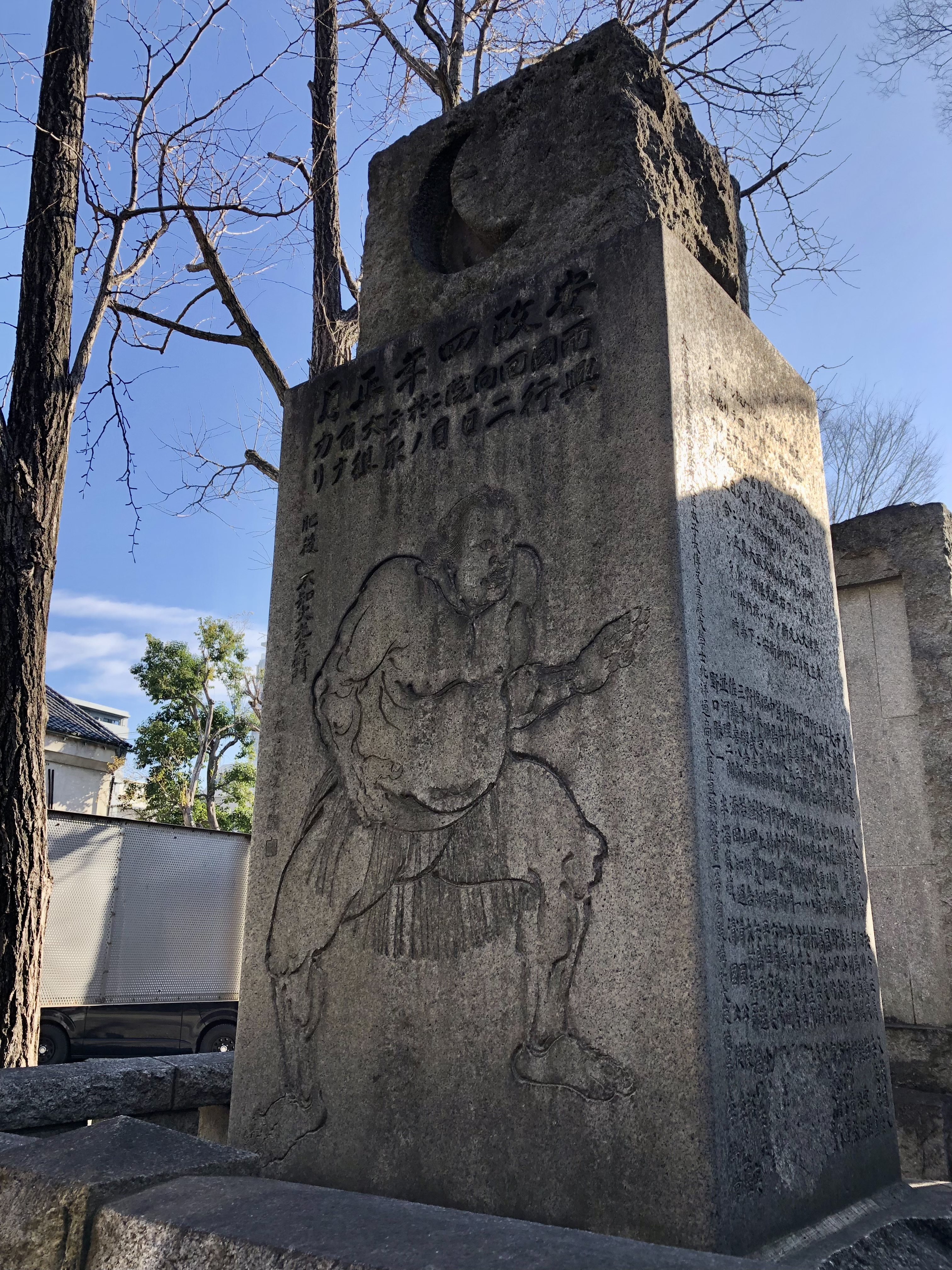
In addition to the overall vibe, there was one thing we had to stop by and visit tucked away in the back of the property to the right side of the main shrine: the Yokozuna stone.

Tomioka Hachiman. The circle with the three symbols inside is everywhere. 
The Yokozuna stone is there to honor those sumo rikishi (basically a term equated with any professional sumo wrestler) who have achieved the highest rank in the sport. Elevation to this rank is not easy. Typically it takes a successful career and an achievement like winning two grand tournaments in a row, although there is no set criteria for being named a Yokozuna. In the history of sumo, only 73 rikishi have achieved this rank and only six have earned the distinction in the 21st century. It's not something that happens every year. We were fortunate to see one of those 73 when we attended our first (and to date only) sumo tournament in 2017.

The stone was placed at the shrine by Jinmaku Kyügorō, the 12th Yokozuna, in the year 1900. Since that time, the name of each subsequent Yokozuna has been added to the stone when each new member is added to the club. There's a special ceremony held at the shrine for each of these additions. Definitely worth a visit.

There's a reason why sumo is so special to us. One of the most notable (if not THE most notable) interactions we have ever had with a stranger while traveling happened in May of 2017 at our first tournament. At that tournament, we sat next to a younger man who was a huge sumo fan, and during a break in the tournament he left his seat, went to the souvenir stand and came back with a poster showing all the Yokozuna in history that he presented to us to as a souvenir of our visit. It was an amazing gesture and we now have that poster framed and hanging in our house.

Based on that interaction with someone we will likely never ever see again, sumo, sumo tournaments, Japan and the Yokozuna will always occupy a special place in our travel history. Visiting Tomioka Hachiman added another piece to that already remarkable history in our lives. The point for us to go to Tomioka Hachiman was really to lay eyes on that stone and remember that connection back to 2017.

Our goshuin-cho with newly acquired stamps from Tomioka Hachiman (right) and Sensō-ji (left).

A few last things about this layover. First, I wish these things could happen more often. There's not a lot you can do on a hours-long layover but there is a real opportunity to add a special unexpected memory to a trip. I know that happened here in Tokyo. It also made us long for Japan and book our next trip there.

Second, we did get two new goshuin added to our goshuin-cho that we picked up years ago at the Komitake Shrine on the slope of Mount Fuji. They are displayed above. Each time we do this, our temple and shrine visitation path diverges from all others that are similar. It is truly a unique memento tied directly to us as two people. This book is likely like no other in the world. I think that's cool. I also love the green ink on the Tomioka Hachiman seal. First time I've seen multiple colors. 

Third, we did eat two meals in our half day plus in Tokyo. And like our choice of breakfast spots, there was really no debate on where we were going for lunch. One of our last meals in 2017 in Japan was eaten at a spot called CoCo Curry House. I have no idea if this chain restaurant is like Denny's to the average Japanese citizen but we love this stuff and we couldn't set foot in Japan without dipping a spoon into a bowl of brown Japanese curry next to some rice on a plate. This is really like the most visually unappealing meal we have ever eaten (twice) but it's so, so good. Had to stop here. I expect that a trip to CoCo Curry will be on our 2025 Tokyo itinerary. 

Lastly, let's talk about the cover picture of this post. There are many enduring images and memories from our first trip to Japan seven years ago. One of those is (believe it or not...) vending machines. I'm serious. These things were everywhere in 2017 and so we were not surprised in any way to find a few at the Tomioka Hachiman shrine. One of the great joys about Japanese vending machines on our first visit was that most stocked beer. That's right, you could walk up to a vending machine, drop some yen in and come away with a cold birhu. 

Now, we didn't really expect to find beer in the vending machine at a Shinto shrine. But the surprise was that we didn't find beer in vending machines anywhere, not even in the hotel. That's because in late 2017, Japan banned beer in vending machines. Not because kids were buying them and drinking them (come on...it's Japan) but because local businesses were complaining about the loss of money due to vending machine beer sales. 

Things change. Japan is still awesome. This was a such a treat at the end of our epic Southeast Asia journey. Can't wait to go back here next spring.

Tuesday, June 11, 2024

Tea For The Tillerman


To answer what might be an inevitable question, there's no tillerman in this post.

Our trip to Southeast Asia earlier this year had us in Singapore for a night, on to Cambodia for three nights, back to Singapore for another seven nights and then finishing in Malaysia for four nights. Cambodia was amazing. Singapore was amazing. Malaysia was...not amazing. There was nothing necessarily regrettable about our time in Malaysia. It just wasn't amazing. 

I don't know what we did wrong in Malaysia but the place didn't capture our imagination the way the other two countries did. Maybe it was our questionable choices to visit the Kuala Lumpur Bird Park and take a trip out to the coast to see (very, very few) fireflies at night. Maybe it was the fact that we found one of KL's marquee tourists attractions, the Batu Caves, to be mostly just smelly and hot. Or maybe we just didn't get anything out of taking the elevator up to the top of the Petronas Towers (once the tallest building in the world) because there's nothing else up there to look at. Whatever it was, we didn't love Malaysia. Maybe it was just Kuala Lumpur. Maybe we should have gone to Penang.

If there's any other evidence needed of how much we didn't love Malaysia, consider this: Cambodia got five blog posts; Singapore got five blog posts; Malaysia's getting one. Yes, there's one post shared between all three countries about food but as far as Malaysia-only posts, this is it. It's about tea. And it was the best thing we did by far in Malaysia. 

To be clear, this isn't like a token post to make me or the country of Malaysia feel good about the fact that we visited. Our time with tea in Malaysia was worth writing about. So here goes.

Boh tea plantation. Cameron Highlands, Malaysia.
I grew up on tea. I spent the first 11 years of my life in England and drank tea every day pretty much for as long as I can remember. Now, I'm sure there was a time when I was really young that my mom fed me something other than tea, but as far as I can remember in my childhood, there was tea on the breakfast table and for afternoon tea on weekends every time we had breakfast or tea. It's an essential part of growing up in England and likely always will be. I don't drink tea really today like ever but when I go back to England to visit I do. Every time I have any sort of sit down meal to start off the day. It must be some kind of innate behavior kicking in.

Of course, tea doesn't grow in England. The reason why English people drink tea is that they took over about half the world centuries ago and produced goods in all their territories to make life back at home in Britain that much better. That included tea, which was produced in massive quantities in places like India and Sri Lanka (then Ceylon) and Kenya and Uganda and yes, even Malaysia.

As of the beginning of this year, I had never visited a tea plantation anywhere in the world. Some of that has to do with the fact that I haven't really been that many places where tea is grown. Yes, I've been to Kenya and Uganda but I was a bit more focused on something other than tea in the week long safari we spent in each of hose two countries (although we did see tea plantations in Uganda). I've visited a coffee plantation (in Hawaii), but never tea. Time to change that. In Malaysia.

Some of the seemingly endless greenhouses that coat the Cameron Highlands.

There are no tea plantations in Kuala Lumpur. Or anywhere near there really. Apparently, something about the climate or the soil or the elevation or something isn't right there. KL is barely above sea level and it's hot pretty much all the time. Particularly in February. So we had to get out of town a bit to the north.

There's a spot in Malaysia called the Cameron Highlands which is perfect for growing almost anything that needs soil and water to grow. Tomatoes, long beans, greens, lettuce, spinach, eggplant, cucumbers, you name it. The elevation and climate are ideal. It's also (as the name suggests) high enough above sea level (say 5,000 feet or so) that the nights are cooler and misty and the land doesn't get baked by the mid-day (or late day or early morning) sun. It's also a pretty good spot to grow tea. There are at least two very large tea plantations there. 

The problem? It's nowhere near Kuala Lumpur. Want to drive out there? Google Maps says three hours to get there. Train? Five hours. If we wanted to go there (and we did), we'd need a ride. 

We found one on Viator. We picked what sounded like a jam packed 12 hour (!!!) day traveling to the Cameron Highlands, exploring various things up there (including a tea plantation) and then back again to KL. We paid to make the tour private and then hoped we'd be able to talk our guide into skipping most of the stuff and just focusing on the tea plantation part of the whole thing. It sort of mostly worked. Kind of. His wife tripped us up a bit.

So what was on the tour? Ready for this? A basket weaving demonstration. A waterfall. An aborigine village. A vegetable market. A strawberry farm. A butterfly farm. A honey bee farm. A cactus shop. Lunch. A visit to a tea plantation (Boh Tea, as it turned out) and a photo stop at a second tea plantation. We didn't figure we needed all that. I mean, why do we need to go to a vegetable farm? It's not like we are picking up some garlic and some long beans or something like that. Pass on the vegetable farm. Pass on the strawberry farm. Pass on the basket weaving.

We figured we'd just stick to the things we were really interested in and if we were able to squeeze a bit more time at the tea plantations, that was good for us. Plus maybe then we'd have a day that lasted less than 12 hours and could make it back to the hotel in time for afternoon happy hour in the executive lounge at the Kuala Lumpur Hilton. Free food and booze. Always with the mooching with these two.

Three hours to Cameron Highlands is no joke by the way. It was two hours on Malaysia's super-modern North-South Expressway followed by an hour's drive up and around twisty-turny roads to the beginning of Cameron Highlands. And our driver was no slouch. He was definitely driving at a good clip. There were times that the roads definitely tested his ability to keep his Toyota Innova on the road or at the very least between the lines. It would be at least 30 minutes after the three hour mark before we got to anywhere we could stop.

It is truly a different world in the Highlands, by the way. When you get out of the hot and sticky lowlands of tropical Malaysia and up a bit in the clouds, it's a totally different world, one which man has figured the best thing to do is cover it with greenhouses as far as the eye can see. I'm not convinced there was a single right angle used in the construction of a single one of these things. Those stick and plastic-built plant incubators covered the contours of the land and mimicked the surface of the Earth. A dip in the land meant a dip in the roof structure. 

And it is COLD. Not like freezing cold but I definitely regretted not bringing something with long sleeves with me. A 20 to 30 degree drop in temperature will do that to you.

The approach to Boh Tea's visitor center.

Somewhere between the butterfly farm and the cactus shop, we stopped at Boh Tea.

Malaysia is not a huge tea producer. China leads the world in tea production at 2.47 million metric tons per year. That number represents 40% of the world's total tea production. India is next. Then Kenya. Then Sri Lanka. Sri Lanka manages just a bit more than 10% of China's output at 349,000 metric tons per year. Malaysia isn't anywhere close in terms of volume produced. It isn't even in the top ten. How much in Malaysia? 10,000 metric tons per year. That's nothing. It doesn't look that way when you visit one of these plantations, though. I can't imagine these things in China.

A metric ton by the way is 1,000 kilograms, or 2,200 pounds. 2.47 million metric tons is a lot.

My first impression of our drive to the Boh Plantation was how incredibly beautiful these tea plant covered fields were. They are a gorgeous mix of dark and light green colors and the plants coat the Earth just the same way those greenhouses we passed on our way to the plantation do. Although instead of ugly white-ish plastic, it's verdant green. The plants create a cover for the ground, with tiny paths separating the plants for the pluckers to walk through. This is a strange analogy but the only thing I can liken the appearance to is a craquelin topping on top of a chou pastry bun. I know that's ultra obscure (yes, I do watch the British Baking Show religiously) but for me, that's exactly the look.

Every surface that can be covered with tea plants is covered with tea plants. There's no need to mess about with anything else. The walkway to the plantation visitor center is as narrow as it can reasonably be to accommodate the volume of incoming tourists. Either side of the path? Tea.

Tea plant. Up close and personal. 

It's funny what you don't know about how things that you consume are produced. We came face to face with that last year in Zanzibar when we stopped by a spice farm. We got the same kind of experience here in Malaysia. I mean, I had no idea how tea was produced. I could have guessed at the picking but after that...I don't know. Ignorant.

There are five basic steps after picking: withering, rolling, fermentation, drying and sorting. Do these five things in that order, and you end up with some tea. Withering takes about 20 hours to complete. Drying takes just 20 minutes. The object of the entire process is to get the moisture content of the tea down, down, down and concentrate the flavor so it's useful to make drinks for British people and whomever else out there loves a good cuppa. There's a display outside the 1934 factory on property that shows the various stages of leaf condition during the entire production process.

The factory, which was built about five years after the plantation was established, is still in use today. A tea plant, by the way, takes about that length of time to go from seedling to tea-producing vine.

The entire process of tea production, along with the history of Boh Tea and some ancient tea-rolling and drying equipment that replaced hand labor and time respectively, are on display for all to see in the visitor center. If you are a tea geek (and I'm not quite sure I'm completely in that category) this must be a dream come true. For someone like me just generally interested in food production, it was still pretty fascinating. I mean the lengths people used to go to just to dry some plant leaves so they could be shipped halfway around the world and steeped in hot water so people who couldn't have imagined the sight of the place where these little leaves came from could have a drink is just amazing to me.

And of course they had samples. They had to have samples, right? And I have to say...my eyes are opened.

After you get through all the history of Boh and the stats about worldwide production of tea and the process of the whole thing, there are four urns of tea (I was honestly going to use the term coffee urns but, well, you know...) each of which has a different flavor of sweetened tea. And get this...the tea is powdered. 

Now, look, I know that we can buy powdered iced tea drink here in the United States but I figured that was some kind of synthetic drink that wasn't really tea. Some sort of chemical concoction to approximate real iced tea drink. Apparently I was wrong.

Iced tea is disgusting by the way. It just is. It's one of those American things I can't get my head wrapped around.

This powdered tea stuff...incredible! They were serving this stuff in tiny cups and I must have had 12 of these things. I kept going back. I don't know what they made this stuff with, whether it was milk or water or some magic elixir but the taste was just mindblowingly good. And I'm not particularly a tea guy (except in Britain...) and no way am I a powdered tea guy. But this stuff. Just wow! The caramel and matcha flavors were just indescribably good.

I will say that we have purchased some U.S.-based version of what we had at Boh and I just can't make it the way they made it at the headquarters there in Malaysia. It was just transcendent. Maybe it was the being there. Being there often makes the difference, although if that's what this was, it was a pretty extreme example of being there making a difference.


Antique tea-rolling machine (top) and the good stuff (bottom). The matcha and caramel...I'm telling you.
This travel stuff is eye-opening sometimes. But ain't that most of the point of doing this?

So about that plan to spend more time at the tea plantation and get back early. I think it worked. We milked maybe an extra 15 to 20 minutes out of our time at Boh. We probably could have got a little bit longer stay but honestly, we were pretty much finished anyway. And yes, we did make it back for free happy hour at the hotel.

We also visited the vegetable farm. Or at least a market. I said we were skipping it. We didn't. 

Apparently, vegetables in the Cameron Highlands are significantly cheaper and presumeably better than veg available in the local supermarkets around Kuala Lumpur. And our driver had a list from his wife and (I think) an appointment at a specific stall. So we stopped. 

Far be it from me to get in the way of a hardworking Malaysian couple and a some groceries that can save them a ringgit or two. I'm not being facetious here. I am sure both of them work harder to make ends meet than we do or ever have and I don't want to stand in the way of any of that and I'm not stuck up enough to be so self centered to be upset about this. We try to tip well on these excursions for just that reason. We had two priorities for this day: (1) spend as much time as possible at a tea plantation and (2) get back for free happy hour. We got both. I appreciate our driver pushing the schedule and his car's ability to climb those hills. I think we ended up with a 10 hour day instead of a 12 hour day. That's a heck of a long time to spend driving two tourists around. I'm happy to stop for some veg. 

We did stop at a second tea plantation (Cameron Valley Tea) for a photo opportunity. More of that gorgeous tea-coated Malaysia landscape. That's what this whole day was about and it was completely worth it. I won't forget those landscapes. It's the craquelin. I don't know how else to convey the appearance.


Top to bottom: Boh's factory; the view from Boh's visitor center; Cameron Valley Tea plantation.