 |
| The souks and Jemma El Fna looking north and west from Cafe de France. |
By far the thing I was looking forward to most of all in Marrakech was exploring the souks. The souks are a series of open air shops just north of Jemma El Fna, the main square in Marrakech's medina or old city. They have existed in that part of Marrakech since the Berbers established the city late in the 11th century. They have survived hundreds of years of change and progress and I expect they operate today much as they did decades or centuries ago. These types of markets are not necessarily unique to Marrakech; they can be found throughout northern Africa and on other continents; they may just not be known by quite the same word. In the middle east, the souks would be known as a bazaar, if that gives you any better context.
The souks are located in the center of Marrakech's old city. They stretch about 1/3 of a mile north to south and are about half as wide across in the east to west direction. Not very big. But within that extremely small area is packed a super dense maze of commerce generally separated by merchant type: produce and meat is in one location, silver work in another; rugs are separate from leather; there are entire stores devoted to scarves or perfume or spices. Scattered in between all the tiny shops that make up the souks are restaurants, hotels and back alleys that seem to go nowhere and which invite no sort of exploration whatsoever.
And at night, the souks seem to extend south into the Jemma El Fna itself through fruit and juice stalls to street entertainment to restaurant stalls set up just for the night. While not technically part of the souks, the square for me was as fascinating at night (if not more so) than the souks were during the day and night combined so I'll beg for a little bit of poetic license and consider the square (which is really nothing of the sort - it's not even a parallelogram) as an extension of the souks for the purposes of this post. For me it's worth treating them as one. The same sort of chaos exists in both.
The souks are located in the center of Marrakech's old city. They stretch about 1/3 of a mile north to south and are about half as wide across in the east to west direction. Not very big. But within that extremely small area is packed a super dense maze of commerce generally separated by merchant type: produce and meat is in one location, silver work in another; rugs are separate from leather; there are entire stores devoted to scarves or perfume or spices. Scattered in between all the tiny shops that make up the souks are restaurants, hotels and back alleys that seem to go nowhere and which invite no sort of exploration whatsoever.
And at night, the souks seem to extend south into the Jemma El Fna itself through fruit and juice stalls to street entertainment to restaurant stalls set up just for the night. While not technically part of the souks, the square for me was as fascinating at night (if not more so) than the souks were during the day and night combined so I'll beg for a little bit of poetic license and consider the square (which is really nothing of the sort - it's not even a parallelogram) as an extension of the souks for the purposes of this post. For me it's worth treating them as one. The same sort of chaos exists in both.
 |
| Jemma El Fna at night. |
Every book and on line article I read before arriving in Marrakech pretty much guaranteed you would get lost in the souks. I didn't believe it. Not even close. I possess a pretty good sense of direction and thought with a good map of the area that I'd be more than OK and in an hour or two would have the place mapped in my head. I also thought having our hotel just on the west edge of the souks on what looked to me like a pretty sizable street would be a huge advantage.
I should have recognized the first warning sign when our driver dropped us off from the airport and we were greeted by our hotel staff who loaded our bags into a cart and escorted us down a dirt alley that varied between ten and 12 feet wide at its widest point. While I didn't know it yet, the alley we were walking down was the "pretty sizable street" that I had pinpointed on our travel guide book as being a huge advantage in re-setting my whereabouts when I got a little lost in the souks. This place was way smaller than I read on the map, which meant the smaller streets in the souks would now be tiny. I still didn't believe I would have a problem navigating the shops and my confidence was bolstered when we received a very detailed souk map upon check-in. I thought I was truly ready.
My first excursion into the souks was a quick walk to Jemma El Fna, through the square and west of the post office to get some lunch. The walk to the square involved taking a single road south for about 400 yards and then taking a slight right. I got lost. The first right I took was, of course, the wrong right. The distance, which I thought would be easy to judge, was just about impossible. The street that led me south to the square was unpaved, narrow, covered and complete pandemonium. It was impossible to concentrate on where or how far you were walking with merchants asking you what you were looking for; donkeys pulling carts forcing you to step aside; and bicycles, motorcycles and scooters (minimum two passengers per motorcycle or scooter) whizzing by passing so close to you and each other that it was a wonder I never saw anyone crash in my three days in Marrakech.
I should have recognized the first warning sign when our driver dropped us off from the airport and we were greeted by our hotel staff who loaded our bags into a cart and escorted us down a dirt alley that varied between ten and 12 feet wide at its widest point. While I didn't know it yet, the alley we were walking down was the "pretty sizable street" that I had pinpointed on our travel guide book as being a huge advantage in re-setting my whereabouts when I got a little lost in the souks. This place was way smaller than I read on the map, which meant the smaller streets in the souks would now be tiny. I still didn't believe I would have a problem navigating the shops and my confidence was bolstered when we received a very detailed souk map upon check-in. I thought I was truly ready.
My first excursion into the souks was a quick walk to Jemma El Fna, through the square and west of the post office to get some lunch. The walk to the square involved taking a single road south for about 400 yards and then taking a slight right. I got lost. The first right I took was, of course, the wrong right. The distance, which I thought would be easy to judge, was just about impossible. The street that led me south to the square was unpaved, narrow, covered and complete pandemonium. It was impossible to concentrate on where or how far you were walking with merchants asking you what you were looking for; donkeys pulling carts forcing you to step aside; and bicycles, motorcycles and scooters (minimum two passengers per motorcycle or scooter) whizzing by passing so close to you and each other that it was a wonder I never saw anyone crash in my three days in Marrakech.
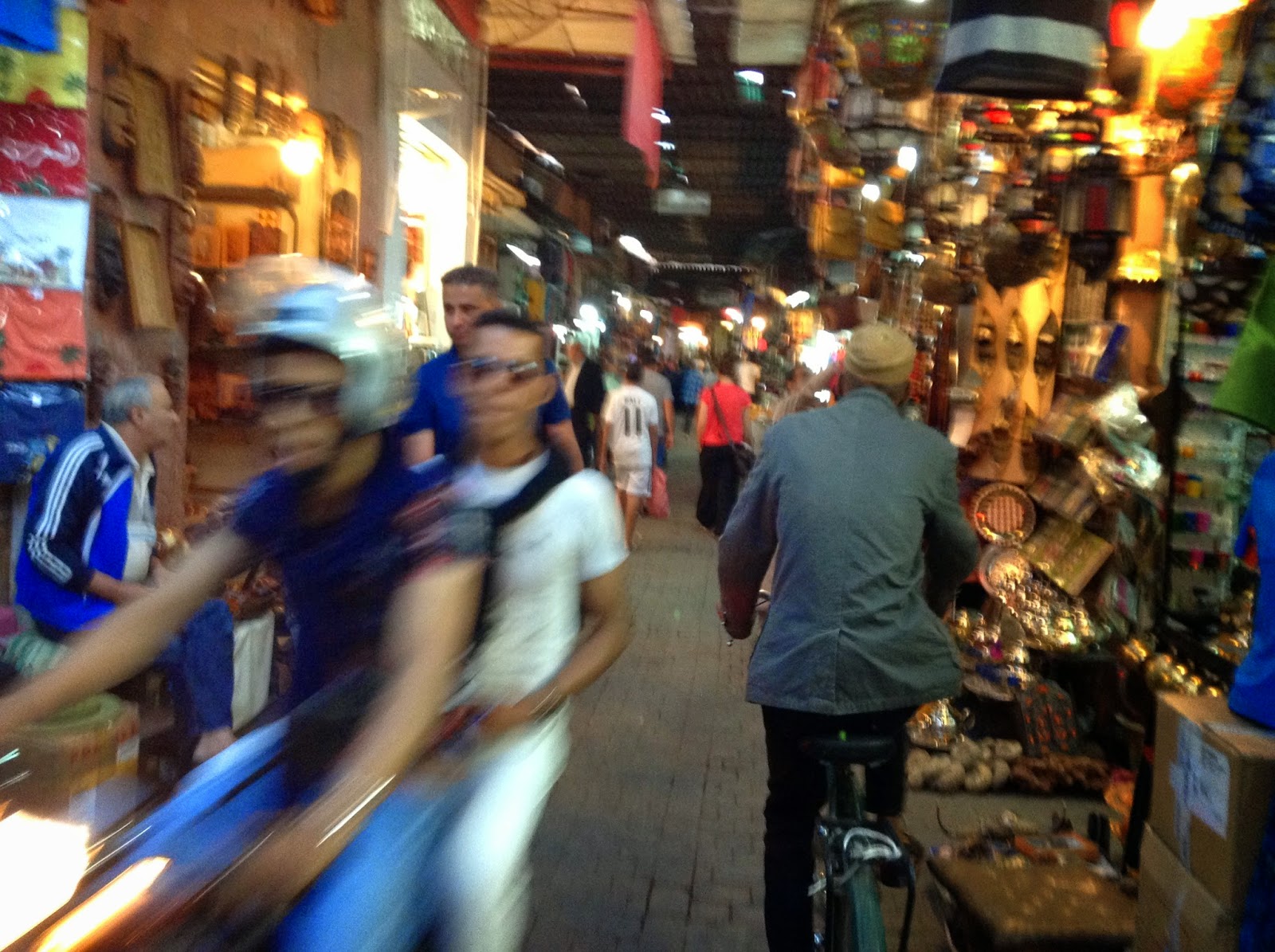 |
| A typical scene in the souks: motorcycle passing bicycle. |
I realized almost immediately that my first right was incorrect and reversed myself and headed south again until I got to a small clearing that I struggled to imagine was Jemma El Fna (it wasn't) before finding the right I thought I took before and making my way into the square and finally to find some food. I honestly still at this point didn't think it was that bad. After all I'd only taken one wrong turn, right?
It was only after lunch that first day that I understood there was no way I was becoming master of the souks on this trip. We headed back to our hotel, walked past it on purpose and then decided to venture a little further to see what we could find. With no firm destination in mind, we got hopelessly lost. The afternoon excursion was really just a heat check to see if we really could navigate around these things. It didn't go well. Every souk on first pass looks pretty much about the same; there are no landmarks to speak of; and what seems like hard rights or lefts become soft lefts and rights when backtracking. After 15 minutes or so, we ended up yelling at each other and had to pull out the map to see if we could find out where we were.
Yep, that's right, we pulled out the map. Big mistake. It's like sharks smelling blood in the water. Literally everyone notices and about half the people around you will offer "help". "Where are you going?" "Do you want to go to the square?" "I can take you where you need to go." I even think I could have gotten a ride on the back of a motorcycle and would have ended up who knows where (probably a relative's carpet shop). Naturally, since I'm a man, I refused all help. I had to figure this out for myself.
It was only after lunch that first day that I understood there was no way I was becoming master of the souks on this trip. We headed back to our hotel, walked past it on purpose and then decided to venture a little further to see what we could find. With no firm destination in mind, we got hopelessly lost. The afternoon excursion was really just a heat check to see if we really could navigate around these things. It didn't go well. Every souk on first pass looks pretty much about the same; there are no landmarks to speak of; and what seems like hard rights or lefts become soft lefts and rights when backtracking. After 15 minutes or so, we ended up yelling at each other and had to pull out the map to see if we could find out where we were.
Yep, that's right, we pulled out the map. Big mistake. It's like sharks smelling blood in the water. Literally everyone notices and about half the people around you will offer "help". "Where are you going?" "Do you want to go to the square?" "I can take you where you need to go." I even think I could have gotten a ride on the back of a motorcycle and would have ended up who knows where (probably a relative's carpet shop). Naturally, since I'm a man, I refused all help. I had to figure this out for myself.
 |
| Follow the little blue signs to Jemma El Fna. It works! Trust me! |
It was then I noticed little blue signs on the walls or hanging from whatever overhead cover there happened to be pointing the way to Jemma El Fna. We just had to follow these and we'd get back to the square, right? And from there back to the hotel pretty easily (note the confidence in this last statement). But the signs didn't seem to be taking us back to the square. What seemed like endless rights and a few lefts took us seemingly deeper into the maze. And just when it seemed like the blue signs were a cruel joke designed to mess with tourists' minds, we spotted the alley with our hotel. Home. But day one in the souks was definitely a mess for me.
After the first day, the souks got a lot less scary, but admittedly my explorations got a lot less bold. By the end of our second day in Marrakech (a day we spent mostly out of town), I could find my way to Jemma El Fna and back fairly easily without even thinking of pulling out my map. I could recognize the subtle changes in direction of the Rue Moussaine enough to not veer off to the right too soon and I also knew the first time I saw daylight when walking south didn't mean I was at the square. That required walking a couple of hundred feet more to the south.
That second day was the first time we made it to the square at night. We had walked through the square mid-afternoon the day we arrived and couldn't see what the fuss was all about (Jemma El Fna is a UNESCO World Heritage Site). The first walk through the square saw us passing orange juice stalls, dried fruit stalls, palm readers and henna tattoo artists in addition to the ubiquitous donkeys pulling carts and the occasional car. We got a sense of the persistence of the square's merchants when we declined the services of a henna tattoo artist when she asked maybe later and we replied "yes, later." If only I knew later to her meant about 20 steps further. But at nighttime, almost everything in the square was different.
Snake charmers. Monkeys on leashes. Belly dancing. Impromptu boxing matches. Walking on hot coals. Anything and everything that existed in northern Africa for entertainment before the turn of the 20th century. Jemma El Fna is completely unlike anywhere else I had been. The sole purpose of all these entertainments of course is to get you to fork over some money. The boxing matches we watched took so long to get started after a hapless looking spectator had been picked from the crowd to participate that we left two of them; the collecting of coins just took too long.
After the first day, the souks got a lot less scary, but admittedly my explorations got a lot less bold. By the end of our second day in Marrakech (a day we spent mostly out of town), I could find my way to Jemma El Fna and back fairly easily without even thinking of pulling out my map. I could recognize the subtle changes in direction of the Rue Moussaine enough to not veer off to the right too soon and I also knew the first time I saw daylight when walking south didn't mean I was at the square. That required walking a couple of hundred feet more to the south.
That second day was the first time we made it to the square at night. We had walked through the square mid-afternoon the day we arrived and couldn't see what the fuss was all about (Jemma El Fna is a UNESCO World Heritage Site). The first walk through the square saw us passing orange juice stalls, dried fruit stalls, palm readers and henna tattoo artists in addition to the ubiquitous donkeys pulling carts and the occasional car. We got a sense of the persistence of the square's merchants when we declined the services of a henna tattoo artist when she asked maybe later and we replied "yes, later." If only I knew later to her meant about 20 steps further. But at nighttime, almost everything in the square was different.
Snake charmers. Monkeys on leashes. Belly dancing. Impromptu boxing matches. Walking on hot coals. Anything and everything that existed in northern Africa for entertainment before the turn of the 20th century. Jemma El Fna is completely unlike anywhere else I had been. The sole purpose of all these entertainments of course is to get you to fork over some money. The boxing matches we watched took so long to get started after a hapless looking spectator had been picked from the crowd to participate that we left two of them; the collecting of coins just took too long.
 |
| Snake charmers! Not much else to say here. How awesome is this? |
Any watching, any picture taking, anything at all will get you hit up for money. I took a picture of some snake charmers and one of them was all over me immediately for some cash (complete with snake). But once you pay, you can seemingly do anything you want. After pulling out a couple of dirhams (literally twenty-five cents), the snake charmers let me take more pictures, encouraged me to touch the snakes (I did, once) and even take more pictures with the snakes around your neck (I passed). The best benefit of my quarter that I paid the first night is that it allowed me to not get bothered the second night we were in the square. When approached the last night we were in Marrakech, I simply said we paid last night and all the pressure went away; they knew I wouldn't pay again. Act like you know what you are doing and it works sometimes.
Besides the entertainment, the other industry that pops up at night in Jemma El Fna is the food industry. At about 7 pm or so, food stalls fill all the available space in the square, setting up portable kitchens and (I suppose) refrigerators (although this may be incorrect) along with tables for diners. Each place then deploys a series of runners (I guess they are maitre d's?) to bring folks in to eat. Each place promises the same and when you start talking to one maitre d, others pile around you to let you know how preposterous the claims of the first are and how their food is better. All of it's probably nonsense; there's no gourmet food to be had here. We passed by the first couple of runners (including the one who asked me to high five him - I did - and claimed his food was finger licking good) but couldn't pass by the guy at stall no. 25 (also known as Chez El Mahdi Chraibi) with the fake English accent who promised no diarrhea for two years. How could we pass that up?
Besides the entertainment, the other industry that pops up at night in Jemma El Fna is the food industry. At about 7 pm or so, food stalls fill all the available space in the square, setting up portable kitchens and (I suppose) refrigerators (although this may be incorrect) along with tables for diners. Each place then deploys a series of runners (I guess they are maitre d's?) to bring folks in to eat. Each place promises the same and when you start talking to one maitre d, others pile around you to let you know how preposterous the claims of the first are and how their food is better. All of it's probably nonsense; there's no gourmet food to be had here. We passed by the first couple of runners (including the one who asked me to high five him - I did - and claimed his food was finger licking good) but couldn't pass by the guy at stall no. 25 (also known as Chez El Mahdi Chraibi) with the fake English accent who promised no diarrhea for two years. How could we pass that up?
 |
| Stall no. 25. Not sure what I ate, but it stayed down! |
I think the best thing about the meal at Jemma El Fna stall no. 25 was that we didn't get diarrhea. It hasn't been two years yet but I was just thankful that there was no diarrhea in the next couple of days; I likely won't fault them for anything that happens from this point on. We ordered the mixed skewers (lamb, beef and chicken) and the vegetable skewers and settled for those along with the bread provided for every diner and the olives appetizers at the table. I ate at least four skewers and I have to say I have no idea which was beef, which was lamb and which was chicken (they could have been cat for all I know) but they went down ok with incredibly salty chile sauce that was delivered table side and I'm glad we stopped here. While we were eating we were treated to a view of a cart of desserts rolled by from other vendors with tons and tons of flies all over the food. We passed on the desserts.
I spent a couple of hours my third day in Marrakech exploring the souks one final time. We found the olive souks we had passed on the first day before we got hopelessly lost and picked up a huge container of olives for 10 dirhams ($1.25). I also made sure we found a spice souk and got some turmeric, ginger, sweet paprika and cumin to take back home (already used to make Moroccan dishes twice) at a fraction of the cost I could have got them in the United States. We also explored a little part of the way we got lost on the first day. I felt pretty confident by the end of day three that I could find my way around about 15 to 20 percent of the souks without a map and without getting lost. Sounds like not much of an accomplishment but I actually feel pretty proud of myself.
 |
| Two of my favorite souks: olives… |
 |
| ...and spices. |
Finally, I also made sure we did some haggling, although admittedly at a total JV level. About everything that's sold in the souks is open to price negotiation. Not being sure about the olives and spices, I paid what was asked for those but I wanted to pick up a Morocco t-shirt before I left and so made my way to a stall we had picked out earlier just as it appeared they were packing up. The books I had read told me not to express interest in anything just to haggle and that you had better be prepared to buy whatever you discussed. I definitely wanted a red Morocco shirt (which later turned a lot of my whites pink in the wash) and so confidently offered 100 dirhams for a 120 dirham list price with the promise that I would buy a second at that same price. Most guides say to start at half the price (I told you it was a JV attempt) and with that it mind, I knew my 83% offer of full price would be accepted, which it was immediately. At least I feel better that I didn't get taken for full price. What a bargain (if it wasn't for the pink socks I now have…).
The souks and Jemma El Fna definitely lived up to my hope that these would be the best part of my Morocco trip. They were without question the best memories I have of my three days in Marrakech. If there's a next time, I'm mastering these things, even if it takes a week. I already know I'm a few steps ahead of the curve from last time. My advice to travelers: keep your eyes front and center when walking through the souks (doing otherwise will invite pleas to buy from merchants); don't start talking to anyone unless you are really interested in what they have to sell (be firm no matter how polite you think you want to be); haggle, even if it's a feeble attempt (it's super easy to knock a few dirhams off); follow the blue signs to the square when lost; and never never never pull out your map, although I suppose you really will be OK even if you have to pay someone to get you home.
The souks and Jemma El Fna definitely lived up to my hope that these would be the best part of my Morocco trip. They were without question the best memories I have of my three days in Marrakech. If there's a next time, I'm mastering these things, even if it takes a week. I already know I'm a few steps ahead of the curve from last time. My advice to travelers: keep your eyes front and center when walking through the souks (doing otherwise will invite pleas to buy from merchants); don't start talking to anyone unless you are really interested in what they have to sell (be firm no matter how polite you think you want to be); haggle, even if it's a feeble attempt (it's super easy to knock a few dirhams off); follow the blue signs to the square when lost; and never never never pull out your map, although I suppose you really will be OK even if you have to pay someone to get you home.


