Showing posts with label Yellowstone National Park. Show all posts

Tuesday, November 10, 2020

From The Tetons To Yellowstone


It is very strange for us to spend an entire week of vacation the way we spent a week in Grand Teton and Yellowstone National Parks. Generally speaking, we crave variety when we travel and spend our days rushing from one different thing to the next different thing to take in as much as possible. Call it attention deficit disorder or a fear of being bored or impatience or wanting to suck the marrow out of life every day we are not at work, but the notion of spending a week focused on just two National Parks is craziness for us. But that's just what we did. 

Not that Yellowstone and Grand Teton are lacking in variety.

We definitely had an agenda. Elk. Moose. Bison. Geysers. We felt pretty sure we'd get all of these and we were right, although the quality and quantity of moose sightings exceeded our expectations and was definitely very much appreciated. But we also didn't want to be too myopic on this trip and lose sight of the big picture. We wanted to see more wildlife than just elk, moose and bison. We wanted to exist in a place that man has left largely untouched. We wanted to be awed and relaxed and forget about how badly our species has messed up this planet. At least for a week.

We got all of that.


One of the reasons we could stand to spend a week out in northwest Wyoming was simple: these places are enormous. There's just a whole lot of territory to cover. And that means that filling a day is easy, especially when some drive times to the places we wanted to go are 2-1/2 hours or more. I knew this before I went out there because I'd spent a little more than a day in Yellowstone nine years ago and missed a ton. But it really hit home when we spent the better part of two days in the Tetons and pretty much four whole days in Yellowstone and STILL missed a ton. Maybe MORE than a ton.

I asked some friends before we left for this trip for some advice on must dos in Grand Teton. A boat trip across Jenny Lake sounded like a can't miss thing to put on our list and then check off at some point in our couple of days in the Tetons. But honestly, we just didn't have time. And it was probably due to the hours we spent down Moose-Wilson Road watching moose and bears. We also missed about half the length of Antelope Flats Road, all of Mormon Row in the same area and a whole bunch of turnoffs and side roads that could have really been worth exploring. We also didn't do any hiking in the Tetons.

I think we did a better job of covering ground in Yellowstone, although we didn't drive between Lake Village and West Thumb (in favor of another pass through Hayden Valley) and the road between Canyon Village and Tower-Roosevelt was closed to all traffic (it's closed all of 2020 and 2021). We missed a side road here and there I'm sure, especially when we were in thermal areas information overload mode. It makes sense we'd cover Yellowstone more comprehensively. We did spend almost three times as long in that Park than in Grand Teton.

I could easily have spent probably two more days, most of it in Grand Teton, than we did. I'm shocked to be writing those words. 

The Teton Range looking west from the Mormon Row area.

The Grand Canyon of the Yellowstone, Yellowstone National Park.

So how did we spend our time? Mostly driving around and gazing at the scenery and the wildlife.  Pretty simple.

On the scenery side of things, Grand Teton is dominated by the Teton Range on the west side of the Park. These peaks are so striking and they seem to be visible from just about everywhere you go in the Park. They form a sort of staged backdrop to the incredible landscape in the main part of the Park and they are reflected in the Snake River and other bodies of water you encounter as you make your way around the loop in the south section. They are without doubt the singular most distinct memory I have of Grand Teton.

Yellowstone is completely different. Whereas the Tetons are fairly homogeneous, Yellowstone is like a theme park with different worlds seemingly invented by a park designer to get the visitor the maximum range of landscape experiences. Geyser basins, valleys, rivers, canyons, mud pots, cliffs, mountains, scorched vistas, water containing multicolored collections of microscopic organisms and one really, really big lake. Yellowstone has all of that and way more.

We traveled most of Yellowstone for the first time in the dark, getting up before dawn to get to Hayden Valley or Lamar Valley before the wildlife got moving off the wide open spaces and into the Park's forested areas. It was astonishing to see some of the places we'd driven and how close to the edges of roads with some sheer drops. It sounds like a stupid statement but Yellowstone is way more varied than it looks at night but one of the aspects of Yellowstone that I found fascinating was the fact that we traveled through such diverse landscapes in the dark without realizing it.

The Teton Range reflected in the Snake River near Schwabacher Landing, Grand Teton National Park.
First mountain goat I've seen in the wild. Yellowstone National Park.
The river valleys in both Parks were some of my favorite places to hang out. This year has in many ways been one where we've visited river after river all over the west of the United States and the Snake and Yellowstone and Madison Rivers we saw out in Wyoming were just as striking as any others we've seen. I love the way the valleys are so broad with a lazy waterway winding its way down the middle with mountains or forests on one or both sides. It also doesn't hurt to have a bison or elk or two or three or ten dotting the valley.

I also appreciated the mountains. I mean we were in the Rockies for crying out loud. I loved the very small mountain area of Yellowstone for a number of reasons, not the least of which is we managed to spot a couple of mountain goats hanging out among the rocks. And it's difficult not to gaze in wonder at the Tetons at every opportunity. These things look like God just deposited a series of perfectly crafted peaks on a great plateau in the Rockies. We couldn't help taking picture after picture of these mountains from about every spot in the Park we could see them.

And of course, nothing could be further from the truth about how the Tetons got where they are. They came from below through tectonic action, not from above by divine act.
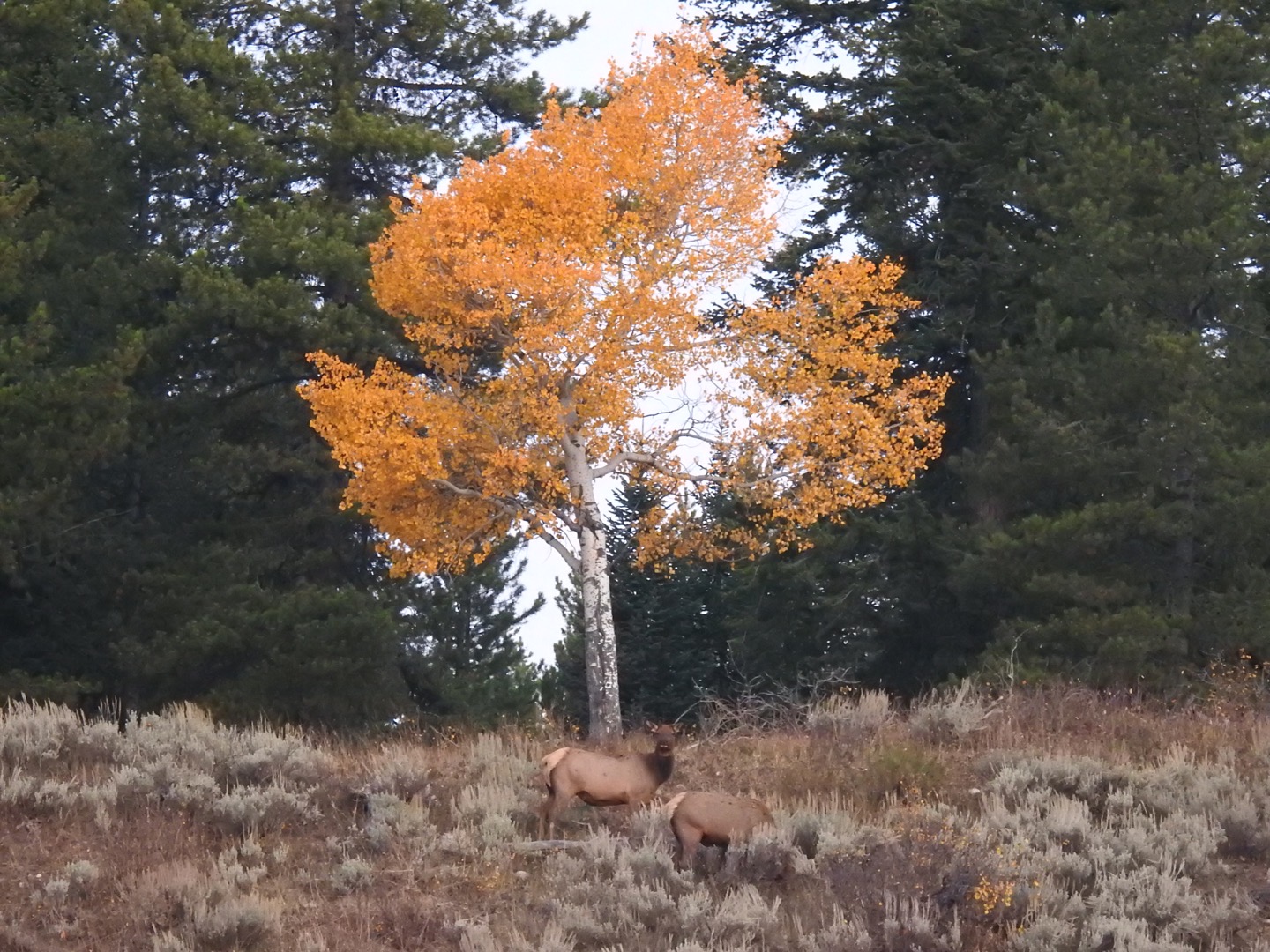
Fall colors with two elk. Grand Teton National Park.
Coyote. Lamar Valley. Yellowstone National Park.

I also think that visiting in the fall helped our trip. The last time I was in Yellowstone it was as green as can be from the grass in the valleys to the evergreens and deciduous trees everywhere else where anything could grow. In the fall, there are trees here and there with bright oranges and yellows to inject a dash of color into the sameness in the forests and the grass in the valleys is a pale straw color, which among other things is perfect for hiding coyotes.

I don't know why I am still amazed at nature's camouflage. I have watched lions the color of grass and leopards in trees in Africa and marveled at how the colors and shadows of their natural environments hide those animals. I've also written just last month how the color of the bark and the darkness of the trees in Yellowstone obscure animals as massive as elk. I guess I just didn't expect coyotes to be so invisible in the fall grasslands of Yellowstone. Maybe it's the Road Runner cartoons.

Ultimately, we did spend the majority of our time in both Grand Teton and Yellowstone either watching wildlife or moving from one place to the next in hopes of seeing wildlife. I've already written about the moose, elk and bison we saw last month in separate posts because those were the most visible species. But that wasn't all we saw. 

Bald eagle in flight over the Snake River. Grand Teton National Park.
Bear no. 2. Grand Teton National Park.
If there was a hope we had in our animal search in Yellowstone and the Tetons, it was that we would see plenty of bears. By plenty here, I don't mean plenty like we saw plenty of elk or bison. Maybe 10 was a stretch goal? We saw three earlier this year in Rocky Mountain National Park in a single day in a park where bears aren't that common. I felt I was being realistic in hoping to exceed that total in six days in a place where there are more bears. And by that I mean more total quantity (although the precise numbers in RMNP aren't known) and more species (two vs. one). There are more than 700 grizzly bears in Yellowstone alone; Rocky Mountain likely has less than 1/4 of that total number of just black bears. Of course, it's a bigger area. Much bigger.

If there's one thing we pretty much counted on not seeing, it was wolves. Wolves were re-introduced to Yellowstone in 1995 and their numbers as of the date of our visit were reported to be 99 total. I'd seen every species we hoped to see in Grand Teton and Yellowstone before with the exception of mountain goats and wolves. No way did I hope to see either. I didn't even realize there were goats in Yellowstone or the Tetons, or at least not visible from a car, but we saw our first couple ever. But wolves? The odds seemed stacked way against us. Yellowstone was full of surprises.

There were really no disappointments on this trip but if there was an unpleasant surprise, it was that we only saw two bears in the whole week we were roaming around the Parks. They were both pretty poor looks. The best photograph we got of either bear (and frankly they may have been the same bear in the same area of Grand Teton at two different times) is above. We struck out entirely in Yellowstone.

I know. I know. I'm whining. Or Crying. Wahhhh!!!!! I didn't see more than two bears on my week trip to one of the premier destinations in the United States. But it's true. We wanted more bears. We thought we'd see more than two. For the record (and based on the narrative of people around us who may or may not know what they were talking about), it was either a grizzly and a black bear or two different black bears or the same black bear twice. Personally, I'm leaning towards a grizzly and a black bear, although the best photographic evidence of bear no. 1 (the "grizzly") is below. That bear, by the way, was moving fast. Good thing it was a good distance away.

Grizzly or black bear? I'm leaning towards grizzly.
But we did see wolves.

I know I've already said this but I thought there was no way we were going to see any wolves whatsoever. We're talking 99 dogs in an area almost twice the size of Rhode Island. What are the odds?

But we didn't just see one or two wolves. We saw a lot of wolves. On three different days in two separate locations in Yellowstone National Park.

My first tip for seeing wolves in Yellowstone based on our very, very limited exposure is to visit the Lamar Valley in the northeast corner of the Park. I know, it's remote and if you are staying in West Yellowstone, Montana (like we were), you'll need to get up super early to get over there when the wolves are still active in the morning (we left one morning at about 5:30 a.m.). But we were two for two in Lamar. Two visits, two sightings of multiple wolves.

Admittedly, both sightings were at a very great distance. Probably at least half a mile away. The animals were like ants on the landscape, even when using binoculars or the zoom lens on our camera which we have been so impressed with in the past. But they were clearly wolves and it was remarkable to see them move across the landscape as a pack, not in a group like I expected but single file with a really good amount of space between them. I think one of the most remarkable benefits of observing wildlife with your own eyes in a natural environment is seeing behaviors that wouldn't necessarily stand out if you were told about those behaviors in a TV show or something like that. How wolves move is indelibly stamped on my brain from our visits to Lamar Valley.

If you do go to Lamar Valley, or anywhere else in the Park really, be prepared to share space with people with some fantastic and very large zoom lenses and telescopes. Their equipment dwarfed what we thought was the ultimate travel camera for seeing and photographing wildlife. Their gear was much better than ours. Although I wouldn't want to lug their stuff on a plane as cabin baggage. 

Wolves in Lamar Valley. Yellowstone National Park.
Lone wolf. Hayden Valley. Yellowstone National Park.

My second tip for seeing wolves in Yellowstone is to get lucky. I know...it's a terrible tip. But in a way it applies to all wildlife watching. We didn't get lucky with bears. We got super lucky with wolves.

We always have an itinerary for our trips. Most of the time, we follow those agendas to the letter and build in enough float to linger or improvise. Sometimes, we read the conditions on the ground and decide to go a different way. We did the latter in Yellowstone and it completely paid off. Our original plan for Yellowstone had one trip to the Hayden Valley, but after driving through once, we not only adjusted our route back to our hotel to take another pass on the same day but we decided an early morning visit on a different day might pay off somehow. That's where we got to see a wolf at a distance of about 20 feet.

There were a number of wolf false alarms (or was it crying wolf?) in our time in Yellowstone. There were at least four or five or maybe more times when we heard someone calling a coyote a wolf. So on our second day in the Hayden Valley we were not quite ready to believe that the dog-like creature trotting about ten feet off the road just before the sun was really up was a wolf. But after a second or two lapse of brain processing time, it was.

Right there in front of us (and a caravan of 15 or so cars) was a yearling wolf separated from her pack. Super close. Way closer than the 100 yards of separation recommended by the Park for this kind of an animal (although that doesn't really count when you are in a car). Honestly, this was such a thrilling sight that for the 20 minutes or so we followed this wolf, we forgot all about the whole no bears thing. This is one of the apex predators in the Park and it's right there in front of us.

This was absolutely amazing. So amazing in fact that our fellow tourists stopped their cars as close as they could and piled out of their passenger side and driver and back seats to snap the best possible pictures. I'd love to say that we exercised a little more caution (and I think we did - keeping the car between us and the wolf or opening the door but standing on the step of our SUV) but it's super easy to get excited and lose track of what the rules are. I mean it's a wolf less than 30 or maybe even 10 yards away.

Wolf. Carcass. Hayden Valley. Yellowstone National Park.

If there has to be a singular experience that represents this trip (and I'm not sure there has to be), this was it. To get this good a view of a wild wolf is something that's not going to happen each time you visit Yellowstone. It truly was so lucky, although getting up early was definitely a part of making our own luck.

We don't have great pictures of our lone wolf. The lighting was not ideal and she moved pretty fast which made taking amazing pictures with our camera a little difficult. I still think we got a couple of pics that I'm proud of for us to remember what we saw.

Two Parks. Six days. It's still crazy to me that (1) we spend this much time doing sort of the same thing over and over again and (2) that we still missed so much. No hikes. No Jenny Lake. No bears (well...two), no Tower-Roosevelt, tons of missed side roads and drives. But wolves, fighting elk, moose, herds of bison, geysers, multicolored pools and those gorgeous Tetons in the fall? Tremendous. What a week. 

Everyone should go to Yellowstone at least once in their life. If you go, make your own luck. Get up early and stay for multiple days.

One last look at the Tetons. From Mount Moran Turnout. Grand Teton National Park.

How We Did It

Both Grand Teton and Yellowstone National Parks are open all year round but access to certain parts of both Parks are severely limited in the winter season. Check their websites for current conditions by clicking the names of each park earlier in this paragraph.

Both Parks charge admission, although there are days of the year when admission is waived. You might also save a few bucks by purchasing U.S. Parks Annual Pass which will get you into all National Park Service properties and a whole host of other sites for free. The Pass, which we purchased last November, costs $80 as of this writing. The 2020 entrance fee for Grand Teton is $35 and you can add another $35 for Yellowstone. It won't take but one more Park visit somewhere else to make buying a Pass worthwhile. The $35 admission fees to both Parks are good for seven days each.

Note there is a large amount of territory in the south end of Grand Teton that is outside of the entrance gates so depending on where you want to go, you might be able to visit Grand Teton for free. You can get to our favorite moose and bear watching spot down on Moose-Wilson Road without paying. Or at least you can if you are traveling from the south.

We found the best places to see wildlife in Yellowstone to be Lamar Valley and Hayden Valley. Get up early for the best sightings or stick around until dusk. We considered hiring a guide for a day to help us find wolves but found pricing to be north of $500 per day. We took our chances on our own and I think we made out pretty well. We actually followed a couple of guided tours in Grand Teton for a while and they didn't seem to have any better luck finding animals than we did. I guess a huge advantage of being with a guide is that they likely have better gear than you do. I'm happy with the $500+ that's still in my bank account.

We also found it really useful to ask what people were looking at. We got a lot of help from strangers pointing out what they were focused on when we were just lost. You might not have that long to see some of these animals. They have a way of disappearing into forests quickly. Ask for help.

You can see that gorgeous Teton mountain range from just about any spot in Grand Teton south of Jackson Lake.


Sunday, November 1, 2020

Colter's Hell

In 1803, John Colter, born in Virginia (probably) but then a resident of Kentucky, joined up with the Corps of Discovery Expedition led by Meriwether Lewis and William Clark. The Corps was charged by President Thomas Jefferson with finding a practical route across the newly acquired Louisiana Purchase and then further all the way over the continent to the Pacific Ocean. They made it there and back again, although I'm not sure they found a practical route to the Pacific.

Colter was in his early 20s (again, probably) when he signed up with Lewis and Clark. He made it all the way across North America but didn't come all the way back. He decided to leave the company on the return journey to seek his fortune in beaver pelts. His point of separation was probably somewhere in present-day Montana, although that's a pretty big territory to pinpoint his exact departure spot and I'm not sure it really matters here.

Colter's post-Corps wonderings became legendary, although not for his beaver trapping prowess which apparently was pretty unsuccessful. Between an early departure from his hunting pals and a should-have-been death experience at the hands of the Blackfeet, Colter came across a spot which he later described as a landscape with gloomy terrors, smoking pits, noxious streams and an all-pervading smell of brimstone. Nobody believed him. How could such a place exist? They mockingly started calling it Colter's Hell.

But what Colter had seen was real. Eventually, fact merged into myth and then legend and sometime in the late 19th or early 20th century, Colter was given credit as the first white man to lay eyes on what is now Yellowstone National Park. Gloomy terrors? Smoking pits? Noxious streams? An all-pervading smell of brimstone? Yep, they got all that in Yellowstone.

Palette Spring Terrace, Mammoth Hot Springs, Yellowstone National Park.

Colter wasn't the last man to come back from the American west with less than believable stories about Yellowstone. In the 1830s, mountain man Jim Bridger began telling tales of a place in the northern Rocky Mountains that had to be seen to be believed. Bridger talked about waterfalls spouting upwards and a petrified forest where petrified birds sang petrified songs. He also claimed that if you did it right, you could pull a trout from a lake fully cooked and ready to eat. Like Colter, nobody believed Bridger either.

They also didn't believe Joe Meek, another mountain man who'd been saying about the same thing as Bridger in the previous decade. Steam billowing out of the Earth. Hissing craters. Gasses whistling. Scary and creepy stuff. Bridger was a well known liar, or at least a strong exaggerator, so it was no surprise nobody believed him. But they didn't believe Meek or Colter either. Why would they? It sounded like pure fantasy. Or madness.

Eventually, as more and more Europeans pushed into the American west, more and more stories similar to Colter's, Bridger's and Meek's emerged. In 1869, David Folsom, Charles Cook and William Peterson set out from Diamond City, Montana on a self-funded expedition to gather evidence to support or refute the stories coming out of what would later be Yellowstone National Park. Turns out Bridger and Meek and Colter were right. Something strange was going on out on the surface of the Earth out west.

Can you imagine a time where people met stories of geothermal pools, geysers and hot springs with such disbelief and derision? It was less than 200 years ago. I'd like to say that I can't believe that I'd doubt what Colter, Meek and Bridger said but who's kidding whom? I probably would have. By the way, Colter's description is way better than that of Meek or Bridger. It's the brimstone, I think.

John Colter probably never visited what is now Yellowstone. When he narrated his tale it appears he identified a spot somewhere on the opposite side of present day Wyoming where he saw what he couldn't believe. It was only through a literary misappropriation in 1895 that Colter's Hell got stuck in Yellowstone. But it's a cool name so it's the title of this post for that reason.

The walk to Grand Prismatic Spring. Yellowstone National Park.

It might not be Colter's Hell, but something seriously strange is still going on out in Yellowstone National Park. And we made a point of exploring this feature of Yellowstone as thoroughly as we did the wildlife in the Park. Or maybe close to it, anyway.

There are many, many spots on this globe of ours where volcanic activity is perilously close to the surface of the Earth and where an eruption or explosion of some sort would have disastrous consequences for the planet. Yellowstone National Park is perhaps one of the more dangerous of those locations, although the chances of something big happening there is likely extremely remote. Strange that we would go out there knowing all this? Look...if Yellowstone blows, we are no safer on the other side of the country than we are in the Park itself. May as well take in the wonder out there while it's still there. Plus, you can see all this in a National Park for crying out loud.

I have fond memories of visiting Yellowstone's thermal areas during my last trip in 2011 but I also know I missed a whole ton of spots because we tried to do the whole place in one day. Look, there is only so much you can stop at in a place as big as Yellowstone in a single day. This time would be different, I pledged. Sure I wanted to go back to Old Faithful and Mammoth Hot Springs but I also didn't want to miss the spectacular Grand Prismatic Spring (which I skipped in '11) and all the other important geothermal spots in the Park.

We still didn't cover them all. We just couldn't. There are so many big and small geysers, pots of bubbling mud, steam vents and pools, petrified trees and landscapes and multicolored microorganisms in scalding water. After a while, it gets numbing. They all look the same. Or more accurately, they don't look different enough to make you want to linger very long. Another clear and brilliant blue pool? Pass. It's just like the other five or ten that we've already seen.

Canary Spring. Mammoth Hot Springs. Yellowstone National Park.

There were some hotspots in Yellowstone that I really enjoyed and thought were super valuable to visit. There were five in particular that I would definitely recommend to the first time Yellowstone visitor. 

I also thought we went to some places that were not worth visiting ever again. I was disappointed in Norris Geyser Basin's Back Basin area (just too many similar and unspectacular sights) and Mammoth Hot Springs. I almost can't believe that I was disappointed in Mammoth Hot Springs because after my first visit in 2011, I thought it was one of the most impressive sights we saw. I understand colors in geothermal areas of the Park change with the seasons and the years. Maybe October 2020 just wasn't a good time to go to Mammoth Hot Springs. I found the whole place pretty monochrome.

I also think we struck out on one of the most anticipated stops we made: Grand Prismatic Spring. This was my number one spot that I didn't visit in 2011 that was a can't miss for me this year. I'd read about the spectacular colors and the sheer size of Grand Prismatic Spring and was pretty excited to see it with my own eyes. But the viewing angle you get from the boardwalk and the steam coming off the pool obscuring most anything you could see anyway made this a disappointment. To be fair to Grand Prismatic Spring here, I'd also read the best view of this place was an aerial view, which I couldn't get without a helicopter or a drone, neither of which I own or could use if I did. The cover photograph of this post is of Grand Prismatic Spring.

But enough about what I didn't find valuable. Here are five spots I'd go back to if I ever find myself in Yellowstone again. I'm listing them in the order which we visited them.


West Thumb Geyser Basin

We entered Yellowstone National Park through the South Entrance after completing a couple of days at Grand Teton National Park. West Thumb Geyser Basin was the first gloomy, smoking, noxious, brimstone place we came to. So we stopped. Why not?

As a prelude to what was to come in the Park, I thought West Thumb was a great introduction. If you visit here, you'll find a microcosm of what the rest of the Park has to offer in these sorts of settings (without the geysers). There's steam coming out of the land and off the tops of pools; colorful orange and brown thermophiles living in the hot water; bubbling pots of mud; and some ultra clear and still pools like the Bluebell Pool and Abyss Pool.

Maybe West Thumb benefited from being the first place we stopped and if we'd taken a walk around Norris Geyser Basin on our first day in the Park rather than stopping at West Thumb I'd have these two spots reversed in this post. Norris has a lot of what West Thumb has plus it has some geysers, some of which are apparently somewhat spectacular (albeit not very predictable).

The west edge of Yellowstone Lake, seen from West Thumb Geyser Basin.
But there's one thing West Thumb does have over Norris and that's its proximity to Yellowstone Lake, by far the most massive body of water in the Park. Nowhere else in Yellowstone can you see the interaction between hot springs and a body of freshwater quite the way you can at West Thumb. There are spots in the Park where heated water merges with streams or rivers and you can actually swim or bathe in some of these waters (although not in a pandemic, apparently) but not on the scale of Yellowstone Lake. 

Jim Bridger emerged from Yellowstone with some pretty tall tales. His story of petrified birds singing petrified songs is just a straight out lie. But there are some folks out there who think Jim's story of pulling a trout from the water fully cooked if you did it right might have some ring of truth to it. If he did manage to do this when fishing, maybe it happened at West Thumb.


Old Faithful Geyser

If there's one spot in Yellowstone that is probably on every visitor's list, it's Old Faithful. It's the most famous geyser in the place, not because it's the biggest or erupts the longest but because it's predictable and big enough to be spectacular every time. Plus it also helps that it's separated from other geysers in the Park so when it erupts, there's basically no competition for attention.

Old Faithful erupts to an average height of about 150 feet and it does so every 60 to 90 minutes. You can tell how close to eruption time it is based on the number of people gathered along the perimeter path and on the benches which line the sidewalks on the west side. We lucked out and got there probably about 10 minutes before showtime. Full, but we kept walking south and eventually found a clear view which was also sufficiently separated from the rest of the masses.

It's a good show. It's long enough to be satisfying and short enough to not be boring. And the setting on a slight mound away from anything else against the blue Wyoming sky is spectacular. It's simple and it delivers. There's a reason people keep coming. You will likely see more people here than at any other spot in Yellowstone. But it's worth it.

Morning Glory Pool

There are some spectacular colors in the waters of Yellowstone National Park. The colors are caused by thermophiles, microscopic organisms that live unchallenged in the hostile hot water and generate energy from sunlight based on their bright pigments. Different pools throughout the Park have different thermophiles in them. For us tourists, the most spectacular pools are generally those with the broadest range of colors. Say hello to Morning Glory Pool.

There were two colorful pools I was looking forward to seeing in Yellowstone: Grand Prismatic Spring and Morning Glory Pool. Where Grand Prismatic Spring was so large and steamy to be essentially un-viewable, Morning Glory was the exact opposite. It's relatively small (say 15 feet across), has a slightly raised walk around about 50% of the perimeter and is calm and unclouded by steam. Plus the colors are absolutely incredible. We never saw colors anywhere else all together like the greens, ochres, yellows and oranges in Morning Glory. If you want to see vivid, otherworldly colors created by living things, go here.

Morning Glory is at the north end of the Upper Geyser Basin, the same place as Old Faithful. It will take you a while to get there. It's a 1-1/2 mile walk each way along a paved and relatively unshaded path. It's not a difficult hike but it's not super easy on the feet and if it's an unclouded day, you will feel the sun most of the way. There are a couple of colorful pools along the way to Morning Glory. Don't feel like those are good enough. Keep going to the end. Totally worth it.

Beehive Geyser

We got lucky at our stop at the Upper Geyser Basin. We took in the Old Faithful show, walked out to Morning Glory and got back to Old Faithful when it was super packed with people, which meant it was about to go again. We'd get to watch it twice without waiting much either time. So lucky. We positioned ourselves along the west side in the shade and waited.

And then something amazing happened. Off to our left we heard a rushing and when we looked over saw a gushing tower of hot water erupting from the ground. It was not only taller than Old Faithful, it was way more powerful and consistent and lasted way longer. It was like someone turned on a hose pointing straight upwards on its most concentrated setting.

I wrote earlier in this post that one of the attractions of Old Faithful is that it's off on its own with no competition from other geysers. If the Beehive Geyser erupted every 60 to 90 minutes, that wouldn't be true. This was truly impressive. 

It was also truly lucky. Beehive erupts maybe once a day or sometimes twice in summer and less frequently in winter. We just happened to be there at the exact right time. It was way better than Old Faithful. I'd watch this show anytime, but I wouldn't wait hours to see it because there are very few things in life I would wait hours to see.

Dragon's Mouth Spring

We hit West Thumb, Old Faithful, Morning Glory and Beehive on our first day in Yellowstone but continued to probe other spots where we might see some impressive geothermal activity. We were relatively unsuccessful, although maybe that's because we kept seeing the same things that had already wowed us earlier in the week.

A couple of days into our Yellowstone time, we visited Hayden Valley on the east side of the Great Loop and stopped at Mud Volcano after our first pass through Hayden. It was a toss up between Mud Volcano and Sulphur Cauldron just to the north. We decided Mud Volcano sounded less smelly.

This stop is a typical Yellowstone hydrothermal attraction: multiple different types of volcanic activity in a single spot, including bubbling mud, hot springs and spitting hot water and gasses. Most stops like this in the Park have a wooden boardwalk leading you from place to place and most feature multiple route choices. We picked the shortest one here. Heading west into Mud Volcano and then curving around immediately to the north (right) as soon as we could towards a large plume of steam in a corner of the boardwalk. It was Dragon's Mouth Spring.

Dragon's Mouth got its name in 1912, relatively late considering the Park was established 40 years earlier. But the name couldn't be any more perfect. It's a bubbling spring tucked back in a crevice above a pool that bellows steam and makes a noise just like a dragon about to breathe fire. Or at least maybe what Hollywood makes dragons sound like just before they breathe fire. It's the perfect name for a tiny piece of Yellowstone that is very impressive. It's not as famous as Old Faithful or any of the other places in this post, but I think it was worth stopping.

Old Faithful. Alone.
On the average visit to Yellowstone, there are so many choices about what to see and seek out. I could honestly have spent all four plus days we spent in the Park just seeking out wildlife. But I think an essential part of Yellowstone is the waterfalls spouting upwards, the hissing craters and that all-pervading smell of brimstone that Jim Bridger, Joe Meek and John Colter found on their travels about a couple of centuries ago. We may not be terrified of geysers and hot springs the way these three men were but it doesn't make these scenes any less intriguing. I think a visit to Yellowstone should include a little time watching the Earth be angry.


How We Did It
There's nothing much complicated about how we did this: drive around Yellowstone National Park and stop anywhere you like. Yellowstone is open year round but most entrance roads close at the beginning of November as winter sets in. Check their website for more details.

If you want to see specific geysers erupting during your time in the Park, we noticed signs listing the next likely eruption close to each geyser. Some blow just once a day or even less frequently so if you have a lot on your list, you may be in Yellowstone a long time or might have to do some serious coordination. If you don't feel like personally visiting each site to find out the next showtime, the Park does have an app which lists the most likely eruption time for significant geysers. I assume it's accurate although we didn't use the app for that purpose.


Tuesday, October 27, 2020

Bison Bison Bison

About two and a half years ago, we visited Theodore Roosevelt National Park in North Dakota. We wanted to visit a new state and see bison. We were successful in both efforts, although I think we never saw more than five bison together on that long weekend trip and we probably saw fewer than 50 bison total the entire time we were there. 

I called the post that I wrote about that trip Bison Bison, the animals' genus and species name, to emphasize that these creatures are not buffalo. Today's post adds another "bison" to the title because we just finished a trip where we saw way, way, way more bison than we did in 2018 in North Dakota. 

When I wrote my last bison blog post, I offered up some pretty chilling numbers: an estimated 20 to 30 million bison on the great plains before the arrival of European man reduced to 1,091 by the year 1889. Those statistics only considered bison on the great plains because that's where the slightly more than a thousand ended up. The real numbers are way worse. There are estimates out there of 30 to 60 million total bison alive before the 1800s, so it's really 60 million to 1,000 in less than a couple of centuries. It's an almost inconceivable destruction of a single species.

How did this happen? Hunting, habitat destruction, disease, the railroad, sport killing, a belief that slaying the bison would hasten the death of the Native American tribes. Take your pick. They are all significant factors. What is it about man that we feel compelled to wipe out every member of a species? Bison ranged as far east as Ohio at one point. Ohio!!!! I always think of bison as a western animal. Who'd have thought they lived that far east? Not me, certainly, but maybe that's because that's because they were wiped out in Ohio in 1802.

Bison sculpture showing Native American warrior on horseback chasing six bison. Antelope Island State Park, Utah.

There were some legitimate and half-hearted efforts made in the 1800s to preserve the herds of bison roaming the American west and midwest. Several states introduced legislation that made it illegal to waste bison meat (bison were regularly killed for hides and their bodies left to rot where they were killed) but the laws were either not enforced or vetoed by the state's governor before they became law (I'm looking at you, Kansas!). Idaho was a trailblazer of sorts in species conservation, becoming the first state to enact a law protecting the bison in 1864. Although they passed the law after all the bison in Idaho were eradicated (d'oh!!). New Mexico did the exact same stupid thing in 1880.

The United States house and senate eventually took a shot at preservation, passing a bill protecting female bison in 1874, only to see it go deliberately unsigned by President Ulysses S. Grant. Further north, Canada did us one better, actually passing sweeping protections for bison all the way into law. And then they repealed it the very next year. Overall, we as humans just weren't very serious about keeping these animals on the face of the Earth.

Thank God we didn't finish the job. Those 1,091 from 1889 have rebounded to about half a million today, although many of those 500,000 or so animals are cross-breeds somehow with cattle. There's a herd of about 500 or so in Theodore Roosevelt National Park and we saw very few of those in 2018. This year, we went big with a trip to Yellowstone National Park which has the largest wild herd in the world at 5,000 or so. Four full days in the Park would likely get us the bison viewing experience of a lifetime.

Bison herd. Lamar Valley. Yellowstone National Park. This is my favorite bison pic of the trip.

So first of all, Yellowstone is not Theodore Roosevelt National Park. It's way bigger, the landscape is significantly more varied and there are a whole ton of bison (not buffalo) everywhere. If we had wanted to spend a single day inside Yellowstone and see no bison, I'm not sure it would have been possible. We saw solitary bison around Upper Geyser Basin on day one in Yellowstone. We saw pairs and threes of bachelor bison in Hayden Valley. We saw bison freezing in the early morning throughout the western side of the Park. And we saw massive herds between Norris and Madison and in Lamar Valley.

By "massive herds" here, I don't mean in the millions or thousands or even hundreds of animals. I mean maybe 100. In 2020, that passes for massive, bison-herd-wise. We tried counting one especially large group and got to 86 before we lost count of which we had counted and which we had not. Still, 86 or maybe up to 100 is way more than the five maximum we saw at Theodore Roosevelt two years ago. 

We saw them spread across fields, running down hillsides, eating at a distance of feet from the roadside and running in a herd in the opposite lane of the road between Tower-Roosevelt and Lamar Valley as if they were moving commuters on the way to work. They were everywhere and there was a ton of time over four plus days in the Park to get some great looks at these creatures. 

Large herd of bison between Madison and Norris. Yellowstone National Park.
Closer look in Lamar Valley, Yellowstone National Park. 

One of the great things about spending so much concentrated time watching bison (or any other large animal for that matter) is that you get to appreciate both how massive these things are but also take in their smallest behaviors. An adult male bison can weigh up to 2,000 pounds and they are solid. And dangerous. I guess you could be fooled into thinking they are just shaggier cows with a bit more weight but they move way quicker and faster than any cow I've seen. You get a sense of that size when they walk or run within a couple of feet of your open car window (not kidding about the distance there). These are some large and lethal animals.

It seems like every year there's a story about someone getting gored or worse by a bison somewhere in the United States, including in Yellowstone. The most notable bison "attack" this year probably occurred in South Dakota's Custer State Park where a woman was picked up by her belt loop and tossed by a bison after getting a bit too close to a calf. What is with these people? Even if you didn't get handed a flyer describing how dangerous bison are when you enter Yellowstone (you do, by the way), what makes you want to get close to an animal with sharp horns ten times the size of a good-sized adult man?

While we didn't see anyone get attacked in our week at Yellowstone, we did see several instances of people getting uncomfortably close to bison in the Park. If something had broken the wrong way for the woman who was about five times further from her car than to the approaching bison one morning near Norris, I could have seen something seriously troubling happening. I understand the excitement of wanting to get close to these animals, but just keep your car (or at least another person) between you and them. It's just smart. 

Bison swimming, Hayden Valley, Yellowstone National Park.
Bison keeping warm near a hot spring in the below freezing early morning. Yellowstone National Park.

While you are keeping a respectful distance, watch. You might find something worth remembering.

It's always thrilling to see wildlife super close up. One of the most exciting aspects of seeing bison in particular in Yellowstone is that while we are not supposed to be approaching these animals to closer than 25 yards, there's nothing preventing you from being approached by a bison or two or twelve or more. And if there's a species that will get close to you in Yellowstone, it's the bison, the biggest species in the Park.

I feel pretty comfortable in saying that it's unlikely that a bison is going to attack your car. I'm not saying it's never happened, just that I felt pretty secure inside with the doors closed and the windows up (and mostly when they were down too for that matter) when we were in Yellowstone. But there were times I worried just a little bit which I guess made those bison encounters all the more thrilling. These animals are aggressive with one another and I don't know enough about bison to know if they are play fighting or really getting serious. There was one time that two bison in a pretty confined spot tussled with each other and then raced past our car. No danger really but there was a sense for a second that something could have gone wrong, if a bison had decided to run headlong into a large metal object. Although why would they, really?

The two aggressive bison rushing past the passenger side of the car were part of a bachelor foursome. We thought we might be subject to a second round when we saw one of the two left behind digging in the dirt with his front hoof, looking very much like a bull ready to charge. As it turned out, he was just loosening up the dirt so he could roll around and cool off in the dust. 

Nothing like a good dust bath! Between Norris and Madison. Yellowstone National Park.
Bison in the road in Yellowstone. Not an uncommon sight.

We'd seen bison in the distance earlier in the week roll around in the dirt in a couple of other locations in the Park. Never really understood that if the dirt wasn't loose already, the bison were willing to break it up a little so they could get good and dusty. 

We got plenty of insight into bison life in four plus days over and above their dust bathing habits and plenty of time watching them eat. When in herds they are clearly protective of calves. We always felt a little skittish even in the car when around young bison, especially when the one 20 feet or so away looked right at us and mooed towards us through the open car window. And there was lots of aggression between males (we assume) manifested in pushing and shoving (mostly with their heads) and chasing each other away.

They also clearly appreciate Yellowstone's thermal spring areas. We saw several groups of bison near some of the steam vents and hot springs in the Park, particularly early in the morning (the temperature swing in Yellowstone in early October is pretty much low to mid-20s to mid-70s each day). It was actually pretty amazing to watch the steam freeze as ice on the bison's backs. I read one sign in the Park that said only the fattiest and furriest bison would survive the Rocky Mountain winters. They think they need those steam vents in early October? Just wait until February or March. 

More bison in the mist.


Sitting in a car (or sometimes even venturing outside of the vehicle) watching bison in Yellowstone in the middle of a global pandemic was incredible. It almost made it seem like things were sort of OK and almost normal. I mean, I'd be watching bison the exact same way if there weren't a deadly virus on the loose. And there's a lot to see and observe. Leaving behind West Yellowstone, Montana each morning and heading into the Park in search of wildlife was an escape. And bison, the most visible and obvious animal in the Park (despite numbering fewer than the elk), were the symbol of that escape, just like they represent both the National Park Service (they are the Service's mascot after all) and the United States in general.

Although I have to say the one added wardrobe accessory that this pandemic has mandated in the form of a face mask or neck gaiter does come in useful when you are standing outside before dawn with the temperature in the 20s.

We didn't just see bison in Yellowstone on this trip. We drove up to northwest Wyoming from Salt Lake City through Grand Teton National Park. We saw our first significant-sized herd of bison in the Tetons but none of those pictures made the cut. 

We also hit up Antelope Island State Park just north of SLC right after we landed. This was the second time this year we found ourselves in a Utah State Park (who'd have thought it?). Antelope Island is a piece of land in the south end of the Great Salt Lake with its very own bison herd. While the quality and quantity of bison sightings were nowhere near what they were in Yellowstone, the backdrop of the shoreline of the Salt Lake made for some different types of bison sightings. If you are in Salt Lake City, I'd recommend a visit.

Bison with the Great Salt Lake. Antelope Island State Park, Utah.

How We Did It
There are bison all over Yellowstone National Park. They are not difficult to spot. Just cruise around the Park and look. And watch the road while you are scanning the horizon for wildlife. One of the easiest places to spot bison is right in the middle of the road you are driving on. Yellowstone is open year round, but there are portions of the Park that close each winter. Check their website for more details.

There are many species in Yellowstone that you will need to get up early or visit right before nightfall to see. Bison are not one of those species. I guess being the biggest animal around affords a measure of safety. Or at least the illusion of it.

The entrance to Antelope Island State Park is about a 45 minute drive from Salt Lake City airport. From there, things slow down a bit. It took us about an hour and a half to drive down to the southern end of the island (with stops) and back. The drive across the Great Salt Lake is pretty impressive. It was hazy the day we made the trip. I bet it's way better when it's clear. The Park is open daily from 6 a.m. to 10 p.m. There are allegedly pronghorn, mule deer and bighorn sheep in the Park. We didn't see any but we were focused on bison and had a long drive ahead of us to Jackson so didn't linger too long.


Friday, October 16, 2020

Rack 'Em

This year started out looking like an amazing year for wildlife watching. With trips planned to Costa Rica in March; Yosemite in June; and Rwanda, Uganda and Zanzibar in October, it looked like my hard drive would be packed with all sorts of new pictures of wildlife being wild in jungles and forests and grasslands. But if you've read any of my blog posts recently, you'll know through all my whining and complaining that things didn't go as planned this year. No Costa Rica. No Yosemite. No Africa.

Despite all that, we did get some quality wildlife sightings in 2020, albeit all in the United States. Sure it was nowhere near as good as trekking and kayaking through a jungle in Central America or tracking gorillas on foot in the mountains of Africa but in traveling for an overview of large mammals in the United States, I think we got some great looks at some animals. And let's face it, everything I've done this year would have been on my list eventually at some time. Why not do it now when travel options are limited?

Our vacation to Yellowstone and Grand Teton National Parks this month had its roots in our trip out to Colorado and Utah earlier this summer. We ended that trip with a day plus in Rocky Mountain National Park and got super lucky with some quality viewings of moose, elk, black bears and particularly bighorn sheep, which have been eluding me for many, many years. 

While those two days in RMNP sated my lust for bighorns, it also teased me with moose and elk. I saw more of both of those species on that trip than I had ever seen and I kept thinking about them over the summer. When it came time to decide if we were going to even go anywhere to replace our 2020 Africa trip, eventually Yellowstone and the Tetons started to make sense as a way to finish what we started in Colorado in June.

The elusive and solitary moose...
and the not so solitary, but sometimes equally elusive, elk.
Why teased, you may ask? Well, honestly, it was all about the headgear here. And we didn't see what I wanted to see in Colorado. What we saw in Rocky Mountain were moose and elk with developing antlers. Not because they were young animals or anything but because these two species of animals grow their antlers every year for mating season, and mating season (or the rut as it's more commonly known) occurs in late summer and fall. That means smaller, velvet-covered antlers in late June and larger (or much larger) and significantly more dangerous racks later on in the year. This is what I came to see. This is what I'd been thinking about this summer.

A fully grown set of elk antlers can weigh as much as 40 pounds and they look downright lethal. The early summer softer rounded ends of the antlers are transformed into sharp points for the rut and they are used in combat against other elk bulls for competition for their very own harem of cows. Moose go a little bigger on the headgear but with the same goal of competing for cows, although moose tend to eschew the harem in favor of loving and then quickly leaving a single cow. Moose antlers top out at about 60 pounds. Can you imagine carrying 60 pounds of antlers around at the end of the summer after growing them all year?

Let's go see if we can find some antlers!!!

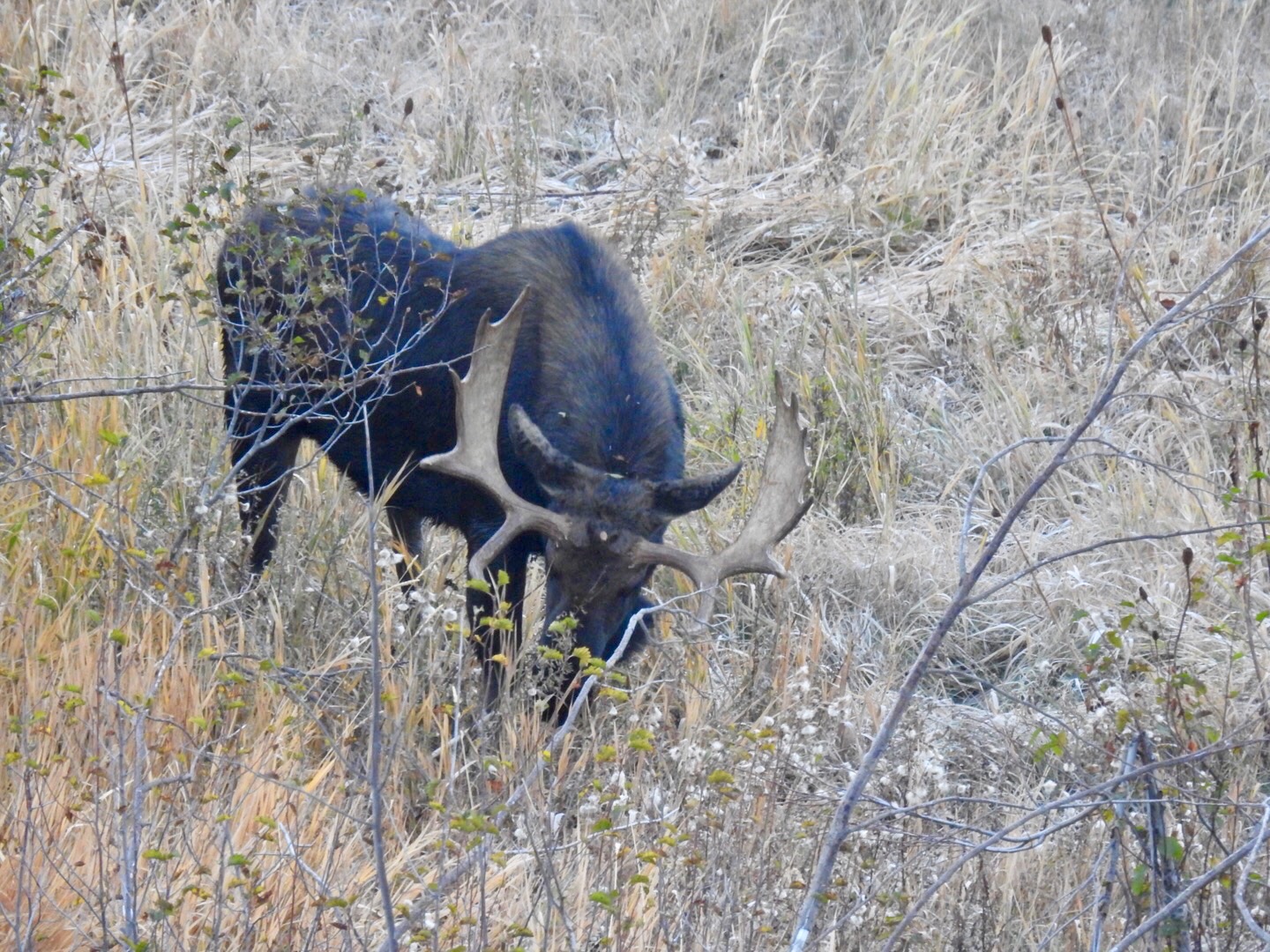
This is exactly what I came to see: moose antlers...
and elk antlers.

We started this trip in Salt Lake City and drove up to Jackson, WY, which meant our first shot at either species would come in Grand Teton National Park. It would be on to Yellowstone National Park after that. Oddly enough, from a moose and elk perspective, these two parks were polar opposites. Perhaps it's to be expected with about four times the moose in Grand Teton than Yellowstone and about double the number of elk in the Tetons up in Yellowstone but the contrast was clear and obvious. We got some awesome moose sightings in Grand Teton but only the most fleeting of elk viewings there. In Yellowstone, elk were easy to spot, but moose...not so much. 

Our task at hand would need some early wakings. Both moose and elk are most active at dawn and dusk. We spent seven nights out west and used an alarm to wake ourselves every morning, although admittedly the last one was to get to the airport. We knew we needed to be up before sunrise and head out to where we guessed and had read we might lay eyes on these species. The sun comes up in early October at around 7:30 a.m. or so. That meant alarm times anywhere from 5 a.m. to 6:15 a.m. depending on the day and our destination. I guess we could have slept in and just shot for the dusk movement but why cut our chances in half? Alarm every morning, please!

It was completely worth it. Yes, we came home tired and a bit sleep deprived but the looks at these species and the other animals we saw in the Parks were way worth it. There is something about seeing animals live and in the wild and observing their habits that sticks with you in a way that reading something in a book or seeing something on TV doesn't. Watching behaviors in person sinks in. I'll never forget watching elephants eat grass along the banks of the Chobe River in 2015. There are some moose and elk (and bison) behaviors I won't forget from this trip. And of course, we saw some antlers.

Moose in the early morning light in Grand Teton National Park.

Bull elk bugling along the banks of the Madison River in Yellowstone National Park.

We used West Yellowstone, Montana as a base for our explorations through Yellowstone. The town is right outside the West Entrance of the Park and our hotel, which was deep into the town, was all of a mile from the Park gate. Pretty darned convenient, I'd say. We generally spent the early morning and mid-day somewhere in the almost 3,500 square miles of the Park itself before exiting for a quick early dinner and then heading back to the Park for sunset.

Because we'd been driving around for up to nine hours earlier in the day, we wanted our dusk trips to be short and sweet. Fortunately, we found that the Madison River valley, which parallels the road to the West Entrance, is a great spot to watch elk. There were herds every night along the banks to the south of the road and in the trees along the north side of the same road. And always with a bull with some good sized horns.

Elk are some massive creatures. They are way, way bigger than the deer we sometimes see along the roads in Northern Virginia. But they are amazingly quiet when they want to be and they blend into the Wyoming forests in a way that I guess I should expect but which is astonishing anyway. In the early morning or late evening light, their lighter coats almost perfectly mimic the colors of the bark on the lodgepole pines that make up the forest, and the darker portions of their fur recedes in the shadows between the trees. You can't even spot their antlers because they so closely resemble the branches sticking out from the tree trunks.

We got great and clear looks at elk when they were out in the open along the river. It was a lot harder to pick these animals out when they were buried in the woods. I am sure we probably drove within 20 feet or so of many elk that we didn't even see. But of those we did see along the Madison, we got some great looks at some pretty good-sized antlers. This is what we came to see.

Elk in the forest along the road to the West Entrance, Yellowstone National Park.
Bull moose spotting a cow, Grand Teton National Park.

Our Yellowstone strategy of finding somewhere close to the hotel to see wildlife in the evening worked equally well at dawn and dusk earlier in the week in Grand Teton. I'm all for getting up early but not any earlier than I really have to. It took us maybe 10 or 15 minutes to get to a prime elk viewing spot in Yellowstone in the evening; we found an equally desirable spot in Grand Teton about 20 minutes from our hotel in Jackson.

Where was this magical spot, you might ask? Moose-Wilson Road. If there was ever a spot to spy moose, it had to be road with the word moose in it, right? I know, I know, we visited a road informally named Moose Alley earlier this summer and saw nothing. But we didn't go to Moose Alley first thing in the morning or right before dark.

I have probably spent too few mornings in my life watching the sun come up. Doing it twice in a row in Grand Teton National Park was amazing. Both times it was pitch black when we arrived at our spot along the creeks that feed the Snake River and it was so still. There were stars and likely Venus or maybe another planet (we didn't bring our star chart along on this trip) overhead and we were not alone. 

By "not alone" I don't mean that the forest was packed full of wildlife. I mean other humans beat us to the parking area along Moose-Wilson Road. And of course, in the black of pre-dawn, they claimed to see moose. It's pitch black and we are looking into a shaded (were there any light at all, of course, which there was not) valley at animals with dark brown to black hides. A cow and calf by the water and a bull a bit further back from the shore. I know I have poor eyesight but there's no way these people can see dark moose in the black of night!

On morning number one, they were right. I mean, of course, they were right. As the darkness receded and gave way to the light, there were revealed to us three moose right there in front of us. Eating and poking around in the willow thickets without a care about our presence. We could see on the first morning there that the young bull moose (shown in the top photograph above) had some ideas about how he'd like to get to know the cow a little better, but she seemed totally disinterested and he didn't pursue anything. Just kept eating and walking and (in between some excitement about a bear) eventually we'd move on and seek more moose elsewhere and come up empty. We'd seen our first moose antlers. They weren't as big as we thought they might be.

Day two played out in much the same way. Get up early. Drive 20 minutes. Park in the dark. People already there. Tall tales about moose here or there which turned out to be totally accurate. Only this time with two bull moose. And the newcomer was quite a bit bigger, with a much more impressive rack. He's pictured right above. This was more like it.

I don't know why I'm obsessed with antler size in this blog post. Maybe it's because this feature of the elk and moose give identity to these creatures in a way their body shape or faces or hoofs or whatever else it might be cannot do. Who can grow the biggest, most massive set of prongs on top of his head? That's what I wanted to see. I was happy to see the second moose. 

Like the smaller bull the day before, he also had some designs on the cow, complete with some moose catcalling (is that a thing? it wasn't exactly the bugling of the elk). But as soon as he started looking her way she moved away from him. Her reaction was completely different from the advances of the smaller of the bulls. She moved into cover by the water quickly, followed by him. Nothing happened, I swear, but how three massive dark-colored moose (remember there's a calf) disappear into willow thickets which are not that dense is beyond me. But that's just what happened. Poof! They were gone. Right before our eyes. This camouflage stuff, folks...pretty impressive.

The only other thing I can say about the moose we saw in the Tetons is talk to your neighbors. "Surely," some folks next to us said, "you must have seen the three very large moose on the way into the Park by the Visitor Center that morning." Very large moose? We're gone!


We didn't find three moose. But we did find the guy above. And I'm just putting these pictures up for your enjoyment. I am sure there are moose with larger antlers in this world, but this guy is real and he is spectacular. This is some impressive stuff. I'm happy now. Enough about moose.

But not enough about elk.

Moose at a distance are awesome to see. So are elk. I love these creatures. Most of our looks at moose in the Tetons and elk along the Madison River came from a football field or two or more distance away. But nature is so much more intimate when it's closer. 

There are many, many places in Yellowstone National Park where you can see elk, but one of the best spots to see these animals is in the town of Mammoth. For most of the year, elk cows sit around in the town 24 hours a day and graze and sleep. But it's a little bit more exciting during the rut. Where there are female elk during mating season, there is at least one testosterone laden, sex-crazed bull around. If there's more than one, get ready for some fireworks and get ready to move out of the way quickly.

Two elk bulls during the rut equals trouble.

I never really felt like I was in any danger from wildlife in Yellowstone but there were a couple of times that the adrenaline surged in response to wildlife moving a bit too fast and a bit too close. One of those two times was in Mammoth with the two boys above: a younger bull on the left (known as 24 for his ear tag number) and the slightly larger dominant male on the right who had already claimed the town's harem of cows.

They bugled at each other and to the cows. Bugling is a long higher-pitched-than-it-seems-like-it-should-be noise used to ward off competitors and signal availability for mating to a partner or partners. They chased females. They chased each other. And they actually came to blows, locking antlers twice quickly in a test of strength before separating and splitting up. Each time over the course of an hour or so, 24 lost. He didn't bugle loudly enough or he lost an antler fight or he was chased away. No matter how many times he came back, he was run off. And every time he did, the team of six or eight Park Rangers moved gawking spectators like us out of anything resembling a straight line between the bulls and another elk.

We never saw an elk bigger or closer with a rack like the bull who had installed himself among Mammoth's cows. The antlers on this male were majestic and enormous. If they had been intact, they would have had a full 12 points, although some past skirmishes had clearly knocked off a tine or two. When he bent his head to graze, his antlers stretched above the top of his back, a good four and a half to five feet tall. There are signs all over Yellowstone posting warnings about how fast or dangerous or both the wildlife in the park are. If you want to see some very large animals with very sharp things on their head move very fast, spend some time in Mammoth during elk mating season. Scary dangerous. But oddly enough somehow completely safe.


It seems odd to see elk in the middle of a town but these things are wild and dangerous.

We spent a total of about five and a half days in Grand Teton and Yellowstone. If we came to see just moose and elk, we had checked that box quite securely. I can't imagine getting any better looks at these animals in the short time we spent spread all over these two parks. No complaints at all here from me. Almost no moose sighted in Yellowstone? Who cares. We got them further south. No elk to speak of in the Tetons? That's what Yellowstone is there for. There's no real way that I could have expected more here.

Two days after our first elk encounter in Mammoth, we passed back through the town. 24 was there. The other bull was not. 24 had run him off. Life comes at you fast. Be prepared.

24, ruler of Mammoth. Do not approach elk, folks. Don't mess with those antlers!


How We Did It
We found the most reliable spots for elk watching in Yellowstone National Park to be along the Madison River and in the town of Mammoth.

The Madison River runs just to the south of the road connecting the Park's West Entrance to Madison Junction. There are a number of pullouts with parking lots along this road to stop and gaze out over the fields on the banks of the River, although if there are any sorts of animals roaming around, you'll likely see a ton of stopped cars and people standing by their vehicles with cameras and binoculars. We had some amazing success along this road in the early morning and just before sunset. According to the Park map that you get handed when you enter the Park, the road along the Madison River is closed from early November to mid-April.

The town of Mammoth is just south of the North Entrance to the Park. The primary attraction in this area is Mammoth Hot Springs but both times we drove through the town we saw a ton of elk and right in the middle of the day. Don't stop in the road to take pictures. Park and get out of your car and obey the directions of the Park Rangers at all times. They are there to keep us safe. Elk are dangerous.

For moose spotting in the Tetons, I can't recommend the Moose-Wilson Road enough. We spent both our sunrises and our one sunset in the Park at the exact same spot and we saw moose all three times. To get there drive north from Jackson, take a left at the Moose Junction sign, drive past the Craig Thomas Discovery and Visitor Center and take a left. After a little while you'll come to a noticeable slope up. There's a parking area on the left just beyond that slope. Look behind you further up the hill towards the treelike and you might see some elk. We also saw two bears in this spot. Definitely a good spot for wildlife.

Two final and likely totally irrelevant details. First, if you love elk so much that you want to try having some for dinner, I can totally recommend the Elk Burger at the Slippery Otter Pub in West Yellowstone, Montana. I thought it was seasoned and cooked perfectly. Second, if you want to drink a beer with a moose on the can, I'd enthusiastically recommend you pick up some Big Sky Brewing's Moose Drool. It's about the most delicious brown ale I've ever had (and I don't typically drink brown ales because I find them lacking in flavor). If you are in West Yellowstone, pick some up at the liquor store portion of Bullwinkle's or it's also available at the Market Place grocery store at 22 Madison Avenue.