Showing posts with label Bavaria. Show all posts

Monday, September 16, 2013

Arbeit Macht Frei


It's been a few weeks since my last Bavaria post and almost three months since I set out on that one week plus journey but I still have one more to post to get through and it hasn't been easy to write. This will be the last one I publish about Bavaria unless I return someday in the future to that corner of the world.

Overall our trip was a great trip. I learned a lot about the history of the region; changed my opinion of German food (for the better) and beer (for the worse); and saw gorgeous countryside in and around the Alps. But it featured two of the most uneasy days I've ever spent on vacation in Dachau and Berchtesgaden.

One of the darkest chapters in 20th century history occurred in Germany from 1933 to 1945, beginning when the National Socialist German Workers' Party (more commonly know as the Nazi Party) took power in that country until they were defeated at the end of World War II. While I don't usually seek out unpleasant holiday destinations, I thought I owed it to myself and to everyone killed in that war to visit some sites connected with the Nazi regime to remind at least myself of what we collectively should never allow to happen again. It was worth it, but it was chilling.

We arrived in Munich on a Friday afternoon and the next morning boarded a train for the town of Dachau, a typical German town about 20 kilometers northwest of the city. Only not so much. Dachau was selected by the Nazis as the site of the first concentration camp to house persons that the Nazis thought should be removed from society. And there were a lot that the Nazis thought should be removed from society.

The camp was established in March 1933 on the site of an abandoned munitions factory to hold communists, trade unionists and other opponents of the Nazi party. Eventually, other groups were brought to the camp, including Jehovah's Witnesses, gypsies, homosexuals and, after Kristallnacht in November 1938, a significant number of Jewish men. In 1937, the camp became a work camp, first demolishing the old munitions factory and then enlarging the very place that would hold and work many until their death. The place remained a work camp until liberation by American forces in 1945. Dachau was not officially a death camp, meaning there was no mass extermination in gas chambers (although there was one built), but for sure there was plenty of death in this place.

A guard tower and poplar tree at either end of one of the barracks' foundations.
When we first got to the site, my first impression was that the place was huge. It was just way bigger than I expected. This was not a place that held a few people against their will; it was massive. We walked the site from the south end of the complex to the north, starting at the prison and then moving through the administration block (which is now a museum), past the barracks and the memorials and chapels on the property before ending up at the crematorium. That was probably the right sequence. There is no doubt the crematorium was the toughest spot to visit.

As I walked through the place, it was impossible not to be affected by so much that was there and had happened. Overall, I was struck by the abject cruelty of the entire enterprise. There was a vision of hatred put forth by Adolf Hitler and Heinrich Himmler that truly applied to everyone not like them and it was clear from the exhibits that it would have been all but impossible for most people to avoid their persecution. The camp was truly there to work people to death. There was no constructive purpose behind some of the labor that the prisoners were forced to endure. Some work details simply moved rocks or piles of sand from one location to another before just being made to move them back to their original locations.
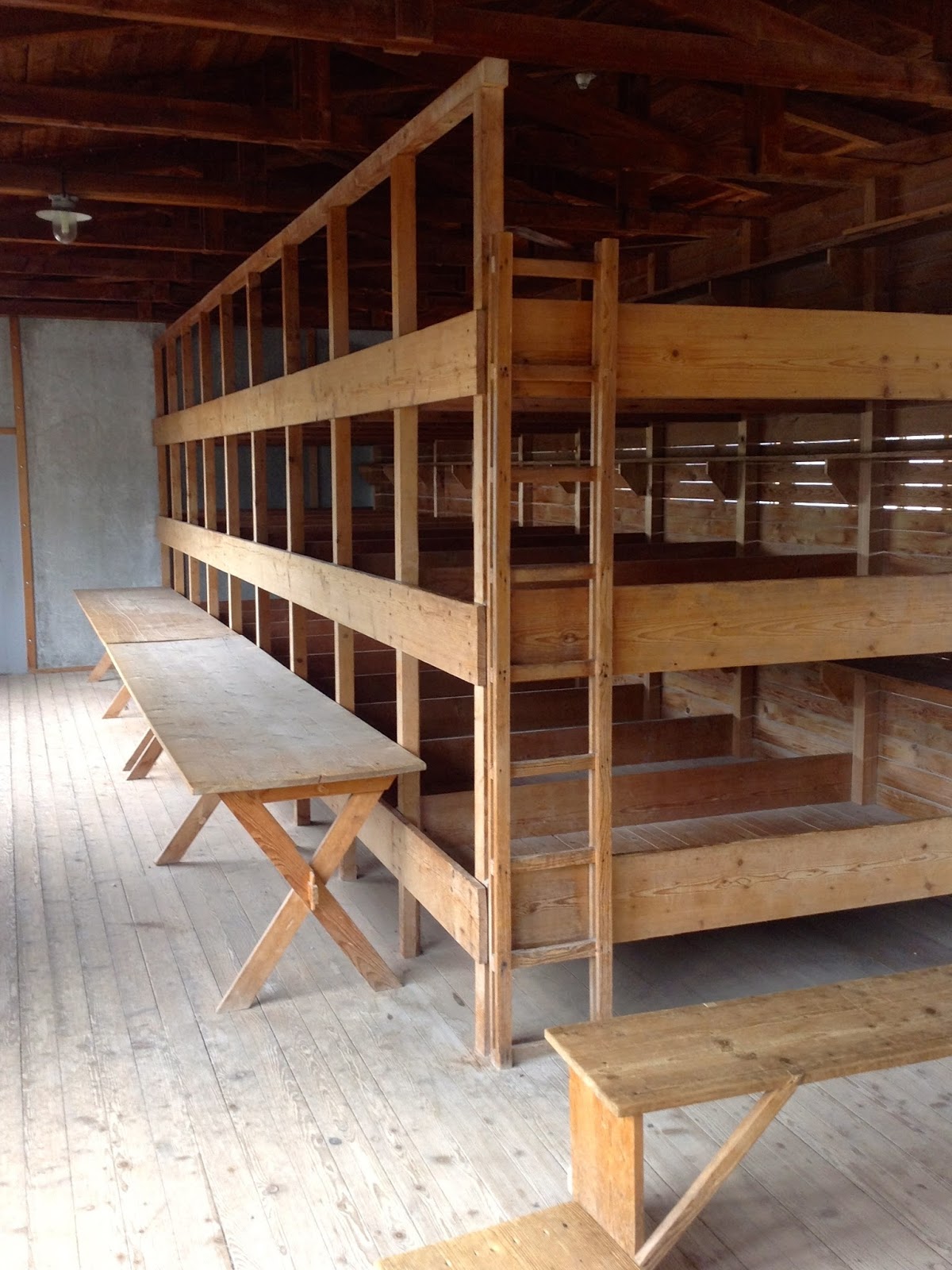
Reconstructed barracks.
Originally the camp had 40 barracks, each constructed to hold 200 men. At the camp's highest occupancy, there were up to 2,000 men squashed into any one barracks. Walking through the two reconstructed barracks at the south end of the site, it is unthinkable that that many men could be packed into the bunks inside. Different types of bunks are depicted in the two barracks and none of them seems any better than the other. I can't imagine how awful it was to be kept here. In many ways it is remarkable that the prisoners didn't rise up against the guards. I guess there was true belief despite all that was happening around them that the intent was not to work everyone to death.

After passing through the barracks, you are faced with the foundations of 38 other housing units, each numbered to seemingly remind you of how many there were and how many men were kept here, divided by an allée of beautiful poplar trees, who were witness to such cruelty for the first years of their lives. It's a long walk and that walk makes you think even more about the hell that the people here must have endured.

The path then directs you to the west, through the barbed wire fence atop the deep perimeter ditch and to the crematorium. As amazing as it sounds, the crematorium initially in and of itself was not that difficult to visit. This was the place where the bodies were burned, not where people died. But once you get to the gas chamber, it's absolutely incomprehensible why man would want to do this to another man. I've read and seen stories of the Nazis building gas chambers to look like showers so I expected the "shower heads" above me as I passed through the space. But the attention to detail was absolutely disgusting. There are drains in the floor which serve no purpose since no liquid would ever pass through there. It was literally one of the most horrifying spaces I have ever been in. It was never used at Dachau and that's little comfort to me. It was designed to be used. That's enough.

As if the gas chamber weren't enough, the path from the crematorium takes you past the shooting range, where the guards used prisoners as practice. For me the fact that the gas chambers were never used mattered when I got to this place. People were gunned down here for sport by men. It was truly sickening.

Looking south between the poplars to the administration building.
I can't imagine how the German people come to terms with what their ancestors have done in this place and the guilt about what happened here is obvious. After the war, the barracks were used to house refugees until 1965. Only in the 1970s did Germany start to make any effort to recount what happened here. There is so much here that is new or recently discovered, from memorial chapels and sculptures to roads and guardhouse foundations recently unearthed. It is patently obvious that this history has been avoided in some measure. Thank God it appears there is progress being made.

Dachau is perhaps the worst place I have ever been on vacation. Despite that I suggest you go if you ever find yourself in Munich. The world needs visitors to see and remember what happened here. The main gate to the camp features the words "arbeit macht frei" which loosely translated means "work shall set you free." It's horrifying to think that whoever hung that gate honestly believed those words.

Four days after our visit to Dachau, we visited the Berchtesgaden region. Our agenda for the day featured a boat ride in the gorgeous Berchtesgaden National Park in the morning and then a trip up into the Alps to visit the Kehlsteinhaus in the afternoon.

The Kehlsteinhaus, or Eagle's Nest, was built as a gift for Adolf Hitler's 50th birthday. It is a diplomatic entertainment spot designed to show the benevolence and love for nature demonstrated by the Nazi party. It was built in just 13 months, an incredible feat considering it is sitting on top of a mountain accessible by a one way road (which had to be built before construction on the building could be started) and a gold plated elevator built into the heart of the mountain. This place is clearly a demonstration of what the Nazis could build if they set their mind to it. 


When I was planning this trip to Germany, I knew I wanted to visit the Eagle's Nest. Quite honestly, I expected the place to be a typical wooden chalet like the kinds you imagine exist in the Alps. Indeed, the trip south to the Berchtesgaden takes you by a number of picturesque chalets. But the Eagle's Nest is nothing like that. It is an ashlar masonry structure with (appropriately enough I guess) very little warmth whatsoever.

It honestly feels like an executive conference center which I guess in many ways it absolutely was. Other than its size (it's huge), it doesn't seem excessive at all. There are no Nazi motifs on the building or any sort of celebration of German power. Other than the fact that it is built on top of a mountain and you have to take a gold plated elevator to get there, it doesn't seem that impressive. I guess it would have in the first half of the 20th century.

Once you are on top of the mountain, the site is really amazing. It is not quite on the top of a mountain but the peak is just a short walk from the building. The views are incredible. It's difficult to imagine the type of men who built this place in a spot so beautiful.

While walking around the Eagle's Nest, I found myself torn about the continued existence of the place. This building and this site are reminders of Nazi power and excess and I would have no qualms about wiping it off the face of the Earth. I feel this is different than Dachau. A site like that needs to remain to remind us of what we should not become again. I don't feel the same way about the Eagle's Nest. On the other hand, there doesn't seem to be any purpose to razing it.

I do think there was an opportunity that was missed by the German government. The Eagle's Nest today is a tourist spot and a cafeteria style restaurant. The reasons why the building exists and what it symbolized are relegated to what used to be an outside porch type corridor, squirreled away off the main path of travel by the bathroom. I'd be much more accepting of keeping the place around if it was a museum to what the Nazis had done to the people of Germany and Europe, rather than as a beer and food place on top of a hill.


The Eagle's Nest is not an easy place to get to. From Salzburg, we took three buses there and three back (eight total with our trip to the Berchtesgaden National Park) in one day. I recommend you try though. Despite the sinister reason for it being there, the view is incredible.

It seems odd that I would devote two of my nine vacation days to these sites but I thought it was extremely important. Despite the reminders that these two places represent, we keep allowing dictators to persecute their own people. I guess we can't take on all the world's problems but it's awfully difficult standing by.

Wednesday, August 28, 2013

Bavarian Food And Beer

Beer kegs at the Paulaner brewery.
I'll start this post with some statements I never thought I would make. The beer in Bavaria was almost universally disappointing and was without doubt the part of my recent trip to Europe that fell farthest below my expectations. The food in Bavaria, on the other hand, was absolutely amazing; I loved almost every serious meal I ate while I was on vacation there. If you had asked me to describe my expectations for beer and food before I boarded my flight to Germany two months ago, I would have said I was looking forward to the beer more than most aspects of my trip and I was dreading the food. Something strange happened between the time I took off from Dulles Airport and arrived back in the United States ten days later.

When I arrived in Frankfurt and presented my passport to enter through immigration, I was asked the purpose of my visit. When I responded that I was on vacation, the follow on question was if I was visiting to drink German beer. I responded enthusiastically that I intended to drink a lot of German beer. About eight hours later, I was downing my first liter of dunkles beer at the Hofbrauhaus near the Marienplatz in Munich feeling a little let down and hoping that the rest of my beer drinking experience in Bavaria would be better. It was, but only a little.

Munich is surrounded by breweries; there are at least nine world renowned breweries in or near the city. The rest of Bavaria is not much different; there are breweries almost literally everywhere. Each brewery in Bavaria generally brews three types of beer: a helles, which is essentially a beer which tastes like Bud Light but with about twice the alcohol content; a dunkles, which is a little deeper in flavor and color than helles because of the roasted malt used in the brewing process; and a weissbier or German wheat beer, which is a chewy citrusy wheat beer.

My first mug of beer in Bavaria (in the foreground).
In addition to the breweries, Munich and the rest of Bavaria is full of bars and beer gardens. Each bar or beer garden is usually aligned with a single brewery meaning two things: you have no choice of beer brand when you sit down to drink and you typically have three types of beer to choose from: helles, dunkles and weissbier. That's it. That's all you can get. There are some exceptions to this rule. Sometimes, you can find a bar that serves a helles and dunkles brewed by one brewery and a weissbier brewed by a second but you still end up with three choices. Pretty daunting, especially if you consider it's impossible to find non-Bavarian beer in Bavaria. It made me realize the kind of creativity and variety in beer we can now get in the United States. It has to be one of the premier beer brewing nations, unconstrained by strict adherence to brewing tradition.

Before you lament my dilemma with only three beers to choose from, let me say that I really like German weissbier. It has a ton of delicious flavor with not too much yeast taste and the texture and body of the beer is wonderful. Think Samuel Adams Summer Ale if you need a point of comparison. It's so much more satisfying than Belgian style witbier, which I generally find watery and sometimes lacking in taste. Of all the weissbier I had on my trip, I thought the König Ludwig and Munich's Augustiner Bräu were the best although not by a lot. If you like the taste of weissbeer, I don't think you can really go too far wrong in Bavaria. But drinking weissbier for nine straight days was not why I came to Bavaria. 

Now because I like to work hard at finding good beer, I refused to let the situation presented to me keep me down. So I worked at it (meaning I kept drinking). Where I was frustrated with the limited beer selection in bars and beer gardens I visited, I found greater variety at breweries' official beer gardens. Hofbrauhaus offered four beers to choose from but Paulaner, Andechs Abbey and Hacker-Pschorr all offered at least five and the selection beyond the ubiquitous helles / dunkles / weissbeer choices were worth seeking out.


Both Hofbrauhaus and Hacker-Pschorr's beer gardens served a summer beer, which is a medium colored unfiltered lager with good body and far more taste than the helles or dunkles beer but without the sweeter yeasty taste you get from a weissbier. The Nockherberg beer available at the Paulaner beer garden had a similar profile and was perhaps the better of those three beers. I also found a bottled Hacker-Pschorr keller beer at the end of our Paulaner brewery tour (ironically) that was far tastier than the helles beer we were assaulted with at other places. I'd liken it more to a full bodied pilsener beer than the standard light German style lager we found elsewhere. Sometimes hard work pays off.

And then there's the food. If I had to give my impression of Bavarian food prior to my trip, I would have described it as meat and potatoes based and would have displayed very little enthusiasm for it at all. Add in to the equation an experience I had at an Alsatian restaurant in Paris on a trip I took in 2004 where I was served blood sausage and my piece of pork still had the pig's hair on it and I would say I was positively dreading the food possibilities on this trip. I've loved English, Dutch, Belgian and Finnish food on trips to Europe. I was absolutely not looking forward to food on this journey.

Spaetzle at Hacker-Pschorr's beer garden in Munich.
But I was surprised. And very pleasantly so. Of the first seven days I was in Bavaria, I think I ate sausages at some point on six of those days, before varying my diet just a bit the last three days. The sausages in Germany, be they frankfurters, bratwurst, knockwurst or whatever, are unlike American versions of those same foods. The grind on the meat is super fine, the casings snap and the taste is amazing. There's no gristle or hard crunchy things when you bite into them. I hate to say it was like eating hot dogs every day because the sausages tasted so much better but that's my only point of comparison. I do love hot dogs by the way. I would eat them every day if I thought it was healthy.

Sausages are eaten hot and cold in Bavaria. The cold salami I ate at Andechs Abbey and the weisswurst I ate on a beer and food tour in Munich were equally as good. And each type of sausage is paired with their own spicy or sweet mustard which improves the overall taste of the meat. I didn't see any blood sausage at any of the places I visited, although that's probably because I didn't visit the right (or wrong) places.

The best meal of the trip: pretzels and sausages at Andechs Abbey.
Besides the sausages, other highlights of Bavarian cuisine that I will long for include pretzels and spaetzle. The only real exposure I had to pretzels before this trip was at sporting events (think rock hard brown pretzels with tons of salt) and Rock Bottom Brewery (think fresh baked brown pretzels with tons of salt which get rock hard quick). The pretzels in Germany are works of art: crusty and slightly salty on the outside with warm doughy bread on the inside. And they are served with raw sliced white onion and a spiced cream cheese and butter mixture that is out of this world good. I would kill for some of that stuff right now. Also, for the record, raw white onion makes pretty much everything better. Call me crazy on that one.

I only managed to have spaetzle once on my trip, so the sample size is admittedly difficult to rely on, but the cheese spaetzle I had at the Hacker-Pschorr braureihaus was incredible. It was like a lighter, fluffier version of macaroni and cheese and it was absolutely delicious. If I ever go back, I'm having more spaetzle, if I can give up the sausages and pretzels.

Apple strudel in Salzburg.
Finally, a word about dessert. I'm not much of a dessert guy but I did have to have some apple strudel in both Germany and Austria (especially Austria). If there was a food I thought would be incredible but wasn't, it's the apple strudel. I found the three servings I had to be pleasant, with a lot of apple, but the traditional vanilla custard served with the strudel didn't do much for me and the plates I had were ultimately a little disappointing.

My advice to traveler seeking out good food and beer in Bavaria is this: find the kind of beer you like and drink your beer at brewery beer gardens if you have to; eat plenty of sausages and pretzels; and when presented a chance to eat cheese spaetzle, take it and don't look back. If you don't like it you can always order some more pretzels. Oh, and if you ever make it to Andechs Abbey, get some of the pork roast or convince a friend to get some and steal some of the crispy pork fat. Delicous. Prost!

Sunday, August 18, 2013

Eight Things I Learned In Bavaria

Please please explain to me what this sign means. No playing soccer in the street next to your house with cars around?
Every time I travel outside the United States, I end up realizing that the rest of the world is not like it is at home. Not that I really ever forget that being an immigrant to this country myself but the history, culture, food and behaviors abroad can vary wildly from my sheltered little life close to the capital of one of the biggest and most prosperous nations on Earth.

In many ways I guess it's not just an international phenomenon. The same could be said for traveling in the United States itself; they don't do things in Texas or Boston or South Dakota like they do in Washington, D.C. And all of that is a good thing. Why bother traveling if everything were the same the world over?

Having said all that, I always travel with the particular biases I carry from the place where I live. No matter how savvy I think I am, I always learn something about or from the places I go. Some of the things I learn help me get around and will benefit me on future trips; some are refreshing; and some are just plain baffling or downright amusing. Here are eight things I learned in Bavaria.

1. Carry Cash
The United States is without question a credit driven nation. How else would most people in this country have all the great and glorious stuff they have without the power of credit card debt. On the contrary, cash is definitely king in Bavaria. The opportunities to pay with credit over there are few and far between. You have to carry cash pretty much wherever you go!

The best part of this cash first society for me is the waiters and waitresses in beer gardens and restaurants. When you pay, your cash is not taken to the register to make change. Each server carries a massive wallet full of all variety of Euros and Cents and makes change, seemingly for whatever sum you lay out, right at the table. It's thrilling and amazing. ATMs are plentiful. Hit one as soon as you land and you'll be OK.

Wild boar sausages over potatoes in Salzburg. Lots and lots of sausages. Yummy!
2. Where's The Bacon?
For all the pork I ate in Germany and Austria (mostly in sausage form), I didn't eat a single solitary piece of bacon. And it wasn't by choice because let's face it, no way would I actually voluntarily opt out of eating bacon. I mean, who would? And it's not like we didn't look either. Our last hotel had an incredible breakfast buffet with cereal, eggs, croissants, jam, yogurt, ham, salami, herring (yes, herring), cheese and pretty much everything else you could want for the first meal of the day except, that's right you guessed it, bacon.

Now this would be just unthinkable in the United States but, again, that's why we travel. I guess I can exist for nine days without bacon if I can get the incredible sausages they have over in Bavaria. Just for nine days though.

3. Google Translate Really Works
While I was planning our trip to Bavaria at nights, on weekends and the occasional lunchtime at work, I found a lot of websites (particularly in Germany) that did not offer English translations which I found annoying for a while until I turned to Google Translate. This tool is absolutely amazing. Other than a few words here and there, I found it to be mostly foolproof.

And it really helped with non-English menus (ran into one of those here and there) to determine what exactly we were ordering before something showed up in front of us. I wanted to make damn sure we didn't end up with cow's brains like Brenda and Donna when they went to Paris on Beverly Hills 90210 so I used it religiously in those situations. It's always fascinating to consider what sort of vocabulary I come back with from foreign speaking countries. My Finnish vocabulary from my trip in 2000 consists of hei (hello) and kittos (thank you). Thanks to Google Translate, I know how to say whipped cream (schlagobers) and trout (forellen) in German but I have no idea how to say please.

4. Advance Planning Pays Off
I'm a big believer in advance planning. If there's one thing I've never been accused of, it's not putting enough thought into a trip in advance. I usually know what's important to see; exactly how to get everywhere I need to go; and when museums and other attractions are open and not open.

Having said that, there were some situations in Bavaria where I would have benefited from planning at home before landing in Germany. The train schedules and ticket options are a lot clearer on the Deutsche Bahn website than they are on the ticket machines in the stations. We bought tickets to Hohenschwangau before we got to Germany and saved a ton of money; by contrast, misunderstanding the ticket machines cost us about 30 extra Euros each to get to Salzburg and back.

I also wish we had dug into the bus websites a little more to know that day passes are available which can save a lot of money and time. Fortune favors the prepared mind!


5. Germans Love Long Words
If there's one thing that astonished us about the German language, it was the length of the words. Some words seem to be nouns appended by adjective after adjective which end up in multi-multi syllabic nightmares. I ordered one meal called fleischpflanzerlschmaus which somehow means beef croquette with mushroom sauce and cheese spaetzle. Delicious by the way!

I think the longest words we found on our trip were 27 letters long. The word above (one of the 27 letter words we found) means tax advice firm, although Google Translate doesn't know that (I said "mostly foolproof"). The upside of long words is sentences with few words. I guess it doesn't help if you can't pronounce the words though.

6. Bus Drivers Make Change
The first couple of days of our trip to Bavaria were spent hoarding Cents and Euros so we would have exact change for all the bus rides we needed to take. We religiously paid with large bills for small transactions so we could accumulate massive pocketfuls of change. When buses approached, we swapped and pooled money so we would each have the exact fare and wouldn't overspend. That's the way Metro works in D.C. Why would we think anything different?

Eventually a few days into the trip we got to a situation where we just didn't have the right change and were forced to plop way more than the fare down in the tray in front of the bus driver, feeling foolish that we were overpaying for a bus ride and we hadn't managed to successfully manage our group coin pot. Then something amazing happened: he made change for our bills and it changed our world. Apparently we learned nothing from the number 1 above. Can't see Metro adopting this. Thank God for SmarTrip.

House next to a tree this way? Anybody got any better meanings for this?
7. I Don't Understand German Street Signs
I love signs. Advertisements, wayfinding signs, neon signs, whatever. You name a type of sign and odds are I love it. One of my favorite types of signs are street signs. They are absolutely essential to the driver and pedestrian alike. I find it amazing the kinds of messages that can be conveyed using pictograms and a few words or no words at all.

European signs are often very different from signs in the United States and sometimes take a bit of time to understand their exact meaning. The sign at the top of this post makes no sense unless you understand there's a version of the sign without the red line through it. I believe it's telling you when you can and cannot let your kids play in the street. Despite my best deductive reasoning, there were a few signs in Bavaria that I just didn't get. I can't for the life of me figure out what the sign above means, which we found near a bus stop in Salzburg. The only meaning I can ascribe is that there's a tree next to a building to the left. I cannot figure out why I would care. Can anyone help me out here?

8. Schedules Work
If there's one stereotype of the German and Austrian people that I had before heading overseas this summer, it's that things would run on schedule. Our travel plans on some days in fact counted on it. We worked out day trips where trains or buses leaving early or late would have been major inconveniences. One day, we had to take eight buses to get from place to place.

And do they ever. I think just about every train or bus we waited for came at the appointed time (except of course when I was trying to recover my iPad and depending on a bus to get me back to the hotel for checkout time - hitchhiking works in Germany, although that's not a lesson I'm willing to post as learned). If I'm waiting for a Metro bus in D.C., I know I just have to wait until it decides to get there. It could be early or late or buses 20 minutes apart may arrive five minutes after each other. But Bavarian transportation is clearly different. I spent a lot of time on the Regionalverker Oberbayern website before leaving the United States looking for bus schedules to shore up our plans and it definitely paid off huge. The website, by the way, is not in English. See number 3 above for help.

Tuesday, August 13, 2013

Munich

Tombs in the side wall of St. Peter's Church.
For all the nights I spent in Munich hotels on my recent trip to Europe (seven nights of nine total), I spent remarkably little time exploring the city of Munich itself. As a base for exploring the rest of Bavaria, Munich was perfect. It is about two hours by train or bus from the Alps, Salzburg and Kloster Andechs and it's even closer to significant brewing and historical sites. At night, the city offered us enough to do in the way of eating, exploring beer culture and people watching that it never got boring. I think I could have spent a couple more days in and around Munich but I had to cut it off somewhere. I mean at some point, money and getting back to work come in to play here.

So after all the day trips and overnight trips to all sorts of places around Munich, I reserved the last two days of my time this year in Europe to explore the city that had housed us. Even though we had strolled through the city's altstadt and visited the Hofbrauhaus for the first time the day we got to Munich and took a beer and food tour the very next day, the last two days, Friday and Saturday, of our trip were spent being tourists close to our hotel rooms. Here are three things I did in Munich that I'd recommend for anyone spending time in that corner of the world.

Olives! How did I ever not love olives?
The Viktualienmarkt
One of the things I love most about visiting Europe is the markets. Sure we have farmers' markets all over the United States but it's not the same cultural institution as a market in a European city. I mean this market has existed since 1807. It's not just a place to buy food; it's also a meeting place and an integral part of the city's culture. One of my fondest memories of Finland when I was there in 2000 was strolling through the market in each city we visited. I still have visions of stall after stall of chanterelles. They looked amazing.

Munich's Viktualienmarkt was no exception to my European market experience although this market of course distinguished itself from other cities' markets by the enormous beer garden right in the middle. We spent Saturday's lunch here roaming between butchers, cheese stalls and all manner of fruit and vegetable stands. Lunch consisted of some mozzarella and oil poached tomatoes on a stick followed by 100g (about a quarter of a pound) of citrus olives. I'm so deliberate about shopping for food and cooking that I know I could never do this, but I imagine how amazing it would be to grab fresh ingredients at random from the market and whip up something incredible at home. I could snack all day here.

The monk statue in the Paulaner Wirtshaus beer garden.
Paulaner Brewery and Wirtshaus (Beer Garden)
Modern Munich beer culture has been dominated by the big six breweries: Augustinerbrau, Hacker-Pschorr, Hofbrauhaus, Lowenbrau, Paulaner and Spaten. There are other smaller breweries in the country around Munich like Weihenstephaner, Eridinger and Ayinger but the big six are clearly dominant in Bavaria. One of my must sees in Munich was to take some kind of tour of at least one of these breweries in my time there. Surprisingly, this task proved pretty difficult, but I found decent tours at appropriate times for both Paulaner and Spaten.

I ultimately opted to go on the Paulaner tour for two reasons: I like Paulaner's wiessbeer a lot and Spaten is owned by InBev, a worldwide brewing consortium which now owns Stella Artois and Anheuser-Busch among other companies. Spaten was just too big. The Paulaner tour was nothing special; I've been on countless brewery tours in my life and the story they told was nothing unusual or different although admittedly the beer tasting definitely stood out since they served a whole meal with the tasting. But the beer garden after the tour was great. The brewery is a little out of the way of the city center so it was a little more peaceful and Paulaner was one of the few places in Munich where we found excellent beer. Definitely a good choice.

Ironically even though the narrative of the tour wasn't different than other brewery tours, this tour was special because it was in German. Of 20 or so total people on the tour, Mike, Bryan and I were the only three who didn't speak German, which meant that the few minutes the tour guide agreed to talk to us at each stop became a private tour of sorts. Pretty cool for a place this big.

Hang ten, dude! Surfing on the Isar (no, this is not me).
English Gardens
Just to the north of the Marienplatz or the main plaza in Munich is a large public garden called the Englisher Garten or English Gardens. The park was established in 1789 and was one of the first large scale public parks in the world.  The Garden was created by Sir Benjamin Thompson, an American who fought on the side of the English during the Revolutionary War. It was originally conceived as a military garden to be used by soldiers but soon after its establishment was changed to serve the population of Munich.

This place is huge. Areas of places, whether inside or outside, are something I struggle to grasp but the English Garden is about 15 percent larger than New York's Central Park, which in my mind makes it enormous. The park is designed in the English landscape style (hence the name) complete with meadows, lakes, winding paths and follies at strategic locations, all designed to look very natural. It's all in all a very European garden except for the surfing.

Yes, you read that right. A portion of the Isar river is diverted through the park and at several locations throughout the park, underwater baffles are placed below the river causing eddies and rapids in the river which are now used by surfers in Munich. And not just one or two. This is some serious business. There are lines of people waiting to surf from one side of the river before either being tossed aside or abandoning their wave. It's worth a trip to see the surfing alone. I wish I had visited the park earlier than the last day on my trip. There's (of course) a very large beer garden in the park. I think it would have been fun to knock back a liter or two there one night.

So those were my favorite three things I did in Munich in addition to spending a lot of time in beer gardens; visiting the BMW Museum; exploring the Oktoberfest museum as part of a food and beer tour; and watching the Glockenspiel on the Marienplatz. The Glockenspiel tells the story (much abbreviated I am sure) of the marriage of Duke Wilhelm V to Renata of Lorraine. The performance, which lasts about ten minutes, is conducted three times a day in summer in the tower of the New Town Hall on the Marienplatz. While not incredibly exciting (you have to watch closely to see the excitement in the joust), it's the ultimate tourist attraction in Munich and so is worth spending a quarter of an hour waiting and then watching.

The Rathaus, or New Town Hall on the Marienplatz.

Thursday, August 1, 2013

Not A Cars Guy


By my own admission, I am not a cars guy. In fact, I am nowhere close to thinking about becoming a cars guy. I don't like dealing with them, I hate when things go wrong, I don't understand how they work and I don't follow what's going on in the automotive world. I can put a key in a car and make it go and that's about it. So it's understandable that one of the vacation stops I was looking forward to the least on my recent trip to Munich was the BMW Museum. My dragging my ass out to the Museum and the adjacent BMW Welt (essentially a massive showroom of BMW and Mini cars) was purely for my friend Bryan's benefit.

Having admitted I am not a cars guy, I will say that every so often a car comes along that I absolutely love. When I say that please understand my love of cars is based strictly on the design of the car. It has nothing to do with the performance, efficiency, importance, power or anything else. So throughout the years I've been driving, I have gravitated towards cars whose designs I love: the old Honda CRX (had two but never got the yellow one I coveted), the new Volkswagen Beetle (got a yellow one of those) and my current blue Nissan 350Z (not giving that up for a while). Other than those four cars, the only other car I considered mine was our family's old 1979 Buick Century station wagon with fake wood siding. I loved the power and mass of that car but little else.


I know Bryan loves his BMW. I am not positive, but the day he got that car may have been one of the happiest of his life. I have never liked BMWs. They all look like boring sedans to me and I can't tell one from the other. 3 Series, 5 Series or whatever...I just don't get the appeal. We sat in some BMWs in the BMW Welt that retail for over 100,000 Euros. Totally not worth it. But on my way through the BMW Museum, I actually found another car that I love and it is (or was) a BMW.

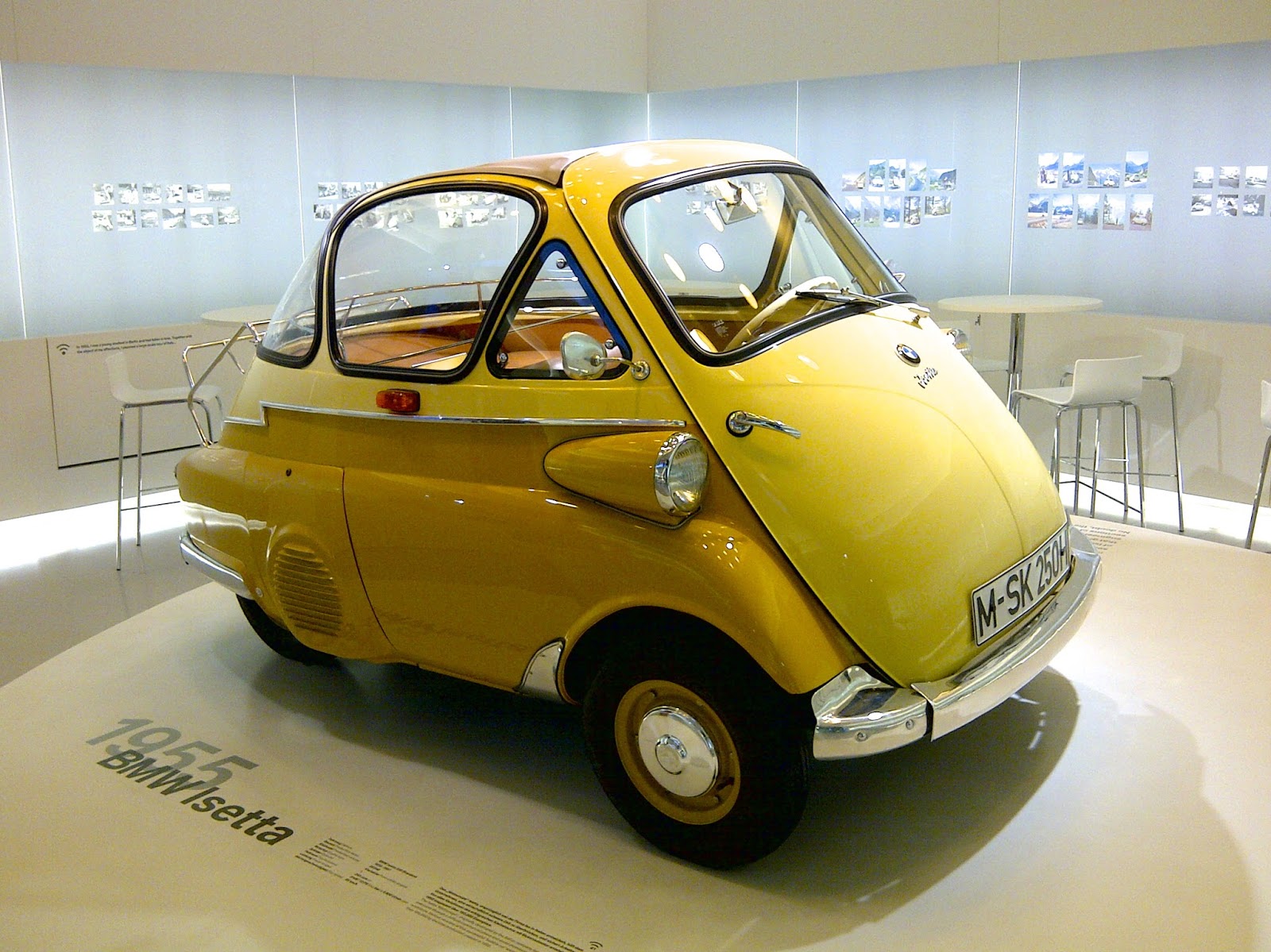
The BMW Isetta, also known as the "bubble car" was produced from 1955 to 1962. It is the world's top selling 1-cylinder car, with almost 162,000 units sold. The car was designed by a company in Italy that manufactured refrigerators, scooters and three wheeled trucks and licensed them for production in several countries, but BMW was the company that really made the car stick in Europe. There are photos all around the car in the Museum of families (or should I say couples?) with their Isettas.

The car is a two seater, just like my 350Z, but it is totally unlike my car in every other way. The two seats are actually a combined bench seat with a shelf behind for storage (so no trunk space at all really). There is one door to the car which is the entire front panel of the car. There is a handle on the passenger side of the front panel of the car used to open the door, which includes the steering wheel and instrument panel. We were fortunate enough to be hanging around the model in the Museum when a guided tour passed by (guides are apparently allowed to open the cars on display) and we managed to shoot the picture below.


This car is pure 1950s to me, which is probably why I love it so much. It looks like what someone in that decade may have thought of as a futuristic car, just like the Jetsons' vehicles and some of the furniture designed in that period. The shape of the car is about as un-aerodynamic as you can get and it looks like you practically have to wind it up to get it to go. I love the externally mounted headlights and especially the chromed accents, from the wire exterior luggage rack to the lightning bolt accent on the side of the car.

I love how life brings the most unexpected surprises sometimes. I realize the discovery of this quirky little car is not going to change my life, but somehow it makes me happier. In the four weeks since I returned home from Germany, I've checked ebay for Isettas and there are actually some on the market. If only I had an extra parking spot... Maybe it's time to move.


Tuesday, July 30, 2013

The Original Mozartkugeln


For the last 20 or 30 years (here my memory is not reliable at all so I'm approximating), I have received from my mother on Christmas morning a box of Mozartkugeln. I don't know why she first bought me these chocolates but I'm guessing it is because they contained marzipan, which I loved as a kid growing up in England but which we struggled to find after we moved to the United States.

For the uninitiated, a Mozartkugeln (literally "Mozart ball") is a chocolate containing pistachio marzipan covered in a layer of nougat coated with dark chocolate and they are absolutely delicious. I love getting these chocolates for Christmas and they don't last long. I'd say mid-January at the latest and they are all gone. Just so I am clear on this, German nougat is traditionally a chocolate and hazelnut praline which is different than the term sometimes used to describe other candy in the United States; this ain't the same stuff in Snickers.


The Mozartkugeln my mother buys me are made by the Reber company located in Bad Reichenall in southeast Bavaria. But the origin of the Mozartkugeln is in the chocolates' namesake Wolfgang Amadeus Mozart's home town of Salzburg, Austria. The chocolates were introduced to the world in 1890 by Paul Fürst, a Salzburg chocolatier. The original Mozartkugeln were a sensation if for no other reason than they were spherical, which Fürst achieved by placing the marzipan and nougat ball on a stick, dipping it in chocolate and setting it to dry vertically on the stick. When the chocolate had dried, the stick was removed and the hole filled with chocolate. The Mozartkugeln was then wrapped in Fürst's signature blue and silver foil for sale. I know the method of achieving spherical chocolates is not revolutionary, but we're talking 1890 here.

The contenders: the original Mozartkugeln in my right hand; the Reber version in my left.
Until this month, I had never had a Mozartkugeln other than the ones my mother buys me. But on July 4 of this year, I visited Cafe Fürst in Salzburg to sample an original Mozartkugeln or two. I came to Europe equipped with a few Reber Mozartkugeln, afraid that I would be unable to find these in Salzburg, so I could compare. My fears in this regard were completely unfounded. In addition to being able to purchase them in a ton of stores, Reber actually has at least two stores of their own in Salzburg's altstadt. The taste test was on!

I started with the incumbent and very familiar Reber that I had brought with me (purchased at Cafe Mozart in D.C. in case you live near Washington and want to go get some of your own).  The original Mozartkugeln, as I mentioned before, contains pistachio marzipan wrapped in nougat. The Reber version is a departure from the original. It actually has three layers below the chocolate coating: a center of nougat, the marzipan which makes up way more than 50% of the candy's volume, and a final layer of nougat outside the marzipan. It's sort of a Mozartkugeln in reverse.

Because of the proportion of the ingredients, the Reber Mozarkugeln tastes almost entirely of the pistachio marzipan, with only a faint hint of chocolate flavor. For the marzipan lover, it's always a delicious bite and satisfies very well the craving for this ingredient that I brought with me as a kid to the United States.


The Reber Mozartkugeln.
After I devoured the Reber candy in two quick bites, the Fürst Mozartkugeln was next, freshly purchased from the Cafe Fürst on the Alter Markt for one Euro. Biting into the Fürst version is quite different than the Reber candy. It is a true Mozartkugeln, containing the traditional pistachio marzipan center wrapped in a hazelnut and chocolate nougat.

The taste is sweeter and way more chocolate forward, a conclusion easily drawn from comparing the amount of chocolate in the picture below to the chocolate above. The taste of hazelnut is also prominent and who doesn't love hazelnut and chocolate? Overall the flavor is more complex. You can taste the chocolate first and foremost, followed by the hazelnut and then finally the pistachio marzipan. It's way more layered than the Reber version, rather than being all about the marzipan. It also has the nostalgic charm of being the original, rather than an imitation. Authenticity appeals to me.


Cafe Fürst's original Mozarkugeln.
I intended to visit Salzburg to find the true Mozartkugeln and declare a winner in my taste test. To this end, I enlisted my friends Mike and Bryan, giving them each one Mozartkugeln from each contender. I believe I did find the true Mozartkugeln but I can't declare a winner. I am a complete sucker for original things and usually disdain copies. But while the Fürst is undoubtedly richer and more complex, it was a little sweet for me and doesn't hit you over the head with marzipan flavor, which for me is what eating these chocolates is all about. I liked both, but if I could only have one for the rest of my life, I'd opt for the Reber. I just love them too much.

The original Mozartkugeln was well liked by our taste test panel. Mike and Bryan actually both preferred the Fürst Mozartkugeln. That doesn't make it a 2-1 victory. It's my blog after all.

Monday, July 29, 2013

Rock Me Amadeus

Salzburg Cathedral seen through one of the cannon ports in Fortress Hohensalzburg.
It's been three weeks now since I've returned from Bavaria. My blogging has been derailed by a trip to Vegas and a visit with my niece but I think it's about time I got back to my what-I-did-on-my-summer vacation posts before the impressions of that trip become too dulled by the liters of German beer I consumed while over there.

After four nights in Munich, my Bavarian itinerary took me to Salzburg, Austria for a couple of days before returning back to Germany for three more nights. The side trip to Salzburg was primarily to get us closer to the Berchtesgaden National Park but I thought crossing the border would allow us to take in the culture of a different city, learn a little bit about the city's most famous son, Wolfgang Amadeus Mozart, and find some apple strudel.

The trip from Munich to Salzburg by train takes about two hours, about the same time as it took to get to Hohenschwangau two days earlier. And just like the trip to Hohenschwangau, the ride to Austria takes you from the flat country around Munich into the beginnings of the Alps, although the terrain becomes hillier way sooner. You start to see mountains in the distance about a half an hour into the journey and the climb is pretty obvious.

As a city, Salzburg is a lot smaller than where we had been the previous few days, with a population of about 200,000 compared to over 1.3 million in Munich in an area about one fifth the size. Both cities have an old city or altstadt. Munich's is walkable in about 30-45 minutes; Salzburg's takes about 15. The city is established along the river Salzach and is situated around a large hill which is topped by a forbidding looking castle. The altstadt, complete with the church after church after church which are ubiquitous in Bavaria, sits at the bottom of the hill. The entirety of Salzburg's altstadt is designated a UNESCO World Heritage Site for its collection of baroque buildings. Perhaps embarrassingly, we compared walking down the streets of the altstadt to walking in the Venetian Hotel in Las Vegas. What can I say...we are sometimes very American.


Settlement in the Salzburg area stretches back to before the time of Christ but the place became the beginnings of today's city in the late seventh century under the Archbishopric of Salzburg. From that time until the city's surrender to Napoleon in 1803, the city was church run, with the succession of Archbishops of Salzburg as the city's top official. There were times that the city was part of the Holy Roman Empire during this period, but whoever the Archbishop was at the time remained essentially the ruler of the city. This was very much a revelation for me. I had run out of time to research the history and importance of the city prior to starting this trip. As it turned out, the two major buildings we visited were both built by the Archbishopric and served as very different illustrations of that office's power.

The most prominent building in Salzburg is Fortress Hohensalzburg (literally high salt fortress - Salzburg was named for salt, the source of its wealth), first erected atop the city's highest hill in the year 1077 and added to over the subsequent centuries. Construction of the fortress was started by Archbishop Gebhard von Helfenstein as protection from the Holy Roman Emperor in the event that there was some dispute between the Emperor and the seated Pope because the Archbishop would inevitably take the side of the Pope. Apparently in those days, disputes could easily devolve into armed conflicts. Actually it's probably not much different today. 

After a couple of days climbing large hills / small mountains in Hohenschwangau and Andechs, the climb to the base of Fortress Hohensalzburg looked daunting. Fortunately, we elected to spend a couple of extra Euros on the funicular ride which got us to the top in about two minutes. Once you are at the base of the fortress, the entire city of Salzburg becomes visible and you can really understand how packed the altstadt is.


The Fortress itself is huge. It's like a small city built to hold the entire population of Salzburg in condensed form. It is without doubt a real castle built to withstand sieges, unlike the two castles I visited in Hohenschwangau two days earlier. The Fortress was equipped with its own water and salt stores for curing food, meaning the city had the ability to withstand assault for some time. The Fortress, as it turns out, was never taken by force and that's very easy to understand having visited. Not that I'd want to try to take over any castle, but looking up at Fortress Hohensalzburg, the thought of conquering it seems extremely daunting. The only time it was ever turned over was when the region surrendered to Napoleon during his conquest of Europe.

Interior of Fortress Hohensalzburg.
From the tower of Fortress Hohensalzburg looking about 8 km to the south, one can make out Hellbrun Palace at the base of a small hill. This was our next destination. Just like the Fortress, Hellbrun Palace was also built by the Archbishopric of Salzburg. But instead of being built for protection of the entire city, Hellbrun Palace was built basically as a day trip getaway for the Archbishop to party with neighboring noblemen. I'm not kidding.

The Palace was built from 1613-1619 by Archbishop Markus Sittikus von Hohenems. Apparently the Archbishopric was flush with cash in the early 1600s because the whole place was built entirely for his own amusement. The property features a small palace (OK, small for a palace) with room after room for entertaining and then vast gardens with the main attraction being a series of fountains to entertain, soak and sometimes just make fun of guests visiting for the day.


The highlight here truly is the fountains and I can imagine at the time these were first built that they were amazing to behold. There are static fountains featuring many many ibexes (the Archbishop's personal symbol); man made grottoes with fountains made to amuse visitors; various scenes featuring mechanical figures which move based on the movement of water nearby; and hidden fountains designed purely to douse the guests.

Some of these fountains, all seen via a timed tour, are actually really remarkable considering they were built 400 years ago. The most impressive for me was the fountain that elevates and lowers a shining crown on a column of water. The rise and fall of the crown symbolizes the rise and fall of royal power, which to me just illustrates how much power the church enjoyed 400 years ago in Salzburg. They clearly thought they would outlast royal rule. I guess nobody rules forever.

The Roman Fountain. If you go and the guide asks for volunteers to sit at the table, do it. But sit at the head. Trust me.
The juxtaposition of these two attractions on this day was not intentional but provided a good overview of the history of the city before exploring some lesser attractions. The remainder of our time in Salzburg was spent roaming the altstadt; eating and drinking; and visiting the two Mozart themed attractions, his birthplace and his family's residence. If you decide to go to these last two, take my advice and just visit his birthplace. The building is original to Mozart (rather than a reconstruction like the residence) and tells the story far more authentically and thoroughly than the residence. If your aim is to know how to identify portraits of Mozart, go to the residence. It covers that subject in great detail throughout its six rooms. For me it offered little else.