Friday, January 14, 2022

Chaco Canyon

Our December trip to New Mexico was not my first trip to the Land of Enchantment. We visited the southern part of that state in early 2017 and I took a solo trip there way back in 2001. The variety and complexity of the landscape and history and culture of that state is just incredible. It's amazing it's not full of tourist but it seemed from everyone I talked to about this trip that New Mexico is off the radar of most people. It's like there's Texas then Arizona and then California. I don't understand it. But I'm also happy for it to be tourist-free.

My 2001 trip to New Mexico has to have included one of the all-time schedule blunders in my vacation planning history. I don't have many, but sometimes when I blow a schedule, I blow it spectacularly. On that trip, I drove down from Denver to spend three or four nights in Santa Fe before heading back to the mile high city and beyond into Wyoming. I planned to spend one of my days in New Mexico driving to Mesa Verde in southwest Colorado with maybe a stop at either Aztec Ruins National Monument or Chaco Culture National Historical Park on the way back. 

The whole idea of that day trip itinerary is preposterous. Santa Fe is not anywhere close to Mesa Verde. How I didn't realize that those two spots are 4-1/2 hours apart by car is beyond me. There was absolutely no way I could possible have driven to Mesa Verde and back and stopped at any other spot, even without construction on the way there that restricted the road I was driving on to a single lane stuck behind a slow-moving truck. If I'm remembering right, this was one of those leave at 6 a.m. and get back at about midnight days that I occasionally used to spend on my trips around the United States. 

I've rued that day ever since. Not so much for Aztec Ruins, but for sure for Chaco Culture. When we decided on New Mexico as our December 2021 getaway, Chaco Culture was at the top of my list. 20+ years is a long time to be rueing. I wanted to stop the rue-age.
Looking east towards Pueblo Bonito from Pueblo del Arroyo.

I would imagine that most people have never heard of Chaco Culture National Historical Park. Part of that may be that it's in New Mexico and therefore out of most people's ideas of what a vacation in the United States might look like. Part of it might be that it tells the story of an indigenous peoples' settlement prior to the arrival of Europeans in the New World. And part of it might be that it's just absolutely in the middle of nowhere. In fact, that last part is probably the biggest deterrent. 

I thought I had been to some National Park Service properties that were in the middle of nowhere before visiting Chaco Culture but the reality of the situation is I had not. I thought we had gotten ourselves pretty remote from civilization just a day before we visited Chaco Culture by checking out the Gran Quivira portion of the Salinas Pueblo Missions National Monument and in June of 2020 when we made the trip to Hovenweep National Monument in southeast Utah. I was wrong.

Driving to Chaco Culture from Albuquerque seems like a reasonable enough proposition. It's only 155 miles and Google Maps says you can get there in just a bit less than 2 hours and 45 minutes. Take I-25 north for a bit before exiting at Bernalillo and then spending a lot of time on Route 550 before hanging a left on New Mexico Road 7900. Take a right off 7900 onto 7950 and eventually the road will disappear. 

I don't really mean that the road disappears. More like the paving disappears. Now, lest you think I'm some citified idiot who's never driven on a dirt road before, I've spent my fair share of driving on unpaved roads in my time, let me tell you. I used to take dirt roads to work in upstate New York in winter specifically because they weren't as icy as the paved roads. I know dirt roads. 


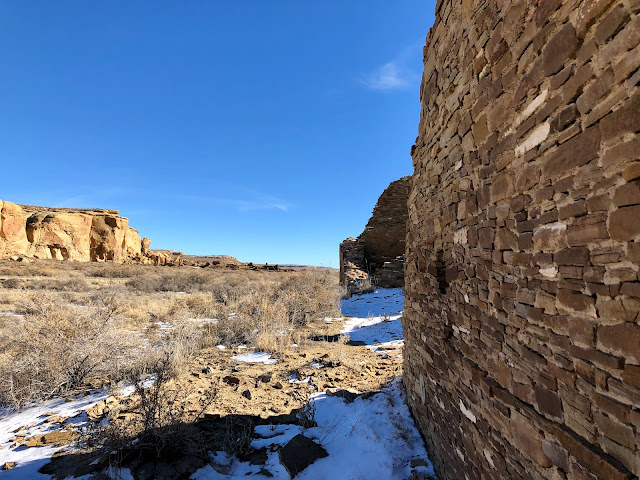
The back wall of Chetro Ketl and a doorway with remains of floor beams above in Pueblo Bonito. 

But I've never driven on anything like the roads to Chaco Culture. When the paving ends there's a 12 to 13 mile section of dirt road that I'd categorize as your standard dirt road that you can comfortably drive 30 miles per hour or so with maybe some spots where you need to slow down a bit or find the best surface by driving on the wrong side of the road every now and then. Hey...it's not like there's anyone coming the other way. We might have passed one car coming the other way coming and going from Chaco Culture.

That's not the tough stretch. After those 12 to 13 miles there's a final stretch of non-paved road that's about three or four miles long and it's a 15 miles per hour maximum road with most parts at 10 miles per hour. The road is so rough that if you go too fast, it feels like the entire car is going to be shaken apart. Four miles at 10 miles per hour takes a long time. Keep in mind, this is after you've dropped cell service a while ago and you haven't seen another car either going your way or the other way likely for a good bit of time too. Anything happens to your car out there and you are not in a good spot. This place is super remote. I'm sure it deters visitors. A lot.

Then you reach the Park gate and everything's paved. It's crazy. Chaco Culture gets between thirty-some and fifty-some thousand visitors per year (although in 2020 when they closed the Park for a bit, they drew just 8,321 visitors). As a comparison, Great Smoky Mountain National Park hasn't drawn less than 10 million visitors in a year since 2014.

Chaco Canyon, from Casa Rinconada Community looking west to Pueblo Bonito and Pueblo del Arroyo.

OK, so it's remote. I think I've established that. What's the payoff? Why go? Just so you can say you have been somewhere remote? 

Not remotely.

Before Europeans "found" the New World, before the native American pueblos that still exist in New Mexico today were established, there was a thriving civilization centered around what today is the "four corners" of New Mexico, Colorado, Utah and Arizona. The ruins that can still be found at Mesa Verde National Park and Hovenweep National Monument were part of that civilization that existed at that time. We are talking serious large sites that were agricultural in nature and had time for things like religion and the arts. Sophisticated peoples. We are also talking like 1,000 to 1,300 years ago. Not recent history.

Of all the sites of this period, the largest by far is at Chaco Canyon. I knew that before I got here. I knew this was a fairly large canyon that had multiple, multi-family dwellings (for lack of a better term pre-visit) constructed within it. Given that size and scale, it seemed it was probably worth the drive into the middle of nowhere and over roads that shook most bolts and rivets on our rental car loose just a little bit.

I had no idea.

Window opening at Pueblo Bonito (top). Stonework at Casa Rinconada Community (bottom).

A visit to Chaco Culture National Historical Park starts at the Visitor Center. I've been to many, many National Park Service properties and have stopped at or skipped (as I believe is appropriate) the visitor center. At Chaco Culture, it's mandatory because they want to know who is there so nobody gets left behind at the end of the day. I'm not kidding. They do a sweep of the road to make sure all cars are gone by closing time. Don't want anyone stuck in the desert overnight.

After our paid admission (free thanks to our National Park Annual Pass), we were told our visit to Chaco Canyon would likely be a minimum of four hours, one hour each at the main stops of Pueblo Bonito, Chetro Ketl, Pueblo del Arroyo and Casa Rinconada Community. They are joking, right? There's no way we are spending four hours in the middle of the desert within days of the shortest day of the year looking at ancient ruins. I mean, they can't be that big, I'm sure.

I was wrong. I had no idea how big these things are. Multi-family dwellings I was thinking. Umm...no. Not exactly. How about large scale condominiums. 


Pueblo Bonito.
Chaco Canyon was not the only spot in New Mexico we visited with hundreds of years old pueblo ruins in our week in December out west. We stopped at Pecos National Historical Park and the three-site Salinas Pueblo Missions National Monument in the couple of days before we made our way out into the desert via those dirt roads. Both Pecos and Salinas Pueblo boasted that their pueblos in their glory days would extend three or four stories high and then left the rest to your imagination based on the foundation ruins barely poking out of the soil. It was honestly difficult to imagine such a thing and the line drawings depicting what life might have been like in the 1600s didn't really help much.

At Chaco Canyon, we didn't have to imagine because those multi-story structures described at the other sites were right there in front of us in real life. Still standing. After more than 1,000 years. It's one thing to read about it on a sign. It's another thing entirely to walk around, above and through it. There's no imagining needed at Chaco Canyon. It's all right there. The impression is honestly staggering. These ruins are huge and incredibly intact. I mentioned earlier visiting Mesa Verde and Hovenweep as contemporary sites to Chaco Canyon. They are nowhere near as massive as this place. As gorgeous as Mesa Verde is with all those ancient dwellings under the cliff edges, Chaco Culture blows it away.

It's the scale more than anything else. I mentioned large scale condominiums tongue-in-cheek as modern comparisons a few paragraphs ago. I wasn't kidding. I see a large dwelling complex with four of five story housing blocks on the outside and two massive interior courtyards with community-use kivas (large underground circular religious spaces) and I think of the condo building I used to live in with 21 stories of residential units and a gym and pool on the roof and shared green space on the ground floor. It's not a far-fetched comparison.


View of the plazas (top) and the great kiva (bottom) at Pueblo Bonito.
We spent the most time at Pueblo Bonito, the largest and most intact of the many communal dwelling structures on the site. And the guidance we received at the Visitor Center was probably right - we did spend about an hour at this property. The four stops we were advised to visit during our orientation talk (and we did visit all four), by the way, are not the only four ruins on the site. They are just the four most easily accessible by car. If you wanted to do a bit of hiking (between about a mile and three miles each way), there are other ruins in the canyon. The overall impression is large scale building after large scale building stretching out for miles. The scale is stunning. The atmosphere in the Canyon in its heyday, with people moving between all the stops in the community must have been impressive, particularly because the Canyon itself would have been far, far greener.

Pueblo Bonito likely dates back to the middle of the 800s at a time when Europe (I know, I shouldn't be bringing up Europe here) was mired in the dark ages. It is D-shaped in plan with thin layer of residential rooms around the exterior perimeter and the public rooms (mostly kivas - about 30!!) and large open spaces inside the complex. It is mostly, but not completely, excavated with a lot of the stone walls still intact, along with some of the wooden floor and roof structural members as well as a lot of the window and door openings. Amazing to think that wood has survived intact for over a millennium, most likely a product of being left out in a place with about zero moisture most months of the year.

One of the best parts about visiting Pueblo Bonito is that you can walk through the rooms. As delicate and fragile as the old walls are, there are no roped off sections of the ruin. Have at it. Go wherever you like. Just be careful of where you step for your own protection and that of the ages old masonry. It is actually such a privilege to be trusted to walk through a place like this. We walked through openings as low as four feet and it is difficult to walk through openings that small without touching the walls themselves.

Walking through is essential. You get a feeling of how someone living here might have moved through the structure. You also get a sense of how compact the floor to floor height was back in the day by measuring the top of your head against the still intact floor beams that still show up in a lot of spots. There would not have been a lot of space for someone close to six feet in height. For sure there would have been a lot of stooping or head-knocking (or both) for me, but I'm also supposing there were not many people my height living there.

Ruined wall at Pueblo Bonito showing the core and veneer in the wall construction.
You can also get a great understanding of how the place was built by walking through Pueblo Bonito. Now admittedly, most of this understanding comes from looking at half collapsed walls. The exterior of the walls were built with a regular veneer consisting of bands of large and small stones facing an irregular core that was built strictly for structural purposes. But there are also parts of Pueblo Bonito where the original floor construction was discovered intact (and likely buried in sand) that can been seen inside heavily rain-protected structures on site. It's informative, but not very visible.

For a better look at how the structure of the floors were built, I'd recommend exploring Pueblo del Arroyo, the next stop along the one way driving loop after the Visitor Center. There are two spots at that site that show this off really well and both are shown below. The traditional way of laying flooring in Chaco Canyon involved three layers: a series of heavy beams seen in most structures that we walked through, topped by a series of lighter spanning members before the flooring itself was laid on top. Incredibly there's one spot you can look down on all three layers of structure at Pueblo del Arroyo. 

A little later in the tour route, there's another spot with a series of broken heavy beams set about two feet above a layer of sand, obviously filling in a room because there's a sliver of door opening in the rear of that chamber. It's amazing how slowly things break down in the desert. These splintered wood members have probably been there in that spot for 1,000 years. 


It is likely impossible to cover all of Chaco Culture National Historical Park in a day. Not properly. And then not even on the longest day of the year. We visited close to the shortest day of the year and our relatively late arrival time combined with thoughts of getting out of the Park at a reasonable time and having to drive on that car-shaking road again had us leaving after a couple of hours. I feel we did Pueblo Bonito and Pueblo del Arroyo really thoroughly. We also walked from Pueblo Bonito east to Chetro Ketl on the petroglyph route and spent some time checking out the largest excavated kiva on the site at Casa Rinconada.

Casa Rinconada is a useful stop because it is not like the larger group houses like Pueblo Bonito. If Pueblo Bonito struck me as a sort of an ancient condominium, Casa Rinconada resembled a suburban neighborhood, with individual dwellings dotting the canyon adjacent a super-sized community kiva. Maybe I'm all wrong with my characterization of the site based on 20th / 21st century comparisons of how we live now, but that's how the place struck me.

I do think that we saw enough to get a really good impression of what the Canyon might have looked like back in the day and I don't know quite what exploring more would have got us. The incredible part about this whole site is that the seven or eight different parts of the Canyon that are open for visitation are that way because they have been excavated. There are likely many more ruins still out there. We can't possibly have the full picture of how significant this settlement was at one time.

I know I wrote this same thought in my Hovenweep post about 18 months or so ago but whenever I visit sites like this, particularly from a culture with no written historical record, I am struck by what the builders of this place might think about me wondering around what they erected with their hands all that time ago. I'm an architect and I've designed buildings that are maybe going to be around for a century or more and that might be on the very long end of their lifespans. The people that built in Chaco Canyon put stones together to make walls and wooden logs to make floors that have stood for maybe 1,200 years or more. And with no maintenance or real preservation (except being buried in sand). That is an extraordinary achievement. I'd love to know that something I created had that level of permanence.


The great kiva at Casa Rinconada (top) and a wall at Pueblo del Arroyo (bottom).

While the buildings they made might have lasted, human habitation in Chaco Canyon did not. In around the 1200s, drought hit the area and it was prolonged enough that it forced those who had created this grand community to leave. It's not difficult to imagine a prolonged drought in Chaco Canyon today. It's literally a desert. I don't know for sure, but when I use the term prolonged it might actually mean from the 1200s until today.

If I'm remembering correctly, when I did a little research about this place in 2001, the conventional wisdom about the people who built Pueblo Bonito and the other great houses was that they were a people called the Anasazi, who had one day just picked up and left what is now the "four corners" area and had mysteriously disappeared, although the Anasazi name was beginning to be removed from descriptions about sites in the area back in 2001. Now, the narrative is that the people who built Chaco Canyon moved south or south and east and became the Zuni, the Hopi and the peoples who built the series of pueblos along the Rio Grande. That explanation makes way more sense than a whole civilization just vanishing mysteriously. I can't imagine how that theory came together.

Our visit to Chaco Culture filled in a huge gap in my personal historical record. It shattered my impression of native American settlements being small communities like I'd seen at Hovenweep and Mesa Verde (I know there's a lot more at Mesa Verde than at Hovenweep but it's nowhere close to the scale of Chaco Canyon). It also put form to what we'd read on signs on this trip and past trips. No longer do I have to imagine what the scale of one of these communities might look like. I've walked through it.

I'm blessed with a reasonably good memory and despite all the years I've been traveling this century, I never forgot that I needed to make it to Chaco Culture someday. It was way different and way better than I ever thought it would be. This is an astonishing place, even with that drive in over the last three or four miles. I'm also glad we went in winter and that, despite the near freezing temperatures, it was a gorgeous day. It's not difficult to get gorgeous blue skies in a place as dry as New Mexico but I think the pictures we took this day turned out great, right down to the snow on the ground.

Last look at Pueblo Bonito in the distance (from Chetro Ketl).


How We Did It

Chaco Culture National Historical Monument is open pretty much daily. When we visited the Visitor Center was open from 9 a.m. to 5 p.m. and the loop road that accesses the ruins was open from 7 a.m. to 5 p.m. with the last admission to the road by 4:30 p.m. All cars are cleared out at 5 p.m. so I'm not sure why you would enter the loop road that late. You can't possibly just be "in the area". I'm not sure if hours vary by season. Check the Park's website for that information. 

It's worth noting that there is no restaurant in the Park. Bring food if you will be getting hungry for a snack or a meal. It's a long way back out to get some. There's also no fuel in the Park. Make sure you have enough juice to get there and back. There's no gas stations once you get off Route 550.

It's also the desert. Bring water. 


Saturday, January 8, 2022

Spanish Ruins


I like to think of myself as fairly well-traveled and worldly. It's arrogant, I know, but there are some good reasons I think of myself this way: I've set foot on six of the seven (or eight, depending on who you believe or choose to believe) continents on our planet; I was born in one continent and live in another; and I've made a point of learning about the history and culture of the places I've traveled when I set foot away from home. I don't just go to the tourist-y parts of wherever I'm headed. I seek out the "real" experiences. This all makes me feel somewhat superior. It's obnoxious and egomaniacal but sometimes I feel this way.

Then every so often, something happens that yanks me back to reality and reminds me that I'm not that special after all and that I carry just as many biases that distort my worldview as most every other person on the planet. That "something" happened again last month when we were in New Mexico.

So, I'll admit it: my view of the history of the settlement of the United States is sometimes lazy. I don't mean the fact that there were people here before European people arrived here for good in the late 1400s. I get that there have been indigenous people in North and South America for thousands of years and that they were as diverse as the landscape of the New World (there I go again convincing myself I'm worldly...).

No. My lazy and very east coast view of the settlement of our country (and I can't believe I'm going to write this) is that Europeans landed on the eastern shore of what would later become the United States and settled generally westward. Yes, I know that there were missionaries and Californios out on the west coast before the USA claimed all the territory between the Atlantic and Pacific Oceans south of Canada and north of Mexico. But it's not like it's pre-Revolutionary War type history or anything like that, right? Right?

By the way, that part about the "real" experiences on my travels. I'm sure I'm kidding myself about that too.

The remains of the Spanish mission church at Quarai. Construction started in 1627.
St. Augustine, Florida was founded in 1565. It is the oldest, continuously-inhabited, European-established settlement in the United States. The Roanoke Colony, the first permanent English settlement in the new world, was founded in 1585 in what is now North Carolina. And how about those pilgrims at Plymouth Rock. They famously landed on these shores in Massachusetts in 1620. And from there, everything spread west, right? 13 colonies, Declaration of Independence, Revolutionary War, Louisiana Purchase, Mexican-American War, Manifest Destiny, Alaska, Hawaii. Isn't that the history of the settlement of our country, in pretty much that order?

It is not. Spanish conquistadors explored what is now New Mexico in 1541. 1541!!!! The first Spanish settlement in our 47th state was founded in 1598. Santa Fe was established in 1610. Europeans have been in New Mexico almost 500 years. Before St. Augustine. Before the Roanoke Colony. Before Plymouth Rock. They came. They built. They brought disease, destruction, death and enslavement. And they left ruins. We thought it might be worthwhile traveling into the New Mexico desert to find some of them.

The second church at Gran Quivira. Construction started in 1659.

Maybe a few words about the Spanish colonization of the New World are in order.

The Spanish were not complicated explorers when it came to the settlement of the Western Hemisphere. Their objectives were fairly simple: (1) convert any indigenous people they encountered to Catholicism and (2) find treasure. Lots of treasure. And if it appeared that there was no treasure or the locals weren't giving up its location, they weren't above some pretty harsh measures. Nor, in some cases, were the priests who were bringing religion to the natives when Jesus didn't take. Not that the natives weren't religious (they were) but they weren't the RIGHT religion in the view of the Spanish Crown.

To spread religion (and kill and rob those possessing the treasure), the Spanish sent two kinds of people into the future New Mexico wilderness: priests and soldiers. Sending soldiers into foreign lands was a tried and true model for the Spanish. It worked with the Aztecs and it worked with the Incas. The Aztecs had tons of gold. The Incas had tons of gold. Their forays into New Mexico would just tweak that model a bit. But surely, all indigenous people in the New World had tons of gold. And they would get the added bonus of the Spanish bringing God with them. No, no, not the existing gods. The REAL God.

The remains of the mission church at Abó, completed in 1651.

What the Spanish found when they started exploring New Mexico was (for the most part) a settled, agricultural society (without gold). They found people living in towns (the Spanish called them pueblos) three, four and five stories high and farming, hunting and collectively pitching in to make the whole thing work. Pottery, cooking, artwork, clothes making, trading, whatever was required to make the entire operation run smoothly. So the Spanish did the only thing that made sense to them: they settled right next to the pueblos. After all, if you wanted to convert people to your religion, you needed to be near to the people you wanted to convert.

I'm not going to lionize the Spanish priests sent into the wilderness in the New World because, God knows (and yes, there's some irony there) they were often unnecessarily cruel in their dealings with native populations. But I will say (and this is with or without soldiers) that the prospect of being sent into a completely alien land where you might meet hostile people willing to kill you at a moment's notice would have terrified me.

And I have to say, the landscapes these priests and soldiers traveled through and over 400 years ago can't look that much different than where we drove last month. The New Mexico desert, stretching for as far as the eye can see dotted with piñon and juniper and yucca and terminating in mesas and mountains, is both extremely gorgeous and completely remote. The first time I drove through New Mexico in 2001 I thought it would be easy to understand what the landscape looked like before the arrival of man because all you would have to do is remove the one road I was traveling on. I felt the same way last month.

Our quest for Spanish ruins in the New Mexico desert (because that's exactly what it boiled down to) centered around two National Park Service properties: the three-site Salinas Pueblo Missions National Monument south of Albuquerque and Pecos National Historical Park south and east of Santa Fe. There is value in visiting both properties.

A rough ride down New Mexico 41.

There is also great value in actually getting there. The New Mexico desert is for sure (and I realize I just said this) a place to behold. The amount of nothingness set against sky is stunning. They call Montana the big sky country. I've been to Montana and I'll take New Mexico's sky over that of Montana any day. One of the most extraordinary hours we spent in New Mexico last month was a 50 minute or so drive southbound down New Mexico 41 in the direction of Salinas Pueblo Missions dodging and mostly hitting hundreds of tumbleweeds rolling across the road in the desert wind. And I'm not exaggerating with the hundreds. There were continuous tumbleweeds rolling across the road for the better part of an hour.

Salinas Pueblo Missions National Monument consists of three sites that the Spanish visited and settled in the 1600s. The three parts of the Park (Gran Quivira, Quarai and Abò) are centered around the town of Mountainair, NM. I guess it's the closest town that's about equidistant between the three sites and it's pretty much in the middle of nowhere. There's one stop light and a series of storefronts (not all open for business) on one side of the street that can't be more than a quarter of a mile long. Just west of Mountainair there are a series of salt lakes (las salinas - and hence the name of the National Monument) which at one time would have represented a source of some wealth, particularly interior to the nation. Easier to extract the salt from somewhere close than travel to the Pacific Ocean or the Gulf of Mexico.

A couple of notes about the Park. First, Gran Quivira is remote. Like really, really remote. There was nobody else there when we arrived and that remained the same throughout our visit. No rangers, no visitors, no cell phone service, no nothing, although the bathroom was thankfully open. It's been a while since I've been that far out into nothingness (although that experience would get surpassed like the very next day). However, as a place to learn about the Spanish and the native pueblos already there before the Spanish, I found it lacking. There clearly at one time was a significantly sized settlement here but today, it's mostly a series of low foundations and a ruined church made from stone that's as pale (but just a bit whiter) than the grass in the surrounding desert.

I felt similarly about Quarai. The church at that site is a lot more intact but the property sits in a hollow which tends to divorce the site from the desert a little. One of the ideas I wanted to explore was that the hand of man and the ruins long left behind could actually enhance the beauty of the desert by highlighting the natural beauty of the landscape against something non-natural. I didn't get that sense at either Gran Quivira or Quarai.


Abó, with the old church fragments in the foreground and the Mazano Mountains behind.
But if there's a bit of a letdown in the sites at Gran Quivira and Quarai, there is a great payoff at Abó. All three sites were abandoned in the 1660s or 1670s, likely due to drought and raids from the neighboring Apache people. When the natives (and the Spanish) fled Gran Quivira and Quarai, most of them came to Abó, only to leave that site about 10 years later.

The church at Abó, while not as intact as the one at Quarai, appears to be the largest of the churches at the three sites and the integration of Spanish and native religion is visible via a couple of kivas (underground chambers used for religious ceremonies in the pueblos) built right into the church footprint. While the site does not have much of the pueblo itself excavated, it does have a good walking trail that gets you a lot of different looks at the site and the gorgeous Manzano Mountains. This is the type of site I wanted to experience: a place with obvious history set against an amazing natural backdrop.

If there were a site at Salinas Pueblo Missions that I were to ever want to return to, it would be Abó.

The Spanish church at Pecos pueblo, circa 1625. That big sky...
But before there was Salinas Pueblo Missions, there was Pecos National Historical Park. Well, at lest that's how it worked for us anyway. Visiting Pecos was one of the best things we did on this trip

If I was hoping to find a site that had some intact Spanish ruins at a native American site where you could understand the magnitude of their construction efforts set against a just unbelievably gorgeous landscape of the New Mexican desert (and I clearly was by the way...), Pecos is it. The site is compact enough to walk comprehensively in less than two hours while also having enough to hold your interest all the way along. 

The site at Pecos is spectacular. The old pueblo was built in a spot called Glorieta Mesa which is high in the Sangre de Cristo Mountains and it overlooks pretty much about everything in the surrounding landscape. It's easy to see from a defensive standpoint why people would establish a settlement there. You can see anyone coming from miles away, I'm sure. It's also situated near a source of water (the nearby Glorieta Creek) and near a travel route through the mountains (Glorieta Pass) which made it a perfect place to facilitate trade of goods from people living to both the north and south. 

But beyond its strategic importance, the natural geography of the location is one of the prettiest places we visited in a week in New Mexico. The views both of the rolling high desert and vistas to the mountains and the mesas in the distance highlight two of my favorite features of the New Mexican landscape.

Ruins of the pueblo at Pecos National Historical Park.
I also found the ruined church at Pecos to be the most intact and picturesque of the four churches. It appears as a true adobe church, unlike the other three that are clearly built of stone. It is unclear to me whether the National Park Service re-coats the remains of the church periodically or if it's just sort of melted away in the infrequent New Mexico rains over however many decades the Park Service has been its custodian. Either way, it appears the way I want (here I go with my lazy views again...) an adobe church to appear. 

The church is also way more there and understandable than the ones at the three Salinas Pueblo Missions sites. By that I mean that you can walk into the ruins and understand what it might be like to move through the church before it became a ruin. There's enough there vertically (and way more than particularly at Gran Quivira and Abó) that you can understand what the church might have felt like the three to four hundred years ago that it stood intact.

The church at Pecos National Historical Monument, with a kiva in the foreground.
Ironically (and perhaps this was the most disappointing aspect of the visits), none of the four sites really conveyed the true scale of construction of the pueblos themselves. There were signs at more than one of the properties noting that the pueblos were constructed several stories high but the ruins at all four sites were barely visible above grade. Pecos was as deficient in this regard as the three sites at Salinas Pueblo Missions, but it also offered two advantages over the other sites. 

First, a section of the walking trail at Pecos takes you into an interior courtyard of the old pueblo with ruins of buildings visible on all sides. It was the first place on this trip we could start to understand just what it might be like to be inside an intact pueblo. I could start to imagine what a day might be like for the people who lived there all those hundreds of years ago. It wouldn't be the last time or the best site, but it would be the only time I really felt this way at a site where the Spanish had built adjacent the native structures. 


Second, Pecos has two reconstructed kivas (underground circular religious cermonial spaces), complete with ladders to allow you to enter. I'd visited a number of native American sites both on this trip and before this trip and had never had the opportunity to climb down into one of these ceremonial spaces. I know it's a reconstruction but they were surprisingly spacious and the light coming into the space from the small opening in the top was more than enough to light the whole place. I can imagine a religious ceremony in such a space would be an intimate experience. I appreciate the fact that Pecos had these kivas available and accessible, particularly on a day when there were so few people in the Park.

Pecos is a super quick drive from Santa Fe. It took us just a little more than a half an hour to get there. So way less remote than a place like Gran Quivira or the other two parts of Salinas Pueblo Missions. And it gave me exactly what I wanted from this part of our trip: some sense of how the pueblos built before the Spanish arrived while also getting a good and close look at what the missionaries built in New Mexico, all in one of the most spectacular natural settings we found all week. Plus it (along with the other three sites we visited) re-set my biased view of how this country of ours was settled. I won't forget that again. 

Until the next time I get lazy, that is.

Either way, I appreciated this part of the trip for its connection to the past and for getting us out into the nothingness of New Mexico.


How We Did It

Getting to both Pecos National Historical Park and Salinas Pueblo Missions National Monument is fairly straightforward. Plug either site into your navigation app of choice and follow the directions. Pecos is a bit more than a 30 minute drive from Santa Fe; Salinas Pueblo Missions is definitely at least an hour from Albuquerque. Note that Salinas Pueblo Missions is spread amongst four sites, the three historical sites plus the Visitor Center in Mountainair. Driving between the two sites farthest from each other (Gran Quivira and Abó) is probably a 45 minute drive by itself.

There's a small museum in the Visitor Center at Pecos detailing the history of the site, which involves way more than just the native peoples plus the Spanish. Glorieta Mesa saw action as part of the Santa Fe Trail and as a Civil War battlefield. The gift store at the Visitor Center is also awesome.

I don't know what's in the visitor centers at any of the Salinas Pueblo Missions visitor centers because all four were closed when we visited. There is a big difference in the operating hours of these sites' visitor centers between winter and summer. The main Visitor Center in Mountainair plus the ones at Abo and Quarai are open during winter but not on Tuesday or Wednesday, when we happened to visit.

Finally, and very important, admission to all five sites discussed in this post is free.


Wednesday, December 22, 2021

Luminarias


It's been a while since I traveled in December. It's honestly a tough time to get away. I mean with holiday parties (well, pre-COVID anyway...) and presents to buy and not to mention multiple holiday days off in late November and then again about month later. We took a couple of quick out of town December trips way back in 2013 (Iceland) and then again in 2014 (Key West / Everglades) but since then, absolutely nothing. Until this year, that is, when we got away for a week to New Mexico. And I do love me some New Mexico.

Despite the seven years of no travel at this time of year, getting away in December is actually one of my favorite times of the year to explore somewhere new. And it's that way for one reason and one reason alone: to see how Christmas is celebrated in other parts of the country or the world. In Iceland, we discovered that country's love / hate relationship with the Yule Lads. This year, we found some awesome holiday traditions in New Mexico.

Now, full disclosure (and limiting my complaining about COVID to one small paragraph) here, we were supposed to be in Vienna, Austria this month browsing the many, many Christmas markets in that city while drinking gluhwein and eating whatever good stuff they serve at the markets over there. But COVID shut down the entire country (OK, so actually the Austrian government did that because of COVID) and cancelled that trip, leaving Vienna in December on a scrap heap with Costa Rica, the United Kingdom and gorilla watching in central Africa from 2020. Maybe next year for Vienna. And Costa Rica. And maybe the United Kingdom. We'll see...

Chile ristras at the Albuquerque Holiday Market.
Biscochitos at Golden Crown Panaderia, Albuquerque.

I have a few things to say about Christmas in New Mexico.

First, the Albuquerque Holiday Market at the Rail Yards is awesome. It's held one weekend per year and that happened to be the weekend we landed in ABQ. I am sure that the markets in Vienna would have been larger, more numerous and filled with way more stuff to buy and eat than the one at the Rail Yards but it doesn't really matter. We stuffed our faces with good food; browsed more Zia-adorned items than we really could have imagined; got a look at our first chile ristras of the trip (there would be many, many more) including some wreaths (so cool...); and walked away with some amazing buys, including an awesome red, metal-and-stone roadrunner sculpture that cost us three times as much to ship as it did to buy and it's going to be so worth it when it arrives in front of our house after Christmas. 

And when I say metal and stone, I really mean the stone is a large pebble that weighs about five pounds. It's so awesome. Trust me.

Second, they have these cookies called biscochitos that are legendary and actually live up to their legendary status. Biscochitos are shortbread-like cookies of Spanish colonial origin that are traditionally baked for celebrations like weddings and important other family gatherings. But particularly for family gatherings at Christmas. The classic biscochito is flavored with anise because anise was rare in colonial Spanish territories and thus saved for special occasions. I hate anise. I really don't understand why anyone would voluntarily eat or drink anything flavored with this stuff. Fortunately for me in 21st century New Mexico, bakeries make biscochitos in other flavors. We headed to local bakery Golden Crown Panaderia for an afternoon snack featuring all four varieties of their biscochitos (blue corn, cappuccino, chocolate and, yes, traditional). 

These things are so soft while also being crisp. It is difficult to describe how texturally amazing these cookies are but it's like they are made of packed sand and they just disintegrate into the most delicious, slightly sweet crumbles when you bite down and and press them between your tongue and the roof of your mouth. The flavoring at Golden Crown is so subtle that the texture and the hint of sugar dominates in the best sort of way. Even the anise almost melts away entirely to something actually pleasing. The cappuccino and chocolate were the best in my opinion.

Christmas lights in the Santa Fe Plaza...
and in some random (but definitely not atypical) Albuquerque neighborhood.

Third, New Mexico loves Christmas lights. But Albuquerque might just take that love to an entirely new level.

Now, I realize there are some people out there who are pretty fanatical about decorating their houses for Christmas. But we took a nighttime holiday lights tour with the ABQ Trolley Company that has me convinced that no city anywhere does Christmas decoration like the Duke City. I'm talking houses decked out with light displays of every variety imaginable. I'm talking large projected images onto the sides of houses. I'm talking entire neighborhoods seemingly in competition between houses to see who has bragging rights (there were lots of neighborhoods like this). I'm talking light displays synchronized to music. I'm talking houses with short wave radio broadcasts playing Christmas songs when you tune to their frequency of choice. I took a number of photos from the inside our of 90 minute or so trek around town and have included one above. But honestly, no photo could do this tour justice.

But that's not even the craziest part. Apparently it's an Albuquerque thing to cover your car in lights and then drive around town looking at other people's Christmas light displays. You read that right: DRIVE AROUND TOWN!!! I'm not kidding, we saw a car coated with Christmas lights just rolling around whatever Albuquerque neighborhood we happened to be in. I swear I have never seen anything like that. Maybe I'm sheltered.

One more (admittedly slightly blurry) picture from our trolley tour. Luminarias straight ahead.
But none of that was the best part about pre-Christmas in New Mexico. The best part was the luminarias.

Visit New Mexico between Thanksgiving and Christmas and you are bound to see what look like illuminated brown paper bags on the roofs and in the windows and lining the walkways and filling the gardens of all sorts of adobe and non-adobe stores and houses and hotels and any other sort of building that humans live or work in. And not just one per store or house or other sort of building. I mean like 10 or 20 or 50 or more regularly spaced bags in sequence providing a type of illumination that we'd never seen before we visited the Land of Enchantment in December. These are the luminarias.

The tradition of lighting up properties to symbolically welcome the baby Jesus into the world stretches back all the way to Spanish colonial times, some 300 plus years ago. The first luminarias in a time when paper bags were not readily available were made as small bonfires of piñon branches set alight. When paper became available, the tradition changed to paper bags with small candles inside and a couple of cups of sand to keep the bags from blowing away. Today, I think you are unlikely to find actual candles inside actual paper bags. Most of the luminarias we saw in our week or so in state were a string of pre-wired plastic rectangles in the shape and color of brown paper bags, although we did see some actual individual paper bags weighted with sand and holding an LED tealight. More effort to turn on than flipping a switch but the lack of wires connecting the bags together is a nice bonus. Both options seemed much safer than actual flames inside actual paper bags. 


Luminarias in Albuquerque's Old Town. Waiting for nightfall (top) and illuminated (bottom).
For as simple as these lights are, they are surprisingly effective and romantic. Or maybe it's actually because they are so simple. They harken back to a time that seems to be less complicated, when resources were scarcer and when buying paper bags and candles and putting them together was an extravagance. They pair especially well with the old adobe and wood buildings in Santa Fe's historic downtown and Albuquerque's Old Town. Or even in all sorts of Albuquerque residential neighborhoods alongside animated lights displays and giant inflatable structures. They just work. They are pretty much the most perfect Christmas reflection of the state's colonial and wild west roots. 

We don't spend a lot of time decorating our townhouse for Christmas. We have a nativity display I've collected over the last 20 or so years and we have a plug-in three foot high Christmas tree that we cover with souvenir ornaments from all our various travels throughout the United States and the world. But next year, I'd seriously consider getting some paper bags and dropping some sand and tealights in them and lighting up our windows or mantel or some other part of our home. And of course, they sell luminaria kits on Amazon.

Our Santa Fe hotel, lit up with luminarias, of course.


How We Did It

It's not difficult to find luminarias in New Mexico in December. At least not if you are in Santa Fe or Albuquerque.

If you are in Albuquerque near Christmas, I'd highly recommend the ABQ Trolley Company's Trolley of Lights Tour. It's about an hour and a half long in a very poorly heated old trolley but it's a complete blast. They take you to some just mind-blowing light displays (and I mean that in the best "what are these people thinking?" way) mostly north of downtown. They also keep you distracted and entertained en route with Christmas movie clips and trivia, including a half impossible name that tune exercise. I think I'm pretty good at name that Christmas song but Slade? Really?

I'd also highly recommend seeking out some biscochitos in your time in New Mexico at any time of the year. Our sample size was pretty much as small as it gets but Albuquerque's Golden Crown Panaderia will not steer you wrong in the biscochito department. They had some pretty good looking non-biscochito baked goods also. Next time, maybe.

Finally, the picture of the burrito on the top of this post has almost nothing really to do with Christmas. It's available year round at Tia Sophia's restaurant on San Francisco Street in Santa Fe. But it does look festive, right? That's because in New Mexico a lot of foods are available with a green or red chile smother. If you want it half and half like I did the chilly Monday morning we were in Santa Fe, just ask for Christmas. Your server will know what you mean.


Thursday, December 9, 2021

Azulejos


Our trip to Portugal this past October took us from Lisbon to the Alentejo to Coimbra to Porto. It took us to cafes and past farms and vineyards and into castles and museums and bakeries and past bridges and to lots and lots and lots and lots of monasteries and churches. It was a bit of a whirlwind tour that touched on some of the highlights of the country and barely scratched the surface in most places. It was an introduction.

If there was a single constant through our entire week in country, I would have to say it would be the ceramic tiles. Sound like a strange thing to highlight as a cohesive memory binding a week long vacation together in a gorgeous European country? Expecting castles or all those monasteries or sardines or hills or churches or art or Cristiano Ronaldo or salt cod or a Mediterranean climate or something else? It was none of those. It was ceramic tiles. It was the one thing we found everywhere we went in Portugal. And to be honest, there are some spectacular looking tiles over there. 

I know maybe what you are thinking: don't we have ceramic tiles in the United States? Well, yes we do. But not like they have in Portugal. If you have been there or if you go in the future, you will know what I'm talking about. It's pretty obvious. These things are everywhere. Just walk the streets. There are buildings everywhere that are tiled on the outside. Think you won't notice? You will. You can't escape it. It is literally inescapable. And if by some chance you don't pick up on it by walking down the street, it will hit you over the head in every church and convent and palace and monastery you visit. And you will visit a lot of these, especially those monasteries. There are a ton of them. I might have already mentioned that.


Azulejo covered buildings in Coimbra (top) and Lisbon (bottom).

Now in Portugal, of course, they don't call them tiles. They call them azulejos. And if you are wondering how to pronounce that word (we were...), it's a-zu-le-jos, not az-ul-e-jos (hopefully that non-dictionary guide makes sense; the "l" belongs to the "lejos" and not the "azul"). The word itself is derived from an Arabic word meaning "polished stone". And Arabic and Muslim lands is not just the origin of the word. It's the source of the tiles themselves.

Azulejos were introduced to the Iberian peninsula in the 13th century by the Moors, who conquered and held much of Portugal and parts of Spain beginning in the 10th century until they were driven out a few hundred years later. Coincidentally that was just about the time that azulejos started to become widely used on buildings in southern Spain. 

While tiles started to become a thing in Spain about the end of the Moorish occupation, it would take a little longer before the azulejos started being used in a common way in what is now Portugal, although the use of mosaics for sidewalks and public paved squares had already been popular for a couple of hundred years when they started decorating the walls of places with these things. Think 15th century and think simple geometric or naturalistic motifs in blue and white only. This is all the Moors had available to them so that's all they used to make these things back in the 1400s.

As Portugal embarked on their age of discovery in the 16th century, they started to import goods which would forever change their way of life. On the tile manufacturing front, trips back and forth to what is now Asia brought yellow dyes which added a third color to the two-tone azulejos that were already so popular. At the same time, the tile artisans started to supplement the regular and repeating patterning with narrative scenes or pictures, effectively creating large scale artworks through tiles.


Tiles (ca. 1680) from the Museu Nacional do Azulejos (top) and St. Michael's Chapel, Coimbra University (bottom).
Those new, large scale scenes seemed to become the next point of departure for azulejos artisans as we entered the 17th century. I can't tell you how many churches and monasteries and train stations we visited with detailed scenes upon scenes from history or the Bible constructed out of tiles 4" or smaller. These things must have been created off site somewhere as a giant sort of canvas and then put back together in situ. And they most always were just simple blue and white, taking a step back a couple of hundred years but in a totally different level of detail and precision.

If churches seem like an odd place to find these murals of azulejos, they shouldn't. For a while, the Catholic church was the main patron of azulejo artisans. Think about the number of paintings and sculptures in churches all around the world. There was a time that the only secure place to have a commissioned work of art was in a church or cathedral. Think Michelangelo in Rome. Think Goya in Madrid. Think azulejos in Portugal. And there is a whole of Catholicism in Portugal.

To get a great look at tiled buildings everywhere we went in Portugal, we walked the streets, we visited churches, we visited monasteries (have I mentioned there are a few of those in Portugal?), we visited castles, we visited palaces. But for a more in depth and formal learning experience, we stopped by the Museu Nacional do Azulejos in Lisbon. Yes, there is a whole museum dedicated to the history of tile work in Portugal.

The Museu is located in the old Madre de Deus convent on the east side of the city. The Museu features both original azulejo artwork in their original spaces and exhibits extracted from elsewhere in the country and moved and displayed in the halls of the convent. Arguably the star attraction in the museum is the main church space, which features blue and white tiled murals in the style that became popular in the 17th century, but there are other similarly impressive exhibits hanging elsewhere in the Museu accompanied by plentiful signage in Portuguese and English. 

Two of the more interesting exhibits in the Museu for me were a tile mold for making tiles with raised patterns and the scene (in tile form, of course) of Lisbon before the great earthquake of 1755 which ends the museum's visit sequence. We saw so few molded tiles in Portugal but we did find some on the walls of buildings in Porto and Sintra; these mini-sculptures are in some ways a lot more interesting than the flat painted tiles we found elsewhere. I also appreciated the scene of Lisbon pre-earthquake as an historical record. It was different and (to me) far more informative than the Biblical scenes we found all over the religious buildings we traipsed through during our time in Portugal.


Museu Nacional do Azulejos: the church, the great Lisbon panorama and the Chicken's Wedding.
I can't tell you how many pictures of tiles I ended up with on my phone after a week in Portugal but it was a lot. I wouldn't be surprised if they made up half of the total pictures that I took during the week. There were a lot because honestly I found these things super interesting. Maybe borderline obsessive. "Maybe" and "borderline" means not really, right?

I think for me, I was more fascinated by the earlier, simpler patterned blue, white and gold azulejos than the later blue and white large scale artworks. I know that part of this attraction was fueled by the Moorish connection. We worked hard to try to find any remnant of Moorish culture in the places we visited and were largely unable, probably because when the Christians drove out the Moors they destroyed most or all of what they had created. Maybe by the time the Moors were defeated the Portuguese didn't remember where the azulejos came from in the first place.

I also appreciated some of the earlier departures from the simple patterning into actual scenes of life real or imagined. There are some really impressive views into daily Portuguese life in some of these tiled works, along with some very fanciful scenes of ridiculousness like the Chicken's Wedding that we found in the Museu Nacional do Azulejos. Seriously, there's a chicken's wedding scene in multicolored tiles. Who thinks up this stuff in the middle (or maybe a little later) of the last millennium?

If you are thinking all that would likely mean that I was not a fan of the later and almost exclusively Biblical artworks created for the churches and monasteries, you would be correct. I just don't get the amount of effort that went into these things and I'm not a super fan of the subject matter either. They are so serious but some churches really got into these things, commissioning about as many works as would fill either the interior or exterior of their buildings. There's a church in Porto (the Chapel of Souls) that has gone full arm sleeve on us and covered pretty much every square inch of available exterior wall space with tiles.


The Chapel of Souls in Porto (top) and a molded or stamped tile in the Pena Palace in Sintra.
Azulejos are clearly a symbol of national pride for the Portuguese. There are so many old buildings with centuries-old tiles inside and outside that have endured over the centuries. But it also appears that there is an ongoing effort to resurrect this tradition in a more modern way, meaning not just copying the colors or motifs of centuries of several hundred years ago. I think we saw this beautifully in the main train station in Porto. 

Porto's train station features some older works of tiled art showing scenes from Portugal's history, including a massive battle scene on the west side (if I'm remembering correctly) of the main entrance hall. But next to these historical artworks are more modern tiles showing locomotives. They aren't necessarily using the colors or subject matter used in azulejos laid in the 15th through 17th centuries, (although honestly the top portion shown below is remarkably reminiscent of the 16th century azulejos) but they ARE tiles. And they do remind us of Portugal's history of this sort of wall treatment. I love it. Well done!

I know it's a strange thing to memorialize as a memory of Portugal but honestly, I'll always remember the azulejos.


How We Did It

As I hope comes across in this post, it is not difficult to find azulejos in Portugal. We found them to be plentiful in Lisbon and Sintra and Coimbra and Porto, although perhaps a little more difficult to find in Évora.

Other than wandering around the streets of these cities and discovering, I thought it was worthwhile visiting the Museu Nacional do Azulejo in Lisbon. The Museu is located at Rua da Madre de Deus, 4 and is easily reachable by public transportation. We took either the 759 or 794 bus directly there from the Plaça do Comércio. The total bus ride is about 15 minutes or so. The Museu is open daily except Mondays from 10 a.m. to 6 p.m. although they do close for lunch every day for an hour starting at 1 p.m.

There are definitely tiled buildings worth visiting in Sintra, Coimbra and Porto in addition to Lisbon. Some are pictured in this post although quite frankly there were many more pictures left on the cutting room floor. Other than the Museu, I don't have a strong feeling either way about the value in seeking out these other buildings. There are literally tiled buildings pretty much everywhere.