Saturday, July 1, 2017

Temples + Shrines


Halfway up Mount Fuji in Japan's Yamanashi Prefecture there lives a demon, or tengu. He is infrequently seen but is often depicted either as a monstrous bird or a long-nosed, red-faced goblin. His exact purpose is unknown (over time, the meaning of the tengu has shifted from harbingers of war to protective but still dangerous spirits) but most today view him as a protector of the many climbers who ascend to Mount Fuji's summit each year.

Your best chance of spotting this helpful goblin is where he lives, at the Komitake Shrine at Mount Fuji's Fifth Station on the north side of that mighty old volcano. Mount Fuji is divided into ten stations, from the first at the base of the mountain to the tenth at the very top. The four fifth stations (generally speaking one at each of the cardinal directions) are generally used as departure points for climbers when the trails are open in the summer months. It would therefore make sense that a demon to protect climbers would live at the starting point of the ascent, right?

As best I can tell, nobody much lives at the fifth stations other than the tengu. The Yamanashi Fifth Station on the north face is a collection of parking lots, horse stables, souvenir shops, food stalls and vending machines and the staff required to maintain this sort of infrastructure can't be more than 10 or 20 folks. Yet there's a Shinto shrine there, a timber framed building with a pitched roof and golden decorations on the ends of the timber beams used to frame it. I guess it's there for the residents and vendors and tourists and would-be Edmund Hillarys to visit. Welcome to Japan.

While I am no mountain climber (at least not this year), one thing I had to do on my first trip in Japan was set foot on Mount Fuji. And the fifth station on the north side, which is open year round provided the roads are passable, seemed like as good a place as any to satisfy that urge. And sure enough, I found myself at the Komitake Shrine while there, not looking for a demon necessarily, but making sure I understood my luck for this trip by buying a fortune (I got a lucky one) and picking up a Japanese zodiac-themed lucky charm for my less fortunate traveling companion. 

Gilded phoenix decorations on the doors of Hanazono Shrine in Tokyo's Shinjuku neighborhood.
The Komitake Shrine was the first of 12 or 13 or so Shinto shrines or Buddhist temples that we visited in our week and a half in Japan. If that seems like a lot, it is. And it isn't. So much of the understanding of that country's history and peoples are tied up in religion, or more accurately spirituality. It seems almost impossible to me to visit Japan without spending time at the many many temples and shrines that exist seemingly everywhere.

When I use terms like "everywhere" and "many many" I really mean it. It seems impossible to walk very far in Japan without bumping into a temple or a shrine. Consider this: there are approximately 200 churches in Paris, a city of 2.2 million people; Kyoto has 1/3 fewer residents than Paris but by estimates I have read has about 1,400 more temples and shrines than Paris has churches. It seemed to me that there were a lot of churches when I visited Paris last year; trust me when I say Japan has a ton of temples and shrines.

We knew this before we left for our vacation about a month and a half ago and we deliberately tried to self-limit the amount of time we were going to spend checking out religious sites. After all, we wanted a well-rounded introduction to Japan. Our initial thoughts were centered on sumo, Hiroshima, food, maybe some video games and something to do with the history of the samurai. Visits to temples and shrines would fill in the gaps. If you had told me before I left we'd end up at 12 or 13 of these things, I might have said it was too much. It turned out to be just about right for 10 full days.

Kohfukuji Temple in Nara. The 50 meter high pagoda is Japan's second tallest.
Perhaps a stop for a little history and perspective is in order. First a little bit about the difference between a temple and a shrine. There are two predominant religions in Japan: Shintoism and Buddhism. Shintoism is the historically indigenous religion of Japan, having origins it is believed to about three centuries before the start of our Common Era (or BCE, if you prefer) but whose written history dates to about the 700s. Shintoism is centered around the worship of a number of different deities, or kami, representing specific aspects of life. Shinto houses of worship are referred to as shrines.

Buddhism arrived in Japan in the 600s and quickly became the adopted religion of the court. It originated somewhere between the fourth and sixth centuries BCE in what is now India based on the teachings of the original Buddha, Siddhartha Gautama. The religion is founded on a concept of a cycle of rebirth where the goal is to achieve enlightenment. Depending on the type of Buddhism being practiced, you are either seeking to achieve a state of Nirvana to break the cycle of rebirth or to become a Buddha and remain in the cycle to help others. Buddhist houses of worship are referred to as temples.

I am quite confident I've glossed over the subtleties and complications of both religions in the prior two paragraphs. I apologize for any unintended offense given.

Looking back down the hill through the vermillion torii at the Fushimi Inari Shrine in Kyoto.
One of our strategies for making sure we spent an appropriate amount of time (read: not too much) at temples and shrines was to focus our visits to these sites on the ancient Japanese capitals of Nara and Heian-kyo (which today is Kyoto). We were so bought into this strategy that we intended to deliberately exclude all temples and shrines in Tokyo from our must-see list. That almost worked.

Traditionally, the capital of Japan was based in the home of the emperor. That meant the location shifted around a lot. In 710, the capital was moved to Nara and was stabilized there for a while, and by that I mean just 84 years. When that happened, a number of older temples and shrines actually moved their buildings to Nara to be closer to the court and new temples and shrines were constructed at the direction of the emperor. Nara to this day has a bunch of temples, including what are known as the Seven Great Temples of Nara (we visited three).

Once the capital shifted to present-day Kyoto, new temples and shrines sprang up around that city. Kyoto managed to  maintain its capital of the country status a bit longer than Nara, about 990 years longer to be precise or until 1868. The 794 relocation of the capital didn't diminish Nara's importance as a spiritual center, but Kyoto grew to match Nara's stature. Given the history of this over 1,000 year span that the capital was in Nara and Kyoto, we figured these two cities were the place to concentrate on temples and shrines.

Keizu-no-Reikado Hall near the top of Mount Misen, Miyajima.
Now, we are not the only people who visit these sites. And I'm not just talking about other tourists wandering the land in search of these things. We found plenty of native Japanese walking alongside us in Kyoto and Nara and everywhere else we went. Indeed there are Buddhist pilgrimages which link together certain temples in a sequence. The Saigoku Kannon Pilgrimage is a journey to 33 temples in the Kansai region of Japan; the 33 all depict an image of the goddess of mercy, Kannon. We stopped at two of these 33 in the Daigoji Temple in Kyoto and the Kofuhkoji Temple in Nara.

If 33 temples isn't enough for you, try the Shikoku Pilgrimage, a route on the island of the same name to 88 (!!!) temples associated with the monk Kukai. This pilgrimage was traditionally made on foot and is approximately 750 miles in length. If you are really motivated, you might be able to make it to all 88 in a month. Most people take two.

Some pilgrims on the Saigoku Kannon pilgrimage record their visits in a prayer book. At each stop the staff at the temples mark each pilgrim's book with a red ink stamp and write in traditional calligraphy the name of the temple and the specific date of the image. We found these marks, called goshuin, to be offered at all the temples in addition to the Shinto shrines we visited. So in addition to the fortune and the lucky charm I picked up at Komitake, I also picked up a book (called a goshuin-cho) to start making my own pilgrim's record as I went.

These books fold out accordion style so you can see all the goshuin at one time. I filled 12 of my 22 empty pages on one side of the book which because it was purchased on Mount Fuji, is wrapped in an embroidered cover with Fujisan on one side and the tengu we didn't find at the Komitake Shrine on the other. Other temples and shrines we visited had similar site specific goshuin-cho which I think is pretty cool. It shows where you started your pilgrimage, especially since I am sure like most people, ours was totally haphazard and random.

Komitake Shrine, Mount Fuji. The starting point of our own unique pilgrimage around Japan.
My goshuin-cho showing goshuin from two sites plus the cover with the tengu from Komitake Shrine.
By American standards, all the temples and shrines we visited were old. It is difficult sometimes in a country where the 1600s passes for old to comprehend what old really means. Most of the temples and shrines we visited were founded between the sixth and ninth centuries with just one established as late as the 17th century. Most of these places have been witness to a little to a whole lot of history.

Each temple or shrine has a theme or a story to tell. Nara's Kasuga Shrine is about lanterns. And I mean a lot of lanterns. They are hanging from just about everywhere you can hang a lantern from. These things must look spectacular lit up at festival time. Visit the nearby Todaiji Temple and you find the world's largest bronze Buddha. It's enclosed within an enormous wooden structure that (just like many of these places) has burned down several times over the centuries they have existed. The Buddha kept sitting in the same spot; every time the structure burned down, they just built a new one to enclose the statue. 

Go see the giant buddha and the Kasuga Shrine in Nara. Make sure you don't miss the pitch black mirrored room filled seemingly with a million lit lanterns at Kasuga; it's pretty impressive.

Of all the temples or shrines we visited over a week and a half, I think the most spectacular was Kinkakuji in Kyoto, or what is sometimes referred to as the Golden Pavilion, which is shown in the top photograph of this post. Kinkakuji was built as a retirement home for the Shogun (or military dictator) Ashikaga Yoshimitisu, who transferred it to the Buddhist community via his will upon his death in 1408. The inside and outside of the building at the top two levels are coated with gold leaf and the whole structure is topped with a golden phoenix, just like the shogun left it. Although as you might have guessed from my remarks about Todaiji Temple, this place too has burned down a number of times, most recently in 1950 when it was set alight by one of the monks on purpose.

It seems about impossible not to take a gorgeous picture of the Golden Pavilion, which is impressive considering there will be tourists and adherents everywhere when you get there. But the Pavilion is off limits to visitors and is sited across a lake, which keeps people from being in front of the building when you fight your way to the front of the crowd to snap your souvenir pics as I did. It's quite a sight and definitely worth the train and bus ride out there.

The garden at Gangoji Temple in Nara.
If Kinkakuji took our breath away, a close second for most impressive was Miyajima's Itsukushima Shrine, home of the famous floating torii, or shrine gate, which is featured in most glamor shots advertising Japan as a tourist destination. My own picture of that iconic shot is at the bottom of this post.

Itsukushima, which is actually the name of the island commonly known as Miyajima, is either spectacularly located or can be a bit of a disappointment, depending upon when you visit. It is constructed at the back end of a beach that also holds the floating torii. Only the floating torii is only "floating" when the tide is in. Otherwise, it's just standing on the sand. Indeed, when the tide is truly all the way in, both the torii and the shrine itself are surrounded by the sea. Visit it then, please. Most hotels on the island will have schedules showing the tides for just that purpose. The picture I took of the floating torii was taken at 11:49 a.m. High tide was 2 minutes later. Hey, what can I say...I couldn't wait.

It is very likely that both Kinkakuji and Itsukushima will be packed full of tourists and gawkers unless you arrive really early, as will most of these places, in fact. But if you want to find something a little more serene, I'd suggest heading over to Kyoto's Daigoji Temple, which we found refreshingly unoccupied when we visited in the middle of the afternoon one day.

Daigoji is located towards the east end of Kyoto's Tozai subway line, a stop which seems to serve few people looking to sightsee in the city. Take a 30 minute or so walk to the east and you'll find Daigoji, which is a complex of buildings highlighted by spectacularly picturesque and peaceful gardens and five story pagoda built in the year 951, making it both Kyoto's oldest wooden structure and considering the fate of most wooden temples and shrines we visited, nothing short of a miraculous survivor. This was truly one of the most peaceful and contemplative sites we visited and most of it had to do with the general lack of other people there. It's a hike there and back, but there's a great convenience store with a couple of beer vending machines and some outside benches to sip one or two cold ones. Just don't sit in the great dane's spot. She gets confused when you do.

Nine of Kasuga Shrine's hundreds and hundreds of lanterns. Nara.
We made out pretty well by adding Kasuga and Itsukushima Shrines and Todaiji and Daigoji Temples to our list but the most rewarding of the sites we visited were the ones that required the most work to get to. These were Fushimi Inari Shrine in Kyoto and Keizu-no-Reikado Hall near the top of Mount Misen on Miyajima Island. Both took a while to get to, both involved climbing up a really really to really really really big hill and both gave us a real sense of accomplishment as well as a great and totally natural stair master workout.

Before I got to Japan, I thought visiting the temples and shrines on our list would be much like visiting European churches. Maybe it takes an hour or so to get round the church and chapels and that probably includes enough time to climb the towers if there are any that are accessible. Some temples and shrines turned out to be just this way. Fushimi Inari didn't. It took four hours. It was completely worth it but just keep that in mind if you go.

If you've seen any images of Japan's shrines and it's not Itsukushima's floating gate, you've probably seen Fushimi Inari. Like most shrines, there is an enormous torii out in front of the place that marks the entrance to the shrine property. But Fushimi Inari has a torii hoarding problem; instead of one or two torii, this place has hundreds which form tunnels of orange gates (the Japanese call the color vermillion but I'm not buying it here) snaking up the mountainside from the entrance to the top of the shrine property.

Fushimi Inari is a shrine to Inari, the god of rice, and has traditionally been a merchant's shrine. Each of the orange torii you walk through on your way to the top was donated by a business, plain on the approach side and featuring kanji characters on the back side presumably listing the name of the donor. Get there at any time other than the crack of dawn and the place will be mobbed, with group after group waiting for the corridor to clear of pedestrians before snapping their souvenir images.

Here's a tip: keep going. Not everyone will. And eventually there will be more spots than you need to get some gorgeous pictures of the stacked torii. 

Here's another tip: be prepared to walk a lot. This is a long trek up a steep hill. You won't be walking up ramps here. You'll be stepping up staircase after staircase of stone steps. You'll hurt. You'll sweat. You'll pass many paired statues of foxes. You'll stop at more than one vending machine along the way. But once you are at the top, you'll feel like you've done something more than just walk around a shrine or temple for a few minutes. You'll feel like you've done something important. And you'll be right. Just budget a lot of time, that's all.

That's a big Buddha! At Nara's Todaiji Temple. 
The only experience that could have overshadowed our experience at Fushimi Inari was likely a similar climb with a better payoff. And by that I mean a hike (well at least partway) up Miyajima Island's Mount Misen to the Keizu-no-Reikado Hall or Lovers' Sanctuary and then beyond.

Miyajima Island is essentially a mountain poked out of the sea. The mountain is called Mount Misen and a good number of visitors to the island I assume end up at the top of the mountain at one time or another. You can climb to the top of the mountain from the seaside and according to some maps I saw around the island it will take you a couple of hours each way. Or you can do what we did and cheat, riding most of the way up on two cable cars (called ropeways on the island) and hoof it from there. I'd recommend going this way. I'm sure It's less spiritual. I'm also sure it's enough work by itself. And I don't for a minute believe the two hour estimate is correct.

The two goals in ascending Mount Misen as I see it are (1) to reach the Lovers' Sanctuary, which features an eternal flame lit by the monk Kukai (yes, the same Kukai of the 88 temple pilgrimage discussed earlier) and maintained alight for a cool 1,200 years and counting; and (2) to make it to the very top and take in the spectacular 360 degree view of the island and the Japanese mainland all the way to Hiroshima and beyond.

Get up early, get on the first ropeway car and get climbing. Step after step with stops periodically to admire the view and recuperate. The views are incredible. Take water because there are no vending machines (unlike everywhere else in Japan) and go step by step. It's worth it. It won't take as long as at Fushimi Inari but the scenery is more spectacular and I can't help thinking that the kind of work and suffering to get to these places is exactly what their founders had in mind when they built these things on top of enormous hills.

The picturesque Kanndo (yes, of the Saigoku Kannon pilgrimage) at Daigoji in Kyoto.
If we hadn't climbed to the top of the Fushimi Inari Shrine and Mount Misen, our visits to temples and shrines would have been an essential part of our glimpse into the history and culture of Japan in the very short time we were there. I think we assembled a great list to visit and get souvenir goshuin. I've included one picture in this post from each place. But my experience walking all the way through the torii at Fushimi Inari and getting all the way to the top of Mount Misen put my own pilgrimage over the top into an ultimate experience. Each person it seems has to find their own way in Japan and I hope their temple and shrine visits will give them what I found.

Now, I mentioned earlier that we tried to exclude Tokyo from our temple and shrine list but honestly we couldn't quite help ourselves. About two blocks from our Shinjuku hotel early in the morning our first day we stumbled across the Hanazono Shrine. After we had bought our goshuin-cho on Mount Fuji, we returned a few days later to get a goshuin from what we at that point considered our home shrine in Tokyo.

When we were getting our books inscribed and stamped, we talked to the person (may have been a monk) expertly writing in our goshuin-cho. He was the only person doing this that we engaged in conversation. He asked where we were from and where we were headed to which we replied Washington, DC and ultimately Miyajima. He then mentioned that his goal in 2018 was to make his own pilgrimage of sorts to New Orleans to hear some Dixieland jazz. Sounds awesome to me. I told him to skip Bourbon Street and head to Frenchman Street. He told us Miyajima was worth the visit. I hope he follows my advice. I believed in his. We loved Miyajima. I hope he loves New Orleans.

Unwanted paper fortunes tied up at the Hanazono Shrine in Tokyo.
I'll close here with a few words about luck, something I think I've always had in abundance and for which I feel very blessed. 

I mentioned very early in this post that the fortune I received at the first shrine we visited was lucky. I stuck with that and didn't get another one. I mean why mess with success, right? Not all of us were so fortunate at that shrine and so in accordance with tradition, we knotted it to one of the strings at that site to leave the bad luck behind.

I also mentioned that to counteract that bad luck fortune, I picked up a lucky charm and gave it away in hopes that her luck would improve. Amazingly, it did. Despite receiving that downer of a fortune, the rest of our trip went very smoothly. We had incredible luck making connections on trains and finding luggage lockers at train stations and just generally making our way around Japan. However, in giving that charm away, I may have given away some of my own luck. The next morning I woke up to find my iPhone inoperable and it never recovered. I, however, did. Turns out I still had a little luck left in that my photos to that point in our trip all synched to the cloud and the next day I rebounded in full. Next time I buy someone a good luck charm, I'm going to make sure I get one for myself. I'm not tempting fate there again.

The floating torii at Itsukushima Shrine on Miyajima Island.

Saturday, June 24, 2017

Japanese Toilets


A couple of years ago, I wrote a blog post about chickens. I expressed some surprise at that time that I would be devoting an entire post to that subject. Today, I am way more surprised that I wrote about toilets. But here we are.

Walk into any hotel bathroom or restaurant toilet room or public toilet at an airport or train station in Japan and you are likely to find a water closet that looks a little different than you will find here in the United States. No, I'm not talking about the all-too-visible outdoor urinals we found at Daigoji Temple in Kyoto or on the ferry to Miyajima (right outside the unisex toilet room). I'm also not talking about the floor-level porcelain squatty potties they have in some of the public toilets out in the cities. I mean the ones that look just like the water closet you have at home with a tank and a toilet seat. Only with the wires.

"The wires?" you might ask. Yep, the wires.

Can't believe I'm taking pictures of toilets on vacation? Yeah, neither can I. Not my proudest blogging moment.
Water closets here at home in the United States are plumbing fixtures. By that I mean they operate by gravity flushing water out of the tank and into the bowl which sweeps anything in the bowl down the sanitary lines and out into the sewers or septic tank, depending on just where you are. They are simple. They work on principles like gravity and the ability of rushing water to carry away liquids and solids just by the power of its current.

Water closets in Japan are NOT plumbing fixtures; I would maintain that they are appliances, as complicated and necessary as your refrigerator or stove or any other convenience of modern life. And they require electricity, which means the water closets come with wires. They need to be plugged in. And they come with a control panel with various buttons and settings. For the first time visitor, this may be a little disconcerting.

So why do you need buttons and settings? Well, that depends on what model of toilet you actually have, but at a minimum you are going to find a "Shower" button and "Bidet" button. These buttons will project a stream of water before you move in to clean up with some toilet paper. "Shower" for the butt (sometimes there's "Rear" button instead) and "Bidet" to take care of other parts for women (sometimes it's just a pictogram of a woman getting sprayed from below; a picture is worth a thousand words, right?). Sometimes, you'll find buttons to adjust the pressure and temperature of the water. Careful with these buttons, please. Don't want to spray too hard and for sure don't want scalding hot water down there.

We were fortunate to find some bilingual toilets; when in Japanese only they can be a challenge to even flush.
If you are lucky enough to find a more deluxe water closet, you may find other features that will enhance your bathroom experiences. Notice a wire running to the toilet seat? It's likely there's a warming feature. You don't want to be sitting on a cold seat first thing in the morning, do you? Embarrassed that others may hear you doing whatever you are doing in there? Well, if you get lucky you'll find a toilet that simulates the noise of rushing water to drown out other sounds you might be making while seated. And if the room needs a little freshening up, some come with a deodorizing feature, although honestly we couldn't quite figure out this function very well.

In the most deluxe spots we visited in Japan, we found a toilet which automatically lifted the toilet seat when you entered the room. Somehow this function must have been electronically tied into the strike of the door or something; it knew when you opened the door. We also found some stalls in the Narita Airport outside of Tokyo which played music. I guess this is sort of the same as the water rushing white noise feature described above. I doubt it's for long extended sessions where you just want to jam to some tunes.

I apologize for those of you out there who think this post may not be in the best of taste but the point of writing this blog is not just to describe the monumentally wonderful things I have seen on my travels. Sometimes, we have to look at the mundane aspects of life elsewhere that fascinate us. And make no mistake, the toilets in Japan for sure fascinated me. So if you are headed to Japan any time soon, be prepared. And if you find yourself in the Narita Airport bathrooms, happy listening. Now back to our regularly scheduled programming.

Deodorizer AND music?? Score!!

Thursday, June 22, 2017

49


Today is my 49th birthday. It's also day 1,462 of this blog. If I keep to my plan that I unveiled on June 22, 2013, I have 365 days after this one to explore the world. I'm nowhere close to what I want to do and see in my life. I can't imagine stopping this after five years. I have a year to reconcile how that notion works with the title of this blog.

Year four of my quest to see the world in many ways has been the best so far. I took more major trips this year (five) than any of the previous three years. Two brand new places and three spots that I've been before. I broke new ground by traveling to two new continents in South America and Asia; returned to my culinary homeland in Mexico to explore Chichén Itzá; and revisited one of my favorite states in the U.S. (New Mexico) and my absolute favorite city in the world (Paris). I've said before and I'll say it again: give me English beer and French cheese every day and I'll be supremely happy for the rest of my life. I got half of that for a week this year.

Along the way in the last 12 months, I've slept on a boat, swam with sharks, eaten guinea pigs and snails, attended symphonies, learned about the planets, seen some of the greatest landscapes I've ever seen, eaten with chopsticks as my only option, sung my heart out and of course eaten as much French cheese as I could in one week in Paris without solely eating cheese. Some of this I have written about. Some I haven't. I've set foot on Mount Fuji. I've been covered in butterflies. I've drunk coffee that I still dream about. I've explored ancient cliff dwellings. I've found treasure at the top of an enormous flight of stairs in Montmartre. Above all, I've lived and learned.

Monarch butterflies in Mindo, Ecuador.
So how am I doing with my list? This time last year I claimed all my original goals complete save one: to set foot on two new continents. I made it to continent number three (Africa) less than 12 months after I started this blog. It was another two years and three months before I got continent number four (South America) which fulfilled my promise to myself. What was a long time coming for number four turned in to continent number five just nine months later. I'm pretty happy about that. But I'm very happy I did what I set out to do. Maybe it's time to start thinking about a new list?

If there's something that this five year quest has proved to me, it's that we really gain a lot of perspective about our planet and the people who inhabit it (including ourselves) by seeing different parts of the globe. Travel is usually confusing and strange when you go somewhere new for the first time and there are frequently situations that challenge us. But once you work through that initial shock and once you break through and start figuring things out and engaging other people, you start to appreciate the differences and the samenesses that exist everywhere and those experiences add to your being when you get through them. Whether it's as simple as communicating with gestures when you don't speak the same language as the person you are communicating with or as seemingly life threatening as a plane you are on aborting a landing twice in a row, what we have been through and done and seen changes us. And usually for the better. This year has been full of life-changing experiences.

Over the past few years, I've been fortunate to take one or two trips here and there with friends. I was very lucky to spend a week and half in Japan this year with two friends whom I have known for a decade and a half or more. I find traveling with different people helps us pay attention to things we sometimes don't notice by ourselves. This is especially true in a place like Japan, where so many things seem foreign to a western hemisphere guy like myself. I appreciate Larry and Rachel making the trip at the same time we did. We definitely got into some things that would have been way less fun as a twosome than a foursome.

So now it's on to year five. I see a big trip in the late winter or early spring overseas somewhere but I think unlike last year, I'll be spending a good amount of time at home this year. And by "at home" I mean about as far from where I live as I can get and still be in the United States or in other words not really at home at all. But that's to come in a few weeks. For now, happy birthday to me (again). This time next year my age will start with a 5. Craziness!

Traveling is thirsty work; fortunately, they have beer machines in Japan. Near Daigoji Shrine, Kyoto.

Thursday, June 15, 2017

Rock You Like A Hurricane


Let's say you are a kind of venture capitalist or something similar to that in the early 1970s. One day someone walks into your office and says they have a great idea for a new business where customers will pay to sing along with musical tracks (minus vocals) with their friends. All that's needed is an entire multi-story building outfitted with private rooms, let's say 10 or 11 stories with about four or five rooms per floor. In other words, a not insignificant capital investment. They swear it will catch on and people will be flocking to this kind of a business for decades to come. You are not going to approve this and finance it, are you? I mean you can't, can you? There's no way this is going to work.

At some point in time in the last fifty years or so, someone came up with the idea outlined in the previous paragraph. Maybe they didn't quite conceive of things the way I wrote it, but eventually they got there over time. And of course what I'm describing is what we know now as karaoke, which of course just like sumo, the katana sword and most great video games (we'll get to those last two later) was invented in Japan, in this case in the city of Kobe in about 1971. And if it wasn't invented in Japan, why would I really be writing about it as part of my Japan trip report?

I get that we have karaoke in the United States and that it's not quite like I described above. Most of the karaoke we could find here at home would be in bars converting to that function for a specific night. I'm sure on any day of the week, but realistically probably just on the weekdays, I could find a bar somewhere in my now hometown of Arlington, VA where I could belt out some tunes at karaoke night in front of my friends and whomever else happened to be there at the bar that night. It would be an entire room affair and the next night at the same place, I doubt I'd find karaoke at the same spot. They would have probably moved on to trivia night or Taco Tuesday or some such thing.

But we don't have karaoke in the United States the way they have it in Japan. At least not at the places I hang out in. Remember that first paragraph I wrote? Sure you do. I mean come on it was only three paragraphs ago. The part about the multi-story building devoted entirely to a seven day a week karaoke joint where each party gets their own private room to serenade just their friends with their favorite ballads or whatever else you choose out of the system? Yeah...that part. THAT's the way it works in Japan and it's amazing to me that it's economically viable. And not just one place either. Within about a five block radius of our hotel in the Shinjuku neighborhood of Tokyo there are five separate karaoke places, some of which are open 24/7. This is not American karaoke, folks.

Now I have never even considered going out for karaoke night at home. I'm quite sure I'm a lousy singer. I don't have any recent proof of this but I did test it out in high school once. I decided one day in senior year that I would see what my singing voice was like. Who knows what I was thinking but I probably decided it would enhance my cool-ness factor or something, although I can't quite fathom how it would do that.

I had a tape player with a microphone input and decided I would sing along with Sting's "Russians" while recording my voice. I picked that song because I'm sure I thought it was an easy one to sing, not having much respect at 17 for Sting's voice I suppose. The playback was embarrassing and I immediately deleted all the evidence and never tried any singing in public or private ever again. Well, except singing along with the radio in the car and maybe the occasional song in the shower. I mean who doesn't do that?

But being in Tokyo with karaoke bars (although I'm not sure that's what they are called) all around me? You bet I'm going karaoke-ing and I'm putting my all into it. So on full day one of my time in Japan after about six hours watching sumo live and a quick meal of yakatori in an alley, we took the plunge and entered a karaoke establishment. A quick rundown of the rates and rules from the guy at the front desk and an order for a few "pitcha"s of beer and it was on!

Tell me this doesn't look like a party on a Sunday night in Tokyo.
We made our way to room 24 which was one flight up from the lobby and down the hall to the right. What we found was a smallish chamber that would have struggled to hold many more than six or seven vocalists but which quite comfortably held our group of four. Table in the middle of the room for our pitchas and the control box; TV at the front of the room just adjacent the door; phone for ordering more beer and other sorts of libations just near the door with a quick "moshi moshi" and some instructions; and some low black leather or more likely vinyl bench couches around the outside of the rest of the room. Welcome to our karaoke palace for the next three hours. No, that's not a typo.

I don't know what it is that makes it difficult to sing in front of your friends but there's clearly something there. Yes, the liquid courage helps but you can't all very well sit around in silence until someone's had enough to drink where they break down and start to make a fool of themselves. Someone has to go first.

I was actually sort of prepared in advance. I had a little bit of a playlist in my head: Styx's "Mr. Roboto", Foreigner's "Juke Box Hero", something by Cheap Trick that they sang on their At Budokan album and Cole Porter's "Don't Fence Me In". Styx because the song has Japanese words in it; "Juke Box Hero" because I practiced in the car and in my infinite wisdom figured I could pull that one off (I'm relegating Lou Gramm to my 17 year old me's opinion of Sting here); Cheap Trick because At Budokan has to be the greatest live album ever recorded in Japan; and "Don't Fence Me In" because they sung it at a karaoke bar in the movie Rising Sun.

Song selections are made via the tablet-like thing that comes in the room. Use the attached stylus to search for your desired song or artist, although don't search for artists by last name first; the Japanese sort by first name. They even use the first name first system in Tower Records, which still exists in Japan. Joan Jett starts with "J", Billy Idol starts with "B", Kanye West starts with "K"...well, you get the point. 

Singer's eye view during "Planet Earth".
First song: D-U-R-A-N D-U-R-A-N yielded a couple or three screens of songs. Let's go with "Planet Earth". Let's start singing.

I admit to some stage fright when it came to singing in front of some of my oldest and dearest friends but to me, it was about impossible to hear the quality of your voice coming back through the speakers and once you got into it, you really got into it. Admittedly the darkness and the sparkling, flashing lights that only came on when someone was singing into one of the two microphones in the room helped tremendously. Whether I knew it or not, I was either a bad singer, or the next Celine Dion (OK, maybe not Celine) or somewhere in between and you know what? It didn't really matter.

It's been almost 32 years since I was a senior in high school and I've learned a thing or two since then. I know I'm no Sting on the vocals. I also know enough to know Lou Gramm has a better voice than me although it might have taken me singing "Urgent" in Tokyo ("Juke Box Hero" was inexplicably not not on the list) to nail home that point this year. But I'm pretty confident I can do a passable Bob Dylan (that's B-O-B...I've covered this already I know), so that's where I started after we were done dueting on "Planet Earth".

If I needed something to get me going, it was a song where I thought I could reasonably pull off the vocal range but also get a little bit of screaming in to get the adrenaline pumping. After that, I'm sure I wouldn't care. And Bobby D's "Rainy Day Women #12 & 35" seemed like the perfect song to get me in the karaoke mood. The song has a regular, steady meter to it but you can really belt out the "everybody must get stoned" chorus. After that, it didn't matter. Get me song after song to sing to, along with another pitcha or two of beer here and there. I didn't even care when I knew my voice was cracking on the high notes on Cheap Trick's "Surrender"; I'm for sure no Robin Zander.

Sing it, baby!!!
Eventually everybody got into it even if it took a good number of songs to do so. I cannot definitively say if any of the four of us were regularly off key or butchered song after song or just were not having our best day on the mike. And I wouldn't say if I knew; what happens at karaoke stays at karaoke. I will say that I was impressed by the range of material available; at one point I was threatened with revocation of song selection privileges when I went too far into the prog rock vault for Larry's taste with Emerson, Lake and Palmer's "Karn Evil 9". I don't know what the big deal was; it was just Part 2 of the First Impression and not the entire 29 minute song. Love me some prog!!!

Apparently, by the way, so do the Japanese. I had difficulty finding any Marillion CDs (insert joke here) at Shibuya's Tower Records until I realized there was an entirely separate Progressive Rock section. Cool!

This was a ton of fun. I couldn't imagine going to Japan and NOT going to karaoke and this experience confirmed it. While the night started slow, by the end of our three hour session we had a uniquely Japanese touchpoint in the books and I wouldn't necessarily rule out not doing this again the next time (if there is a next time) in Tokyo. But I will say that I'm not in a hurry to do this in the U.S. if I were even inclined to search for bars where I could do this in front of a room of total strangers.

Singing a few hours worth of songs made me appreciate two things, in addition to what incredible friends I have. First, as a stress reliever (not that I needed it on vacation), I could see this doing the trick. I would imagine that banging out some Scorpions or Guns 'N' Roses over a couple of drinks could really tone down an anxiety filled work day. Second, singing for hours hurts. I mean I guess I knew that (John Lennon allegedly couldn't sing for days after finally capturing "Twist and Shout" on tape) but there's nothing like doing something to drive home the point. My respect meter for the vocalists I love just went up a tiny notch.

We entered room 24 just a bit after 7:30 p.m. and left for the one block walk home to our hotel three hours later, which was super super early by Shinjuku standards even for a Sunday night. In between, I think we assembled a pretty good set list. I got a nod in to my favorite guitar player of all time with Dire Straits' "Sultans of Swing" (there was no Mark Knopfler solo section); we got some Tokyo themed jams in with Billy Idol's "Dancing With Myself" and Blue Öyster Cult's "Godzilla"; and I was extremely happy Gerry Rafferty's "Baker Street" was available. "Baker Street" remains my favorite song of all time but doing it Karaoke style allowed me an opportunity to get some karaoke air guitar in. Hugh Burns' guitar solo in that song is absolutely amazing and I'm pleased I got to jam out on my imaginary axe after taking Rafferty's vocal parts in tribute to one of the most underrated artists I love.

It was a couple of days later that we realized we forgot about "Mr. Roboto". And I know what you are thinking: how could we possibly forget about Mr. Roboto? Oh well. Next time...

Me doing my best Hugh Burns on the air guitar next to a TV with a tree on it.

Sunday, June 11, 2017

Sumo


In the year 1684, the Tomioka Hachiman Shrine in Tokyo decided to hold a wrestling tournament. If this seems like a strange thing for a Shinto shrine to do, consider that the origins of wrestling in Japan can be traced back centuries to Shinto dance rituals, so part of the ceremony involved in each bout was ultimately derived from a religious rite. The 1684 tournament was the first in what would become a series. From that point on, tournaments were held twice yearly at the Shrine under the protection of the shogun, or military dictator, of Japan. The Tomioka Hachiman Shrine called their 1684 tournament kanjin zumo; today, we call the sport that originated at that tournament "sumo".

Sumo, or sumo wrestling if I wanted to be redundant, is likely a familiar sport to some people, although their impression of what really happens in a bout might be very different from the reality. To most, I think sumo could be summed up by two fat Japanese men in diapers running into each other at top speed until one surrenders and the other one wins, however exactly that might happen. Before I set foot in Japan determined to see this sport in person, I might very well have fit into this category, although I likely wouldn't have used the words "fat" or "diapers". Now I see things differently.

The origins of sumo can be traced back centuries. And I don't mean about three and a half centuries to the year 1684. I mean CENTURIES. Like a couple of millennia. There is evidence of rituals which might suggest sumo all the way back to the start of our Common Era or about the year zero. It may have stemmed from festivals which included references to Shinto myths in which spirits were summoned and fought by men for the entertainment of the gods.

As the Japanese began to record their history more rigorously, we know that sumo was definitely performed at the royal court for the entertainment of the emperor. There is evidence that sumo tournaments featuring the finest wrestlers in Japan were held prior to harvest time during both the Nara Period (710-794) and the Heian Period (794-1185) as a way of securing favor from the gods for a successful crop. During the Nara Period, the royal court (or capital) was located in Nara, a city about 300 miles west of present day Tokyo; during the Heian Period, the court was moved to Heian-kyo, which is present day Kyoto, about 25 miles north of Nara.

While sumo's history goes back 2,000 years, the origins of today's professional sport can be traced to that 1684 tournament at Tomioka Hachiman. Over time following 1684, rules of the sport were codified; the notion of tournaments spread to other parts of Japan (particularly Osaka); and the bouts moved out of shrines and into secular buildings constructed strictly for sumo tournaments. In the early 20th century, there were two prominent sumo organizations in the country, one based in the east of the country in Tokyo and the other in the west in Osaka.

In 1926, these two organizations merged, agreeing to hold four tournaments per year which would alternate locations between the east and west. The east tournaments would be hosted in the custom-built-for-sumo Ryogoku Kokugikan building in Tokyo; the west tournaments would be held in either Osaka, Nagoya or Fukuoka. Today, there are six grand tournaments held annually in the odd numbered months: the January, May and September tourneys are held in the Ryogoku Kokugikan and the March, July and November contests are scheduled for Osaka, Nagoya and Fukuoka respectively. They still alternate between east and west.

Banners hanging in the Ryogoku Kokugikan train station let you know you are near sumo.
If there was a single reason I visited Japan last month, it was to watch sumo in person. To be clear, that was not the ONLY reason I visited Japan but sumo certainly determined the timing of my visit. I had to be in Tokyo at least one day between May 14 and May 28, the start and end dates of the May Grand Sumo Tournament at Tokyo's Ryogoku Kokugikan, the high temple of sumo. Sumo was the first thing on my planning list and we bought tickets for Sunday, May 21 as soon as they went on sale (thanks, Larry, for that). We were on our way.

Before I go on, perhaps a little terminology check is in order. First of all, there's no need to call it sumo wrestling. Sumo means wrestling; saying both is redundant. I won't do that here anymore. The big fat guys in the ring at the center of all the action are rikishi and they are not doing battle in a ring, it's a dohyo (not to be confused with dojo; we'll get to that sort of stuff eventually in this blog, just not in this post). They are also not wearing diapers. The belts they wear are referred to wamashi. Got all that? Good. I won't confuse you with any more vocabulary right now but I do think it's worth mentioning here that sumo is the only type of wrestling in history where the combatants wear garments that can be held onto; we'll come back to that concept.

Each Grand Tournament, or honbasho, held in Japan spans 15 days. Each rikishi participating in the  top divisions of the honbasho wrestles once per day. The riksihi with the best record after the 15 days is declared the winner. Pretty simple, right? Now since it is possible for two rikishi to make it through the honbasho with the same record, even if they are undefeated, there is a provision for a playoff to determine a single champion.

At the food lines inside the Ryogoku Kokugikan. Rikishi got to eat too.
Each day's docket features a schedule that starts with the lowest divisions, where rikishi wrestle about once every other day, and then moves into the two top divisions, starting with the juryo, or intermediate division, before proceeding to the makuuchi, or senior division, towards the end of the day. In the juryo and makuuchi divisions (and perhaps in the lower ranks too although it wasn't obvious to us) the rikishi are divided into two teams: the higashi (or east) and the nishi (or west). There are no weight classes in sumo. It's all based on skill. You can be as heavy or light as you want to be in a division. You just need to be competitive.

There is no time limit on a sumo match. There are also no rounds or innings or quarters or periods. The match starts when the referee declares the match started and it ends when one rikishi is either forced out of the dohyo or touches the ground with some part of his body other than his feet. Most matches are incredibly quick. The fastest we saw was probably on the order of about 5 seconds or as long as it took one riskishi to run straight across and out of the dohyo past his opponent who had simply stepped aside. 5 seconds is sometimes all it takes for a day's work in sumo.

Our sumo adventure began on the first full day we were in Japan. After an uneasy night's sleep (Tokyo is 13 hours ahead of the timezone I usually live in) and a very early wakeup time followed by a walk around the Shinjuku neighborhood we were staying in, we got ready to head out. We knew the doors at the Ryogoku Kokugikan opened at 8 am and the day would go for about 10 hours but decided early on we didn't want to sit through all of that. A 10:30 or 11 am arrival time seemed good to us, early enough to get the lay of the land and figure out maybe something of what was actually going on before the top matches got started.

The Ryogoku Kokugikan is pretty easy to get to from Shinjuku. Just a 25 minute ride on the Japan Rail Chuo-Sobu line to the stop named after the arena. From there it's a five or so minute walk past the multicolored flags and maybe a rikishi or two wondering in the street to the front door. Entering the building is like entering a temple. For sports fans, or at least for me, I think visiting a hallowed ground in sports has it's own special significance. Setting foot in this mecca of sumo for me was like watching basketball at Madison Square Garden or college football at the Rose Bowl or something like that. It is clearly a special place.

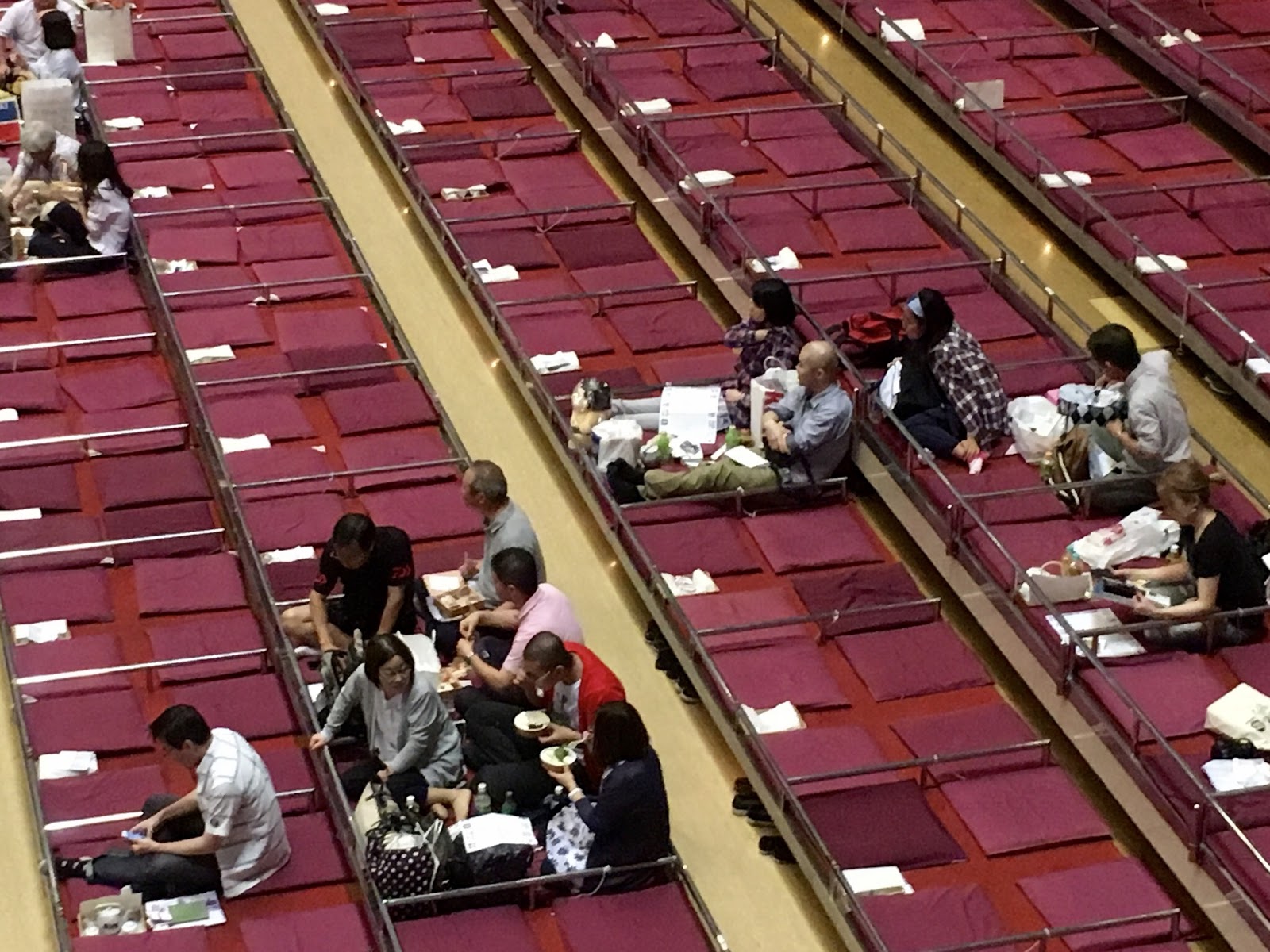
The arena is constructed especially for sumo and it's obvious. The main hall is square to mirror the raised platform where the dohyo is located. Above the dohyo is a suspended roof structure made to evoke a Shinto shrine to reference the sport's history and it's significance as a descendent of a religious ritual. The arena has two levels. The lowest consists of a series of four-person boxes containing mats for the spectators to sit on; the upper is built with western style seating. The prospect of sitting crossed-legged or on my knees for hours on end in a confined area which would need to contain at least two people significantly larger than the average Japanese man in addition to two others made my seating choice easy. I'd be sitting upstairs thanks.

Do these seats look comfortable? Not to me they didn't.
Both levels of the arena have a perimeter corridor circling the entire building for accessing each individual seating area. This same concourse has stores selling sumo souvenirs and a variety of snacks and drinks that would provide everything we needed for a full day of watching sweaty men banging into each other. Bento box? Check. Yakatori? Check. Red bean paste buns? Check. Grab some skewers of chicken meatballs, maybe some rice crackers and a couple of cans of Morinaga sweet sake (an apparent bargain at 320 Yen or just a shade less than $3) and head to your seats ready for some action.

From my one time attendance at a honbansho I can tell you if you get there before noon, there's going to be plenty of space to spread out. Need a better seat than what you bought? You can probably get one pretty easily if you are prepared to move once the rightful owner shows up. The matches at that time of the day usually move pretty quickly. There's not a lot of fuss between bouts like there will be later in the afternoon; just two men pitted against one another trying to get the other one to touch the ground with an illegal body part or to exit the dohyo. This time for me allowed me to get my head wrapped around some of the strategy for the sport before examining the finer points of the whole experience when the good stuff started.

Let me say that a sumo bout is anything but a friendly interaction. As cordial and respectful as the Japanese are to each other (including rikishi to rikishi before and after the bout), this is a violent act. Each match starts with an explosion of two 300 or more plus pound men launching themselves towards one another. Most times, they are not just letting their bodies collide. Most matches feature a barrage of face slaps and throat punches and any other way a man can make contact with another in rapid succession. In addition to the shock of having a large man hit what is usually an equally large body, these head shots have to hurt.

If both men are left standing inside the ring after this initial assault then there is likely some grappling and pushing and twisting coming as the two rikishi try to force the other out of the dohyo. And if your opponent gets a handful of your mawashi and you can't get a piece of his then look out. The ability to get a big hand on your opponent's belt seemed to be a key advantage in winning a bout.

The interior of the Ryogoku Kokugikan. Shrine roof over two rikishi and a brightly colored referee in the dohyo.
Each match starts with a singing introduction from some sort of ring official and is ended with the referee (who is outfitted in some fancy brightly colored costume with an odd hairdo which makes him look like some sort of elf or sprite) waving his paddle towards the winner before the victor leaves the arena. Before the juryo division, these things come rapid fire, which both passes the time rapidly and gives the novice sumo spectator a lot to study.

Before we get to the main events, let me say that the biggest guy doesn't always win. There is definitely a size/stamina/nimbleness balance to a rikishi's success in the dohyo. The biggest size mismatch we saw looked like a complete and utter destruction waiting to happen; to my untrained eye there was no way the smaller guy, who probably ranged between 250 and 300 pounds, was going to outmatch his opponent who by my estimate had him by at least 200 pounds and that is not an exaggeration. The whole thing seemed incomprehensibly unfair to the little man, a term which I use lightly here. But sure enough and in a match that lasted into the minutes in duration, the smaller man won. It was obvious just seconds into the contest that the larger rikishi had no ability to move with any sort of agility and after a long while for a sumo match that proved to be his undoing.

Before showing up at the Ryogoku Kokugikan, I had read and heard stories of the pre-match rituals involved in sumo matches. The foot stomping. The throwing of salt to purify the ring. The squatting. The staring. But in the morning and early afternoon matches there was none of this. It was assembly line sumo; in and out as fast as possible. That all changed when the juryo and makuuchi took the ring.

One half of the makuuchi division, pre-bout introductions.
The juryo and makuuchi matches start with an introduction of the competitors, first the east and then the west (or vice-versa, it wasn't clear who was first). All of the rikishi for a particular side of the country enter the arena and parade around the dohyo in an elaborate kesho-mawashi, a kind of apron in bright colors with logos or writing on them (sponsorship information as I understand it). Once all are present and accounted for, they perform a facing and clapping ritual after being announced over the PA system.

After the parade of kesho-mawashi wearing rikishi (say that ten times fast along with the name of the building) at the senior level, there were three rikishi that entered individually for a solo stomping and display ritual. We assumed these three were the reigning champion and the two leaders of the honbansho to that point in the tourney, although we may be way off here. Each of these three sported white cloth or paper (difficult to tell from so far away) zig-zag shaped ribbons hanging from their mawashis. You can see these ribbons in the second photograph above and in the last photograph in this post. You can also see them around Japan at the many many Shinto shrines you can visit when you are in country. 

During both these ceremonies, the crowd is totally into everything with whooping and hollering for individual rikishi and the group as a whole. I didn't even notice it really but the empty arena that we found when we showed up was no longer empty. There was hardly an empty seat or mat to be spotted in the building.

Finally, it's time for the individual juryo or makuuchi bouts and here the rituals of sumo are on full display. There will be no more quick match after quick match. From this point forward, there is going to be a lot of pre-match posturing and ceremony. Think of it as the kind of stuff that batters in baseball go through when they step to the plate. If you watched much baseball in the early 1980s, Mike Hargrove's at bat routine when he was with the Cleveland Indians is about as close as I can get to an American sports analogy. Suffice it to say that there's a lot of time to wait before things actually happen after the rikishi appear to be ready to battle.

So what exactly happens here? Let's start with the pre-match stomping which is done facing the crowd with some yelling. Then move on to the mouth rinsing, similar to the kind of thing you yourself can do at a Shinto shrine elsewhere on your trip to Japan. Maybe some squatting and staring at your opponent? A glare or two to get him nice and intimidated? Follow with some sand kicking and maybe we are ready to go, right? 

Not even close. Time to pull out and throw some salt, in mimicry of an old Shinto purification ritual. Sometimes the salt throw is dramatic; sometimes it's almost lazy. But it was the most exciting part of the pre-match posturing. And not because the match could start after that. Still not there. Maybe some more sand kicking, some more squatting and staring and then maybe a wipe all over (including the very sweaty armpits) with a towel before maybe some more salt along with some belt or flesh slapping. It's all good. After all, the match is probably lasting less than 30 seconds. 

The end of one of the makuuchi matches. Note how crowded the place is.
This is all part of why I came to see sumo. There's no other sport you can get quite this amount of showmanship. Eventually we got through match after match this way. I like to think by the end of the day we could pick up some of the subtleties of the sport through some close watching and comparing strategies used by individual rikishi in their matches. 

We were also able to make sense of who was whom in the east and west thanks to our new friend Hirohite (at least that's what his name sounded like; apologies if I got it wrong) who was sitting next to us. Pointing; broken English and Japanese; and some furious typing and speaking into the Google Translate app worked wonders here. Hirohite also helped us understand why about half the spectators in the building kept taking pictures of the banners depicting rikishi behind us. In the Ryogoku Kokuigakan they hang full body banners of each of the past hanbansho champions and apparently Kisenosato (who won the past two and who we saw in his own introduction) is a pretty popular guy.

After six or so hours in the building, I believe I can say I understand sumo a lot better than I did when I entered. There is some skill in this sport and these guys, despite their massive size, are true athletes. I believe we got a sense of the strength of the rikishi, particularly in their legs, which must endure terrible stress from carrying all that weight. I also appreciated the balance that some of these guys had. Time after time, it looked like some matches were going to end very quickly and a rikishi was able to recover with a quick and amazingly nimble re-shuffling of the feet. 

On the fan side, I can say I get it. I'd sit through another one of these if it came to that. Although I'm not sure I could be a fan of one particular rikishi. Imagine sitting through an entire day's sumo for 10 or 15 seconds of action from the guy you have posted up on your office wall. There would seem to be very little payback for a true fan of an individual, although I'm admittedly open to changing my mind here since I have about as little experience as I could possibly have with this sport.  This day was worth it.

A few final thoughts on my one day sumo experience.

First, it's a good thing we bought tickets the day they went on sale. I checked a couple of days after and the whole tournament seemed to be sold out. There certainly were very visible signs when we got to the arena that there were no tickets available.

Secondly, while I didn't get much of a sense of this, being in sumo is a demanding and rigorous endeavor. There are sumo stables all over Tokyo for the rikishi to practice in with understudies for the next day's match. Some are even open to visitors, although we couldn't find time in our schedule to do that. Maybe next time.

Thirdly, at a number of times during my week and a half in Japan, I was struck by how generous and welcoming the Japanese people were and we got another glimpse of this through our new friend Hirohite. Through our Google Translate-heavy conversation, he asked if this was our first sumo experience which of course we responded that it was. The next time we look over he's gone but he returns minutes later with a box for us containing a poster displaying the history of the yokozuna, rikishi who have achieved the highest rank possible in sumo by securing victory in a Grand Tournament. Included on that poster is both crowd favorite Kisenosato as well as a yokozuna named Hakuho, the winner of the tournament we attended and the most decorated of all yokozuna. It's my favorite souvenir of Japan because it came from the heart and it will soon be framed and hanging somewhere in my home. What an amazing gesture from a total stranger.

Finally and perhaps most importantly is some advice for you if you plan to make your own first sumo pilgrimage. Pass on the sweet sake; get a Sapporo or Kirin instead. You'll thank me for it. 

Me and what I assume are life-size cutouts of everyone's favorite rikishi. 

Saturday, June 3, 2017

Japan


Since I started writing this blog in 2013, I've taken seven trips away from home of longer than a week. Each time I have done that, I've written a pre-travel blog post relating the upcoming vacation to either some part of my own personal history or an earlier trip taken during this now almost four year long journey. Those pre-travel posts have addressed everything from filling in family histories to making up for missed opportunities to sweatshirts I used to own. Call them the inspiration behind the destination, if you will.

Last month, I made my first trip ever to Japan. Breaking with tradition, I didn't write a blog post before leaving home mostly because there was no personal connection to my past in Japan but partially because I had really no idea what to expect from that country or that continent. I was content to have Japan serve as my gateway to Asia while also learning and exploring some small parts of Japan's history and culture that I was sure were so different from my birth country of England and my home today in the United States.

I was right. This was in many ways an experience like no other. Armed with a little Japanese (hello, goodbye, thank you, excuse me, the ability to count to 100 and little else) and enough background on where I was going to appreciate things on some sort of level beyond just being there, I set off for a week and a half in the Land of the Rising Sun. Now that I know something, I thought I'd do my pre-trip post right after I got back before the rest of the blogging about what I found there. So here goes.

The Arishiyama Bamboo Grove in Kyoto. The one true disappointment. Way too small.
Our Japan itinerary started out as an idea about spending half our time in Tokyo (the current capital) and the other half in Kyoto (the former capital) with day trips from Tokyo to see Mount Fuji and from Kyoto to visit Nara (the capital before Kyoto) and Hiroshima. With one small change (a night on Miyajima Island west of Hiroshima), that initial itinerary ended up being our final one and I think it worked pretty well. It got us to Japan's most important modern city as well as its most important ancient ones and Tokyo and Kyoto provided a great counterpoint to each other. Tokyo is one of the world's largest cities with a population of 13.5 million; Kyoto's nothing to sneeze at as a city but its 1.5 million people are clearly nowhere near as large as Tokyo's population.

With our big picture agenda set, we started filling in a detailed day-by-day plan. When we first started this process it looked like there was no way we could find enough to do in 10 plus days in Japan; when we were complete with the major attractions, it looked like there was no way we could fit it all in. The latter turned out to be true. For the first time in a while, I actually overplanned a vacation and didn't get everything on the agenda complete during our time away. 

Two things stood in our way to getting things done that we didn't expect. First, Japan is bigger than I expected and the time it took to get from one place to the next surprised me. Second, some things took way longer than I expected, particularly visits to some of the many temples and shrines we had on our list. I anticipated visiting a Buddhist temple or Shinto shrine would be much like visiting a Christian church in Europe; an hour tops for the main building inside and out and maybe a little extra if you can climb one of the towers at the front facade of the church. Not so with some of our visits for this vacation. The Fushimi Inari Shrine turned out to be on the top of a pretty good sized hill that needed to be climbed; we arrived at about 11:30 a.m. and finally got back to the bottom of the mountain about four hours later.

Despite not seeing everything on our list, I think we got a great impression of the parts of the country we visited. Overall, things generally worked out. We had great weather every day but one (and that one was not too bad) and we (or at least I) only had one major disappointment. We got a taste of history (both ancient and modern); sport; Godzilla (yes, Godzilla); late 20th century fads; and for sure some of the varied types of food we went to Japan to try. It's rare I take a food list with me on vacation; I did for Japan. We also got some great stories to tell, some of which will be told to the world in this blog. Or at least the part of the world that chooses to read some of them.

Gachapon in Tokyo's Akihabara district.
We were sent on our way to Japan with a number of myths, although we didn't know that they were myths before we departed for Japan: the subway is confusing; nobody speaks English; the Japanese are not a friendly people; the number of people in Tokyo is overwhelming; the plastic depictions of food in restaurant windows are amazingly lifelike. None of these proved true. It was easy to navigate the subway (there are signs and instructions in English); most everyone spoke some English and pointing and gesturing generally worked if they didn't; I've been overwhelmed by the number of people on Fifth Avenue in New York way more than I was at any point in Tokyo; and the plastic food in the restaurant windows doesn't look like real food at all. Like not even close.

But more than any other myth, we found the one about Japanese people not being helpful was so far off the mark it was laughable. I was genuinely impressed with how helpful the Japanese people were. And I don't mean when asked after a quick "sumimasen"; I mean just walking up to a group of gaijin at a bus stop or train station and telling us spot on where to go without us telling them where we were going. I don't think I've met a group of people more helpful or wanting to interact with tourists in a positive way than I found the Japanese. That was pretty impressive.

Having said all that, we did find that we needed some help in making reservations for some things. Despite being technologically one of the most advanced countries in the world, Japan is remarkably telephone based when it comes to making restaurant reservations and we found some ticket sites which were all but impossible to navigate because they were in Japanese only. To solve these issues, I turned to a third party reservation site called Voyagin, which proved remarkably successful. I get that all these people are doing is charging you money because we can't read Japanese but sometimes a little service charge is OK to get to some things you really want to get to. I know we would have had a much harder (or impossible) time getting tickets to a sold out traditional geisha dance in Kyoto without them. Based on my interactions with this site, I'd recommend them to others on a spot basis.

This trip for me was a huge success. I'm not sure it got me ready for the rest of Asia because honestly getting around Japan was one of the easiest, most comfortable experiences of my life. Between the beginning and the end I got some memories that will last for the rest of my life. Let's get to the storytelling shall we?

Oh no, there goes Tokyo, go go Godzilla. At the Hotel Gracery Shinjuku in Tokyo.